911 Dispatcher Cover Letter Example (2026)
By FindAJobAI Team Updated How we built this page
Communications center managers read 911 dispatcher cover letters with one question in mind: will this person stay calm, follow protocol and show up for nights, weekends and holidays? A strong letter gives your call volume and answer-time results, names your certifications and tells one short story about a call where your steps made a difference, without dramatizing it.
911 Dispatcher cover letter template
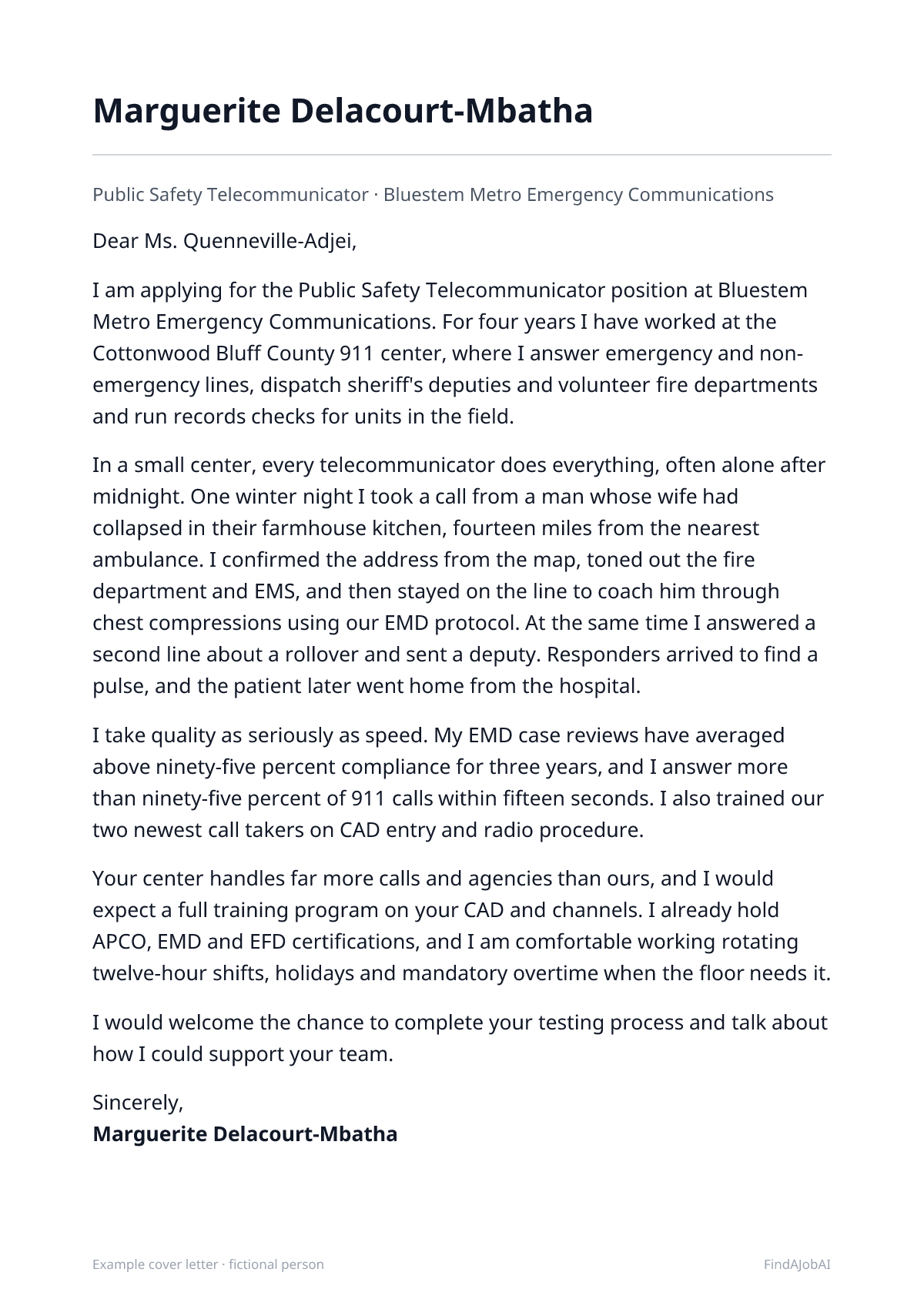
This letter as a one-page template: an opening that names the job and your strongest fact, proof that answers the ad, a reason for this employer and a short close.
After you sign up, FindAJobAI drafts your own letter for a real job from your CV in this format, and you edit it before you send it.
Example 1 · Experienced
County telecommunicator applying to a larger consolidated center
Marguerite answers 911 and dispatches sheriff units at a small county center. The ad is for a telecommunicator at a large consolidated city-county center.
Example letter · fictional
Dear Ms. Quenneville-Adjei,
I am applying for the Public Safety Telecommunicator position at Bluestem Metro Emergency Communications. For four years I have worked at the Cottonwood Bluff County 911 center, where I answer emergency and non-emergency lines, dispatch sheriff's deputies and volunteer fire departments and run records checks for units in the field.
In a small center, every telecommunicator does everything, often alone after midnight. One winter night I took a call from a man whose wife had collapsed in their farmhouse kitchen, fourteen miles from the nearest ambulance. I confirmed the address from the map, toned out the fire department and EMS, and then stayed on the line to coach him through chest compressions using our EMD protocol. At the same time I answered a second line about a rollover and sent a deputy. Responders arrived to find a pulse, and the patient later went home from the hospital.
I take quality as seriously as speed. My EMD case reviews have averaged above ninety-five percent compliance for three years, and I answer more than ninety-five percent of 911 calls within fifteen seconds. I also trained our two newest call takers on CAD entry and radio procedure.
Your center handles far more calls and agencies than ours, and I would expect a full training program on your CAD and channels. I already hold APCO, EMD and EFD certifications, and I am comfortable working rotating twelve-hour shifts, holidays and mandatory overtime when the floor needs it.
I would welcome the chance to complete your testing process and talk about how I could support your team.
Sincerely,
Marguerite Delacourt-Mbatha
Example 2 · Career changer
EMT moving from the ambulance to the dispatch console
Leopold has five years as an EMT on a private ambulance service. The ad is for an emergency communications specialist at a fire and EMS dispatch center.
Example letter · fictional
Dear Chief Ellsworth-Adomako,
I am writing to apply for the Emergency Communications Specialist role at Redcliff Fire and EMS Communications. For five years I have worked as an EMT on a busy private ambulance service, answering about ten calls a shift and listening to dispatchers on the radio every hour of the day.
From the back of an ambulance I have seen how much a good dispatcher changes a call. On one cardiac arrest last spring, the call taker had the caller doing compressions and unlocking the front door before we turned onto the street. We walked into a scene that was already organized, and the patient had a pulse by the time we reached the hospital. I want to be the person who sets up calls that way.
My field work gives me a head start. I know what responders need to hear on the radio, what a good address and cross street sound like and how quickly a situation can change. I also know medical terms, so EMD questions and pre-arrival instructions will feel familiar. To prepare, I completed the APCO basic telecommunicator course and passed a practice CritiCall test with a typing speed of fifty-two words per minute.
I understand that the console is a different job from the street, with more multitasking and no chance to see the scene. I am ready to learn your CAD, protocols and radio procedures from the start and to work nights, weekends and holidays.
I would be glad to sit for your testing and discuss the role whenever it suits you.
Best regards,
Leopold Nwachukwu-Haverkamp
Example 3 · Senior or lead
Senior telecommunicator applying for communications supervisor
Augustina is a senior telecommunicator and training officer. The ad is for a shift supervisor at a regional 911 center facing staffing shortages.
Example letter · fictional
Dear Director Pennington-Asamoah,
I am applying for the Communications Supervisor position at Driftwood Shores Regional 911 Authority. I have worked in emergency communications for thirteen years, the last six as a senior telecommunicator and communications training officer at the Granite Falls Emergency Communications Center, where I often act as shift lead when our supervisor is off.
Staffing has been our hardest problem, as it is for most centers. Two years ago we were losing nearly half of new hires before the end of training. I worked with our training coordinator to split the program into shorter phases with clear checklists, paired each trainee with one main trainer and added a short weekly check-in with the trainee's family support in mind. Since then, most new hires have finished training, and our overtime hours have fallen steadily.
On the floor I focus on steady quality. I review calls for protocol compliance each month, give feedback within a week and recognize good work out loud. During our largest incidents, including a chemical plant fire and a severe ice storm, I ran the main fire channel and kept command staff updated while making sure call takers took breaks.
I know your center is short-staffed and moving to a new phone system next year. In my first months I would learn each team member's strengths, review training and overtime data with you and make the phone transition part of a clear, realistic training plan.
I would welcome a conversation about your center's goals and how I could support the people on your floor.
Kind regards,
Augustina Valderrama-Kipchoge
All three letters, and the short version below, are fictional: the people, employers and numbers are invented. Borrow the structure, never the facts.
- Prefer to write it yourself? Use the free cover letter template.
- Check your CV against the job first: the free CV score shows the missing keywords.
Why the first letter works, paragraph by paragraph
Paragraph 1: Opening
Names the current center, the lines answered and the agencies dispatched, so a manager can see the writer's scope at once.
Paragraph 2: The farmhouse CPR call
Shows protocol, mapping, radio and a second line handled at once, with a measured outcome and no dramatics.
Paragraph 3: Quality scores and training
Answer-time and EMD compliance figures prove the story is typical, not a lucky night.
Paragraph 4: Bigger center, same readiness
Admits the step up in volume, then lists certifications and shift availability the center needs.
Paragraph 5: Close
Mentions the testing process directly, which fits how public safety hiring works.
What the career changer's letter does differently
The EMT's letter turns field work into dispatch value: knowing what responders need on the radio, medical terms for EMD and respect for pre-arrival instructions. The APCO course and practice test show the change is already under way.
What the senior letter does differently
A senior dispatch letter talks about the floor, not one call: retention, training, call quality review and major incident leadership. It links the writer's plan to the center's real staffing and technology challenges.
Short 911 dispatcher cover letter: an email-ready version
Many applications arrive as an email or a small text box, and a full page doesn't fit. This version runs 120 to 150 words and keeps only what a reader needs to decide whether to reply. A police dispatcher replies by email to a city communications manager who posted an opening for a lateral telecommunicator.
Short version · email · fictional122 words
Subject: Lateral Telecommunicator – 5 years police dispatch, APCO and NCIC – Florentina Hargreaves-Mwangi
Hi Ms. Stavropoulos-Nkemelu,
I am writing about the lateral telecommunicator opening with Quillfeather Gap Police Communications. For five years I have answered 911 and dispatched patrol for a suburban police department, working two primary channels and running NCIC checks for officers.
My strength is officer safety on busy nights. I run status checks on every unit on a traffic stop and repeat key details clearly, and last year my shift had no missed status checks in our quarterly audits. I hold current APCO PST1 and NCIC certifications.
I can start after a standard notice period and can work any shift, including nights and holidays. My resume is attached, and I am glad to complete your testing and sit-along.
Thank you,
Florentina Hargreaves-Mwangi
The short version leads with police dispatch experience, channels and NCIC, then gives one officer safety result. A communications manager can judge a lateral candidate in under a minute.
Opening lines that work for 911 dispatcher cover letters
The first sentence decides whether the second gets read. Here are six openings, one for each situation you might be in. Pick the one that matches yours and swap in your own facts: every name and number below is invented.
1. You have a standout result
I answer 911 calls and dispatch deputies and volunteer fire departments at a rural county center, and I would like to bring that experience to your consolidated floor.
2. The ad names a problem you've solved
Your posting asks for a telecommunicator who stays calm while handling several emergencies at once. One winter night I coached a man through CPR while sending a deputy to a rollover.
3. Someone referred you
After five years as an EMT listening to dispatchers on every call, I am ready to move from the ambulance to the console.
4. You admire what they build
Your training coordinator, Cornelius Abernathy-Ofori, encouraged me to apply after we met at the state APCO chapter conference.
5. You're new to the field or switching into it
I answer more than ninety-five percent of 911 calls within fifteen seconds and keep my EMD scores above ninety-five percent, because callers deserve both speed and accuracy.
6. You have senior scope or a specialism
As a senior telecommunicator and training officer, I helped turn around our center's new hire retention, and I am ready to lead a shift.
How to write a 911 dispatcher cover letter
Five steps, in the order you'd write them. The shape stays the same for every job (a short opening, proof, a reason for this employer, a close), and what goes into each part is what changes with the role.
Open with your center and disciplines
In the first two sentences, say what kind of center you work in and whether you handle police, fire, EMS or all three. Mention the lines and channels you work. Managers sort candidates by experience type, so make it clear from the start.
Tell one call in clear steps
Choose a call that shows protocol and multitasking, such as CPR coaching or a pursuit. Describe how you found the location, which units you sent, what instructions you gave and the outcome. Keep caller details private and the tone calm.
Back the story with numbers
Add answer-time results, protocol compliance scores or quality review results. These prove your performance is steady across many shifts and many call types, which matters more to a hiring manager than any single dramatic call you describe.
List certifications and shifts
Name APCO, EMD, EFD, EPD, NCIC and CPR certifications with their issuers. Then state plainly that you can work nights, weekends, holidays and overtime, because staffing a 24-hour floor all year is a center's biggest worry.
Close with the testing process
Most centers use pre-employment tests, such as CritiCall, plus a background check. End by saying you are ready to complete their testing and interview, which shows you understand public safety hiring and keeps the close short.
911 Dispatcher cover letter do's and don'ts
Do
- Give your call volume, answer-time results and protocol scores in the first half of the letter.
- Tell one call story in steps: location, units sent, instructions given and outcome.
- List certifications with their issuing bodies and state your shift availability.
Don't
- Don't dramatize calls or share details that could identify a caller or patient.
- Don't claim you never feel stress; show the habits that keep you steady instead.
- Don't skip shift work; centers worry most about nights, holidays and overtime.
Common 911 dispatcher cover letter mistakes
Each one is easy to make and quick to fix before you send the letter.
Writing a dramatic story
Describe what you did step by step in calm language, and leave out graphic or identifying details.
Forgetting answer-time and quality results
Add your share of calls answered within standard and your protocol compliance scores.
Not mentioning shift work
State that you can work rotating shifts, holidays and overtime, so the manager does not have to guess.
Treating it like a customer service job
Phone skills help, but focus on emergencies, protocol, radio and teamwork with responders.
Email subject lines for 911 dispatcher applications
Applying by email? Put the job title, any reference number and your name in the subject line.
- Public Safety Telecommunicator – 4 years county 911, APCO, EMD, EFD – Marguerite Delacourt-Mbatha
- Emergency Communications Specialist – EMT, 5 years field experience – Leopold Nwachukwu-Haverkamp
- Communications Supervisor application – 13 years 911, CTO – Augustina Valderrama-Kipchoge
Everything for 911 Dispatchers
- 911 Dispatcher resume exampleA full resume, plus bullet and summary examples
- 911 Dispatcher interview questions30 questions with sample answers
- 911 Dispatcher job descriptionDuties, skills and requirements
- Career change cover letter: template + examples
Other cover letter examples
911 Dispatcher cover letter FAQ
What should a 911 dispatcher cover letter include?
Your call volume and answer-time results, the agencies you dispatch for, your certifications, one short call story with clear steps and your availability for nights, weekends and holidays. Keep it to one page.
How do I write a 911 dispatcher cover letter with no dispatch experience?
Use jobs where you answered busy phones, calmed upset people or worked in emergencies, such as call centers, hospitals or EMS. Mention typing speed, any APCO or EMD course and that you can work rotating shifts.
Should I describe a difficult call in my cover letter?
Yes, briefly and respectfully. Focus on the steps you took and the outcome, leave out personal details about callers, and avoid dramatic language. The goal is to show judgment and protocol, not to shock the reader.
How we built this page
The FindAJobAI team wrote the three example letters, the short email version, the opening lines and the advice for 911 dispatcher roles. The people, employers and numbers in the letters are invented; the structure, the kind of evidence and the order of the paragraphs are the parts to copy.
Once we track enough live 911 dispatcher job ads, this page also shows the skills they ask for most, counted the same way as our in-demand skills report.
Last reviewed on November 1, 2026.