Aircraft Mechanic Cover Letter Example (2026)
By FindAJobAI Team Updated How we built this page
Maintenance managers at airlines and MROs read for three things: your certificate, the aircraft you know and whether your work and paperwork hold up. A good aircraft mechanic letter tells one story from the hangar or the line that shows careful troubleshooting under time pressure, and it never trades safety for speed.
Aircraft Mechanic cover letter template
This letter as a one-page template: an opening that names the job and your strongest fact, proof that answers the ad, a reason for this employer and a short close.
After you sign up, FindAJobAI drafts your own letter for a real job from your CV in this format, and you edit it before you send it.
Example 1 · Experienced
Regional line mechanic applying to a mainline carrier
Hendrik has six years on E175 overnight line work. The ad is for an A&P line technician on A320 family aircraft at a hub station.
Example letter · fictional
Dear Ms. Bergstrom-Ahn,
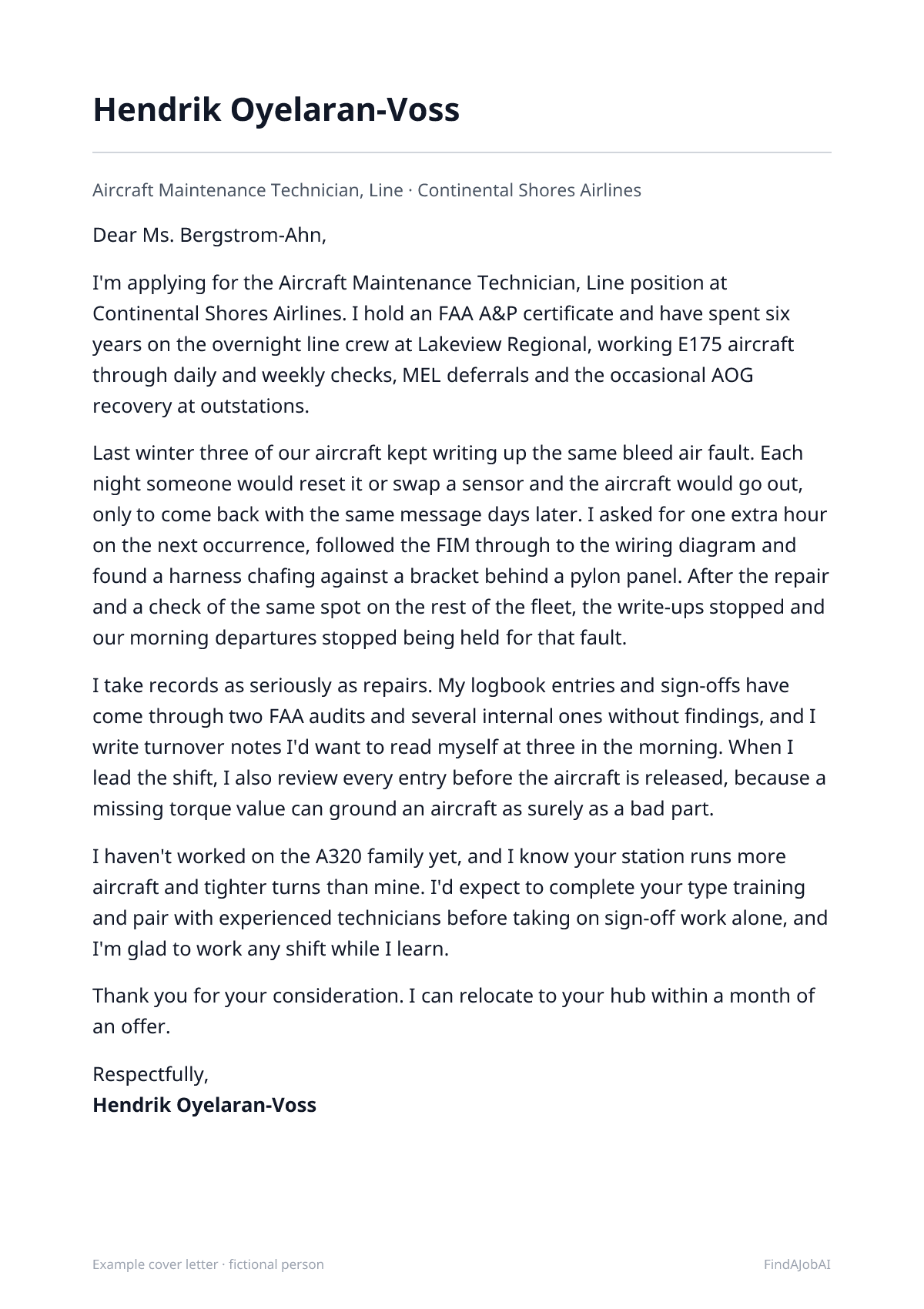
I'm applying for the Aircraft Maintenance Technician, Line position at Continental Shores Airlines. I hold an FAA A&P certificate and have spent six years on the overnight line crew at Lakeview Regional, working E175 aircraft through daily and weekly checks, MEL deferrals and the occasional AOG recovery at outstations.
Last winter three of our aircraft kept writing up the same bleed air fault. Each night someone would reset it or swap a sensor and the aircraft would go out, only to come back with the same message days later. I asked for one extra hour on the next occurrence, followed the FIM through to the wiring diagram and found a harness chafing against a bracket behind a pylon panel. After the repair and a check of the same spot on the rest of the fleet, the write-ups stopped and our morning departures stopped being held for that fault.
I take records as seriously as repairs. My logbook entries and sign-offs have come through two FAA audits and several internal ones without findings, and I write turnover notes I'd want to read myself at three in the morning. When I lead the shift, I also review every entry before the aircraft is released, because a missing torque value can ground an aircraft as surely as a bad part.
I haven't worked on the A320 family yet, and I know your station runs more aircraft and tighter turns than mine. I'd expect to complete your type training and pair with experienced technicians before taking on sign-off work alone, and I'm glad to work any shift while I learn.
Thank you for your consideration. I can relocate to your hub within a month of an offer.
Respectfully,
Hendrik Oyelaran-Voss
Example 2 · Career changer
Air Force crew chief moving to a civilian MRO
Desmond is leaving the Air Force after eight years as a C-130 crew chief and has just earned his A&P. The ad is for a heavy check technician.
Example letter · fictional
Dear Mr. Rasmussen,
I'm writing to apply for the Aircraft Maintenance Technician, Heavy Check role at Tidewater Aero MRO. I'm finishing eight years in the U.S. Air Force as a C-130 crew chief, and I earned my FAA Airframe and Powerplant certificate this spring using my military experience and the written, oral and practical tests.
As a crew chief I was responsible for one aircraft and everything on it, from servicing and inspections to coordinating specialists for engine, avionics and hydraulic work. During a deployment we found a crack in a wing panel fitting on a scheduled inspection, days before a planned mission. I documented it, worked with structures and engineering on the repair, and kept the aircraft's forms accurate through every step. The aircraft returned to service on the revised schedule with the repair fully signed off.
I'm used to following technical orders exactly, using torque and safety wire procedures without shortcuts, and working long shifts in heat and cold. I've also trained six junior airmen on inspections and forms documentation, which taught me how much clear paperwork protects the next person who touches the aircraft. I'm comfortable asking questions when a procedure is unclear, and I'd rather stop a job than guess.
I know civilian maintenance uses different manuals, task cards and record systems than the Air Force, and I haven't worked on commercial airliners. Your posting says new technicians pair with leads during their first checks, which is the right way for me to learn.
Thank you for your time. I separate in six weeks and can start right after.
Very respectfully,
Desmond Achterberg-Lowe
Example 3 · Senior or lead
Hangar lead applying to supervise a heavy check line
Paloma has led C-check crews for six years. The ad is for a hangar supervisor responsible for turn times and quality on narrowbody checks.
Example letter · fictional
Dear Mr. Fitzgerald-Obi,
I'm applying for the Hangar Maintenance Supervisor position at Silverline Aircraft Services. I've been an A&P mechanic for fifteen years and a C-check lead for the last six at Harborview MRO, running a crew of twelve on A320 family aircraft, and I hold an Inspection Authorization.
When I became lead, our checks regularly ran three or four days late, mostly because technicians waited on parts and tooling once a zone was opened. I worked with planning and stores to build kits for each zone before induction, using findings from previous checks on the same customer's fleet to predict what we'd need. Over the next year our crew's checks started finishing close to the planned date, and the approach was adopted for the other two lines.
Quality matters as much to me as turn time. I started a walkdown with an inspector before each aircraft is released, looking for loose panels, missed safety wire and incomplete paperwork. Customer findings after delivery dropped noticeably, and one airline extended its contract partly because of it. I also review every shift's open task cards with the incoming lead, so nothing important is lost between crews during long checks.
I haven't managed three shifts at once or owned the relationship with the FAA principal inspector, both of which your role includes. I'd want to spend my first weeks on each shift and learn how your quality department handles findings before changing anything.
Thank you for reading. I'd welcome a conversation about your current turn times and where your checks lose days.
Best regards,
Paloma Szczepanski-Reid
All three letters, and the short version below, are fictional: the people, employers and numbers are invented. Borrow the structure, never the facts.
- Prefer to write it yourself? Use the free cover letter template.
- Check your CV against the job first: the free CV score shows the missing keywords.
Why the first letter works, paragraph by paragraph
Paragraph 1: Opening
Gives the certificate, years, aircraft type and kind of line work in two sentences, the screening facts a maintenance manager checks first.
Paragraph 2: The repeat fault he ended
Shows the most valued line habit: refusing to reset and release a repeat fault, using the FIM and wiring diagrams, and checking the rest of the fleet afterward.
Paragraph 3: Records
Audit results on logbook entries prove the paperwork side of airworthiness, and the turnover note line shows he thinks about the next shift.
Paragraph 4: Honest gap
Names the missing A320 experience and a busier station, then says how he'd close the gap through type training and pairing, which reassures a careful reader.
Paragraph 5: Close
Gives a relocation timeline, an important practical point for a hub station hire.
What the career changer's letter does differently
The crew chief translates military work into civilian terms: owning one aircraft, coordinating specialists and documenting a structural repair. He names the real gaps, different manuals and record systems and no airliner time, and points to the company's own pairing program as the way he'll learn.
What the senior letter does differently
A supervisor letter has to show results across a crew, not individual tasks. Paloma's zone kits and pre-release walkdown improved turn time and quality for the whole hangar, and she names plainly the parts of the role she hasn't done yet, which reads as confident rather than weak.
Short aircraft mechanic cover letter: an email-ready version
Many applications arrive as an email or a small text box, and a full page doesn't fit. This version runs 120 to 150 words and keeps only what a reader needs to decide whether to reply. An A&P mechanic applies to a charter operator through a job board's short message box, so the note goes out as a brief email.
Short version · email · fictional121 words
Subject: Aircraft Mechanic – A&P, 5 years King Air and Citation – Lucian Abernathy-Mensah
Hello Ms. Halvorsen-Diaz,
I'm applying for the Aircraft Mechanic role at Highplains Charter Aviation. I hold an FAA A&P certificate and have five years of Part 135 maintenance on King Air 350 and Citation XLS aircraft, including phase inspections, PT6 hot sections and avionics troubleshooting.
At my current operator I cut phase inspection downtime by preparing parts and tooling lists the week before each aircraft came in, so most inspections now finish a day sooner. I also handle weekend on-call trips to fix aircraft stuck away from base.
I'm hoping to join a smaller team where I can work on a wider range of aircraft. My resume is attached, and I can talk any time this week.
Thank you,
Lucian Abernathy-Mensah
The short version leads with certificate, operating rules and aircraft types, the three filters a charter maintenance director applies, then gives one practical improvement and mentions on-call work, which small operators rely on.
Opening lines that work for aircraft mechanic cover letters
The first sentence decides whether the second gets read. Here are six openings, one for each situation you might be in. Pick the one that matches yours and swap in your own facts: every name and number below is invented.
1. You have a standout result
Three of our aircraft kept writing up the same bleed air fault until I traced it to a chafed harness behind a pylon panel. That habit of ending repeat write-ups is what I'd bring to your line.
2. The ad names a problem you've solved
Your posting mentions a hub station with tight overnight turns, which is the kind of line work I've done on E175 aircraft for six years as an A&P mechanic.
3. Someone referred you
Your hangar lead, Thaddeus Ibekwe, and I worked C-checks together at my previous MRO, and he told me your heavy check line is hiring A&P technicians this quarter.
4. You admire what they build
I flew on your airline home from a family visit last spring and watched your ramp crew clear a gate hold in minutes. I'd like to be part of the team behind that kind of operation.
5. You're new to the field or switching into it
Eight years as an Air Force crew chief taught me to own an aircraft from inspection to launch, and with my A&P certificate now earned, I'm ready to bring that discipline to civilian maintenance.
6. You have senior scope or a specialism
Six years leading C-check crews and building zone kits that brought our checks back on schedule have prepared me to supervise your heavy check hangar.
How to write an aircraft mechanic cover letter
Five steps, in the order you'd write them. The shape stays the same for every job (a short opening, proof, a reason for this employer, a close), and what goes into each part is what changes with the role.
Lead with your certificate and aircraft types
An FAA A&P certificate, plus IA or inspection authority if you have it, and the aircraft and engines you've worked on, are the first things a maintenance manager checks. Put them in your opening two sentences instead of making the reader find them in your resume.
Tell one troubleshooting or inspection story
Choose a repeat fault you ended, a finding you caught during a check, or an AOG recovery. Describe the manuals and tests you used and the outcome for the operation. This shows judgment, which matters more than listing every task you've signed.
Show your paperwork holds up
Maintenance records are part of airworthiness, and auditors read them closely. Mention audit results on your entries, RII sign-off volume or how you write turnover notes, so the reader sees you take documentation as seriously as the repair itself.
Translate military or general aviation experience
If you're coming from the military, a repair station or general aviation, explain your experience in terms an airline or MRO uses. Name the aircraft, inspection types and responsibilities, and be clear about how you earned your certificate.
Be honest about type training and gaps
Moving to a new aircraft type or a busier station is normal. Say what's new to you, and describe how you'd learn it, such as completing type courses and pairing with experienced technicians before taking on sign-off work alone.
Aircraft Mechanic cover letter do's and don'ts
Do
- Put your A&P certificate and aircraft types in the first paragraph.
- Tell one troubleshooting story that ends with a repeat fault stopped or a finding caught.
- Mention the quality of your records, such as audit results or RII sign-offs.
Don't
- Don't describe skipping steps to make a departure, even if the aircraft left on time.
- Don't use military abbreviations without explaining them for a civilian reader.
- Don't claim type experience you don't have; it will be checked against your records.
Common aircraft mechanic cover letter mistakes
Each one is easy to make and quick to fix before you send the letter.
Bragging about speed over procedure
A story about skipping steps to make a departure is a red flag. Show how you kept the aircraft on time by planning and troubleshooting well, never by cutting corners.
Leaving the A&P to the resume
Some readers stop if they can't see a certificate in the first lines. Mention your A&P, and any IA or inspection authority, in the opening sentence.
Writing in military shorthand
Civilian managers may not know your unit's terms. Replace abbreviations with plain descriptions of the aircraft, inspections and responsibilities you handled.
Listing every system you've touched
A long list reads like a task card index. Pick one story that shows how you think and let your resume carry the full list of systems and aircraft.
Email subject lines for aircraft mechanic applications
Applying by email? Put the job title, any reference number and your name in the subject line.
- A&P Line Technician application – 6 years E175 overnight line – Hendrik Oyelaran-Voss
- Heavy Check Technician – A&P, former C-130 crew chief – Desmond Achterberg-Lowe
- Application: Aircraft Maintenance Technician (Req. 5528) – Hendrik Oyelaran-Voss
Everything for Aircraft Mechanics
- Aircraft Mechanic resume exampleA full resume, plus bullet and summary examples
- Aircraft Mechanic interview questions30 questions with sample answers
- Aircraft Mechanic job descriptionDuties, skills and requirements
- Career change cover letter: template + examples
Other cover letter examples
Aircraft Mechanic cover letter FAQ
What should an aircraft mechanic cover letter include?
Your A&P certificate and any IA or inspection authority, the aircraft and type of maintenance you know, one troubleshooting example with a clear outcome, and evidence your records hold up. End with availability and relocation plans.
How do I write an aircraft mechanic cover letter coming from the military?
Translate your role and aircraft into civilian terms, explain how you earned or are earning your A&P, and pick one maintenance story that shows inspection discipline. Be honest about learning civilian manuals and record systems.
Do airlines read cover letters for mechanic jobs?
Some don't require one, but a short letter helps when you're changing aircraft types, moving from military or general aviation, or applying for a lead role. Keep it to one page and focus on certificates, aircraft and one strong example.
How we built this page
The FindAJobAI team wrote the three example letters, the short email version, the opening lines and the advice for aircraft mechanic roles. The people, employers and numbers in the letters are invented; the structure, the kind of evidence and the order of the paragraphs are the parts to copy.
Once we track enough live aircraft mechanic job ads, this page also shows the skills they ask for most, counted the same way as our in-demand skills report.
Last reviewed on November 1, 2026.