Cabinet Maker Cover Letter Example (2026)
By FindAJobAI Team Updated How we built this page
Cabinet shops often hire from a phone call and a look at your work, but larger millwork companies and commercial casework shops ask for a short letter. Use it to say which style of cabinets you build, the machines you run, how you hold quality and whether you install on site.
Cabinet Maker cover letter template
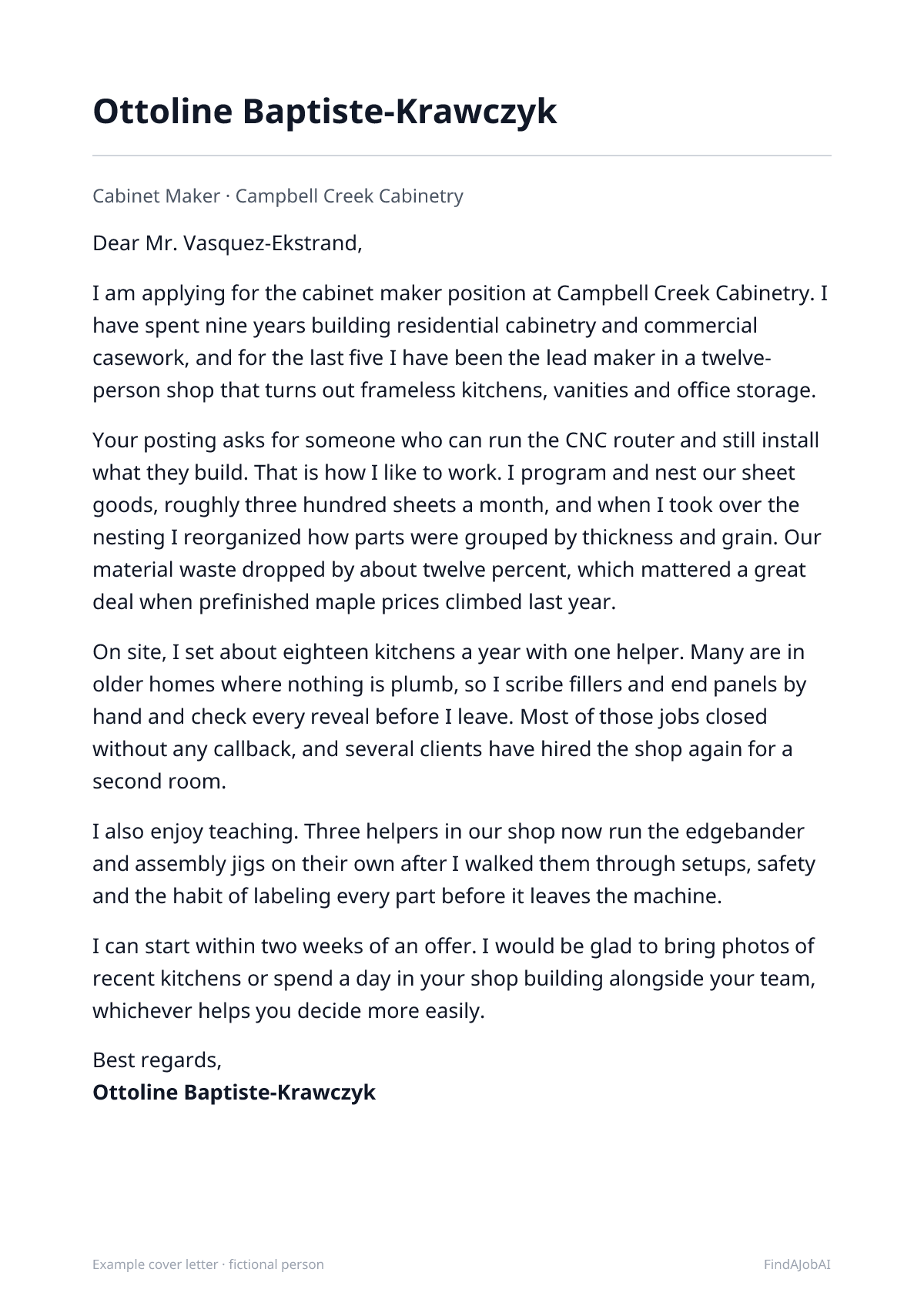
This letter as a one-page template: an opening that names the job and your strongest fact, proof that answers the ad, a reason for this employer and a short close.
After you sign up, FindAJobAI drafts your own letter for a real job from your CV in this format, and you edit it before you send it.
Example 1 · Experienced
Cabinet maker applying to a custom kitchen shop
Ottoline has nine years in custom and commercial shops. A high-end kitchen shop needs a maker who can run the CNC and install.
Example letter · fictional
Dear Mr. Vasquez-Ekstrand,
I am applying for the cabinet maker position at Campbell Creek Cabinetry. I have spent nine years building residential cabinetry and commercial casework, and for the last five I have been the lead maker in a twelve-person shop that turns out frameless kitchens, vanities and office storage.
Your posting asks for someone who can run the CNC router and still install what they build. That is how I like to work. I program and nest our sheet goods, roughly three hundred sheets a month, and when I took over the nesting I reorganized how parts were grouped by thickness and grain. Our material waste dropped by about twelve percent, which mattered a great deal when prefinished maple prices climbed last year.
On site, I set about eighteen kitchens a year with one helper. Many are in older homes where nothing is plumb, so I scribe fillers and end panels by hand and check every reveal before I leave. Most of those jobs closed without any callback, and several clients have hired the shop again for a second room.
I also enjoy teaching. Three helpers in our shop now run the edgebander and assembly jigs on their own after I walked them through setups, safety and the habit of labeling every part before it leaves the machine.
I can start within two weeks of an offer. I would be glad to bring photos of recent kitchens or spend a day in your shop building alongside your team, whichever helps you decide more easily.
Best regards,
Ottoline Baptiste-Krawczyk
Example 2 · Career changer
Finish carpenter moving into a cabinet shop
Caspian has installed trim and doors for six years and wants to build casework in a shop rather than on job sites.
Example letter · fictional
Dear Ms. Delacroix-Amundsen,
I am writing to apply for the cabinet maker opening at Sitka Spruce Casework. For six years I have worked as a finish carpenter on custom homes around Juneau, hanging doors, running trim and installing the cabinets other shops built. I would now like to build them myself.
Installing hundreds of boxes taught me what separates good cabinetry from the rest. I have scribed panels to stone walls, shimmed runs across sagging floors and fixed doors that never lined up because a face frame was out of square. I know how much a careful shop saves the installer, and that is the kind of maker I want to be.
Over the past two winters I took the evening cabinetmaking course at the community college. I built a set of frameless base cabinets, a face-frame vanity and a dovetailed chest, and I learned to run the panel saw, edgebander and line boring machine under supervision. My instructor asked me to help newer students with their cutting lists, which surprised me and told me I had found the right direction.
I understand that I would begin on assembly and sanding before moving to machines and that my pay would reflect that. I am comfortable with early shop hours, I own a full set of hand tools, and I already hold an OSHA 10 card.
I would welcome a shop visit or a trial day so you can judge my work in person.
Thank you for your time,
Caspian Mwangi-Holmgren
Example 3 · Referral or internal move
Experienced foreman referred to run a casework shop
Rosamund was referred by a former installer now at the company. The shop is growing and needs a foreman to shorten lead times.
Example letter · fictional
Dear Mr. Ferreira-Lindahl,
Henrike Solberg-Adeyemi, who installed casework with my crews for four years and now leads installs at Tanana Valley Architectural Millwork, suggested I write to you about your shop foreman opening. She told me your orders have outgrown the shop's lead times and that customers are waiting close to two months for cabinets.
That is the problem I spent my last few years solving. When I became foreman at my current shop, the CNC and the finishing room were scheduled separately, so parts piled up in front of the spray booth while the router sat idle. I started planning the two as one line, with a whiteboard showing every job from nesting to packing. Our lead time fell from about eight weeks to five, and we did it without adding staff or overtime.
I lead fourteen makers, finishers and installers, and my main tool for quality is simple: nothing leaves the shop without a checklist signed by the maker and a photo of the finished box. Warranty callbacks now run at about two percent of jobs. I also check shop drawings before release and have caught errors on school and clinic contracts that would have cost weeks.
Henrike can speak to how I treat installers, since she worked under schedules I set. I try to send complete, labeled jobs so the field crew never has to fix the shop's mistakes.
I would be glad to walk your shop floor with you and share how I would plan the first month.
Kind regards,
Rosamund Quarshie-Vandermeer
All three letters, and the short version below, are fictional: the people, employers and numbers are invented. Borrow the structure, never the facts.
- Prefer to write it yourself? Use the free cover letter template.
- Check your CV against the job first: the free CV score shows the missing keywords.
Why the first letter works, paragraph by paragraph
Paragraph 1: Opening
States years, shop size and the style of cabinetry, so the reader can place the writer quickly.
Paragraph 2: The nesting saving
Answers the CNC requirement with a concrete change and a measured cut in waste.
Paragraph 3: Installs in older homes
Shows field skill and quality through scribing and low callbacks.
Paragraph 4: Training helpers
Adds value beyond the bench, which shops looking for a lead want to see.
Paragraph 5: Close
Offers photos or a shop day, the normal next step in cabinet hiring.
What the career changer's letter does differently
The career changer letter turns installing other people's cabinets into a strong argument for building them well. An evening course with real projects shows the move is planned, and the writer is honest about starting lower.
What the referral letter does differently
The referral letter names the colleague and repeats what she said about the shop's real problem, then answers it with a lead-time result. The checklist and photo habit shows quality leadership, and pointing back to the referrer gives the owner an easy reference.
Short cabinet maker cover letter: an email-ready version
Many applications arrive as an email or a small text box, and a full page doesn't fit. This version runs 120 to 150 words and keeps only what a reader needs to decide whether to reply. A cabinet maker answers a small custom shop's post on a local trades board that asked for replies by email.
Short version · email · fictional122 words
Subject: Cabinet Maker – face-frame kitchens, doors and spray finishing – Ambrose Iheanacho-Pettersen
Hi Ms. Kowalczyk-Arnason,
I saw your post for a cabinet maker at Hillside Joinery Alaska and would like to apply. I have seven years in a small custom shop building face-frame kitchens, vanities and built-ins, and I make most of our solid wood doors on the shaper.
I also spray lacquer and conversion varnish, so I can carry a job from cutting list to finished boxes ready to install. Photos of recent kitchens and a walnut built-in are ready to send whenever you would like to see them.
I am free to start at the end of the month. Could I stop by the shop this week to meet you and see the work you have lined up?
Thank you,
Ambrose Iheanacho-Pettersen
Small shops posting on trade boards want the essentials fast. This email names the cabinet style, door making and finishing skills, offers photos and asks for a short shop visit.
Opening lines that work for cabinet maker cover letters
The first sentence decides whether the second gets read. Here are six openings, one for each situation you might be in. Pick the one that matches yours and swap in your own facts: every name and number below is invented.
1. You have a standout result
For five years I have led the bench in a twelve-person shop building frameless kitchens, and I would like to bring that work to your team.
2. The ad names a problem you've solved
Your posting asks for a maker who can run the CNC and still install, which is exactly how I have worked for the last five years.
3. Someone referred you
After six years installing other shops' cabinets, I want to build casework that makes the installer's day easy.
4. You admire what they build
Eighteen years in casework and eight as a foreman have taught me how to shorten lead times without cutting corners.
5. You're new to the field or switching into it
Henrike Solberg-Adeyemi, who installed casework with my crews for four years, suggested I contact you.
6. You have senior scope or a specialism
Most of the kitchens I installed last year closed without a single callback, even in older homes.
How to write a cabinet maker cover letter
Five steps, in the order you'd write them. The shape stays the same for every job (a short opening, proof, a reason for this employer, a close), and what goes into each part is what changes with the role.
Lead with your style and shop
Open with your years, the size of shop you work in and whether you build frameless, face-frame or both. Cabinet shops are tooled for particular systems, so this first line tells the owner how quickly you would fit into their production.
Give one cost or quality result
Choose a result such as less material waste from better nesting, fewer callbacks or tighter reveals. Give a number for before and after, so the owner can see how your work would change their margins or their customers' opinion of the shop.
Name machines and finishing
List the machines you run alone, such as the CNC router, edgebander, panel saw or shaper, and the finishes you spray. Shops pay for independence on machines, and a clear list saves the owner from guessing during the first phone call.
Mention installation honestly
Say whether you install, how many jobs a year and how you deal with walls that are out of plumb. If you do not install, say so plainly. Owners plan crews around this, and an honest answer builds more trust than a vague claim.
Close with photos or a shop day
Finish by offering photos of recent work or a trial day at the bench, and give your start date. Cabinet work is easy to judge by eye, so inviting the owner to look is often the fastest route to an offer in this trade.
Cabinet Maker cover letter do's and don'ts
Do
- Say whether you build frameless, face-frame or both.
- Name the machines you run alone.
- Offer photos of your work or a trial day in the shop.
Don't
- Don't stop at saying you are good with wood; give numbers.
- Don't hide that you install or finish, since many shops need both.
- Don't send a long letter; shop owners read between jobs.
Common cabinet maker cover letter mistakes
Each one is easy to make and quick to fix before you send the letter.
Calling yourself a woodworker without details
Name the cabinet style, products and output so the shop can match you to its work.
Leaving the CNC level unclear
Say whether you program and nest or only load and unload the router.
Asking the owner to take your skill on trust
Mention photos you can send or a trial day at the bench.
Skipping safety around machines
Add a line on guarding, push sticks or your injury-free record.
Forgetting your start date
Say when you can begin, since shops often hire to meet a backlog.
Email subject lines for cabinet maker applications
Applying by email? Put the job title, any reference number and your name in the subject line.
- Cabinet Maker – 9 yrs frameless kitchens, CNC nesting, installs – Ottoline Baptiste-Krawczyk
- Cabinet Maker – finish carpenter, cabinetmaking course – Caspian Mwangi-Holmgren
- Shop Foreman, referred by Henrike Solberg-Adeyemi – 18 yrs casework – Rosamund Quarshie-Vandermeer
Everything for Cabinet Makers
- Cabinet Maker resume exampleA full resume, plus bullet and summary examples
- Cabinet Maker interview questions30 questions with sample answers
- Cabinet Maker job descriptionDuties, skills and requirements
- Career change cover letter: template + examples
Other cover letter examples
Cabinet Maker cover letter FAQ
Do cabinet makers need a cover letter?
Small shops often hire after a phone call and a look at your work, but commercial casework firms and larger millwork companies usually ask for one. A short letter that names your cabinet style, machines and install record can set you apart.
How do I write a cabinet maker cover letter with no shop experience?
Point to carpentry, furniture projects, a woodworking course or any time on a panel saw or edgebander. Show you measure carefully, work safely and are happy to start on assembly and sanding.
How long should a cabinet maker cover letter be?
About 260 to 330 words. Cover your experience and cabinet style, one quality or cost result, your machines and install work, then offer photos or a shop day.
How we built this page
The FindAJobAI team wrote the three example letters, the short email version, the opening lines and the advice for cabinet maker roles. The people, employers and numbers in the letters are invented; the structure, the kind of evidence and the order of the paragraphs are the parts to copy.
Once we track enough live cabinet maker job ads, this page also shows the skills they ask for most, counted the same way as our in-demand skills report.
Last reviewed on November 1, 2026.