Data Entry Clerk Cover Letter Example (2026)
By FindAJobAI team Updated How we built this page
Data entry ads mostly ask for speed, accuracy and a specific system, so a cover letter should prove those three things rather than just claim them. Name your typing speed with its accuracy rate, the volume you handle, and the error you caught before it became a problem.
Data Entry Clerk cover letter template
This letter as a one-page template: an opening that names the job and your strongest fact, proof that answers the ad, a reason for this employer and a short close.
After you sign up, FindAJobAI drafts your own letter for a real job from your CV in this format, and you edit it before you send it.
Example 1 · Experienced
Medical records clerk applying to a billing company
Sabrina enters patient intake data for a clinic network. The ad asks for comfort with medical terminology and strict accuracy under volume.
Example letter · fictional
Dear Ms. Whitfield,
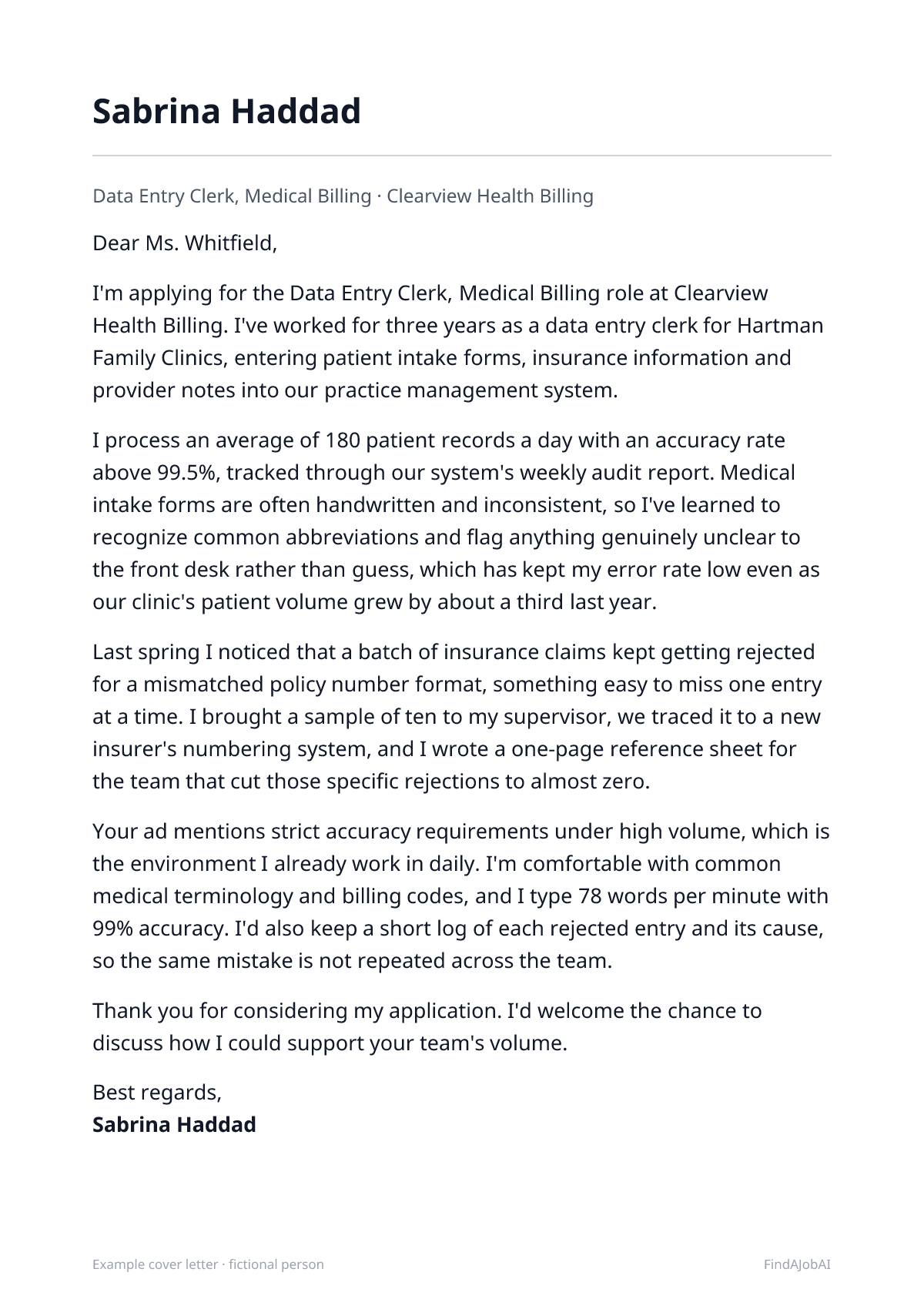
I'm applying for the Data Entry Clerk, Medical Billing role at Clearview Health Billing. I've worked for three years as a data entry clerk for Hartman Family Clinics, entering patient intake forms, insurance information and provider notes into our practice management system.
I process an average of 180 patient records a day with an accuracy rate above 99.5%, tracked through our system's weekly audit report. Medical intake forms are often handwritten and inconsistent, so I've learned to recognize common abbreviations and flag anything genuinely unclear to the front desk rather than guess, which has kept my error rate low even as our clinic's patient volume grew by about a third last year.
Last spring I noticed that a batch of insurance claims kept getting rejected for a mismatched policy number format, something easy to miss one entry at a time. I brought a sample of ten to my supervisor, we traced it to a new insurer's numbering system, and I wrote a one-page reference sheet for the team that cut those specific rejections to almost zero.
Your ad mentions strict accuracy requirements under high volume, which is the environment I already work in daily. I'm comfortable with common medical terminology and billing codes, and I type 78 words per minute with 99% accuracy. I'd also keep a short log of each rejected entry and its cause, so the same mistake is not repeated across the team.
Thank you for considering my application. I'd welcome the chance to discuss how I could support your team's volume.
Best regards,
Sabrina Haddad
Example 2 · Career changer
Retail cashier moving into data entry
Tyler built an inventory-tracking spreadsheet at a hardware store and wants a dedicated data entry role. The ad mentions Excel and inventory systems.
Example letter · fictional
Dear Hiring Manager,
I'm applying for the Data Entry Clerk role at Marsden Wholesale Supply. For two years I've worked as a cashier and inventory associate at Dunmore Hardware, where I took on most of our manual data entry because nobody else wanted it, and found I was good at it.
Our stockroom counts were tracked on paper and were usually a week out of date by the time anyone looked at them. I built a spreadsheet in Excel to log incoming shipments against our point-of-sale system, which meant entering about 200 line items a week by hand, checking each against the packing slip. Within two months, our inventory counts matched what the system expected over 98% of the time, up from somewhere around 80%, and my manager now has me train new hires on the process.
I type 72 words per minute and I'm comfortable in Excel, including basic formulas like VLOOKUP and SUMIF, which I taught myself to speed up the shipment reconciliation. I double-check entries in batches of twenty rather than one at a time, which has caught several of my own mistakes before anyone else saw them.
Your posting mentions Excel and inventory systems, which is exactly the work I've already been doing informally. I'd like to do it as my main job, with the structure and systems a dedicated role would give me.
Thank you for your time. I'm available to start as soon as needed and happy to complete any data entry test as part of your process.
Kind regards,
Tyler Brooks
Example 3 · Senior or lead
Data entry supervisor applying to lead a growing team
Donna supervises eight data entry clerks at an insurance processor. The ad is for a supervisor to set quality standards for a team that doubled.
Example letter · fictional
Dear Mr. Santoro,
I'm applying for the Data Entry Supervisor role at Rowland Claims Processing. For the last two years I've supervised a team of eight data entry clerks at Beacon Policy Services, and before that I spent five years as a senior clerk myself. I'd like to bring that experience to a team that's growing quickly.
Your ad says quality has slipped since the team doubled in size, which is close to what I inherited at Beacon. I set a standard double-entry check on our highest-risk claim types, built a short reference guide for our five most common entry errors, and moved our weekly accuracy report from a manual count to an automated pull from the system. Average team accuracy went from 96.2% to 99.1% within four months, and it has held there since.
One clerk on my team was consistently fast but made more errors than anyone else. Instead of writing her up, I sat with her for an afternoon and found she was skipping a verification step under time pressure. We adjusted her daily quota slightly and paired her with a mentor for two weeks, and her error rate dropped below the team average within a month; she's since become one of my strongest clerks.
I've managed day-to-day quality and scheduling for a team of eight, but I haven't yet hired for a team this size or set up training for a team that's still actively growing, and I'd want to build both carefully with your HR team early on.
A conversation about which error types concern you most right now, and what training new hires currently receive, would be a good place to start.
Sincerely,
Donna Pressley
All three letters, and the short version below, are fictional: the people, employers and numbers are invented. Borrow the structure, never the facts.
- Prefer to write it yourself? Use the free cover letter template.
- Check your CV against the job first: the free CV score shows the missing keywords.
Why the first letter works, paragraph by paragraph
Paragraph 1: Opening
Names the specific type of data entered (patient intake, insurance information) and the system used, so the reader knows the work is a direct match, not generic typing.
Paragraph 2: Volume and accuracy with a method
Gives a measurable daily volume and accuracy rate, then explains the method for handling messy source material (handwritten forms), which shows the number is earned, not just claimed.
Paragraph 3: A problem caught and fixed
One specific story about noticing a pattern in rejected claims and creating a reference sheet shows initiative beyond simply entering data accurately.
Paragraph 4: Why this role fits
Directly answers the ad's stated requirement (strict accuracy under volume) and adds the concrete typing speed and accuracy figures the ad is likely screening for.
Paragraph 5: Close
Offers to discuss the team's specific volume needs, a small but concrete next step.
What the career changer's letter does differently
The career changer's letter opens from a real problem (inventory counts a week out of date) solved informally with Excel, with a before-and-after accuracy figure (80% to 98%) instead of a job title. It names the exact Excel skills taught himself and offers to take a data entry test, which answers the employer's likely doubt about someone without the title directly.
What the senior letter does differently
A supervisor-level letter reports team-wide change, not individual output: an accuracy rate across the group (96.2 percent to 99.1 percent) and a process built to sustain it, like double-entry checks and an automated report. The story about the fast-but-error-prone clerk shows people management, and the letter names the gap, hiring and training at a larger scale, directly.
Short data entry clerk cover letter: an email-ready version
Many applications arrive as an email or a small text box, and a full page doesn't fit. This version runs 120 to 150 words and keeps only what a reader needs to decide whether to reply. A data entry clerk answers a logistics company's short online application question, sent as an email because the job posting listed a direct contact for questions.
Short version · email · fictional120 words
Subject: Data Entry Clerk application – shipping records, 80 WPM – Angela Ferris
Hello Mr. Kowalski,
I'm applying for the Data Entry Clerk role at Haldane Freight Solutions. I've spent two years entering shipping manifests and customer orders for a regional distributor, typing 80 words per minute with 99% accuracy.
I process around 150 shipping records a day in our order management system, and I batch-check every twenty entries against the original paperwork, which has caught several mismatched addresses before shipments went out. I'm comfortable with Excel and have picked up new systems quickly in past roles.
I'd like to bring that same volume and accuracy to your shipping records. My resume is attached, and I'm happy to complete a typing or data entry test as part of your process.
Best,
Angela Ferris
A short application keeps the typing speed, accuracy rate and daily volume, since those three numbers are usually what's actually being screened for. It still names a specific check (batching entries against paperwork) to show the accuracy claim has a method behind it, not just a stated percentage.
Opening lines that work for data entry clerk cover letters
The first sentence decides whether the second gets read. Here are six openings, one for each situation you might be in. Pick the one that matches yours and swap in your own facts: every name and number below is invented.
1. You have a standout result
I type 80 words per minute with 99% accuracy and process around 150 shipping records a day in my current role. I'd like to bring that same volume and accuracy to your team.
2. The ad names a problem you've solved
Your ad mentions quality has slipped since your team grew quickly. At my current company I built a reference guide for our five most common entry errors, and I'd like to help solve a similar problem here.
3. Someone referred you
Your office manager, Felix Dumont, and I worked together briefly covering a vendor's intake process last year. He mentioned you're looking for someone comfortable with high volume, which is the work I already do daily.
4. You admire what they build
I've used your company's customer portal for two years as a client, and the accuracy of your order confirmations made me curious about the data entry process behind it, which is work I'd like to be part of.
5. You're new to the field or switching into it
I spent two years as a cashier and inventory associate, where I built an Excel tracking system by hand because nobody else wanted the job. Data entry is where I'd like to keep doing that kind of work full time.
6. You have senior scope or a specialism
As a data entry supervisor managing a team of eight for the past two years, I raised our group's accuracy rate from 96.2% to 99.1%. I'm looking for a team that's ready to build those same standards.
How to write a data entry clerk cover letter
Five steps, in the order you'd write them. The shape stays the same for every job (a short opening, proof, a reason for this employer, a close), and what goes into each part is what changes with the role.
Identify the type of data and the system this ad names
Data entry ads usually name a specific record type, like medical intake, shipping manifests, or customer orders, and often a specific system or software. Match your example to the closest type of data you've entered, and name the software if you've used it.
Open with your speed and accuracy as one fact
State your typing speed together with its accuracy percentage in the same sentence, since employers often screen for both. If you don't have a formal number, describe your method for checking accuracy instead of estimating a figure.
Give a volume figure tied to a checking method
Name how many records, forms or line items you handle daily or weekly, then describe how you catch errors, such as batch-checking every twenty entries or comparing against source paperwork. The method makes the volume credible.
Describe one specific error you caught
Pick one real inconsistency, mismatch or rejected entry you noticed, what you did about it, and what changed afterward. This shows attentiveness beyond simply typing quickly. Name the system or spreadsheet involved and say how you made sure the same error could not recur.
Close by addressing any doubt about your fit
If you're newer to data entry or moving from another role, offer to complete a typing or data entry test, which removes the employer's main hesitation. If experienced, name the specific volume or system you're ready to support.
Data Entry Clerk cover letter do's and don'ts
Do
- State your typing speed with its accuracy percentage, and the system or software named in the ad if you've used it.
- Give a daily or weekly volume figure for records, forms or line items entered, with how accuracy was measured.
- Describe one specific error or inconsistency you caught, and what you did about it.
Don't
- Don't write "detail-oriented and hardworking" without an example; those words appear in nearly every data entry letter.
- Don't pad the letter with unrelated duties; keep the focus on entry, accuracy and the systems used.
- Don't exaggerate typing speed or accuracy; these are often tested, so the number should be real.
Common data entry clerk cover letter mistakes
Each one is easy to make and quick to fix before you send the letter.
Claiming to be "detail-oriented" with no example
Nearly every data entry letter uses this phrase. Replace it with one specific error you caught or a checking method you use, like reviewing entries in batches.
Giving a typing speed with no accuracy figure
Speed alone doesn't show quality. Pair words per minute with an accuracy percentage, or describe how your accuracy is tracked if you don't have an exact number.
Listing unrelated past duties at length
A long work history summary distracts from what the role actually needs. Keep the focus on entry volume, accuracy and the systems used, even if that means leaving out other duties.
Rounding up a typing speed or accuracy number
Many employers test typing speed and accuracy during hiring. An inflated number creates a problem at the testing stage, so give the real figure.
Not naming the specific system or software used
A letter that only says "data entry software" misses a chance to match the ad. Name the actual system, such as Excel, a CRM, or a practice management system, and how you used it.
Email subject lines for data entry clerk applications
Applying by email? Put the job title, any reference number and your name in the subject line.
- Data Entry Clerk, Medical Billing application – Sabrina Haddad
- Data Entry Clerk application – Excel and inventory experience – Tyler Brooks
- Application: Data Entry Clerk, Remote (Req. 3015) – Sabrina Haddad
Everything for Data Entry Clerks
- Data Entry Clerk resume exampleA full resume, plus bullet and summary examples
- Data Entry Clerk interview questions30 questions with sample answers
- Data Entry Clerk job descriptionDuties, skills and requirements
- Career change cover letter: template + examples
Other cover letter examples
Data Entry Clerk cover letter FAQ
What should I write in a data entry clerk cover letter?
Your typing speed with its accuracy percentage, the volume of records or forms you handle, and the software or system named in the ad if you know it. Add one specific example of an error or inconsistency you caught.
How do I write a data entry cover letter with no direct experience?
Use any job where you entered, tracked or organized information by hand, such as inventory, scheduling or customer records, even informally. Give a volume figure, the tools you used, and a result like improved accuracy or time saved.
Should I mention my typing speed in a data entry cover letter?
Yes, with its accuracy percentage if you have one. Many employers test this during hiring, so give an honest number rather than a rounded-up guess.
How we built this page
The FindAJobAI team wrote the three example letters, the short email version, the opening lines and the advice for data entry clerk roles. The people, employers and numbers in the letters are invented; the structure, the kind of evidence and the order of the paragraphs are the parts to copy.
Once we track enough live data entry clerk job ads, this page also shows the skills they ask for most, counted the same way as our in-demand skills report.
Last reviewed on November 1, 2026.