Data Scientist Cover Letter Example (2026)
By FindAJobAI team Updated How we built this page
Data science hiring managers are tired of letters that list models. They want to know which decision your work changed and by how much: a forecast that set a budget, an experiment that changed a launch, a model that moved revenue or retention. A strong data scientist cover letter pairs every method with its business result.
Data Scientist cover letter template
This letter as a one-page template: an opening that names the job and your strongest fact, proof that answers the ad, a reason for this employer and a short close.
After you sign up, FindAJobAI drafts your own letter for a real job from your CV in this format, and you edit it before you send it.
Example 1 · Experienced
Growth data scientist applying to a subscription company
Laura leads retention and pricing analytics at a fitness app. The ad says the company is moving to personalized offers.
Example letter · fictional
Dear Mr. Okonkwo,
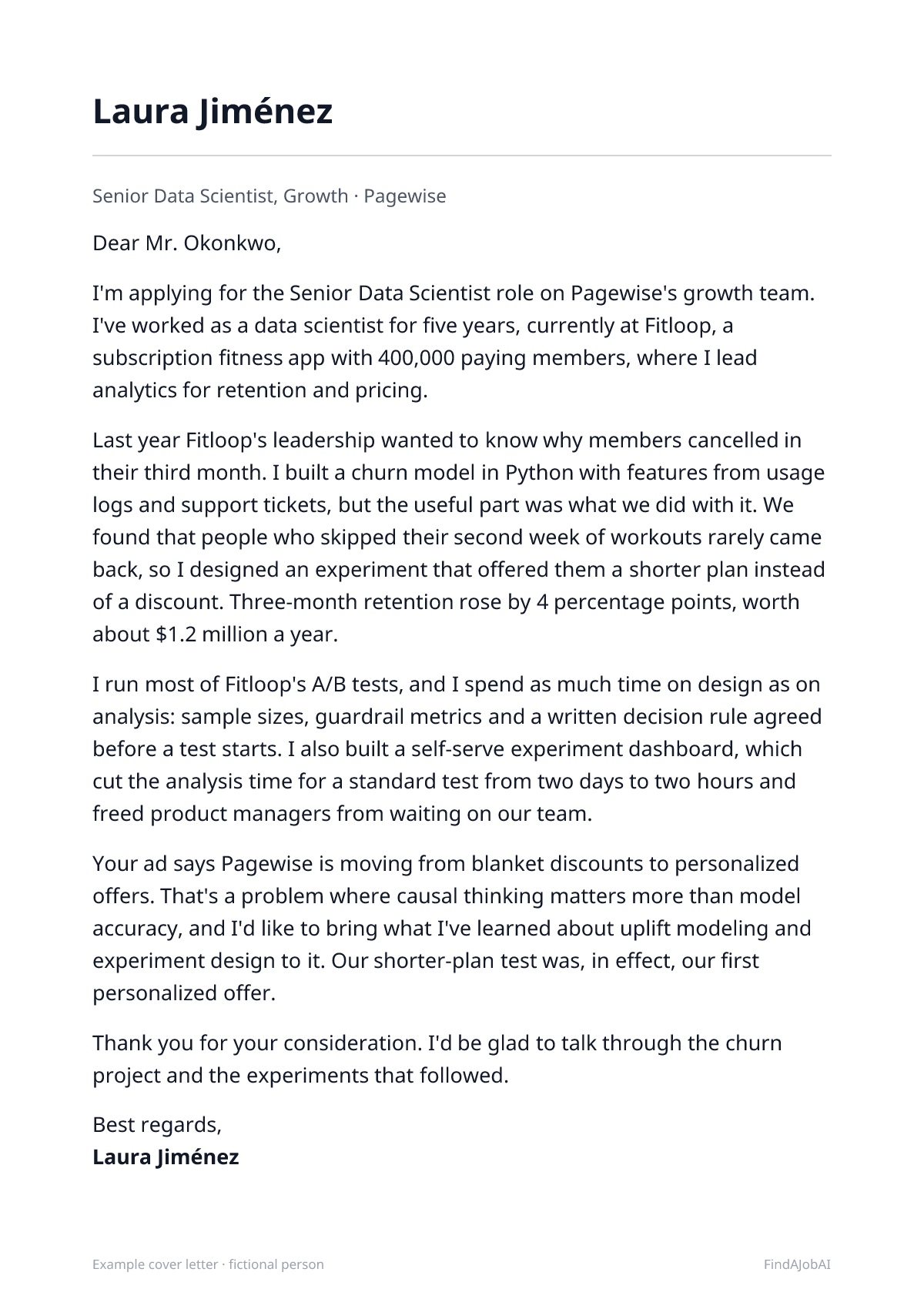
I'm applying for the Senior Data Scientist role on Pagewise's growth team. I've worked as a data scientist for five years, currently at Fitloop, a subscription fitness app with 400,000 paying members, where I lead analytics for retention and pricing.
Last year Fitloop's leadership wanted to know why members cancelled in their third month. I built a churn model in Python with features from usage logs and support tickets, but the useful part was what we did with it. We found that people who skipped their second week of workouts rarely came back, so I designed an experiment that offered them a shorter plan instead of a discount. Three-month retention rose by 4 percentage points, worth about $1.2 million a year.
I run most of Fitloop's A/B tests, and I spend as much time on design as on analysis: sample sizes, guardrail metrics and a written decision rule agreed before a test starts. I also built a self-serve experiment dashboard, which cut the analysis time for a standard test from two days to two hours and freed product managers from waiting on our team.
Your ad says Pagewise is moving from blanket discounts to personalized offers. That's a problem where causal thinking matters more than model accuracy, and I'd like to bring what I've learned about uplift modeling and experiment design to it. Our shorter-plan test was, in effect, our first personalized offer.
Thank you for your consideration. I'd be glad to talk through the churn project and the experiments that followed.
Best regards,
Laura Jiménez
Example 2 · Entry level
PhD graduate applying for a first industry data science role
Samuel is finishing an epidemiology PhD built on mobility data. The ad asks for statistics, Python and clear communication.
Example letter · fictional
Dear Fairway Hiring Team,
I'm applying for the Data Scientist position at Fairway Mobility. I'm finishing a PhD in epidemiology at the University of Michigan, where I've spent four years building statistical models of how illness spreads through cities, and I'd like to apply the same methods to how people move through them.
My thesis models disease transmission using anonymized mobility data for 2.3 million people. I wrote the pipeline in Python and SQL, fitted Bayesian hierarchical models in PyMC, and presented the results to county health officials, who used them to choose locations for two vaccination sites that served 18,000 people. Explaining uncertainty to people who have to make a decision anyway turned out to be the most valuable skill I learned.
To prepare for industry, I completed a summer internship at a regional transit agency, where I built a ridership forecast the planning team now uses to schedule buses; its errors are about 20% lower than their previous method's. I've learned to work in Git with code review and to write analyses others can rerun. I'm newer to A/B testing in a product setting, and I'm reading up on it now.
Your ad asks for strong statistics, Python and the ability to explain results to non-technical teams. Those are the three things my research has trained most, and mobility data is a subject I already know well, including its privacy limits.
Thank you for considering my application. I'd welcome the chance to talk about the forecast, my thesis work and how both would apply to your riders.
Kind regards,
Samuel Osei
Example 3 · Referral or internal move
Data scientist applying on a former labmate's referral
Jonas was referred by a labmate who now leads analytics at the hiring company. The ad asks for causal inference, Python and pricing experiments.
Example letter · fictional
Dear Dr. Oyelaran,
I'm applying for the Data Scientist role on the pricing team at Fennel Health. You and I shared an office for three years during our doctorates in applied statistics, and when we spoke last month you mentioned the opening. I'd like to make the case here on the evidence, as I would for any other employer.
For four years I've been a data scientist on pricing at Pricehaven, where we can't always run a clean A/B test because customers talk to each other. I used a staggered regional rollout and a difference-in-differences model to estimate elasticity for 300 product groups. The recommended price changes raised gross margin by 2.3 points over two quarters, with no measurable change in conversion. The method is now the team's default for any change that can't be randomized by customer.
I'm careful about what an analysis can claim. I pre-register the question, run power calculations before a test starts, and ask a colleague to attack the result before it reaches a decision-maker. When one promising model turned out to be picking up a seasonal promotion rather than price sensitivity, I said so in the review and we reran it, which saved a bad rollout.
I haven't worked in healthcare or under HIPAA, and subscription pricing for care plans will bring fairness questions I haven't met in retail. You know how I think, so I'd be glad to do a case study or a take-home exercise first, to show the work rather than rely on history.
Which pricing question does your team most want answered first, and how would it measure whether the answer was right? I'd enjoy talking that through.
Kind regards,
Jonas Keller
All three letters, and the short version below, are fictional: the people, employers and numbers are invented. Borrow the structure, never the facts.
- Prefer to write it yourself? Use the free cover letter template.
- Check your CV against the job first: the free CV score shows the missing keywords.
Why the first letter works, paragraph by paragraph
Paragraph 1: Opening
Names the area of work (retention and pricing) instead of "machine learning". Growth teams hire people who already think about the same metrics they do.
Paragraph 2: Model to decision
The churn model gets one clause; the paragraph is about the insight, the experiment that followed and the revenue result. That order is what data science managers want to see.
Paragraph 3: Experimentation practice
Shows rigor (sample sizes, guardrails, pre-agreed decision rules) and leverage (a self-serve dashboard). Both say this person makes the whole team better.
Paragraph 4: Why this company
Connects the company's plan to a specific method, uplift modeling, and why it fits, which shows real understanding of their problem.
Paragraph 5: Close
Short, and points to the strongest story for the interview.
What the entry-level letter does differently
The PhD letter translates research into industry language: data volume, tools, and a decision officials made using the work. An internship forecast with a measured improvement proves applied skill, and the letter names its gap, product A/B testing, without underselling the research.
What the referral letter does differently
A referral from someone who knows the writer well is disclosed in the first paragraph, along with its basis, and the letter then argues from evidence: a method chosen for a messy test, a result with a margin figure and a model that was caught and rerun. Offering a case study answers the risk of friendly bias.
Short data scientist cover letter: an email-ready version
Many applications arrive as an email or a small text box, and a full page doesn't fit. This version runs 120 to 150 words and keeps only what a reader needs to decide whether to reply. Sent to an analytics director who posted the role and asked for 'a few lines on how you'd approach a churn question'. The note answers that directly.
Short version · email · fictional128 words
Subject: Data Scientist (churn and experimentation) – Ayesha Khan
Hello Ms. Dalgaard,
You asked how I'd approach a churn question, so briefly: define churn the way the business feels it, look at who leaves and when, check whether the early signals are causes or symptoms, then test one change before building a model. I'm applying for the Data Scientist role with four years of subscription analytics behind that approach.
At Streamnest, a streaming-box company, I found that churn clustered in the first nine days. We tested a simpler setup flow, and 30-day cancellations fell by a fifth, which was worth far more than the prediction model I had planned.
I'd enjoy applying that to Wickerby's subscribers, starting with the first week after sign-up, where I suspect your biggest drop sits. I've attached my resume.
Best,
Ayesha Khan
The best short version answers the question the post asked, in the reader's own terms, before introducing the writer. It then supports the approach with one real result, and the closing sentence is short because the work has already been shown.
Opening lines that work for data scientist cover letters
The first sentence decides whether the second gets read. Here are six openings, one for each situation you might be in. Pick the one that matches yours and swap in your own facts: every name and number below is invented.
1. You have a standout result
About $1.2 million a year in kept revenue: that is what a retention model I built for a subscription product is worth, and it's the kind of work I'd like to do for your growth team.
2. The ad names a problem you've solved
You run many experiments but struggle to tell which results to trust, as your ad says. I built our review checklist and a sequential-testing approach last year, and wrongly shipped changes fell to almost none.
3. Someone referred you
I heard about this role from Tobias Hahn, a statistician on your pricing team. We published a paper together, and he thought my demand-forecasting work would fit your plans.
4. You admire what they build
Your blog post on estimating the effect of a price change without a clean test was one I'd have liked to write, and it's why I want to work on your team.
5. You're new to the field or switching into it
My epidemiology PhD finishes this spring, built on large mobility datasets. I'd like to bring that statistical training to a first industry role where the results reach a decision.
6. You have senior scope or a specialism
Seven years of leading data science for a subscription business, from forecasting to pricing, have made me want a principal role where I decide which questions the team asks.
How to write a data scientist cover letter
Five steps, in the order you'd write them. The shape stays the same for every job (a short opening, proof, a reason for this employer, a close), and what goes into each part is what changes with the role.
Find the decision behind the ad
Data science ads often list methods, but the job is a decision: who to target, what to charge, what to build. Work out which decision this team makes and choose the analysis of yours that changed one. Methods are the means; the decision is the point.
Open with a result in business terms
Start with the title, your years and one outcome a non-statistician values: revenue kept, cost avoided, a forecast error reduced. Put the technique in the next sentence. Leading with the algorithm makes the reader do the translation, and many won't.
Show the method you chose and why
Describe the data, the constraint, such as no clean experiment, and the approach you picked. A sentence on why you rejected the obvious option shows judgment. Data science managers hire people who choose methods for the problem, not the other way round.
Be honest about what the analysis can claim
Include one moment where you checked your own result: a power calculation, a holdout, a finding you corrected. It signals that you protect the team from confident mistakes, which is what experienced managers fear most from new hires.
Connect to the company's data and close on a question
Say what's interesting about their data, such as subscriptions, marketplaces or sensors, and how you'd start. Close with a specific question for the first conversation, which shows you've thought about their problem and not only about your own record.
Keywords employers use for data scientist roles
The skills named most often in the 483 newest data scientist job ads we track (out of 2,454 live postings), with the share of ads that mention each:
- Python 81%
- Machine learning 73%
- SQL 59%
- Statistics 50%
- LLMs 37%
- Data analysis 36%
- R 24%
- AWS 24%
Don't list them in your letter: pick the two or three the ad repeats and back each with one sentence of evidence. Full list: Data Scientist resume keywords.
From live job ads · updated November 2, 2026
Data Scientist cover letter do's and don'ts
Do
- Pair every model or method with the decision it changed and the metric that moved.
- Mention experiment design (sample size, guardrails, decision rules) if the role involves A/B testing.
- Show you can explain results to non-technical people: who you presented to and what they did next.
Don't
- Don't list algorithms (XGBoost, random forests, LSTMs) without the problem they solved.
- Don't lead with model accuracy alone; business impact matters more to the reader.
- Don't overstate causality; if a result came from observational data, say so.
Common data scientist cover letter mistakes
Each one is easy to make and quick to fix before you send the letter.
Leading with algorithms
A paragraph of gradient boosting, transformers and Bayesian models says what you know, not what you've achieved. Lead with the decision the work changed and mention the method in a clause.
Reporting accuracy and nothing else
An AUC or an R-squared doesn't tell a manager what happened to the business. Add what the model was used for, the action it triggered and a result such as revenue, retention or hours saved.
Overclaiming causality
If your evidence is observational, say so and describe how you handled confounders. Statisticians on the hiring panel will notice a causal claim from correlational data, and it costs more credibility than a modest, honest estimate.
Relying on coursework or competition rankings
A leaderboard place shows technique on a clean dataset. If you're early in your career, use a project with messy, real data and a person who used the result, even a small one, and describe the cleaning too.
Writing in academic voice
Long sentences and passive constructions hide the point from a business reader. Write as you would explain the work to a product manager: the question, what you did, what changed and what you're unsure about.
Email subject lines for data scientist applications
Applying by email? Put the job title, any reference number and your name in the subject line.
- Senior Data Scientist, Growth – retention and experimentation – Laura Jiménez
- Data Scientist application – PhD in epidemiology, mobility data – Samuel Osei
- Application: Data Scientist, Pricing (Job 2218) – Laura Jiménez
Everything for Data Scientists
- Data Scientist jobs2,454 open roles, updated hourly
- Data Scientist salary in the United StatesAdvertised pay in real job ads
- Data Scientist resume exampleA full resume, plus bullet and summary examples
- Data Scientist interview questions30 questions with sample answers
- Data Scientist resume keywordsThe skills job ads ask for most
- Data Scientist job descriptionDuties, skills and requirements
- Cover letter with no experience: templates
Other cover letter examples
Data Scientist cover letter FAQ
What should a data scientist cover letter include?
One or two projects where your analysis or model changed a decision, with the result in business terms (revenue, retention, cost), plus how you worked with stakeholders. Methods belong inside those stories, not in a list.
How do I write a data science cover letter after a PhD?
Translate your research into impact: the data you handled, the tools you used, and who made a decision because of your work. Add applied experience, such as an internship or a project with real users, and name what you still need to learn about industry practice.
Should I mention Kaggle in a data scientist cover letter?
Only if it's a strong result relevant to the role, and even then in one line. Hiring managers prefer evidence that your work changed a real decision over a competition ranking.
How we built this page
The FindAJobAI team wrote the three example letters, the short email version, the opening lines and the advice for data scientist roles. The people, employers and numbers in the letters are invented; the structure, the kind of evidence and the order of the paragraphs are the parts to copy.
The live keyword section is based on 483 data scientist job ads analysed, the newest we track, with the same deterministic skill matcher as our in-demand skills report: no AI model reads the postings. It was last computed on November 2, 2026 and refreshes daily.
Last reviewed on November 1, 2026.