Editor Cover Letter Example (2026)
By FindAJobAI team Updated How we built this page
Editor ads ask for a sharp eye and strong judgment, which every applicant claims, so the letter has to prove it. Name a piece you reshaped, the problem with it, and what changed once you were done, rather than describing yourself as detail-oriented.
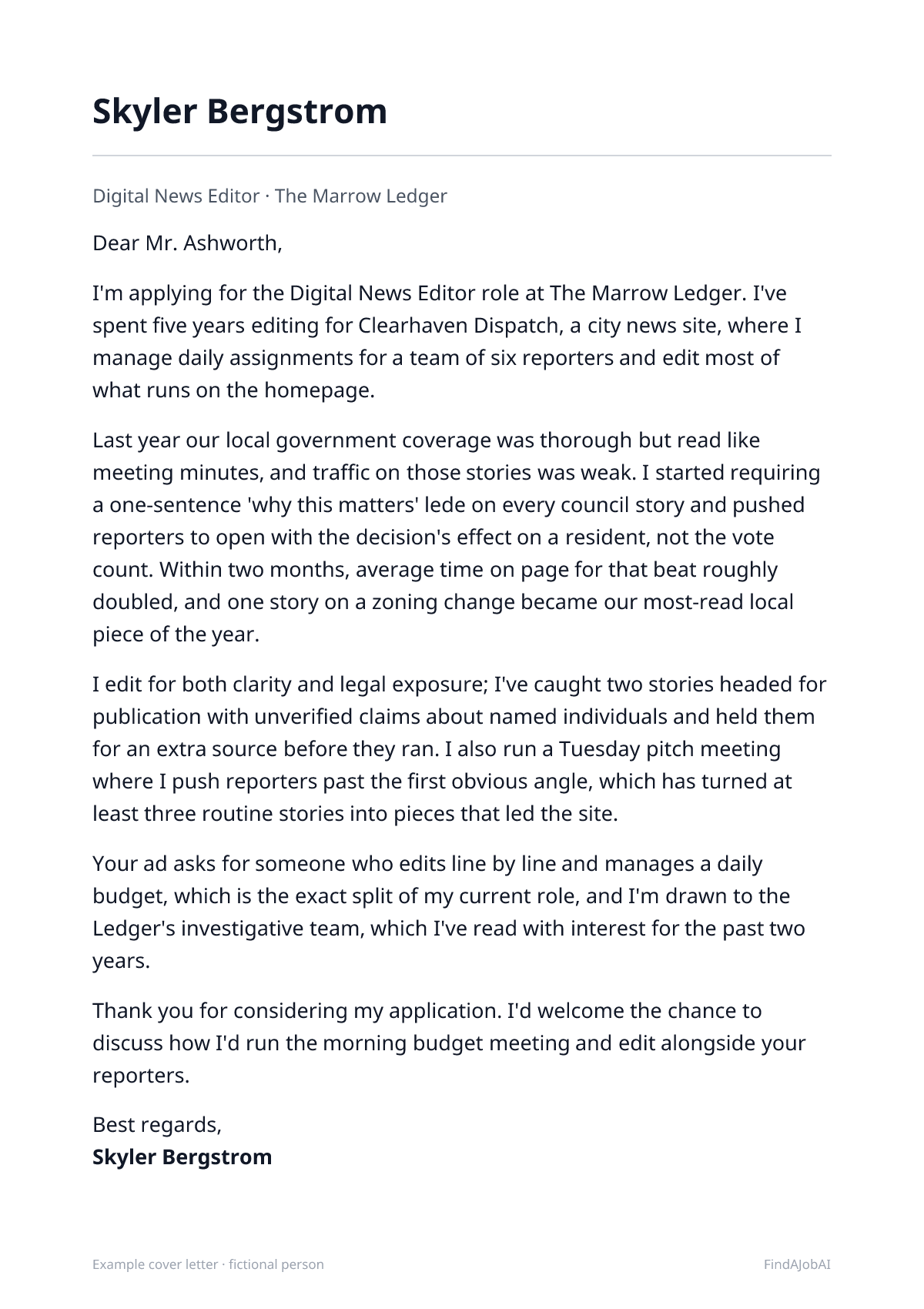
Editor cover letter template
This letter as a one-page template: an opening that names the job and your strongest fact, proof that answers the ad, a reason for this employer and a short close.
After you sign up, FindAJobAI drafts your own letter for a real job from your CV in this format, and you edit it before you send it.
Example 1 · Experienced
Digital news editor applying to a regional outlet
Skyler edits a team of six reporters at a city news site. The ad wants someone who can both edit copy and manage daily story assignments.
Example letter · fictional
Dear Mr. Ashworth,
I'm applying for the Digital News Editor role at The Marrow Ledger. I've spent five years editing for Clearhaven Dispatch, a city news site, where I manage daily assignments for a team of six reporters and edit most of what runs on the homepage.
Last year our local government coverage was thorough but read like meeting minutes, and traffic on those stories was weak. I started requiring a one-sentence 'why this matters' lede on every council story and pushed reporters to open with the decision's effect on a resident, not the vote count. Within two months, average time on page for that beat roughly doubled, and one story on a zoning change became our most-read local piece of the year.
I edit for both clarity and legal exposure; I've caught two stories headed for publication with unverified claims about named individuals and held them for an extra source before they ran. I also run a Tuesday pitch meeting where I push reporters past the first obvious angle, which has turned at least three routine stories into pieces that led the site.
Your ad asks for someone who edits line by line and manages a daily budget, which is the exact split of my current role, and I'm drawn to the Ledger's investigative team, which I've read with interest for the past two years.
Thank you for considering my application. I'd welcome the chance to discuss how I'd run the morning budget meeting and edit alongside your reporters.
Best regards,
Skyler Bergstrom
Example 2 · Career changer
Proofreader moving into a full editing role
Brent caught a legal error no one else saw and already does light editing beyond proofreading. The ad wants structural and line editing for a trade magazine.
Example letter · fictional
Dear Hiring Manager,
I'm applying for the Associate Editor role at Kettlewright Trade Monthly. For three years I've worked as a proofreader at Brinsdale Publishing, where I've gradually taken on structural notes and light line edits on manuscripts beyond the proofing stage, and I'm ready to do that editing work full time.
Last year, while proofing a manuscript on supply chain regulation, I caught a claim that misstated a compliance deadline in a way that could have exposed a reader's business to a real penalty. Beyond the correction, I rewrote the surrounding section for clarity and flagged two other places where the argument's structure buried the actual recommendation under background. The author kept most of my restructuring, and the piece ran without further changes.
Since then I've taken on a monthly column edit on my own, cutting one writer's drafts from around 1,800 words to a tighter 1,200 without losing the argument, and I've completed a line editing course through a publishing program to formalize what I'd been doing informally.
Your posting asks for structural and line editing for a technical trade audience, which is close to what I already handle with the compliance column, and I'd bring both that editorial judgment and the proofreader's habit of not letting a wrong fact slip through. I'd also like to learn your style sheet and trade vocabulary quickly, and I keep a running list of the terms each writer prefers.
Thank you for your time. I can send two before-and-after excerpts from the column, with the writer's permission, if that would help.
Sincerely,
Brent Kapoor
Example 3 · Senior or lead
Senior editor applying to become a first managing editor
Remy oversees two section editors and a freelance pool at a culture magazine. The ad is for a managing editor who will set the editorial calendar and budget.
Example letter · fictional
Dear Ms. Vautour,
I'm applying for the Managing Editor role at Siltmark Quarterly. I've spent the last three years as a senior editor at Fenhollow Review, overseeing two section editors and a rotating pool of about fifteen freelancers, and before that I edited features there for five years. I'd like to take on the full calendar and budget responsibility your ad describes.
Your posting says Siltmark's issues regularly slip past deadline because assignments go out without a shared calendar. Fenhollow had the same pattern when I stepped into senior editing. I built a shared editorial calendar with hard deadlines for drafts, first edits and fact-checking, and moved us from an informal rolling schedule to issues that close on a fixed date. Our last six issues have shipped on schedule, compared to roughly half before the calendar existed, and our freelance pool has grown because writers trust the deadlines now.
The editorial decision I'm proudest of involved a feature on a local labor dispute that arrived well-reported but buried its strongest material, an interview with a worker who'd later been fired, two-thirds of the way through. I restructured the piece to open with that interview and moved the background material later, and it became one of our most-shared features that year and prompted a follow-up from a regional outlet.
I've managed section editors and a freelance budget, but I haven't yet set an entire publication's annual budget or negotiated contracts with printers and distributors on my own. At Siltmark I'd want to learn that side closely with your publisher in the first several months.
I'd welcome a conversation about where Siltmark's calendar tends to slip and which section you'd want a managing editor to stabilize first.
Sincerely,
Remy Zamora
All three letters, and the short version below, are fictional: the people, employers and numbers are invented. Borrow the structure, never the facts.
- Prefer to write it yourself? Use the free cover letter template.
- Check your CV against the job first: the free CV score shows the missing keywords.
Why the first letter works, paragraph by paragraph
Paragraph 1: Opening
States the scope the ad asks for (editing copy plus managing assignments) and the size of the team, so the reader sees a matching role, not just adjacent experience.
Paragraph 2: The editorial decision that changed a result
Names the problem (coverage that read like minutes), the fix (a specific editing rule), and the measurable effect (time on page, a top story), tying editorial judgment to a result rather than a vague claim of improving quality.
Paragraph 3: Judgment and process
Catching unverified claims and running a pitch meeting that produces better stories shows both risk management and the daily craft of assigning and improving work, which a manager-editor role needs beyond line editing.
Paragraph 4: Why this company
Matches the ad's stated split of duties and names a specific team at the company the writer has followed, which reads as researched rather than generic.
Paragraph 5: Close
Offers a concrete, relevant next step (discussing how the writer would run the budget meeting) instead of a general thank-you.
What the career changer's letter does differently
The career changer's letter opens with a specific catch from the editing work already being done quietly within a proofreading role, including a real stake (a compliance deadline), then shows a second, ongoing project (a monthly column) with a measurable before-and-after, and names a course that formalizes self-taught skills the ad requires.
What the senior letter does differently
A managing editor letter reports organizational fixes at the calendar and process level, like a schedule that moved six issues from roughly half on-time to consistently on-time, rather than a single line edit. The feature example shows structural judgment at scale, and the gap, full budget and vendor ownership, is stated plainly.
Short editor cover letter: an email-ready version
Many applications arrive as an email or a small text box, and a full page doesn't fit. This version runs 120 to 150 words and keeps only what a reader needs to decide whether to reply. A copy editor answers a lifestyle website's short application form after the ad said to send a note by email instead of using the portal.
Short version · email · fictional129 words
Subject: Copy Editor application – AP style, CMS experience – Idris Castellane
Hello Ms. Okonjo,
I'm applying for the Copy Editor role at Verdant Living Co. I have four years of copy editing experience at a home and garden site, where I edit roughly a dozen posts a week for style, accuracy and SEO structure.
My most useful catch was on a recipe post that listed an ingredient quantity off by a factor of ten due to a conversion error. Beyond the fix, I added a step in our workflow where any converted measurement gets a second check before publishing, and we haven't had a repeat error since.
I'm comfortable in WordPress and Chicago style, with AP for headlines, and I'd like to bring that same close reading to Verdant's recipe and how-to content. My resume is attached.
Best,
Idris Castellane
The short version keeps one concrete catch with a real stake, a wrong recipe measurement, and the process fix that followed, rather than a general claim of accuracy, and it names the style guides the ad likely checks for in a single line.
Opening lines that work for editor cover letters
The first sentence decides whether the second gets read. Here are six openings, one for each situation you might be in. Pick the one that matches yours and swap in your own facts: every name and number below is invented.
1. You have a standout result
A recipe post I copy edited last year had an ingredient quantity off by a factor of ten. Beyond the fix, I built a second-check step into our workflow, and we haven't had a repeat error since.
2. The ad names a problem you've solved
Your ad mentions issues slipping past deadline. At my current publication I built a shared editorial calendar that moved us from roughly half our issues shipping on time to all six of our last issues closing on schedule.
3. Someone referred you
Your features writer, Marisol Quintrell, and I worked together for two years on long-form pieces. She mentioned you're looking for an editor who restructures a draft rather than just polishing its sentences, which is the work I enjoy most.
4. You admire what they build
I've read Siltmark Quarterly for three years and the way your last issue handled a difficult interview subject is the kind of structural editing judgment I'd like to bring to your team.
5. You're new to the field or switching into it
I spent three years proofreading manuscripts before taking on structural edits informally, including a correction that caught a compliance deadline error with real stakes for a reader. I'm ready to do that editing work as my full title.
6. You have senior scope or a specialism
As senior editor overseeing two section editors and a freelance pool for three years, I built the editorial calendar my publication still runs on. I'm looking for a managing editor role where I can own that process fully.
How to write an editor cover letter
Five steps, in the order you'd write them. The shape stays the same for every job (a short opening, proof, a reason for this employer, a close), and what goes into each part is what changes with the role.
Pick one piece that shows your editing judgment
Choose a specific article, manuscript or post you edited where your change mattered, not just one you proofed cleanly. A corrected fact, a restructured argument or a sharpened lede gives the reader something concrete to judge instead of a general claim of a sharp eye.
State the problem before the fix
Describe what was wrong with the draft first, whether a buried lede, an unverified claim or a structural mess, then what you changed. A reader who understands the problem can see why your edit mattered, rather than just that you made one.
Report the result in the outlet's terms
Readership, shares, a corrected error's stakes, or a deadline met are the currencies editors are judged in. State one such result tied to your edit, using relative or rounded figures if exact numbers are confidential to a current employer.
Name your process if you manage other writers
If the role includes assigning or managing contributors, describe one process you run, such as a pitch meeting, an editorial calendar or a style sheet, and a result it produced. This separates editor roles from pure line-editing ones.
Match your tools to the ad without listing them
Mention the CMS, style guide or fact-checking step the ad names, but only inside the story of an edit you made with it. A style guide named in isolation proves nothing; one used to catch or fix something specific does.
Editor cover letter do's and don'ts
Do
- Name one piece you edited, the problem with it, and what changed after your edit, in the reader's own terms (readership, clarity, a corrected fact).
- Mention the style guide or workflow tool the ad names (AP style, a specific CMS) inside the story of an edit, not as a bare list.
- If you manage writers, name the process you run (a pitch meeting, an assignment calendar) and one result it produced.
Don't
- Don't call yourself detail-oriented with an eye for clarity; show one specific catch or rewrite instead.
- Don't count the number of pieces edited; one piece you reshaped matters more than a tally.
- Don't share an unpublished writer's draft without permission; use a published example or ask first.
Common editor cover letter mistakes
Each one is easy to make and quick to fix before you send the letter.
Calling yourself detail-oriented instead of showing it
Every applicant claims an eye for detail. Replace the claim with one specific catch, such as a wrong figure, a misattributed quote or a structural flaw, and what you did about it.
Counting pieces edited instead of describing one
A number like 'edited over 500 articles' says nothing about judgment. Pick the one edit that mattered most and tell its problem, fix and result in two or three sentences.
Sharing an unpublished draft without permission
Using a writer's unpublished work as a writing sample, even anonymized, can create a real problem. Use a published example, or ask the writer first and say in the letter that you have permission.
Treating proofreading and editing as interchangeable
Proofreading catches errors; editing changes structure and argument. If you're applying for a full editing role, show a structural or line edit, not just a caught typo, so the ad's actual requirement is met.
Leaving out how you work with writers
An editor who only describes solo work on a page leaves out half the job. Add one sentence on how you give feedback or run a meeting, especially for a role that manages contributors.
Email subject lines for editor applications
Applying by email? Put the job title, any reference number and your name in the subject line.
- Digital News Editor application – daily assignments and homepage editing – Skyler Bergstrom
- Associate Editor – proofreader moving into structural editing – Brent Kapoor
- Application: Editor, Features Desk (Req. 2290) – Skyler Bergstrom
Everything for Editors
- Editor resume exampleA full resume, plus bullet and summary examples
- Editor job descriptionDuties, skills and requirements
- Career change cover letter: template + examples
Other cover letter examples
Editor cover letter FAQ
What should I write in an editor cover letter?
One piece you edited: the problem with the draft, what you changed, and the result, whether that's readership, clarity or a corrected error. Add one sentence on how you work with writers. Your tools and style guide knowledge belong on the resume.
How do I write an editor cover letter with no formal editing title?
Use editing work done inside another role, such as proofreading notes that became structural edits, or a newsletter or column you shaped. Name one specific catch or rewrite and its effect, then add any course or certificate that formalizes the skill.
Should an editor cover letter mention a style guide?
Only inside a specific example, such as a correction you made following AP or Chicago style. Naming a style guide alone doesn't show judgment; the correction it enabled does.
How long should an editor cover letter be?
About three-quarters of a page, long enough for one substantial editing example and a line on working with writers, short enough to show you edit your own writing tightly, which is the first thing an editor reads for.
How we built this page
The FindAJobAI team wrote the three example letters, the short email version, the opening lines and the advice for editor roles. The people, employers and numbers in the letters are invented; the structure, the kind of evidence and the order of the paragraphs are the parts to copy.
Once we track enough live editor job ads, this page also shows the skills they ask for most, counted the same way as our in-demand skills report.
Last reviewed on November 1, 2026.