Game Developer Cover Letter Example (2026)
By FindAJobAI team Updated How we built this page
Game developer ads usually name an engine and a genre, so a cover letter stands out by describing a specific system you built or a bug you chased down, not by listing every engine you've ever opened.
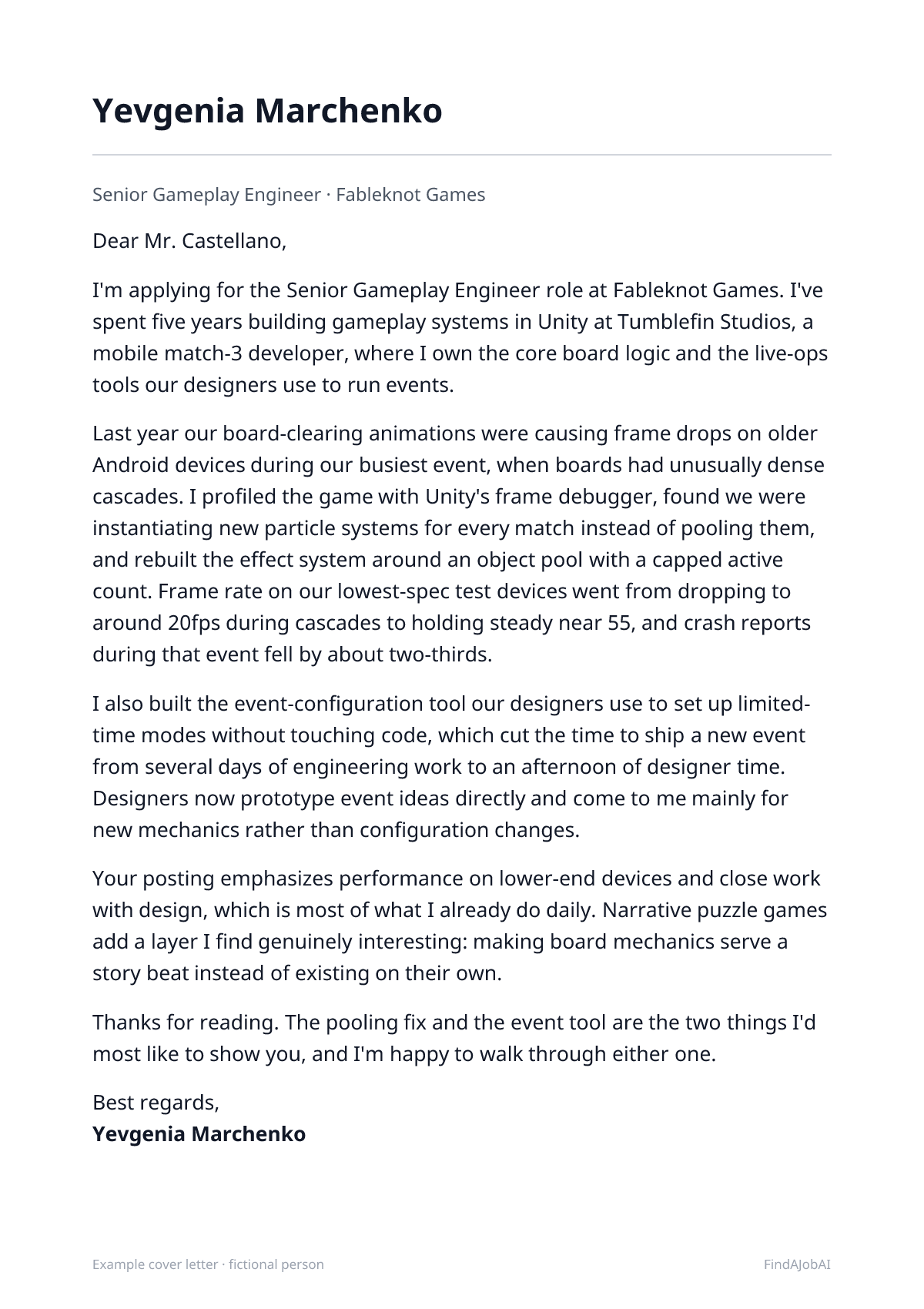
Game Developer cover letter template
This letter as a one-page template: an opening that names the job and your strongest fact, proof that answers the ad, a reason for this employer and a short close.
After you sign up, FindAJobAI drafts your own letter for a real job from your CV in this format, and you edit it before you send it.
Example 1 · Experienced
Mobile gameplay engineer applying to a narrative puzzle studio
Yevgenia builds gameplay systems in Unity for a mobile match-3 studio. The ad asks for performance work and cross-team collaboration.
Example letter · fictional
Dear Mr. Castellano,
I'm applying for the Senior Gameplay Engineer role at Fableknot Games. I've spent five years building gameplay systems in Unity at Tumblefin Studios, a mobile match-3 developer, where I own the core board logic and the live-ops tools our designers use to run events.
Last year our board-clearing animations were causing frame drops on older Android devices during our busiest event, when boards had unusually dense cascades. I profiled the game with Unity's frame debugger, found we were instantiating new particle systems for every match instead of pooling them, and rebuilt the effect system around an object pool with a capped active count. Frame rate on our lowest-spec test devices went from dropping to around 20fps during cascades to holding steady near 55, and crash reports during that event fell by about two-thirds.
I also built the event-configuration tool our designers use to set up limited-time modes without touching code, which cut the time to ship a new event from several days of engineering work to an afternoon of designer time. Designers now prototype event ideas directly and come to me mainly for new mechanics rather than configuration changes.
Your posting emphasizes performance on lower-end devices and close work with design, which is most of what I already do daily. Narrative puzzle games add a layer I find genuinely interesting: making board mechanics serve a story beat instead of existing on their own.
Thanks for reading. The pooling fix and the event tool are the two things I'd most like to show you, and I'm happy to walk through either one.
Best regards,
Yevgenia Marchenko
Example 2 · Career changer
3D artist moving into game development
Noor built and scripted interactive props in Unreal as an environment artist. The ad wants Blueprint scripting and a team player for a small studio.
Example letter · fictional
Dear Hiring Manager,
I'm applying for the Junior Gameplay Programmer role at Driftlight Interactive. For four years I've worked as an environment artist in Unreal Engine on a small studio team, and the part of the job that pulled me toward programming was scripting the interactive props nobody else had time to build.
On our last project, a puzzle adventure game, the design team wanted a set of pressure plates and movable crates that triggered events in combination, but our one gameplay programmer was buried in other systems. I taught myself Blueprint scripting well enough to build the entire puzzle set myself, including save-state logic so puzzles didn't reset if a player left mid-level. The system shipped in the final game largely untouched by engineering, and it became the template our next project's puzzle rooms were built from.
Since then I've completed a C++ course aimed at Unreal developers, rebuilt two of my puzzle systems in C++ to replace the Blueprint versions, and built a small top-down combat prototype from scratch to practice state machines and input handling. I'm comfortable in both Blueprint and basic C++, and I still think visually, which helps me build systems that artists and designers can read at a glance.
Your posting asks for Blueprint scripting on a small team where everyone covers more than one role, which matches both what I've already done and the kind of team I want to keep working on.
Thanks for your time. A short video of the puzzle system running is ready to send, and I'd enjoy talking through how it was built.
Kind regards,
Noor Abdulkarim
Example 3 · Senior or lead
Lead engineer applying to build a studio's first dedicated engine team
Baptiste leads an eight-person gameplay team at an indie studio. The ad is for a lead engineer to build out engine and tools support.
Example letter · fictional
Dear Ms. Vandermeer,
The Lead Game Engineer role at Hollowmoor Studio matches the work I've grown into. I've led an eight-person gameplay team at Tincup Interactive for three years, following seven years as a senior engineer on two shipped titles, and I'd like to build the dedicated engine support your posting describes.
Your ad mentions gameplay engineers spending significant time on engine and tooling issues instead of features. Tincup had the same problem before I split off a two-person tools team from the gameplay group. I defined their first mandate around our worst pain point, a save system that broke whenever a new feature touched shared state, and had them build a validated serialization layer that caught breaking changes before they reached a build. Save-related bugs reported in QA dropped from a regular weekly occurrence to a handful across an entire project.
A tools team only earns its keep if the rest of engineering trusts its priorities. I ran a monthly triage where any engineer could pitch a tooling pain point, and we committed to fixing the top one or two each cycle. One designer's request, a faster way to iterate on dialogue trees, became a tool now used daily by our entire narrative team, which told me the process was working.
I haven't built a tools team at the scale your posting implies, supporting multiple concurrent projects rather than one. I have run cross-project tooling before on a smaller scale, and I'd want to learn your current project pipeline closely before proposing structure.
A conversation about which engine or tooling pain point is costing your team the most time right now would be a good place to start.
Sincerely,
Baptiste Lemercier
All three letters, and the short version below, are fictional: the people, employers and numbers are invented. Borrow the structure, never the facts.
- Prefer to write it yourself? Use the free cover letter template.
- Check your CV against the job first: the free CV score shows the missing keywords.
Why the first letter works, paragraph by paragraph
Paragraph 1: Opening
States the engine, genre, and specific ownership (board logic, live-ops tools), which tells a reader what kind of systems this person has already shipped.
Paragraph 2: The performance fix
A clear symptom, the profiling tool used, the root cause, and the fix, measured in frame rate and crash reports, numbers a mobile studio cares about directly.
Paragraph 3: A tool built for another team
Shows the writer thinks beyond their own tasks to the team's workflow, with a concrete before-and-after in shipping time.
Paragraph 4: Why this company
Mirrors the ad's stated priorities and adds a specific, genuine reason the genre appeals beyond the job itself.
Paragraph 5: Close
Offers a concrete walkthrough of real work as the next step, rather than a general invitation to discuss.
What the career changer's letter does differently
This letter opens with a tool the writer had to build while still working as an artist, and it states the result in what shipped and who reused it. A C++ course and rebuilt systems show the training is now formal, and the art background is tied to systems other artists and designers can read.
What the senior letter does differently
A lead engineer letter reports organizational judgment: a tools team built around the studio's worst actual pain point, a measurable drop in recurring bugs, a trust-building process (the triage), and a named gap (multi-project scale) alongside the adjacent experience that offsets it.
Short game developer cover letter: an email-ready version
Many applications arrive as an email or a small text box, and a full page doesn't fit. This version runs 120 to 150 words and keeps only what a reader needs to decide whether to reply. A game developer answers a studio's short application form after the listed recruiter email bounced, so they were asked to send a resume by email instead.
Short version · email · fictional143 words
Subject: Game Developer (Unity, combat systems) – Rasmus Thorvaldsen
Hello Ms. Okafor,
I'm applying for the Game Developer role at Emberlace Studios. I have four years of experience building combat and AI systems in Unity on a small team that shipped two action-adventure titles.
My most useful project was redesigning our enemy AI's pathfinding after players kept reporting enemies getting stuck near doorways. I traced the issue to a navmesh that didn't account for dynamic obstacles, rebuilt it using a dynamic navmesh component, and added a simple fallback behavior for edge cases. Player-reported pathing bugs dropped from dozens per week during testing to a handful over the rest of development.
Action games live or die on how enemies feel to fight, which is the system I most want to keep working on. My resume is attached, and I can share a short clip of the AI behavior if useful.
Best,
Rasmus Thorvaldsen
The short version keeps one concrete system with a measurable before-and-after, since that's the fastest way to prove ability without a long resume walkthrough, and offers a short clip instead of describing the work further in text.
Opening lines that work for game developer cover letters
The first sentence decides whether the second gets read. Here are six openings, one for each situation you might be in. Pick the one that matches yours and swap in your own facts: every name and number below is invented.
1. You have a standout result
One pooling fix I shipped last year took our lowest-spec devices from dropping frames during busy moments to holding a steady rate. I'd like to bring that same performance focus to your team.
2. The ad names a problem you've solved
Your ad mentions players getting stuck on enemy pathing in dense environments. At my current studio I rebuilt our navmesh system to handle dynamic obstacles, which solved a nearly identical problem.
3. Someone referred you
Esme Falkenhorst, your lead designer, and I shared a game jam team last year, and she told me your studio wants an engineer who can own combat systems from design to ship. That is already most of my week.
4. You admire what they build
I've played your studio's last release through twice, and the way the combat system handles enemy telegraphing made me want to see how that team builds systems like it.
5. You're new to the field or switching into it
I spent four years as a 3D environment artist before teaching myself Blueprint scripting well enough to build an entire puzzle system solo. Gameplay programming is where I want to keep building things like that.
6. You have senior scope or a specialism
The save and progression systems under my studio's last two titles started as my design, and I'm ready for a role where I make decisions of that weight again.
How to write a game developer cover letter
Five steps, in the order you'd write them. The shape stays the same for every job (a short opening, proof, a reason for this employer, a close), and what goes into each part is what changes with the role.
Match your story to the ad's genre and platform
Mobile, console, and PC games fail and succeed in different ways, and ads usually name the genre and engine. Read for the specific pressure the role implies, such as performance on low-end devices or deep systems work, and pick a story from your background that matches it.
Open with the system or bug, not your engine list
Say what broke or what the game needed before you name the engine. A genuine gameplay or technical problem in the opening paragraph makes a reader curious about the fix; a bare list of engines never does.
Walk through the technical path briefly
Name the tool you used to find the cause, whether that's a profiler, a debugger, or careful testing, and the specific fix you built. This shows you can repeat the process, not just that you got lucky once.
State the result in terms players or the team felt
Frame rate, crash reports, bug counts and shipping time persuade better than a claim that things got better. When a current employer's exact figures are off limits, describe the shift in relative terms, such as a weekly problem turning rare.
Show how you work with the rest of the team
One sentence on how you support designers, artists, or other engineers, such as a tool you built for them, shows you think beyond your own tasks. Close by naming a specific system in their game you'd want to work on first.
Game Developer cover letter do's and don'ts
Do
- Name the engine and a specific system you built in it (a combat state machine, an inventory system, a level tool) rather than listing every engine you've touched.
- State the before-and-after of a bug or performance fix in a number that matters for the platform: frame rate, crash reports, or load time.
- Mention a shipped title or prototype by name if you can, and say what part of it was specifically yours.
Don't
- Don't claim to be 'passionate about gaming since childhood' as your main qualification; show one system you built instead.
- Don't list every engine and language you've sampled; depth in one or two beats a long shallow list.
- Don't share unreleased content, internal tools, or confidential assets from a current employer; describe the work without exposing it.
Common game developer cover letter mistakes
Each one is easy to make and quick to fix before you send the letter.
Opening with a list of engines and languages
A paragraph of tools reads like the resume repeated in prose. Open with the system or bug instead, and let the engine and language appear naturally inside that story.
Leading with love of gaming instead of work done
'I've loved games since I was a kid' is what nearly every applicant writes. Replace it with one system you built or a specific problem you solved.
Being vague about what part of a shipped game was yours
'Worked on' a title doesn't say whether you built one system or touched everything lightly. Name the specific system, such as combat, save data, or UI, so the reader can judge the scope of your contribution.
Describing only the result, not the technical path
Jumping straight to 'frame rate improved' skips the part that shows real skill. Include how you diagnosed the problem, since that's usually the harder half of the work.
Ignoring collaboration with design or art
Many gameplay roles involve close work with non-engineers. If the ad mentions this, include one line on a tool or process you built to make that collaboration easier.
Email subject lines for game developer applications
Applying by email? Put the job title, any reference number and your name in the subject line.
- Senior Gameplay Engineer application – Unity, mobile performance – Yevgenia Marchenko
- Junior Gameplay Programmer – Blueprint scripting, environment art background – Noor Abdulkarim
- Application: Game Developer, Live Ops Team (Req. 3317) – Yevgenia Marchenko
Everything for Game Developers
- Game Developer resume exampleA full resume, plus bullet and summary examples
- Game Developer interview questions30 questions with sample answers
- Game Developer job descriptionDuties, skills and requirements
- Career change cover letter: template + examples
Other cover letter examples
Game Developer cover letter FAQ
What should I write in a game developer cover letter?
One system or bug you worked on: the problem, the engine and tools involved, what you built or fixed, and the measurable result, whether that's frame rate, shipping time, or player-facing behavior. Your engine list is already on your resume.
How do I write a game developer cover letter with no professional experience?
Use a prototype, game jam project, or mod you built, name the engine and a specific system within it, and describe what you learned solving a real problem in it. A link to a playable build or short video is often more convincing than description alone.
Should I mention specific games I've shipped in a cover letter?
Yes, name the title if you're able to, and say precisely what part was yours, such as a combat system or a tool. If you can't name a title due to confidentiality, describe the genre and platform instead.
Should a game developer cover letter include a portfolio or demo link?
Yes, if it has one or two polished, playable pieces. Say in one sentence what to look at and roughly how long it takes to see the part you're proudest of.
How we built this page
The FindAJobAI team wrote the three example letters, the short email version, the opening lines and the advice for game developer roles. The people, employers and numbers in the letters are invented; the structure, the kind of evidence and the order of the paragraphs are the parts to copy.
Once we track enough live game developer job ads, this page also shows the skills they ask for most, counted the same way as our in-demand skills report.
Last reviewed on November 1, 2026.