Illustrator Cover Letter Example (2026)
By FindAJobAI Team Updated How we built this page
Art directors decide on illustrators mostly from the portfolio, but the letter tells them whether you will be easy and reliable to work with. A strong illustrator cover letter names one project close to their needs, explains how you interpreted the brief and handled feedback, and shows you understand deadlines, formats and usage rights.
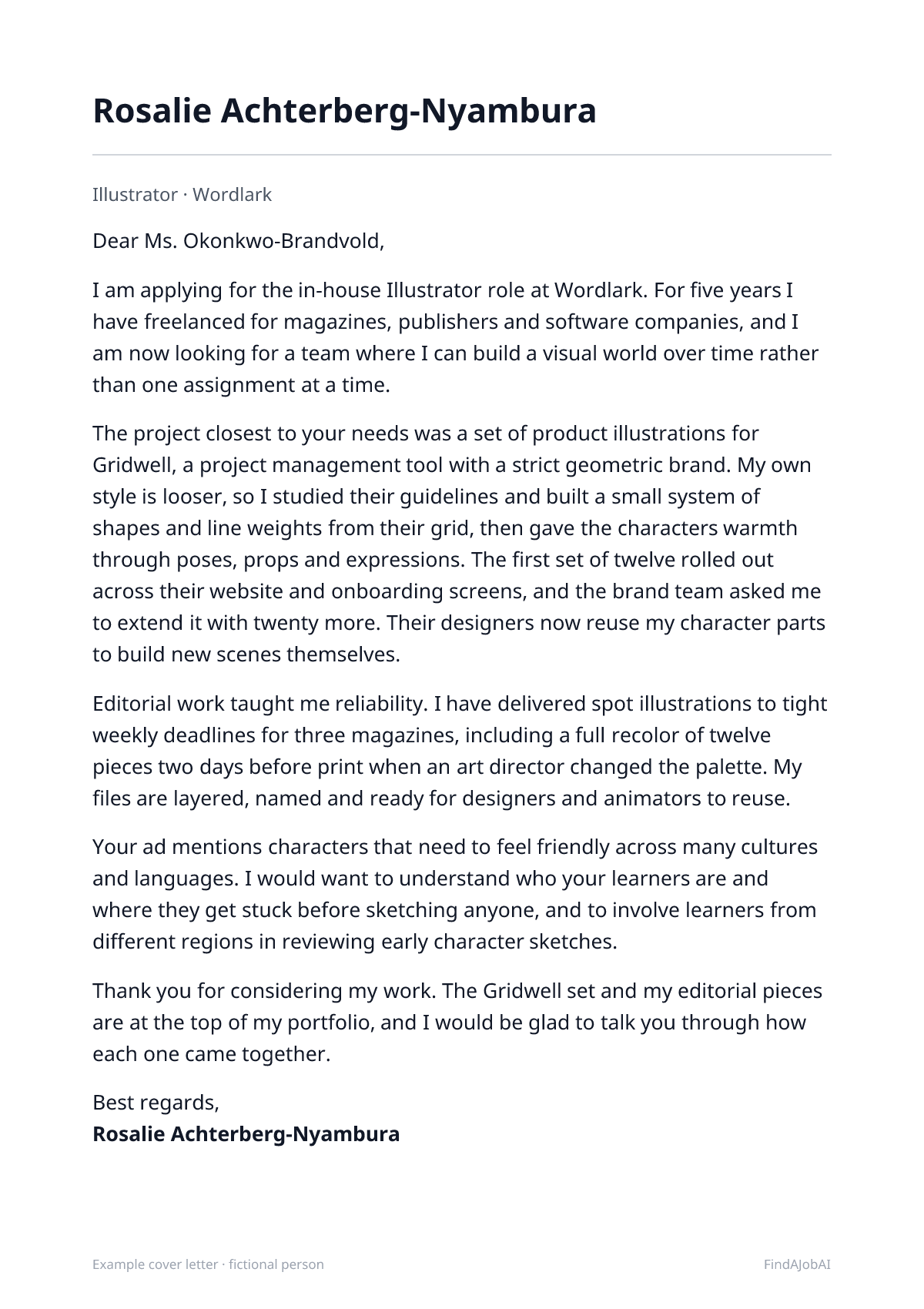
Illustrator cover letter template
This letter as a one-page template: an opening that names the job and your strongest fact, proof that answers the ad, a reason for this employer and a short close.
After you sign up, FindAJobAI drafts your own letter for a real job from your CV in this format, and you edit it before you send it.
Example 1 · Experienced
Editorial and brand illustrator applying to an in-house role
Rosalie has freelanced for magazines and tech brands for five years. The ad is for an in-house illustrator at a language-learning app.
Example letter · fictional
Dear Ms. Okonkwo-Brandvold,
I am applying for the in-house Illustrator role at Wordlark. For five years I have freelanced for magazines, publishers and software companies, and I am now looking for a team where I can build a visual world over time rather than one assignment at a time.
The project closest to your needs was a set of product illustrations for Gridwell, a project management tool with a strict geometric brand. My own style is looser, so I studied their guidelines and built a small system of shapes and line weights from their grid, then gave the characters warmth through poses, props and expressions. The first set of twelve rolled out across their website and onboarding screens, and the brand team asked me to extend it with twenty more. Their designers now reuse my character parts to build new scenes themselves.
Editorial work taught me reliability. I have delivered spot illustrations to tight weekly deadlines for three magazines, including a full recolor of twelve pieces two days before print when an art director changed the palette. My files are layered, named and ready for designers and animators to reuse.
Your ad mentions characters that need to feel friendly across many cultures and languages. I would want to understand who your learners are and where they get stuck before sketching anyone, and to involve learners from different regions in reviewing early character sketches.
Thank you for considering my work. The Gridwell set and my editorial pieces are at the top of my portfolio, and I would be glad to talk you through how each one came together.
Best regards,
Rosalie Achterberg-Nyambura
Example 2 · Career changer
Primary school teacher moving into children's illustration
Florentin taught primary school for eight years and illustrated classroom materials and two books. The ad is for a junior illustrator at an education publisher.
Example letter · fictional
Dear Acornway Art Team,
I am writing to apply for the Junior Illustrator role at Acornway Learning. I have taught primary school for eight years, and for most of that time I have been illustrating the materials my pupils actually use.
It began with phonics cards. The printed sets we had were dull and confusing for children learning English as an additional language, so I drew my own set of sixty cards with clear characters and simple scenes. Other teachers asked for copies, and the cards are now used across all six classes in our school. Reading assessments in my class improved that year, though I know many things contributed. The head teacher later asked me to illustrate our school's reading scheme for younger pupils.
Since then I have illustrated two short picture books that I self-published, taken an evening course in digital illustration, and moved my workflow to Procreate and Photoshop with print-ready files. I understand bleed, color profiles and layered delivery, though I am still building speed for commercial deadlines, and I practise timed briefs every weekend to improve.
What I bring is a clear sense of how children read pictures. I have watched hundreds of them react to images, and I know when a drawing helps a child understand and when it distracts. Teachers and parents also need to understand the images quickly, which shapes how I compose a page.
My portfolio includes the phonics cards and both books. I would welcome the chance to show you how I tested the cards with pupils and changed them based on what confused them.
Kind regards,
Florentin Mbatha-Ellingsen
Example 3 · Senior or lead
Senior illustrator applying to lead an illustration team
Bartholomew leads illustration at a games studio. The ad seeks an illustration lead to build a style guide and team at a children's media company.
Example letter · fictional
Dear Mr. Achebe-Lindqvist,
I am applying for the Illustration Lead role at Puddlestone Media. For six years I have led a team of five illustrators at Kitefield Games, where we create characters, environments and marketing art for family-friendly mobile games played by several million people in more than thirty countries.
Your ad mentions inconsistent artwork across shows, books and apps. We had the same problem when our team doubled in a year. I wrote an illustration style guide with character sheets, palettes, line rules and examples of right and wrong, and I set up weekly critiques where everyone reviewed work side by side. Revision rounds with our art director fell noticeably, and new illustrators produced on-model art within their first month. The guide is now a living document that the whole team updates as characters change.
I also introduced a simple pipeline for handing layered files to animators and designers, which removed most of the rework between teams and cut the time from final art to animated scene by several days. Two illustrators I mentored now lead their own game projects.
I have not worked on broadcast animation or picture books, and I expect their schedules and formats to differ from games. I would spend my first weeks with your show and publishing teams before changing any processes or guidelines. A style guide only works when the people using it helped shape it.
I would enjoy hearing which of your characters the team feels proudest of, and where consistency is hardest to keep across formats.
Sincerely,
Bartholomew Oyelaran-Sundqvist
All three letters, and the short version below, are fictional: the people, employers and numbers are invented. Borrow the structure, never the facts.
- Prefer to write it yourself? Use the free cover letter template.
- Check your CV against the job first: the free CV score shows the missing keywords.
Why the first letter works, paragraph by paragraph
Paragraph 1: Opening
Explains why the writer wants an in-house role, which answers a common worry about freelancers settling into a team.
Paragraph 2: Brand set story
Shows the ability to adapt a personal style to strict brand rules, with a clear outcome and a follow-up order.
Paragraph 3: Reliability paragraph
Proves deadlines and production habits, which matter as much as style to an in-house team.
Paragraph 4: Why this company
Picks up the ad's cross-cultural characters and promises to learn about users before drawing.
Paragraph 5: Close
Points to the exact portfolio pieces, so the art director can check the claims in seconds.
What the career changer's letter does differently
The career changer turns teaching into evidence: illustrated materials adopted across a school, two books and real production knowledge. Modest claims about results and an honest note on speed make the switch credible.
What the senior letter does differently
A lead letter should show how the writer raises a team's quality and consistency: a style guide, critique habits, a smoother pipeline and people who grew. Admitting no broadcast experience shows a lead who plans to listen first.
Short illustrator cover letter: an email-ready version
Many applications arrive as an email or a small text box, and a full page doesn't fit. This version runs 120 to 150 words and keeps only what a reader needs to decide whether to reply. An illustrator replies to an art director's post on a design forum looking for a freelancer for a book cover series.
Short version · email · fictional125 words
Subject: Freelance illustrator – book cover series – Anouk Delacroix-Mensah
Hi Ms. Vandermeer-Osei,
I saw your post this week for Hearthpage Press looking for an experienced illustrator for a series of book covers. Over the last four years I have illustrated eighteen covers for independent publishers, mostly mystery and middle-grade fiction for readers in the UK and Germany.
For one publisher I created a five-book series with a shared palette and lettering space, and the editor told me booksellers placed the set together on display tables because the covers worked so well as a group on the shelf.
My portfolio link is below, with the five-book series near the top of the page. I can start sketches early next month and am free for a call most weekday mornings, Central European time.
Thanks,
Anouk Delacroix-Mensah
An art director with many replies needs relevance and availability quickly. This email names closely related cover work, one series result and a start date.
Opening lines that work for illustrator cover letters
The first sentence decides whether the second gets read. Here are six openings, one for each situation you might be in. Pick the one that matches yours and swap in your own facts: every name and number below is invented.
1. You have a standout result
Last year I built a character system for a software brand that rolled out across its website and onboarding. I would love to create a visual world like that for your learners.
2. The ad names a problem you've solved
Your ad mentions friendly characters for learners in many countries. Designing characters that feel welcoming across cultures is the work I enjoy most.
3. Someone referred you
Your art director, Mireille Oduya, saw my editorial pieces in a design annual and suggested I apply for this role.
4. You admire what they build
I have followed your picture books for years and use two of them with my pupils every term.
5. You're new to the field or switching into it
After eight years illustrating classroom materials as a primary teacher, I want to illustrate children's books full time.
6. You have senior scope or a specialism
I lead a team of five illustrators on family games and am looking to build an illustration style guide and team for children's media.
How to write an illustrator cover letter
Five steps, in the order you'd write them. The shape stays the same for every job (a short opening, proof, a reason for this employer, a close), and what goes into each part is what changes with the role.
Match one project to their audience
Look at the company's existing illustrations, audience and channels, then choose the project from your portfolio that comes closest in tone or purpose. Name it in the letter and explain briefly why it fits, so the art director sees the connection immediately.
Explain how you read the brief
In a few sentences, describe how you interpreted the brief, what you asked the client, and the idea you chose. This shows that you think about communication and audience, not just how an image looks on the screen.
Show you handle feedback well
Busy art directors want illustrators who take feedback calmly, quickly and without drama. Mention a late change or critique you handled, what you did, and how the result improved, without making it sound like a complaint.
Prove you are reliable
Mention deadlines you met, the volume you delivered under pressure and how you prepare files, such as layered artwork, print-ready settings or animation-ready layers. Reliability is often what separates a hired illustrator from an admired one.
Point to the right portfolio pieces
End by naming the pieces that match your letter and where they sit in your portfolio, then offer to talk through your process on a call. Keep the closing short, warm and specific to the company.
Illustrator cover letter do's and don'ts
Do
- Name one project close to the company's style or audience.
- Show reliability with deadlines and production details.
- Point to the exact portfolio pieces you mention.
Don't
- Don't describe your style with vague adjectives only.
- Don't ignore the brand or audience in the ad.
- Don't forget to mention how you handle feedback.
Common illustrator cover letter mistakes
Each one is easy to make and quick to fix before you send the letter.
Letting the portfolio do all the talking
The letter should explain fit, process and reliability, which the images cannot show alone.
Describing your style only with adjectives
Words like whimsical or bold say little. Describe a brief and how your style served it.
Ignoring the client's existing look
Mention their brand or past work and how you would fit in or extend it.
Leaving out production skills
Mention file preparation, formats and deadlines, which in-house teams care about.
Sounding unsure about rights
If relevant, show you understand usage and licensing in a sentence, which builds trust with clients.
Email subject lines for illustrator applications
Applying by email? Put the job title, any reference number and your name in the subject line.
- Illustrator application – brand character systems and editorial work – Rosalie Achterberg-Nyambura
- Junior Illustrator – teacher with classroom and picture book work – Florentin Mbatha-Ellingsen
- Application: In-house Illustrator (Ref. 1846) – Rosalie Achterberg-Nyambura
Everything for Illustrators
- Illustrator resume exampleA full resume, plus bullet and summary examples
- Illustrator interview questions30 questions with sample answers
- Illustrator job descriptionDuties, skills and requirements
- Career change cover letter: template + examples
Other cover letter examples
Illustrator cover letter FAQ
What should an illustrator cover letter include?
One relevant project, how you interpreted the brief, how you handled feedback and the outcome. Add a line on reliability with deadlines and files, and link to the matching portfolio pieces.
Do illustrators need a cover letter?
For in-house roles and many studio jobs, yes. The portfolio shows your art, while the letter shows fit, reliability and how you work with art directors.
Should freelancers mention clients by name?
Yes, if the work is public and your contract allows it. Named clients and published work help art directors trust your experience.
How we built this page
The FindAJobAI team wrote the three example letters, the short email version, the opening lines and the advice for illustrator roles. The people, employers and numbers in the letters are invented; the structure, the kind of evidence and the order of the paragraphs are the parts to copy.
Once we track enough live illustrator job ads, this page also shows the skills they ask for most, counted the same way as our in-demand skills report.
Last reviewed on November 1, 2026.