Instructional Designer Cover Letter Example (2026)
By FindAJobAI team Updated How we built this page
Instructional designer ads ask for a learning model and an authoring tool almost interchangeably, so the cover letter is where you show the problem you actually solved: what people couldn't do before your course, what they could do after, and how you knew.
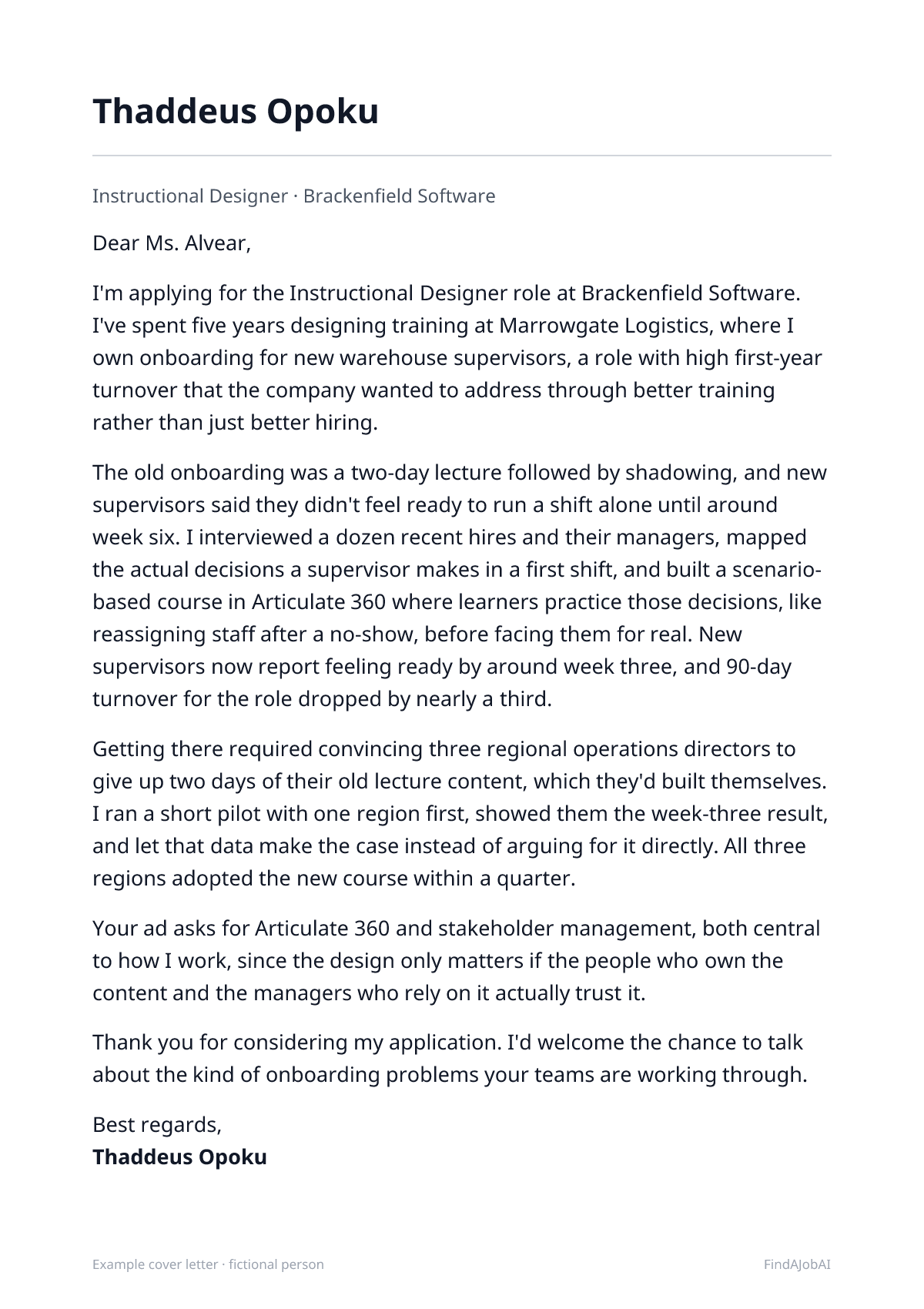
Instructional Designer cover letter template
This letter as a one-page template: an opening that names the job and your strongest fact, proof that answers the ad, a reason for this employer and a short close.
After you sign up, FindAJobAI drafts your own letter for a real job from your CV in this format, and you edit it before you send it.
Example 1 · Experienced
Corporate instructional designer applying to a software company
Thaddeus redesigned new-hire onboarding at a logistics company. The ad asks for Articulate 360 and stakeholder management experience.
Example letter · fictional
Dear Ms. Alvear,
I'm applying for the Instructional Designer role at Brackenfield Software. I've spent five years designing training at Marrowgate Logistics, where I own onboarding for new warehouse supervisors, a role with high first-year turnover that the company wanted to address through better training rather than just better hiring.
The old onboarding was a two-day lecture followed by shadowing, and new supervisors said they didn't feel ready to run a shift alone until around week six. I interviewed a dozen recent hires and their managers, mapped the actual decisions a supervisor makes in a first shift, and built a scenario-based course in Articulate 360 where learners practice those decisions, like reassigning staff after a no-show, before facing them for real. New supervisors now report feeling ready by around week three, and 90-day turnover for the role dropped by nearly a third.
Getting there required convincing three regional operations directors to give up two days of their old lecture content, which they'd built themselves. I ran a short pilot with one region first, showed them the week-three result, and let that data make the case instead of arguing for it directly. All three regions adopted the new course within a quarter.
Your ad asks for Articulate 360 and stakeholder management, both central to how I work, since the design only matters if the people who own the content and the managers who rely on it actually trust it.
Thank you for considering my application. I'd welcome the chance to talk about the kind of onboarding problems your teams are working through.
Best regards,
Thaddeus Opoku
Example 2 · Career changer
High school teacher moving into instructional design
Rosalind built a well-used curriculum unit as a teacher and wants to design training full time. The ad accepts candidates without corporate L&D experience.
Example letter · fictional
Dear Hiring Manager,
I'm applying for the Instructional Designer role at Hearthstone Learning Co. I've taught high school biology for seven years, and I'm writing to you because the part of teaching I care about most, designing material that actually changes what a learner can do, is the whole job at your company.
Two years ago my department's genetics unit was failing half the class on the unit test. I rewrote it around a single driving question, broke it into short practice cycles with immediate feedback instead of one big lecture block, and added a diagnostic quiz at the start so students could skip material they already knew. Failing rates on that unit test fell from about 48% to under 15%, and three other teachers in my department have since adopted the redesign.
Since deciding to move into corporate learning, I've completed a course in instructional design using the ADDIE model, built a sample e-learning module in Articulate Rise based on a workplace safety topic, and am comfortable writing learning objectives that can actually be measured, not just listed.
Your posting says you're open to designers from teaching backgrounds who understand how adults actually learn new material under time pressure, which describes exactly what seven years in a classroom taught me, even without the corporate vocabulary.
Thank you for your time. My sample module is linked on my resume, and I'd welcome a conversation about your team's current projects. I can also send the genetics unit's practice-cycle map, with student data removed, to show how I sequence feedback.
Sincerely,
Rosalind Vantongeren
Example 3 · Senior or lead
Learning lead applying to build a first L&D function
Marguerite manages three designers at a bank. The ad is for a learning lead who will set standards and build the team from the ground up.
Example letter · fictional
Dear Mr. Obiakor,
I'm applying for the Learning and Development Lead role at Ferncastle Financial. I've managed a team of three instructional designers at Hollyoak Bank for the past three years, and before that spent six years designing compliance and product training, and I'd like to build a learning function from its earliest stage.
Your ad says every department currently builds its own training with no shared standard, which was true at Hollyoak when I joined. I wrote a short design standard covering learning objectives, assessment and a maximum course length, got three department heads to pilot it on their next project, and used the pilot results to get the standard adopted company-wide. The backlog of 'urgent' training requests, which had been treated as equally urgent regardless of actual business impact, is now triaged against a simple risk and frequency scale my team built together.
The project I'm proudest of is a redesign of our anti-money-laundering training, which staff treated as an annual formality to click through. I replaced it with scenario-based decisions drawn from real flagged cases, with identifying details removed, and built in a short practical assessment instead of a quiz. Staff who completed the new version flagged suspicious transactions correctly in testing at a noticeably higher rate than those who'd only done the old version, and compliance adopted it as the new standard.
I haven't built a learning function from zero, including vendor contracts and a learning management system, and at Ferncastle I'd expect to work closely with your technology and procurement teams on that part.
A conversation about which three training problems your departments complain about most, and how training requests reach your team today, would be a good place to start.
Sincerely,
Marguerite Delacroix-Sowah
All three letters, and the short version below, are fictional: the people, employers and numbers are invented. Borrow the structure, never the facts.
- Prefer to write it yourself? Use the free cover letter template.
- Check your CV against the job first: the free CV score shows the missing keywords.
Why the first letter works, paragraph by paragraph
Paragraph 1: Opening
Names the specific population served (new warehouse supervisors) and the business problem (turnover) that training was meant to solve, which frames the writer as solving a business issue, not just producing content.
Paragraph 2: The redesign and its result
States the old approach, the research done (interviews, mapping real decisions), the specific tool and method (scenario-based design in Articulate 360), and two measurable outcomes in the company's own terms: time to readiness and turnover.
Paragraph 3: Working with stakeholders
Shows how the writer got buy-in from people who owned the old content, using a small pilot and data rather than argument, which is the real skill behind 'stakeholder management.'
Paragraph 4: Matching the ad's requirements
Directly names the tool and skill from the ad and explains why both matter in practice, rather than just confirming possession of them.
Paragraph 5: Close
Invites a conversation about the employer's actual problems rather than restating interest generically.
What the career changer's letter does differently
The career changer's letter opens from a real teaching result with a measurable before-and-after (failing rates from about 48% to under 15%), since that's the strongest evidence available without corporate experience. It names the formal model (ADDIE) and a self-built sample module to show the skills are now deliberate, and closes by matching the ad's own stated openness to teaching backgrounds directly to the writer's seven years in a classroom.
What the senior letter does differently
A learning lead letter reports organizational habits, not just one course: a design standard adopted company-wide, a triage system replacing an undifferentiated backlog, and a scenario-based compliance redesign measured against the version it replaced. The gap, building a function from zero, is named rather than glossed over.
Short instructional designer cover letter: an email-ready version
Many applications arrive as an email or a small text box, and a full page doesn't fit. This version runs 120 to 150 words and keeps only what a reader needs to decide whether to reply. An instructional designer answers a retail company's short-form application after the online portal rejected a longer upload.
Short version · email · fictional129 words
Subject: Instructional Designer (Articulate Rise, retail onboarding) – Fitzgerald Nnamdi
Hello Ms. Castellanos,
I'm applying for the Instructional Designer role at Hazeldown Retail Group. I have four years of experience building e-learning for retail and hospitality staff, most recently a cashier onboarding course built in Articulate Rise.
The course I'm proudest of replaced a 90-minute lecture with short, scenario-based modules practicing actual register situations, like a price mismatch or a declined card. New hires reached full register speed in about half the time the old training took, based on manager sign-off records.
I'd like to bring that same approach to your onboarding. My portfolio is attached, with one module highlighted, and I'm happy to walk through the design choices behind it. I can also show how I wrote the register-practice scenarios and the checklist managers sign.
Best,
Fitzgerald Nnamdi
The short version keeps one redesign with a measurable before-and-after instead of a tool list, and points the reader to a single highlighted portfolio module rather than leaving them to search an entire folder.
Opening lines that work for instructional designer cover letters
The first sentence decides whether the second gets read. Here are six openings, one for each situation you might be in. Pick the one that matches yours and swap in your own facts: every name and number below is invented.
1. You have a standout result
New cashiers at my last company reached full register speed in about half the time the old training took, after I rebuilt onboarding around real register scenarios. I'd like to bring that approach to your team.
2. The ad names a problem you've solved
Your ad says every department builds its own training with no shared standard. At my current bank I wrote a design standard that three departments piloted and then adopted company-wide, and I'd like to help solve that same problem here.
3. Someone referred you
Your operations manager, Casimir Nwachukwu, worked with me on a training redesign at my last company and suggested I apply, since he said your team is rebuilding onboarding from scratch.
4. You admire what they build
I've taken two of your company's public training courses as a customer-facing employee elsewhere, and the clarity of the scenario design is part of why I'm applying to build courses like them myself.
5. You're new to the field or switching into it
I taught high school for seven years and rebuilt a genetics unit that cut failing rates by more than two-thirds. I'd like to apply that same kind of redesign work to adult learners full time.
6. You have senior scope or a specialism
As a learning and development lead for three years, I built the design standard my company's departments still use. I'm looking for a role where setting that standard is the job, not an extra project.
How to write an instructional designer cover letter
Five steps, in the order you'd write them. The shape stays the same for every job (a short opening, proof, a reason for this employer, a close), and what goes into each part is what changes with the role.
Open with the learner population and the business problem
New hires, compliance staff, customers, or managers each need different design choices. Name who the course was for and the business reason it existed, such as turnover, errors, or a compliance requirement, so the reader sees a problem solved, not just content produced.
Describe the before-and-after, not the course structure
Say what learners couldn't do before the course and could do after, with a way you measured it, such as time to competency, error rate, or assessment scores. Save the module count and structure for your portfolio, not the letter's first paragraph.
Name your learning model and authoring tool inside the story
ADDIE, SAM, Articulate 360, Rise, or Captivate are more convincing attached to a specific project than listed on their own. State how you used the model or tool to solve the particular problem you're describing, not as a general skill.
Show how you worked with the people who owned the content
Subject matter experts, department heads, or compliance officers often resist giving up material they built. Describe one way you earned their trust, such as a small pilot, a shared standard, or showing results before asking for a bigger change.
Close by naming a problem you'd want to work on first
Mention a training challenge from the ad or the company's public materials you'd want to dig into early. This shows you read the posting closely and gives the reader something concrete to respond to in an interview.
Instructional Designer cover letter do's and don'ts
Do
- Name the gap between what learners could do before and after your course, and how you measured it.
- Mention the authoring tool and learning model the ad names (Articulate 360, Rise, ADDIE, SAM) inside a specific project.
- Describe how you got a subject matter expert or stakeholder to trust a design they didn't build themselves.
Don't
- Don't list every tool you've opened once; name the one the ad uses and the project where you used it well.
- Don't describe your work as 'creating engaging content'; show the decision a learner couldn't make before and can now.
- Don't share a current employer's internal training materials or proprietary content as a sample.
Common instructional designer cover letter mistakes
Each one is easy to make and quick to fix before you send the letter.
Describing course structure instead of learner outcomes
'Built a six-module course with knowledge checks' tells the reader about your process, not your impact. State what learners could do differently afterward and how you know.
Listing every authoring tool you've opened
A row of Articulate, Captivate, Rise and Lectora suggests shallow use of each. Name the one the ad uses and the project where you used it to solve a real problem.
Leaving a measurable claim without its baseline
'Reduced training time' means little without the starting point and how it was measured. State what the old approach took, what changed, and how you tracked the difference.
Skipping how you worked with subject matter experts
A letter that is all design theory misses the real difficulty: getting buy-in from people who already own the content. Name one way you earned that trust.
Writing 'passionate about adult learning' as the reason
It's what most applicants write. Replace it with a specific project or result that shows the interest rather than stating it.
Email subject lines for instructional designer applications
Applying by email? Put the job title, any reference number and your name in the subject line.
- Instructional Designer application – Articulate 360, onboarding redesign – Thaddeus Opoku
- Instructional Designer – teacher background, ADDIE certificate – Rosalind Vantongeren
- Application: Instructional Designer, L&D team (Req. 2240) – Thaddeus Opoku
Everything for Instructional Designers
- Instructional Designer resume exampleA full resume, plus bullet and summary examples
- Instructional Designer interview questions30 questions with sample answers
- Instructional Designer job descriptionDuties, skills and requirements
- Career change cover letter: template + examples
Other cover letter examples
Instructional Designer cover letter FAQ
What should I write in an instructional designer cover letter?
One course or module you built: the problem, the learning model or tool you used, and the measurable change in what learners could do afterward. Then one sentence on how you worked with a subject matter expert or stakeholder who owned the content.
How do I write an instructional designer cover letter with no corporate experience?
Use a curriculum, training or onboarding project from teaching, retail or another role, with a measurable result. Add a certificate in a learning model like ADDIE and a sample module you built yourself, and name the tool you used for it.
Should I include a portfolio link in an instructional design cover letter?
Yes, if it has one or two strong, well-explained samples. Say in one sentence what to look at and why, since reviewers rarely explore an unguided portfolio on their own.
How we built this page
The FindAJobAI team wrote the three example letters, the short email version, the opening lines and the advice for instructional designer roles. The people, employers and numbers in the letters are invented; the structure, the kind of evidence and the order of the paragraphs are the parts to copy.
Once we track enough live instructional designer job ads, this page also shows the skills they ask for most, counted the same way as our in-demand skills report.
Last reviewed on November 1, 2026.