Journalist Cover Letter Example (2026)
By FindAJobAI Team Updated How we built this page
Editors read journalist cover letters the way they read a pitch: does the writer have a story, can they get it, and do they know this publication's audience? The strongest letters lead with one piece of reporting, how it was done and what followed, then show they have already studied the beat they want.
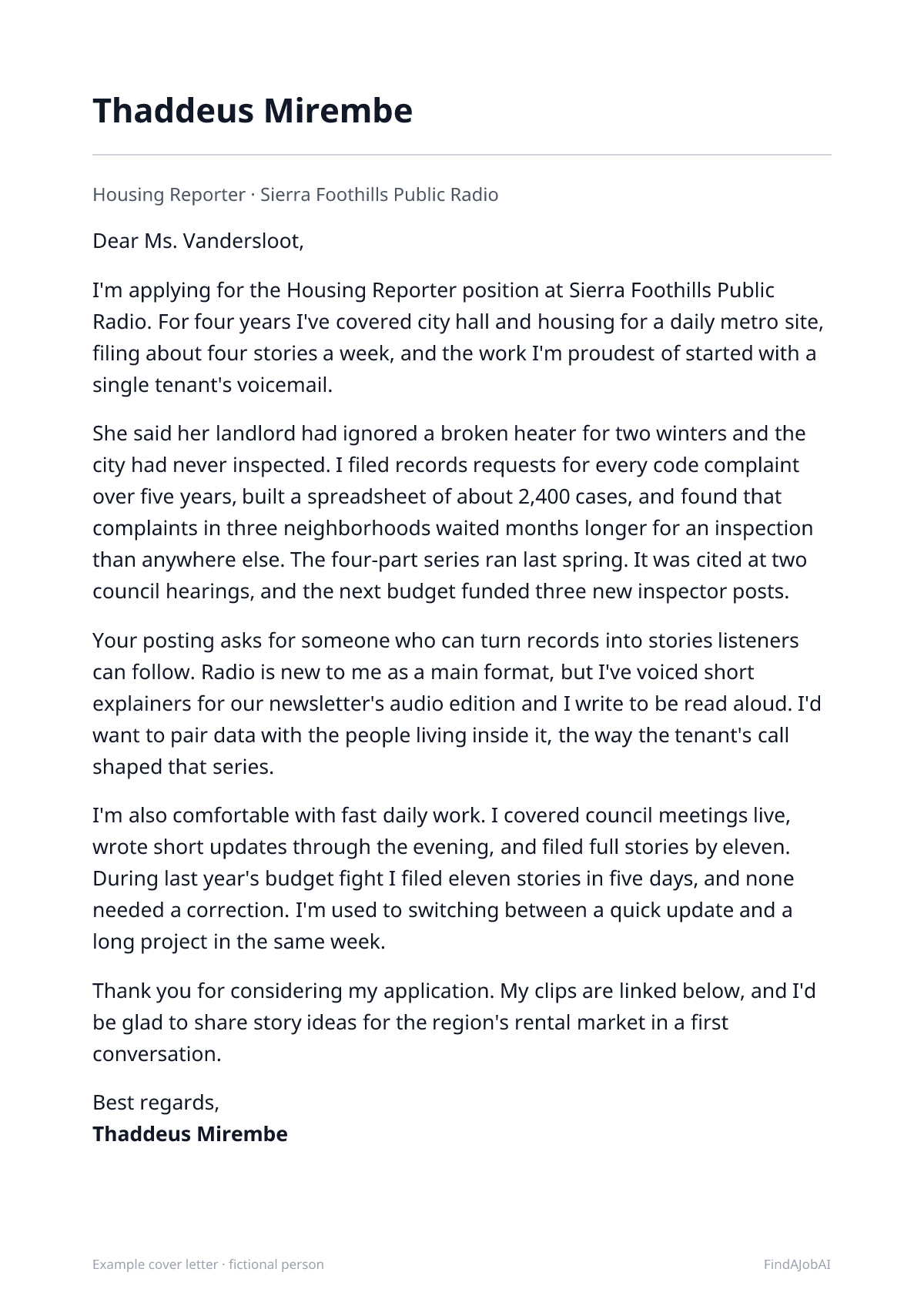
Journalist cover letter template
This letter as a one-page template: an opening that names the job and your strongest fact, proof that answers the ad, a reason for this employer and a short close.
After you sign up, FindAJobAI drafts your own letter for a real job from your CV in this format, and you edit it before you send it.
Example 1 · Experienced
Metro reporter applying for a regional housing beat
Thaddeus covers city hall for a daily site. The regional outlet wants a housing reporter who can work with public records and data.
Example letter · fictional
Dear Ms. Vandersloot,
I'm applying for the Housing Reporter position at Sierra Foothills Public Radio. For four years I've covered city hall and housing for a daily metro site, filing about four stories a week, and the work I'm proudest of started with a single tenant's voicemail.
She said her landlord had ignored a broken heater for two winters and the city had never inspected. I filed records requests for every code complaint over five years, built a spreadsheet of about 2,400 cases, and found that complaints in three neighborhoods waited months longer for an inspection than anywhere else. The four-part series ran last spring. It was cited at two council hearings, and the next budget funded three new inspector posts.
Your posting asks for someone who can turn records into stories listeners can follow. Radio is new to me as a main format, but I've voiced short explainers for our newsletter's audio edition and I write to be read aloud. I'd want to pair data with the people living inside it, the way the tenant's call shaped that series.
I'm also comfortable with fast daily work. I covered council meetings live, wrote short updates through the evening, and filed full stories by eleven. During last year's budget fight I filed eleven stories in five days, and none needed a correction. I'm used to switching between a quick update and a long project in the same week.
Thank you for considering my application. My clips are linked below, and I'd be glad to share story ideas for the region's rental market in a first conversation.
Best regards,
Thaddeus Mirembe
Example 2 · Career changer
Teacher moving into education reporting
Henrietta taught middle school science for seven years and freelanced education essays. The ad is for an entry-level education reporter.
Example letter · fictional
Dear Education Desk Editor,
I'm writing to apply for the Education Reporter role at The Cumberland Dispatch. I've taught middle school science in public schools for seven years, and for the last two I've written freelance pieces about education policy for a state teachers' magazine and a regional news site.
My most-read piece looked at why our district's new science curriculum arrived without lab materials. I interviewed eleven teachers at five schools, requested the purchasing records, and found that the materials budget had been moved to a software contract. The district restored part of the lab budget the following term, and the editor asked me for two more pieces on school spending.
I know the ground your education reporter covers. I can read a school board budget, I know what a state test score release does and doesn't show, and parents and teachers already talk to me openly. What I'm still building is daily news speed, so this year I've been covering school board meetings on my own and filing short stories within two hours to practice. I've covered nine meetings this way, and a local news site published three of those stories with light edits. I'd expect your editors to push me on pace, and I'd welcome it.
I've also completed an online course on public records and data basics, and I'm comfortable with Google Sheets and Datawrapper charts.
Thank you for reading. I've linked four clips and would welcome the chance to talk about coverage of the district's budget vote next spring.
Kind regards,
Henrietta Szabo
Example 3 · Senior or lead
Investigative reporter applying to lead an investigations team
Wilhelmina has led project teams at a public media newsroom. The ad is for an editor to build a small investigations unit.
Example letter · fictional
Dear Mr. Castellucci,
I'm applying for the Investigations Editor position at Great Lakes Civic News. For eleven years I've reported on health, courts and public spending, and for the last five I've led three-person project teams at a public media newsroom from the first records request through legal review.
Our largest project examined staffing at about 700 nursing homes using six years of state inspection records. I set the records strategy, split the analysis between a data reporter and myself, and ran weekly story meetings so the reporting never outran the evidence. The series prompted two state audits and a staffing disclosure bill that passed committee last year.
Your posting says the unit will be new and small. I've learned that small teams succeed when every project has a clear question, a records plan and an exit point if the evidence isn't there. I'd bring that structure, along with a fact-check memo process that has carried every one of my projects through legal review without a correction.
I've mentored about four early-career reporters a year, and two now cover investigations full time. I haven't hired a team from scratch, which I'd want to approach carefully with your managing editor. I'd look for one reporter with strong records instincts and one with data skills, since those two together carried every project I've led. I'd also want early agreement on how the unit shares its work with the daily desk, so investigations feed the newsroom rather than sit apart from it.
I'd welcome a conversation about the unit's first two projects and the records the region still keeps closed.
Sincerely,
Wilhelmina Ashdown
All three letters, and the short version below, are fictional: the people, employers and numbers are invented. Borrow the structure, never the facts.
- Prefer to write it yourself? Use the free cover letter template.
- Check your CV against the job first: the free CV score shows the missing keywords.
Why the first letter works, paragraph by paragraph
Paragraph 1: Opening
States the beat, the pace and a hook in two sentences, so the editor knows what kind of reporter is writing before the first story begins.
Paragraph 2: The investigation
Tells one story the way an editor would want it pitched: tip, records, data, finding and result after publication, all checkable.
Paragraph 3: Answering the format gap
Admits radio is new, then gives concrete evidence of audio work and a plan for blending data with people.
Paragraph 4: Daily speed
A short paragraph proves the writer can also file fast, which matters because regional desks need both modes.
Paragraph 5: Close
Points to clips and offers story ideas for the outlet's own region, which is how editors like a first conversation to start.
What the career changer's letter does differently
The teacher's letter turns classroom knowledge into a reporting advantage, then proves it with a freelance story that used interviews and purchasing records and led to a budget change. The gap, daily news speed, is named plainly with what the writer is doing to close it.
What the senior letter does differently
An editor-level letter shows leadership through how projects are run: a records strategy, split analysis, weekly meetings and a fact-check memo. Results stay concrete, two audits and a bill, and the honest gap about hiring is paired with a sensible approach.
Short journalist cover letter: an email-ready version
Many applications arrive as an email or a small text box, and a full page doesn't fit. This version runs 120 to 150 words and keeps only what a reader needs to decide whether to reply. A freelance journalist emails a pitch and application to a national magazine's features editor after seeing a call for regional contributors.
Short version · email · fictional132 words
Subject: Regional contributor application and pitch: Gulf Coast insurance retreat – Leopold Arceneaux
Dear Ms. Ferreira-Hughes,
I'm responding to your call for regional contributors. I'm a freelance journalist based in Louisiana with six years of reporting on insurance, housing and storm recovery for regional papers and public radio.
My pitch: three Gulf Coast parishes have lost most of their private home insurers since 2022, and homeowners now rely on the state insurer of last resort. I have interviews with eight homeowners, two former agents and a state regulator, plus state filing data showing which carriers left each parish and when, and how premiums changed for those who stayed.
I can deliver a fully reported 2,500-word feature within four weeks of a commission. My clips and resume are attached, and I'd be glad to talk through the angle by phone at your convenience.
Best,
Leopold Arceneaux
A freelance pitch email doubles as the application. It gives credentials in one sentence, a specific story with the reporting already done, and a clear delivery promise, which is what a busy features editor needs to say yes.
Opening lines that work for journalist cover letters
The first sentence decides whether the second gets read. Here are six openings, one for each situation you might be in. Pick the one that matches yours and swap in your own facts: every name and number below is invented.
1. You have a standout result
A tenant's voicemail about a broken heater became a four-part series that funded three new city inspectors. I'd like to bring that kind of records-driven reporting to your housing beat.
2. The ad names a problem you've solved
I've covered city council meetings live for four years, filing updates through the evening, and I'm looking for a newsroom where daily speed and long projects both matter.
3. Someone referred you
Your reporter Ingrid Solheim suggested I apply after we covered the same county budget hearing last month.
4. You admire what they build
Seven years teaching middle school science taught me how school budgets really work, and I'd like to report on them full time for your readers.
5. You're new to the field or switching into it
I've read your newsroom's coverage of the river cleanup for two years, and I've noticed one piece missing: who is paying for it.
6. You have senior scope or a specialism
After eleven years reporting and five leading project teams, I'd like to build an investigations unit that picks fewer stories and finishes every one.
How to write a journalist cover letter
Five steps, in the order you'd write them. The shape stays the same for every job (a short opening, proof, a reason for this employer, a close), and what goes into each part is what changes with the role.
Study the outlet's coverage before writing
Read a month of the outlet's stories on the beat you want. Note what they cover well and what is missing. Your letter will be stronger if it mentions a specific local issue or gap rather than a general interest in journalism.
Open with your beat and one hook
Give your current beat, your filing pace and one striking detail from a story you reported in the first paragraph. Editors read many letters a week and decide quickly whether a writer has reporting instincts.
Tell one story from tip to result
Describe how a story started, what records, data or interviews you gathered, what you found and what happened after publication. Keep every fact checkable, because a good editor will look it up before calling you.
Address the format or beat gap honestly
If you are moving from print to audio, or from another career into news, say so in one sentence and give evidence you are closing the gap. Editors respect a clear plan more than a claim that there is no gap at all.
Close with clips and a story direction
Link two to four clips that match the job, then end with one sentence about a story you would want to pursue for them. That gives the editor a reason to call and a topic for the conversation.
Journalist cover letter do's and don'ts
Do
- Lead with one story you reported: how you found it, what you obtained and what happened after.
- Show you know the outlet's coverage area and audience by naming a local issue you would pursue.
- Link clips and mention the two or three that best match the beat.
Don't
- Don't open with how you have loved writing since childhood; editors want reporting, not motivation.
- Don't list every outlet you have written for; choose the work that fits this beat.
- Don't promise exclusive sources or scoops you cannot deliver.
Common journalist cover letter mistakes
Each one is easy to make and quick to fix before you send the letter.
Writing about a love of storytelling
Editors want evidence of reporting. Replace the passion paragraph with one story and the work behind it.
Sending a generic letter to every newsroom
Each outlet covers different issues for different readers. Mention its coverage area and one story you would pursue there.
Overstating impact
Say exactly what happened after your story ran, such as a hearing or audit, and avoid claiming credit for outcomes others shaped.
Forgetting clips
A letter without links forces the editor to search for your work. Put two to four relevant clips in the letter or signature.
Ignoring daily news pace
Even investigative roles need fast work at times. Show one example of filing quickly on deadline.
Email subject lines for journalist applications
Applying by email? Put the job title, any reference number and your name in the subject line.
- Housing Reporter application – records-based rental series – Thaddeus Mirembe
- Education Reporter – former science teacher with published education clips – Henrietta Szabo
- Application: Investigations Editor (Ref. NEWS-118) – Thaddeus Mirembe
Everything for Journalists
- Journalist resume exampleA full resume, plus bullet and summary examples
- Journalist interview questions30 questions with sample answers
- Journalist job descriptionDuties, skills and requirements
- Career change cover letter: template + examples
Other cover letter examples
Journalist cover letter FAQ
What should a journalist cover letter include?
One story you reported with its method and result, proof that you know the outlet's beat and audience, a note on your daily pace, and a link to clips. Keep it to about four short paragraphs.
How do I write a journalism cover letter without newsroom experience?
Use freelance pieces, campus media or expertise from another career. Describe one story with real reporting behind it and show how your background helps you cover the beat.
Should a journalist cover letter include story ideas?
One or two short ideas for the outlet's coverage area can help, especially at a final line. Keep them brief and grounded in something you have already noticed or reported.
How we built this page
The FindAJobAI team wrote the three example letters, the short email version, the opening lines and the advice for journalist roles. The people, employers and numbers in the letters are invented; the structure, the kind of evidence and the order of the paragraphs are the parts to copy.
Once we track enough live journalist job ads, this page also shows the skills they ask for most, counted the same way as our in-demand skills report.
Last reviewed on November 1, 2026.