Legal Researcher Cover Letter Example (2026)
By FindAJobAI Team Updated How we built this page
A legal researcher's cover letter is itself a writing sample. Hiring attorneys read it for precision, structure and judgment before they read the resume. Show the kinds of questions you answer, how fast you answer them, how you check that authority is still good law and one piece of research that changed how a matter was handled.
Legal Researcher cover letter template
This letter as a one-page template: an opening that names the job and your strongest fact, proof that answers the ad, a reason for this employer and a short close.
After you sign up, FindAJobAI drafts your own letter for a real job from your CV in this format, and you edit it before you send it.
Example 1 · Experienced
Litigation firm researcher applying to an appellate boutique
Perpetua writes about 25 research memos a month for a litigation firm. The ad is for a legal researcher at a small appellate practice.
Example letter · fictional
Dear Mr. Abernathy-Kowalski,
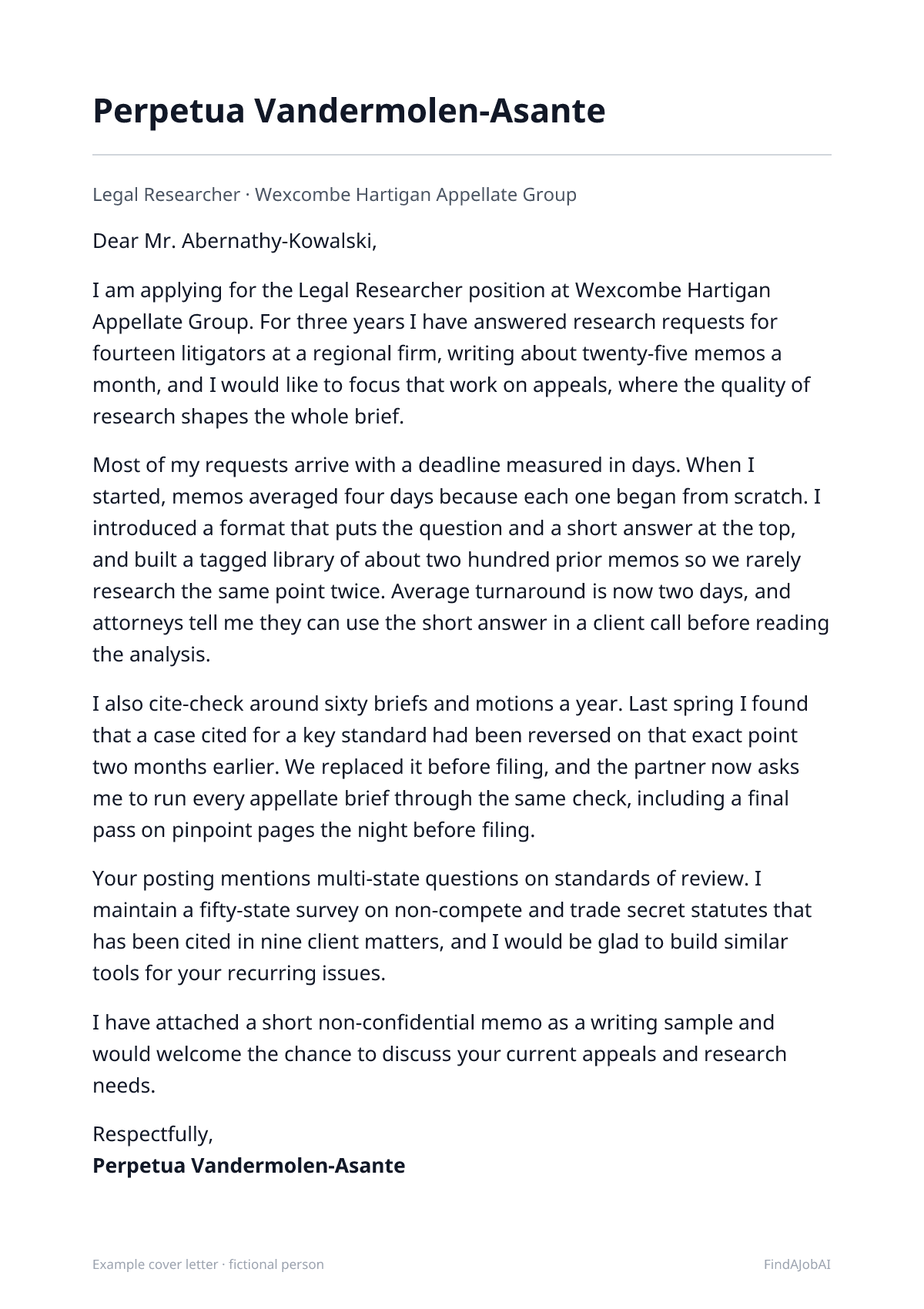
I am applying for the Legal Researcher position at Wexcombe Hartigan Appellate Group. For three years I have answered research requests for fourteen litigators at a regional firm, writing about twenty-five memos a month, and I would like to focus that work on appeals, where the quality of research shapes the whole brief.
Most of my requests arrive with a deadline measured in days. When I started, memos averaged four days because each one began from scratch. I introduced a format that puts the question and a short answer at the top, and built a tagged library of about two hundred prior memos so we rarely research the same point twice. Average turnaround is now two days, and attorneys tell me they can use the short answer in a client call before reading the analysis.
I also cite-check around sixty briefs and motions a year. Last spring I found that a case cited for a key standard had been reversed on that exact point two months earlier. We replaced it before filing, and the partner now asks me to run every appellate brief through the same check, including a final pass on pinpoint pages the night before filing.
Your posting mentions multi-state questions on standards of review. I maintain a fifty-state survey on non-compete and trade secret statutes that has been cited in nine client matters, and I would be glad to build similar tools for your recurring issues.
I have attached a short non-confidential memo as a writing sample and would welcome the chance to discuss your current appeals and research needs.
Respectfully,
Perpetua Vandermolen-Asante
Example 2 · Entry level
New law graduate applying for a first legal researcher role
Benedikt finished his J.D. this spring after a year as a law library research assistant. The ad is for an entry-level researcher at a legal publisher.
Example letter · fictional
Dear Dr. Tremaine-Hollis,
I am writing to apply for the entry-level Legal Researcher position at Bellweather Practice Guides. I earned my J.D. this May, and during my final year I worked as a research assistant in the law school library, where I learned that I enjoy finding and explaining the law more than arguing it.
At the library I answered about three hundred research questions from students, faculty and members of the public. Many of them started vague, so I learned to ask what the person actually needed before searching, which often saved an hour of work and pointed us toward a better source. I compiled four annotated bibliographies for faculty articles, covering about 180 sources, and taught six workshops on terms-and-connectors searching to first-year students.
My law review note on tribal water rights cited more than two hundred cases, statutes and treaties, and I spent weeks tracing how one treaty provision had been interpreted over a century. That project taught me patience with primary sources and real care with citation. I also cite-checked five articles a semester for the journal, and editors trusted me with the final citation pass on two lead articles before they went to print.
Your practice guides are used by attorneys who need a reliable answer quickly, and I would enjoy writing summaries that meet that standard. I am still learning how a publication schedule works, and I would welcome close editing on my first assignments.
Thank you for your time. I have attached a two-page excerpt of my note and would be glad to complete a research exercise if that would help your review.
Sincerely,
Benedikt Oyelaran-Sorensen
Example 3 · Senior or lead
Senior researcher applying to lead research services at a national firm
Evander leads three researchers serving 140 lawyers. The ad is for a research services lead at a national firm consolidating its library teams.
Example letter · fictional
Dear Ms. Nakashima-Pryce,
Please accept my application for the Research Services Lead position at Stonebridge Calloway LLP. I have spent twelve years in legal research, first drafting support for a state legislature and for the last six years leading a team of three researchers who serve 140 lawyers across four offices.
When I took over the team, research requests came by email, phone and hallway conversation, and some sat unanswered for over a week. I designed a short intake form that asks for the question, the deadline and the jurisdiction, then a daily triage meeting to assign work. Requests older than five days fell from about forty at any time to four, and we now answer around nine hundred requests a year.
I also maintain six multi-state surveys, refreshed every quarter, on topics from data breach notice to statutes of repose. They save associates hours on recurring questions and give partners a consistent answer across offices. Each year I train about thirty new associates on legislative history and regulatory research, which has also reduced our spending on outside database charges.
Your posting describes bringing several office library teams under one lead. I have not merged teams before, so I would begin by learning how each office handles requests and what lawyers there value most, then agree on shared standards rather than imposing one office's habits on the others. I would also ask the researchers themselves which tools and routines they would hate to lose.
I would welcome a conversation about your plans for research services and how I could help the combined team serve your lawyers well.
Respectfully,
Evander Kowalewski-Moss
All three letters, and the short version below, are fictional: the people, employers and numbers are invented. Borrow the structure, never the facts.
- Prefer to write it yourself? Use the free cover letter template.
- Check your CV against the job first: the free CV score shows the missing keywords.
Why the first letter works, paragraph by paragraph
Paragraph 1: Opening
States memo volume and audience, then gives a clear reason for moving into appellate work.
Paragraph 2: Process improvement
Explains the short-answer format and memo library, with turnaround cut from four days to two.
Paragraph 3: Accuracy story
A reversed case caught before filing shows exactly the verification habit an appellate group values.
Paragraph 4: Fit with the posting
Ties an existing fifty-state survey to the firm's multi-state questions without overpromising.
Paragraph 5: Close
Attaches a writing sample, which most research roles request, and invites a practical conversation.
What the entry-level letter does differently
The junior letter uses library work, a law review note and cite-checking as research experience, each with numbers. It explains why research suits him better than advocacy and asks for editing support honestly.
What the senior letter does differently
The senior letter shows leadership through systems: an intake process, quarterly surveys and associate training, each with a figure. It admits the team-merger gap and describes a listening-first approach that a national firm would find credible.
Short legal researcher cover letter: an email-ready version
Many applications arrive as an email or a small text box, and a full page doesn't fit. This version runs 120 to 150 words and keeps only what a reader needs to decide whether to reply. A legal researcher replies to a law librarian's post on a professional association listserv about a contract research role.
Short version · email · fictional134 words
Subject: Contract Legal Researcher – regulatory surveys – Marguerite Ashworth-Delacroix
Hi Ms. Baptiste-Holloway,
I saw your listserv post about a three-month contract research role and wanted to get in touch. I am a legal researcher with seven years of regulatory work, most recently tracking state insurance and privacy rules for an in-house compliance team.
My recent projects include a fifteen-state survey of insurance licensing rules, updated monthly, and a set of short alerts on new privacy regulations that went to our compliance officers within two days of each rule being published. I am comfortable in Westlaw, Lexis+ and state regulatory dockets.
I am available from the first of next month and can work remotely or on site three days a week. My resume and a short sample alert are attached, and I'd be glad to talk whenever suits you this week.
Best,
Marguerite Ashworth-Delacroix
The short email names the listserv post, sums up seven years of regulatory work in one sentence and gives two concrete projects. It answers availability and work arrangement directly and attaches a sample.
Opening lines that work for legal researcher cover letters
The first sentence decides whether the second gets read. Here are six openings, one for each situation you might be in. Pick the one that matches yours and swap in your own facts: every name and number below is invented.
1. You have a standout result
Last spring I caught a reversed case in a brief two weeks before filing, and that habit of checking every citation is what I'd bring to your appellate team.
2. The ad names a problem you've solved
I write about twenty-five research memos a month, and attorneys tell me the short answer at the top is the part they use most.
3. Someone referred you
My law review note on tribal water rights taught me to trace one treaty provision across a century of decisions, and I'd like to do that work every day.
4. You admire what they build
I lead three researchers who answer about nine hundred requests a year, and I'm ready to help a larger firm bring its research teams together.
5. You're new to the field or switching into it
Your posting asks for someone who enjoys multi-state questions, and I maintain a fifty-state survey that nine matters have relied on.
6. You have senior scope or a specialism
Good research is mostly asking what the attorney really needs before opening a database, and that is the step I never skip.
How to write a legal researcher cover letter
Five steps, in the order you'd write them. The shape stays the same for every job (a short opening, proof, a reason for this employer, a close), and what goes into each part is what changes with the role.
Edit the letter like a memo
Attorneys will judge your research by the quality of this page. Use short paragraphs, precise words and perfect spelling. Read it aloud before sending, and check every name and title against the posting, because one careless error can end the review.
Describe your research range
Say which kinds of research you handle: case law, statutes, regulations, legislative history or multi-state surveys. Then give your monthly volume and typical turnaround, so the reader can picture how you would fit into their request flow and deadlines.
Tell one verification story
Describe a time your checking caught bad authority, a missed case or an outdated regulation before it reached a court or client. Keep it free of client details. This story often carries more weight than any list of databases you know.
Connect to their practice
Look at the employer's practice areas or publications and link one of your projects to them, such as a survey or a memo on a similar topic. Avoid claiming expertise you don't have; a related project with a clear result is more convincing.
Offer a sample and an exercise
Close by attaching a short, non-confidential writing sample and saying you are happy to complete a research exercise. Many employers use timed exercises, and offering one shows confidence in your skills and saves the reader a step.
Legal Researcher cover letter do's and don'ts
Do
- Give your memo volume, audience and typical turnaround.
- Tell one story where your verification caught a problem.
- Offer a short, non-confidential writing sample.
Don't
- Don't mention any client or matter by name.
- Don't pad the letter with legal jargon; precision reads better than complexity.
- Don't send a letter with a single typo; it is your first writing sample.
Common legal researcher cover letter mistakes
Each one is easy to make and quick to fix before you send the letter.
Listing research databases with no story
Name the one or two platforms you use most and describe a project you completed in them.
Mentioning a client or matter by name
Describe the legal question in general terms so the letter shows discretion as well as skill.
Writing like a brief instead of a letter
Keep sentences short and direct; dense legal prose makes the reader work harder than needed.
No sense of pace
Add memo volume or turnaround so the employer knows how much work you can handle each month.
Forgetting to mention a writing sample
Attach or offer a short sample in the closing paragraph, since most research roles ask for one.
Email subject lines for legal researcher applications
Applying by email? Put the job title, any reference number and your name in the subject line.
- Legal Researcher – 25 litigation memos a month, 50-state surveys – Perpetua Vandermolen-Asante
- Legal Researcher (entry level) – 2025 J.D., library research – Benedikt Oyelaran-Sorensen
- Research Services Lead – 12 years of appellate research – Evander Kowalewski-Moss
Everything for Legal Researchers
- Legal Researcher resume exampleA full resume, plus bullet and summary examples
- Legal Researcher interview questions30 questions with sample answers
- Legal Researcher job descriptionDuties, skills and requirements
- Cover letter with no experience: templates
Other cover letter examples
Legal Researcher cover letter FAQ
What should a legal researcher cover letter include?
The types of research you do, your memo volume and turnaround, how you verify authority, one result your research produced and an offer of a writing sample. Keep it to one tightly edited page.
Should I attach a writing sample to a legal researcher application?
Yes, if the posting allows it. Choose a short, non-confidential memo or published piece, and remove any client details. Mention it in your closing paragraph.
How can a new law graduate show research experience?
Use law library work, law review notes, research assistant roles, moot court and clinic work. Give counts, such as sources cited or questions answered, and describe your verification habits.
How we built this page
The FindAJobAI team wrote the three example letters, the short email version, the opening lines and the advice for legal researcher roles. The people, employers and numbers in the letters are invented; the structure, the kind of evidence and the order of the paragraphs are the parts to copy.
Once we track enough live legal researcher job ads, this page also shows the skills they ask for most, counted the same way as our in-demand skills report.
Last reviewed on November 1, 2026.