Machine Operator Cover Letter Example (2026)
By FindAJobAI Team Updated How we built this page
Plant hiring managers rarely read long letters, but a few honest sentences can move an application ahead of a pile of identical resumes. These cover letter examples show how a machine operator can name the equipment, the shift, a quality or safety record and one moment that proves reliability, all in plain language.
Machine Operator cover letter template
This letter as a one-page template: an opening that names the job and your strongest fact, proof that answers the ad, a reason for this employer and a short close.
After you sign up, FindAJobAI drafts your own letter for a real job from your CV in this format, and you edit it before you send it.
Example 1 · Experienced
Injection molding operator applying to a medical parts plant
Wendell runs presses at an automotive plant. The ad wants molding experience, first-piece inspection and 3rd shift.
Example letter · fictional
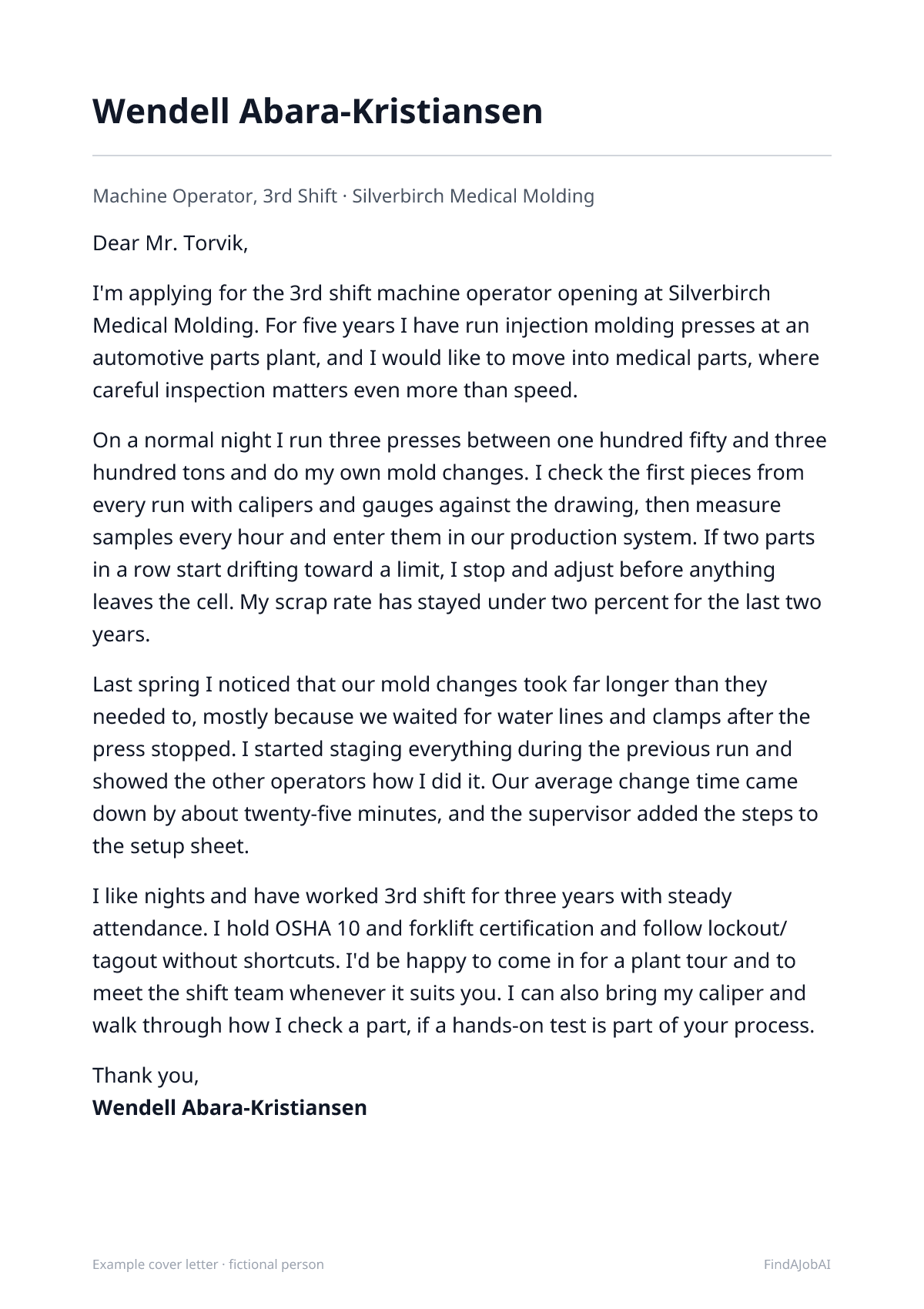
Dear Mr. Torvik,
I'm applying for the 3rd shift machine operator opening at Silverbirch Medical Molding. For five years I have run injection molding presses at an automotive parts plant, and I would like to move into medical parts, where careful inspection matters even more than speed.
On a normal night I run three presses between one hundred fifty and three hundred tons and do my own mold changes. I check the first pieces from every run with calipers and gauges against the drawing, then measure samples every hour and enter them in our production system. If two parts in a row start drifting toward a limit, I stop and adjust before anything leaves the cell. My scrap rate has stayed under two percent for the last two years.
Last spring I noticed that our mold changes took far longer than they needed to, mostly because we waited for water lines and clamps after the press stopped. I started staging everything during the previous run and showed the other operators how I did it. Our average change time came down by about twenty-five minutes, and the supervisor added the steps to the setup sheet.
I like nights and have worked 3rd shift for three years with steady attendance. I hold OSHA 10 and forklift certification and follow lockout/tagout without shortcuts. I'd be happy to come in for a plant tour and to meet the shift team whenever it suits you. I can also bring my caliper and walk through how I check a part, if a hands-on test is part of your process.
Thank you,
Wendell Abara-Kristiansen
Example 2 · Career changer
Warehouse associate moving into production
Annika has two years in a distribution center. The ad is an entry-level packaging line operator role with paid training.
Example letter · fictional
Dear Ms. Strathcoe,
I am writing to apply for the packaging machine operator position at Goldfinch Snack Foods. I have spent two years as a warehouse associate, and I want to move into production, where I can learn equipment and build a longer career in manufacturing.
In the warehouse I picked and packed about one hundred twenty orders a shift with very few errors, and I drove a sit-down forklift for eighteen months without an incident. The job taught me to keep a steady pace for a full shift, follow written procedures exactly and speak up when something looks wrong. Once I noticed a damaged rack upright during my walk-around and reported it before anyone loaded it, and the area was closed until it was repaired.
To prepare for production work, I finished a short manufacturing basics course at my community college this fall. It covered measuring tools, lockout/tagout and reading simple drawings, and I earned my OSHA 10 card at the same time. I practiced with calipers and a micrometer until I could read them quickly and accurately, because I know packaging lines still depend on careful checks of seals, labels and weights.
Your posting says you train new operators on your lines, and I'd value that structure. I'm available for any shift, including weekends, and I can start with two weeks' notice. I have reliable transportation and a strong attendance record from the warehouse, where I missed only one shift in two years. I would welcome the chance to see the packaging floor and meet the team during an interview.
Sincerely,
Annika Bellweather-Ozturk
Example 3 · Senior or lead
Lead operator applying to run a stamping shift
Teodoro leads a crew at a stamping plant. The ad is for a lead operator who will train staff and reduce changeover time.
Example letter · fictional
Dear Ms. Quintanilla-Rhee,
I'm interested in the lead machine operator role at Copperline Metal Forming. For six years I have led a crew of nine on 2nd shift at a stamping plant, running six progressive die presses, and your plan to shorten changeovers is work I have already done on my own floor.
When I became lead, a die change took about ninety minutes, and nobody did it the same way twice. I wrote a checklist with the two most experienced setup operators, marked storage spots for clamps and tools, and had the next die staged before each run finished. Within a year our average change was close to sixty minutes. We also started a simple die wear log with the quality team, which helped bring our shift scrap down from three and a half percent to around two.
Training is the part of the job I take most seriously. I have trained fourteen new operators, and I pair each one with an experienced person for their first two weeks and sign off safety steps myself. Most of them are still with us after a year. I also write a short handover note at the end of every shift so the next lead knows which presses need attention, which parts are on hold and who is still in training.
I have not managed a budget or hired staff on my own, and I would want to learn your approach to both. I'd be glad to walk your floor and talk about what slows your changeovers today, and to hear how your crews share setup knowledge between shifts.
Respectfully,
Teodoro Quarrington-Ncube
All three letters, and the short version below, are fictional: the people, employers and numbers are invented. Borrow the structure, never the facts.
- Prefer to write it yourself? Use the free cover letter template.
- Check your CV against the job first: the free CV score shows the missing keywords.
Why the first letter works, paragraph by paragraph
Paragraph 1: Opening
Names the shift, the equipment he runs and the reason he wants this plant, which tells a supervisor he read the ad and is not mass-applying.
Paragraph 2: How he runs the cell
Describes how he runs and checks his presses, with a scrap figure. That paragraph answers the two questions a supervisor cares about most: can he run the machines and are his parts good?
Paragraph 3: An improvement
A practical change to mold changes, with the minutes saved and the supervisor adopting it, shows he thinks about the line, not just his own station.
Paragraph 4: Shift, safety and next step
Confirms attendance on nights and lists certifications, which removes common worries, then offers a plant tour and a meeting with the shift team.
What the career changer's letter does differently
The career changer's letter uses warehouse habits as evidence: steady pace, accuracy, forklift record and a safety report. A short course and OSHA 10 show she prepared, and accepting training on any shift makes her easy to say yes to.
What the senior letter does differently
The lead operator's letter is built around two systems he created, a die change checklist and a wear log, each with a before and after number. A training paragraph and an honest note about hiring and budgets round out a credible lead application.
Short machine operator cover letter: an email-ready version
Many applications arrive as an email or a small text box, and a full page doesn't fit. This version runs 120 to 150 words and keeps only what a reader needs to decide whether to reply. An operator replies by email to a staffing agency recruiter who asked for a quick summary for a plant client.
Short version · email · fictional125 words
Subject: Machine Operator – 4 years CNC lathes and presses, 2nd shift – Gisela Mbatha-Rourke
Hi Darnell,
Thanks for calling about the machine operator opening with your client in Elgin. I have four years running CNC lathes and small stamping presses, I do my own tool changes, and I measure parts with micrometers to tight tolerances. Most of my work has been small steel and aluminum parts for automotive and appliance customers.
I've worked 2nd shift the whole time and missed only two days last year. I also have OSHA 10 and forklift certification, and I'm comfortable entering counts and scrap in a production system at the end of each run.
My resume is attached. I can do a plant interview any morning this week, and I'm open to a trial shift if your client prefers one.
Thanks,
Gisela Mbatha-Rourke
The short email gives the recruiter four facts to pass on: machines, setups, measuring skills and attendance. It ends with clear availability so the agency can book the interview the same day.
Opening lines that work for machine operator cover letters
The first sentence decides whether the second gets read. Here are six openings, one for each situation you might be in. Pick the one that matches yours and swap in your own facts: every name and number below is invented.
1. You have a standout result
I run three injection molding presses a night, do my own mold changes and have kept scrap under two percent for two years.
2. The ad names a problem you've solved
Your ad mentions paid training on your packaging lines, and I'm ready to bring two years of steady warehouse work to production.
3. Someone referred you
Rafferty Okwuosa-Linde, who runs presses on your 2nd shift, told me you need operators who can handle their own setups.
4. You admire what they build
I have led a nine-person stamping crew for six years and cut our die changes from ninety minutes to about sixty.
5. You're new to the field or switching into it
After four years on CNC lathes, I'm looking for a plant where careful measurement matters as much as speed.
6. You have senior scope or a specialism
I've worked 3rd shift for three years with steady attendance, and I'm applying for your night operator opening.
How to write a machine operator cover letter
Five steps, in the order you'd write them. The shape stays the same for every job (a short opening, proof, a reason for this employer, a close), and what goes into each part is what changes with the role.
Name the machines and the shift
In the first two sentences, say which machines you run, such as injection presses, stamping presses or packaging lines, and which shift you are applying for. Supervisors hire for specific equipment and specific hours, so this is the fastest way to show you fit the opening.
Show how you check your work
Describe how you inspect parts: first pieces, hourly checks, the tools you use and what you do when a part drifts. Add a scrap or defect figure if you know it. This proves you protect quality, not just keep the machine running.
Add one improvement or problem you solved
Pick something practical, like a faster changeover, a recurring jam you reported or a safety hazard you spotted. Explain what you noticed, what you did and what changed, in three or four sentences without technical jargon the reader might not share.
Mention safety and attendance
List OSHA, lockout/tagout or forklift training and describe your attendance honestly. Plants lose money when operators miss shifts or get hurt, so these details matter to supervisors as much as experience on a particular machine.
End with your start date and shifts
Say when you can start, which shifts you can work and that you would welcome a plant tour or interview. Keep the closing short and practical, since the next step is usually a visit to the floor rather than another round of emails.
Machine Operator cover letter do's and don'ts
Do
- Name the machines you have run and whether you do setups.
- Include one quality or safety number, such as scrap rate or days without injury.
- State the shifts you can work and your attendance record.
- Mention certifications like OSHA 10 or forklift in the letter as well as the resume.
Don't
- Don't send a long letter; four short paragraphs are plenty for a plant supervisor.
- Don't claim experience with machines you have only seen others use.
- Don't complain about your current plant or supervisor.
- Don't forget to say which shift you're applying for if the company posts several.
Common machine operator cover letter mistakes
Each one is easy to make and quick to fix before you send the letter.
Copying the job ad duties into the letter
The supervisor wrote those duties. Show your own machines, numbers and one example instead of repeating them back.
Leaving out the shift
Plants often post the same title for several shifts. Say which one you want and that you can work it reliably.
Claiming setups you have only watched
Watching a setup is not doing one. Describe your real level honestly; you will be tested on the floor.
Writing a full page
Keep the letter to four short paragraphs; supervisors read between production meetings and line checks.
Writing a letter with no word on lockout or PPE
Mention lockout/tagout and any safety record. A letter without safety details can make a careful operator look careless.
Email subject lines for machine operator applications
Applying by email? Put the job title, any reference number and your name in the subject line.
- Machine Operator, 3rd shift – injection molding, own mold changes – Wendell Abara-Kristiansen
- Packaging Machine Operator – warehouse background, OSHA 10 – Annika Bellweather-Ozturk
- Lead Machine Operator application (Job 8812) – Teodoro Quarrington-Ncube
Everything for Machine Operators
- Machine Operator resume exampleA full resume, plus bullet and summary examples
- Machine Operator interview questions30 questions with sample answers
- Machine Operator job descriptionDuties, skills and requirements
- Career change cover letter: template + examples
Other cover letter examples
Machine Operator cover letter FAQ
Does a machine operator need a cover letter?
Not always, but a short one helps when you are changing plants or industries, applying without experience, or when the ad asks for one. Keep it to four short paragraphs.
What should I say with no machine experience?
Point to steady work in a warehouse, kitchen or store, safety habits, any equipment you used and training such as OSHA 10 or a manufacturing course.
Should I mention my attendance?
Yes, if it is good. Plants value operators who show up for every shift, so a short line about reliability is worth including.
How long should a machine operator cover letter be?
About 250 to 330 words. Name the machines, the shift and one result, and leave the rest for your resume.
How we built this page
The FindAJobAI team wrote the three example letters, the short email version, the opening lines and the advice for machine operator roles. The people, employers and numbers in the letters are invented; the structure, the kind of evidence and the order of the paragraphs are the parts to copy.
Once we track enough live machine operator job ads, this page also shows the skills they ask for most, counted the same way as our in-demand skills report.
Last reviewed on November 1, 2026.