Plasterer Cover Letter Example (2026)
By FindAJobAI Team Updated How we built this page
Plastering contractors hire on trust: will this person show up, keep pace with the crew and leave walls that don't crack by spring? A cover letter helps when it names the systems you apply, gives one job with real numbers, and shows you care about finish and cleanup in someone's home.
Plasterer cover letter template
This letter as a one-page template: an opening that names the job and your strongest fact, proof that answers the ad, a reason for this employer and a short close.
After you sign up, FindAJobAI drafts your own letter for a real job from your CV in this format, and you edit it before you send it.
Example 1 · Experienced
Journeyman plasterer applying to a restoration contractor
Jory has nine years of veneer and lime work. The ad is from a contractor taking on more historic houses and needs a plasterer who can match old walls.
Example letter · fictional
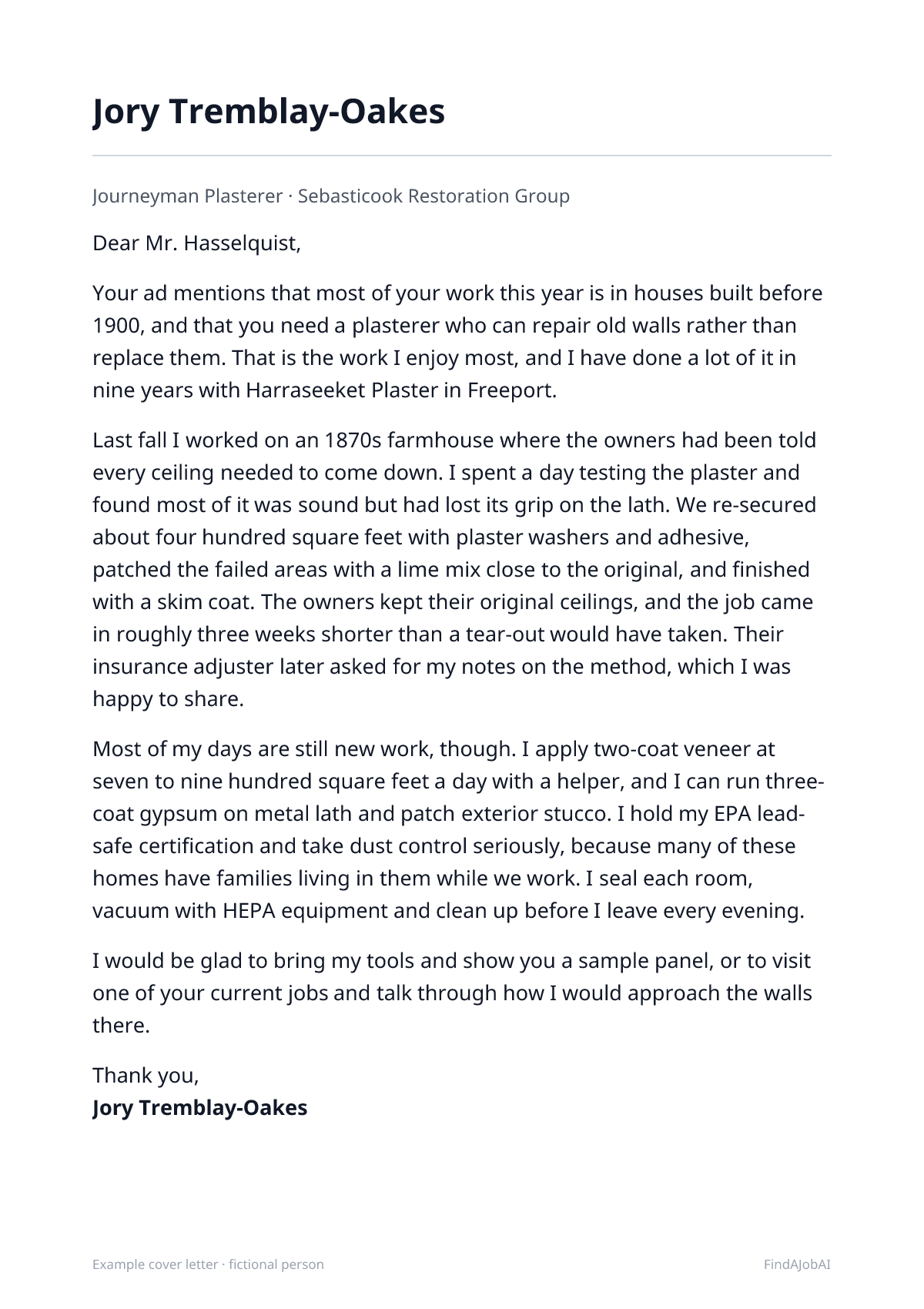
Dear Mr. Hasselquist,
Your ad mentions that most of your work this year is in houses built before 1900, and that you need a plasterer who can repair old walls rather than replace them. That is the work I enjoy most, and I have done a lot of it in nine years with Harraseeket Plaster in Freeport.
Last fall I worked on an 1870s farmhouse where the owners had been told every ceiling needed to come down. I spent a day testing the plaster and found most of it was sound but had lost its grip on the lath. We re-secured about four hundred square feet with plaster washers and adhesive, patched the failed areas with a lime mix close to the original, and finished with a skim coat. The owners kept their original ceilings, and the job came in roughly three weeks shorter than a tear-out would have taken. Their insurance adjuster later asked for my notes on the method, which I was happy to share.
Most of my days are still new work, though. I apply two-coat veneer at seven to nine hundred square feet a day with a helper, and I can run three-coat gypsum on metal lath and patch exterior stucco. I hold my EPA lead-safe certification and take dust control seriously, because many of these homes have families living in them while we work. I seal each room, vacuum with HEPA equipment and clean up before I leave every evening.
I would be glad to bring my tools and show you a sample panel, or to visit one of your current jobs and talk through how I would approach the walls there.
Thank you,
Jory Tremblay-Oakes
Example 2 · Entry level
Apprentice finishing training and applying for a first plastering job
Nell is completing a plastering apprenticeship. The ad is for an entry-level plasterer at a commercial interiors company.
Example letter · fictional
Dear Ms. Szymanek,
I am writing to apply for the entry-level plasterer position at Kennebunk Wall Systems. In March I will complete my three-year plastering apprenticeship, and I am looking for a crew where I can keep learning while carrying my full share of the work.
For most of my apprenticeship I worked with Old Orchard Plaster on schools, offices and a few large homes. I started out mixing and delivering material for a five-person crew, and over the past year I have applied scratch and brown coats on eight three-coat jobs and finish coats on veneer under a journeyman's eye. On a recent dental office project, my foreman let me finish two treatment rooms on my own, and both passed the contractor's punch walk without a single touch-up. That was the first time my work went to a client without anyone redoing part of it, and I have wanted that feeling on every job since.
I know my speed on veneer is still behind an experienced hand, so I have been timing myself on practice boards at the training center after work. I am now close to six hundred square feet a day and getting faster each month. I also hold OSHA 10 and the EPA lead-safe certificate, and I am comfortable working on rolling scaffolds and setting up dust protection in occupied buildings.
Your posting mentions mentoring from senior plasterers, which is exactly what I am looking for. I learn quickly when someone shows me once and then lets me try. I would welcome the chance to meet your foreman and show what I can do on a test wall.
Sincerely,
Nell Abernathy-Coyle
Example 3 · Referral or internal move
Lime plaster specialist referred by the contractor's foreman
Thaddeus was recommended by a foreman he worked beside on a museum job. The company needs a plasterer for a run of historic church interiors.
Example letter · fictional
Dear Ms. Galbraith-Nunes,
Calvin Ostergaard, your plastering foreman, suggested I write to you. We worked side by side two summers ago on the museum annex in Hallowell, and he mentioned that your company has three church interiors starting next spring and needs another hand who knows lime.
I have spent most of my fourteen years in the trade on old buildings. On the museum job Calvin and I rebuilt about ninety feet of cornice and patched lime walls that conservators examined panel by panel. My part was mixing and testing the lime, making sample boards until the color and texture matched, and running the cornice sections. The conservators approved our second set of samples, and the rest of the job went ahead without changes.
Church interiors bring their own problems: tall ceilings, cold buildings and congregations that need the space back on Sundays. I have plastered two sanctuaries before, working from rolling towers and planning lime work around heating and curing so nothing froze or dried too fast. I am also used to sharing a site with organ builders and painters without getting in their way.
I am a careful worker rather than a fast one on restoration, and I will say so plainly. On new veneer I keep up with any crew, but on lime I take the time the material needs. I hold EPA lead-safe and OSHA 30 cards, and I can bring my own lime tools and sample boards.
I would be glad to meet you and Calvin at one of the churches and talk through what you are seeing on the walls.
Respectfully,
Thaddeus Wrenbury
All three letters, and the short version below, are fictional: the people, employers and numbers are invented. Borrow the structure, never the facts.
- Prefer to write it yourself? Use the free cover letter template.
- Check your CV against the job first: the free CV score shows the missing keywords.
Why the first letter works, paragraph by paragraph
Paragraph 1: Opening
Picks up the contractor's own focus on pre-1900 houses and repair over replacement, then states nine years of experience. The reader knows within two sentences that the letter is about their actual work.
Paragraph 2: One restoration job in detail
The farmhouse story shows judgment as well as skill: testing first, saving sound plaster, matching a lime mix. The result is something an owner cares about, original ceilings kept and weeks saved.
Paragraph 3: Everyday systems and care on site
A daily veneer figure, three-coat and stucco experience, and lead-safe certification prove the writer can fill normal production days. Dust control in lived-in homes shows the writer thinks about the client too.
Paragraph 4: Close
Offers a sample panel or a site visit instead of a vague request for an interview, which suits how trades hiring actually works.
What the entry-level letter does differently
The apprentice letter is honest about speed and shows what the writer is doing about it, with a measured figure. One small solo job that passed the punch walk gives the foreman a concrete reason to trust her, and certifications cover the basics before anyone has to ask.
What the referral letter does differently
A referral letter opens with the referrer's name and how they know each other, then backs it with the shared job the reader can check. The church section shows the writer has thought about the specific project, and being open about pace on lime work builds trust with a restoration contractor.
Short plasterer cover letter: an email-ready version
Many applications arrive as an email or a small text box, and a full page doesn't fit. This version runs 120 to 150 words and keeps only what a reader needs to decide whether to reply. A plasterer replies by email to a job board post for a commercial stucco and veneer position, as the post asks.
Short version · email · fictional126 words
Subject: Plasterer – veneer and exterior stucco, available now – Ewan Castellucci
Hi Mr. Gagnebin,
I'm writing about your plasterer opening at Stroudwater Interiors. I have seven years applying two-coat veneer and exterior cement stucco on commercial jobs, and I can start any time this month on day or early shifts.
On my last big project, a three-story medical building, I applied veneer to about twelve thousand square feet of corridors and offices with one helper and finished the stucco on the entrance canopy. We closed our scope four days ahead of the contractor's schedule, and the punch list for our trade had only three items.
I have my own hand tools, a reliable truck, and OSHA 30. My resume is attached, and I'm happy to come by for a test wall whenever suits you.
Thanks,
Ewan Castellucci
The email gives the two systems the post asks for, one recent job with its size and result, and practical details a contractor needs: start date, tools, transport and safety card. The test-wall offer makes it easy to say yes to a meeting.
Opening lines that work for plasterer cover letters
The first sentence decides whether the second gets read. Here are six openings, one for each situation you might be in. Pick the one that matches yours and swap in your own facts: every name and number below is invented.
1. You have a standout result
Most of the walls I repaired last year were older than the houses around them, and I'd like to keep doing that kind of careful work with your crew.
2. The ad names a problem you've solved
Your foreman Calvin and I ran cornices together on a museum job, and he told me you have church interiors coming up that need lime plaster.
3. Someone referred you
I finish two-coat veneer at seven to nine hundred square feet a day with one helper, and my ceilings pass raking-light checks without a skim coat.
4. You admire what they build
I complete my plastering apprenticeship in March, and the jobs I have liked best are the ones where a journeyman let me finish a room on my own.
5. You're new to the field or switching into it
Before I quote a tear-out, I test whether old plaster can be saved, and on my last farmhouse job most of it could be.
6. You have senior scope or a specialism
Seven years of commercial stucco and veneer work have taught me that a clean, on-time finish matters as much to a contractor as a flat wall.
How to write a plasterer cover letter
Five steps, in the order you'd write them. The shape stays the same for every job (a short opening, proof, a reason for this employer, a close), and what goes into each part is what changes with the role.
Match the systems in the ad
Look for the plaster systems the contractor mentions, such as veneer, three-coat, lime or stucco, and name the ones you can apply. If the ad mentions historic homes or commercial interiors, choose a job from that kind of work for your main example.
Describe one job with numbers
Pick a recent job and give its size in square feet, rooms or buildings, the method you used and how it ended: on schedule, a short punch list or a preservation review passed. One real job is worth more than a list of adjectives.
Give an honest pace figure
Foremen want to know how much wall you cover in a day. State your output on one system and your crew size. If you are still building speed, say what you are doing to improve, as that shows you take it seriously.
Show care for the site and the people in it
Mention dust control, floor protection and lead-safe work, especially for jobs in occupied homes. Contractors lose clients over mess as often as over finish quality, so on every job this is a real selling point for you.
Offer a test wall or site visit
Close by offering to show your work on a sample panel or to walk one of their current jobs. Trades hiring often comes down to seeing someone's hands at work, and the offer shows confidence without overselling.
Plasterer cover letter do's and don'ts
Do
- Name the plaster systems you can apply, such as veneer, three-coat gypsum, lime or stucco.
- Describe one job with its size, the method you used and how it turned out for the owner or contractor.
- Give an honest daily output figure for at least one system, with your crew size.
- Mention lead-safe, OSHA and scaffold training, since older and commercial buildings usually require them.
Don't
- Don't claim every specialty; contractors will test you on a sample wall.
- Don't skip how you protect occupied homes from dust and mess.
- Don't send a long letter; most foremen read a page at most, so keep it to four short paragraphs.
Common plasterer cover letter mistakes
Each one is easy to make and quick to fix before you send the letter.
Calling yourself a drywall finisher
Plastering contractors hire for plaster skills. Use the word plasterer, name your systems, and treat taping as an extra rather than your main trade.
No sense of daily output
Without a pace figure, a foreman cannot tell whether you will hold up the crew. Give square feet per day on one system and who you worked with.
Writing about finish without proof
Words like flawless mean little to a contractor. Give a result instead: a punch walk passed, a raking-light check, or a conservator's approval.
Forgetting the homeowner
Much plaster work happens in lived-in houses. One line about dust control and keeping owners informed shows you can be trusted on their sites.
Overstating restoration skill
Claiming lime and ornamental mastery you lack will show on the first sample panel. Describe the specific restoration tasks you have done and stop there.
Email subject lines for plasterer applications
Applying by email? Put the job title, any reference number and your name in the subject line.
- Journeyman Plasterer – 9 years veneer and historic lime repair – Jory Tremblay-Oakes
- Entry-level Plasterer – apprenticeship complete in March – Nell Abernathy-Coyle
- Plasterer application, referred by your foreman – lime and cornice work – Thaddeus Wrenbury
Everything for Plasterers
- Plasterer resume exampleA full resume, plus bullet and summary examples
- Plasterer interview questions30 questions with sample answers
- Plasterer job descriptionDuties, skills and requirements
- Cover letter with no experience: templates
Other cover letter examples
Plasterer cover letter FAQ
Do plasterers need a cover letter?
Not always, since many contractors hire by phone or through the union hall. A short letter still helps for restoration firms and larger contractors, where finish quality and care in homes are part of the decision.
What should I mention in a plasterer cover letter?
The systems you apply, one job with real numbers, your daily output and your certifications. If you do restoration or ornamental work, give a short example, because it is a specialty many contractors need.
How do I write a plasterer cover letter with no experience?
Focus on training hours, tasks you already do well such as mixing and base coats, and your safety certificates. Offer to show your work on a test wall.
Should I attach photos of my plastering work?
Yes, a link or a few photos help, especially for cornices, curved walls or patches blended into old plaster. Make sure the owners agreed to the photos being shared.
How we built this page
The FindAJobAI team wrote the three example letters, the short email version, the opening lines and the advice for plasterer roles. The people, employers and numbers in the letters are invented; the structure, the kind of evidence and the order of the paragraphs are the parts to copy.
Once we track enough live plasterer job ads, this page also shows the skills they ask for most, counted the same way as our in-demand skills report.
Last reviewed on November 1, 2026.