Policy Analyst Cover Letter Example (2026)
By FindAJobAI team Updated How we built this page
Policy analyst ads usually list a degree, a research method and a subject area, so most applicants read the same on paper. The cover letter is where you show the part a resume can't: a question you researched, what you found, and who used it to make a decision.
Policy Analyst cover letter template
This letter as a one-page template: an opening that names the job and your strongest fact, proof that answers the ad, a reason for this employer and a short close.
After you sign up, FindAJobAI drafts your own letter for a real job from your CV in this format, and you edit it before you send it.
Example 1 · Experienced
Housing policy analyst applying to a state agency
Cameron writes rent-stabilization memos for a city council office. The ad asks for someone who can brief legislators directly.
Example letter · fictional
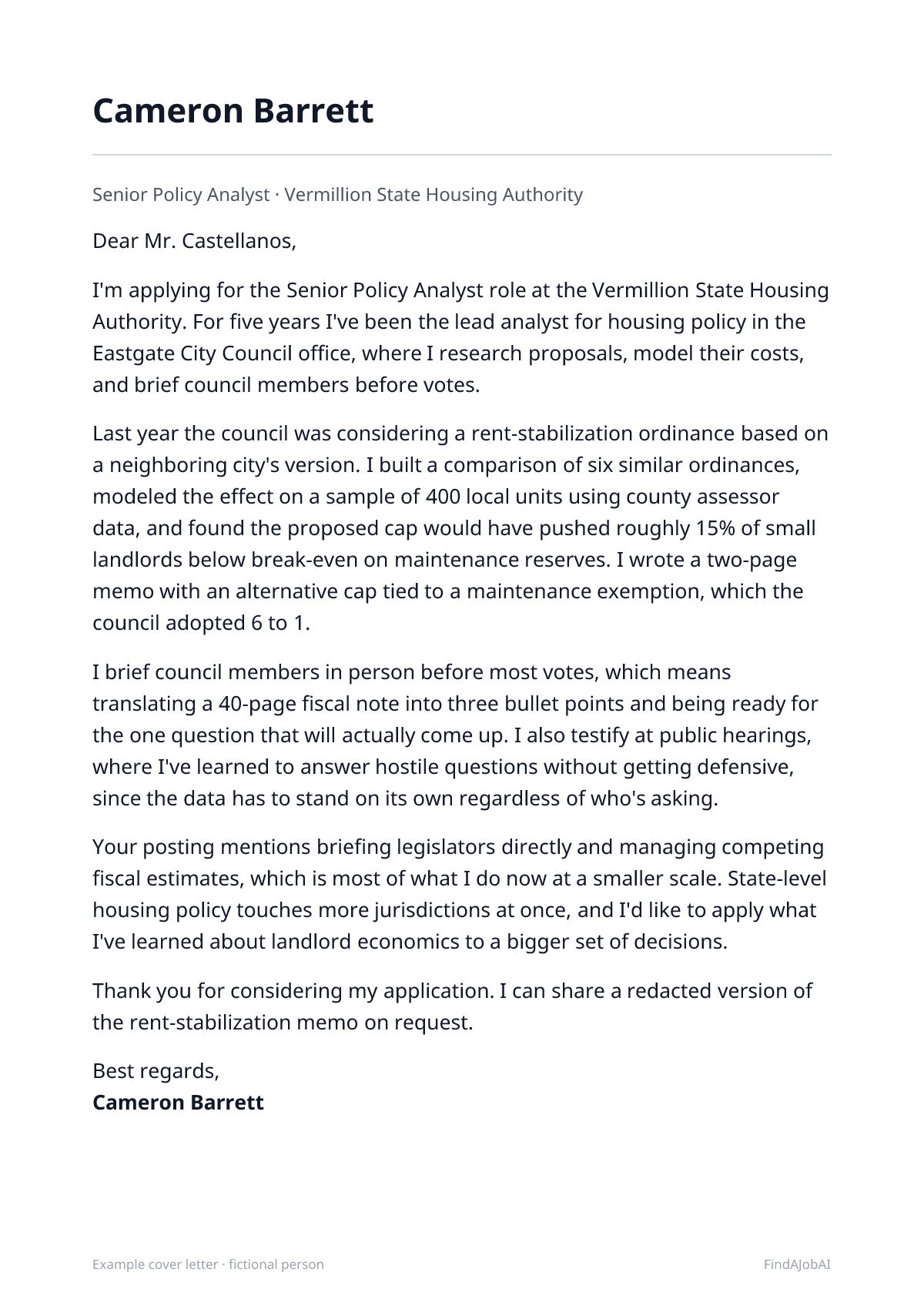
Dear Mr. Castellanos,
I'm applying for the Senior Policy Analyst role at the Vermillion State Housing Authority. For five years I've been the lead analyst for housing policy in the Eastgate City Council office, where I research proposals, model their costs, and brief council members before votes.
Last year the council was considering a rent-stabilization ordinance based on a neighboring city's version. I built a comparison of six similar ordinances, modeled the effect on a sample of 400 local units using county assessor data, and found the proposed cap would have pushed roughly 15% of small landlords below break-even on maintenance reserves. I wrote a two-page memo with an alternative cap tied to a maintenance exemption, which the council adopted 6 to 1.
I brief council members in person before most votes, which means translating a 40-page fiscal note into three bullet points and being ready for the one question that will actually come up. I also testify at public hearings, where I've learned to answer hostile questions without getting defensive, since the data has to stand on its own regardless of who's asking.
Your posting mentions briefing legislators directly and managing competing fiscal estimates, which is most of what I do now at a smaller scale. State-level housing policy touches more jurisdictions at once, and I'd like to apply what I've learned about landlord economics to a bigger set of decisions.
Thank you for considering my application. I can share a redacted version of the rent-stabilization memo on request.
Best regards,
Cameron Barrett
Example 2 · Career changer
Caseworker moving into policy analysis
Carla tracked a housing voucher backlog as a caseworker and got the intake form redesigned. The ad values direct service experience.
Example letter · fictional
Dear Hiring Committee,
I'm applying for the Policy Analyst role at the Thornfield County Health Department. For four years I've worked as a caseworker for a regional housing voucher program, and I'm now ready to move from applying policy to analyzing it.
Our voucher backlog was growing and nobody could say why. I pulled six months of intake records into a spreadsheet, coded each delay by cause, and found that a third of stalled cases were stuck on one confusing income-verification question. I rewrote the form with plain-language instructions and a worked example, and the county adopted it across all four intake offices; average processing time dropped from 19 days to 12.
Since then I've completed a graduate certificate in public policy analysis and taken a course in program evaluation, and I built a short analysis of local eviction filing data as a portfolio piece, looking at which zip codes saw the steepest increases after a rent-assistance program ended. I'm comfortable in Excel and R, and I'm learning Stata for the regression work most of your postings mention.
Your opening focuses on health access programs, and caseload bottlenecks are a problem I've already diagnosed from the inside. I'd bring both the analytical training and a caseworker's sense of where a well-written policy breaks down in practice. I'd also welcome feedback on my write-ups, since turning a spreadsheet into a one-page memo for a busy commissioner is a skill I am still sharpening.
Thank you for your time. I'd welcome the chance to talk about the intake redesign and what it suggested about the voucher program more broadly.
Kind regards,
Carla Whitaker
Example 3 · Senior or lead
Research director applying to lead a new policy shop
Riley runs a six-person research team at an advocacy nonprofit. The ad is for a founding research director at a new state-level institute.
Example letter · fictional
Dear Dr. Whitfield,
I'm applying for the Research Director role at the Brackenfield Policy Institute. For the past four years I've led a six-person research team at a statewide advocacy nonprofit, and before that I spent seven years as a policy analyst. I'd like to build a research agenda for an institute from its first year.
Your posting notes that Brackenfield wants credibility with legislators from both parties before it publishes its first major report. At my nonprofit, I rebuilt our publication process around a pre-release technical review by two outside academics with no stake in our advocacy position, which took longer but meant our minimum-wage analysis was cited by legislators who otherwise distrusted our organization's conclusions.
Research earns attention through decisions, not reports. When a county was debating a job-training subsidy, my team's analysis showed that the program's reported placement rate excluded participants who dropped out before completion, and the real rate was well under half the publicized figure. The county rewrote the subsidy's terms around completion incentives rather than enrollment, and that analysis became the template our team now uses for every workforce program review.
I've hired four of my six analysts and run a quarterly peer-review process where team members critique each other's drafts before external review. I haven't built an organization's publishing or media relationships from nothing, and at Brackenfield I'd expect to work closely with your communications lead to get that right early.
A conversation about which three questions you most want the institute's first reports to answer, and who you need those answers to persuade, would be a good place to start.
Sincerely,
Riley Marchetti
All three letters, and the short version below, are fictional: the people, employers and numbers are invented. Borrow the structure, never the facts.
- Prefer to write it yourself? Use the free cover letter template.
- Check your CV against the job first: the free CV score shows the missing keywords.
Why the first letter works, paragraph by paragraph
Paragraph 1: Opening
Names the office and the actual task (research, cost modeling, briefing council members), which tells the reader the scope of the current job before any single example.
Paragraph 2: The analysis that changed a decision
A specific proposal, a method (comparing six ordinances and modeling 400 units), a finding that was not what the council expected, and the vote it led to.
Paragraph 3: Working with decision-makers
Briefing legislators and testifying at hearings are the two skills policy ads ask for beyond research; naming both, with a concrete detail (three bullet points), makes the claim checkable.
Paragraph 4: Why this employer
Matches the ad's own phrase ('briefing legislators directly') and names the difference in scale the writer is seeking.
Paragraph 5: Close
Offers a redacted work sample, which respects the current employer's confidentiality while still being useful to the reader.
What the career changer's letter does differently
The career changer's letter starts from a service delivery problem solved before any policy job title, with a measurable result (processing time down from 19 to 12 days). A certificate and a self-directed data project show the analytical skills are now formal, and the letter ties frontline experience directly to the kind of breakdown the employer's own programs might have.
What the senior letter does differently
A research director letter reports organizational habits, not just one finding: a pre-release review process, a workforce study that became a team template, a peer-review cycle for drafts. The decision example shows research changing a program's design, and the gap, building publishing credibility from scratch, is named directly.
Short policy analyst cover letter: an email-ready version
Many applications arrive as an email or a small text box, and a full page doesn't fit. This version runs 120 to 150 words and keeps only what a reader needs to decide whether to reply. A policy analyst answers a county's 'why this role' application field, sent by email because the portal rejected the attachment format.
Short version · email · fictional150 words
Subject: Policy Analyst (transit and fiscal modeling) – Teodor Vasquez
Hello Ms. Dunleavy,
I'm applying for the Policy Analyst role at the Ashgrove County Transportation Authority. I have three years of experience modeling transit fare policy for a regional planning commission, where I'm the analyst board members ask for first on fare questions.
My most useful project was a fare-cap analysis: switching to a weekly cap instead of per-ride discounts was projected to cost the agency $380,000 a year, but ridership data from a comparable system suggested it would recover most of that through retained riders within two years. The board adopted the cap on that basis.
Transit funding decisions like this are the kind of work I want to keep doing, and I'd welcome a team that treats fiscal modeling as a tool for public debate, not just an internal number. My resume is attached, and I can send the fare-cap analysis with agency figures removed.
Best,
Teodor Vasquez
A short application field forces one example, so this version keeps the single fare-cap analysis and its dollar figure, in the exact policy area the employer handles. Offering a redacted version signals discretion without over-explaining it.
Opening lines that work for policy analyst cover letters
The first sentence decides whether the second gets read. Here are six openings, one for each situation you might be in. Pick the one that matches yours and swap in your own facts: every name and number below is invented.
1. You have a standout result
A fare-cap analysis I built last year projected a $380,000 annual cost but a two-year ridership recovery, and the board adopted it on that basis. I'd like to bring that kind of modeling to your transit policy work.
2. The ad names a problem you've solved
Your posting says staff spend weeks reconciling conflicting fiscal estimates before a vote. At my current agency I built a shared assumptions document that cut that reconciliation from three meetings to one.
3. Someone referred you
Your deputy director, Hollis Abara, worked with me for a year on a regional transit study from the modeling side. She mentioned you need someone who can defend numbers in a public hearing, which is what prompted this application.
4. You admire what they build
I've followed your agency's fare-equity proposals for two years as a rider, and the open questions in the last public comment period made me want to help answer them directly.
5. You're new to the field or switching into it
I spent four years as a caseworker tracking a benefits backlog by hand before I taught myself the analysis that fixed it. Policy work is where I want to keep solving problems like that.
6. You have senior scope or a specialism
As lead analyst for housing policy for seven years, I wrote several of the cost models the office still uses for rent-related proposals. I'm looking for a role that sets a research agenda rather than responding to one bill at a time.
How to write a policy analyst cover letter
Five steps, in the order you'd write them. The shape stays the same for every job (a short opening, proof, a reason for this employer, a close), and what goes into each part is what changes with the role.
Identify the decision the ad is built around
Policy postings are usually written around a real pending decision: a budget, a regulation, a program renewal. Read for the agency's actual mandate and pick a past project where you researched something comparable, for a similar audience, under a similar deadline.
Open with the finding, not the methodology
State what your research showed and what happened because of it in one or two sentences. Save the method, regression, comparative case study, cost model, for the next paragraph. A reader who sees a real decision up front keeps reading past the first line.
Attach your analysis to a vote, a budget line, or a rewritten program
Describe what changed because of your work: a cap that was adopted, a form that was rewritten, a subsidy that was restructured. Avoid listing reports produced. If the outcome is still pending, say what the decision-maker did differently once they had your numbers.
Name your method and data source inside the story
Work in the method (comparative case study, regression, cost-benefit model) and the data source (assessor records, caseload data, a comparable jurisdiction) as part of the example, not as a separate skills line. A method is credible when it's attached to a specific finding.
Show how you communicate to non-researchers
Name the audience you write or brief for, legislators, a board, the public, and the format they need: a two-page memo, three bullet points, a hearing answer. Close with a question in their policy area you'd want to research first, so the reader sees your first project.
Policy Analyst cover letter do's and don'ts
Do
- Name the specific proposal, program or dataset you analyzed, not just the policy area.
- Give the finding before the method: what changed, then how you figured it out.
- Mention the audience you briefed or wrote for (council members, a director, the public) and what format they needed.
Don't
- Don't claim credit for a policy outcome you only contributed research to; say what you provided and what happened after.
- Don't list think tanks or committees you've read about; name the work you actually did.
- Don't share internal deliberations from a current employer; offer a redacted or anonymized version instead.
Common policy analyst cover letter mistakes
Each one is easy to make and quick to fix before you send the letter.
Describing reports instead of decisions
'Authored twelve policy briefs' tells the reader about volume. Name one brief that changed a vote, a budget, or a program's design, and what that was worth to the agency or the public it serves.
Giving a finding without its baseline
'Reduced wait times significantly' can't be checked. State the starting number, how it was measured, and what you changed, so a reader could ask a follow-up question and get a real answer.
Writing as an advocate instead of an analyst
A letter that argues for a policy position reads like testimony, not an application. Show your method and how you'd handle a finding that cut against your own expectations.
Leaving out who used the research
Analysis that nobody acted on doesn't demonstrate impact. Name the council, director, or board that received your work and what they did with it, even if the decision was modest.
Padding with coursework instead of practice
Listing every policy class you took suggests no applied experience. If you're early in the field, replace the list with one project, even unpaid or academic, where you researched a real question and reached a real finding.
Email subject lines for policy analyst applications
Applying by email? Put the job title, any reference number and your name in the subject line.
- Senior Policy Analyst application – housing and fiscal modeling – Cameron Barrett
- Policy Analyst – caseworker with program evaluation certificate – Carla Whitaker
- Application: Policy Analyst, Health Access (Req. 2240) – Carla Whitaker
Everything for Policy Analysts
- Policy Analyst resume exampleA full resume, plus bullet and summary examples
- Policy Analyst interview questions30 questions with sample answers
- Policy Analyst job descriptionDuties, skills and requirements
- Career change cover letter: template + examples
Other cover letter examples
Policy Analyst cover letter FAQ
What should I write in a policy analyst cover letter?
One piece of analysis that informed a real decision: the question, your method, the finding, and what happened next. Then a sentence on who you briefed and in what format. Your research methods belong on the resume, not repeated in prose.
How do I write a policy analyst cover letter with no direct policy experience?
Use analytical or program work from another role, such as tracking a backlog or evaluating a process, then add relevant coursework or a self-directed research project. Name the data and tools you used and the change that followed.
Should I mention my political views or affiliations in a policy analyst cover letter?
No. Focus on your analytical method and findings rather than your opinions on the policy area, even for advocacy-adjacent roles. Employers are hiring your judgment, not your positions.
How technical should a policy analyst cover letter be?
Name your method and tools in one clause, not a paragraph. The letter should read like you're briefing a busy decision-maker, which is the actual job.
How we built this page
The FindAJobAI team wrote the three example letters, the short email version, the opening lines and the advice for policy analyst roles. The people, employers and numbers in the letters are invented; the structure, the kind of evidence and the order of the paragraphs are the parts to copy.
Once we track enough live policy analyst job ads, this page also shows the skills they ask for most, counted the same way as our in-demand skills report.
Last reviewed on November 1, 2026.