Product Marketing Manager Cover Letter Example (2026)
By FindAJobAI team Updated How we built this page
Product marketing manager ads usually blur together: positioning, launches, sales enablement, win-loss analysis, in some order. The cover letter should pick one launch or one piece of messaging you own and show the business reason it worked, since that's what separates a strong PMM from a generalist marketer.
Product Marketing Manager cover letter template
This letter as a one-page template: an opening that names the job and your strongest fact, proof that answers the ad, a reason for this employer and a short close.
After you sign up, FindAJobAI drafts your own letter for a real job from your CV in this format, and you edit it before you send it.
Example 1 · Experienced
Product marketing manager applying to a workflow automation company
Owen owns positioning and launches for one product line at a SaaS company. The ad asks for someone who can turn a feature into a sales story.
Example letter · fictional
Dear Ms. Oyelaran,
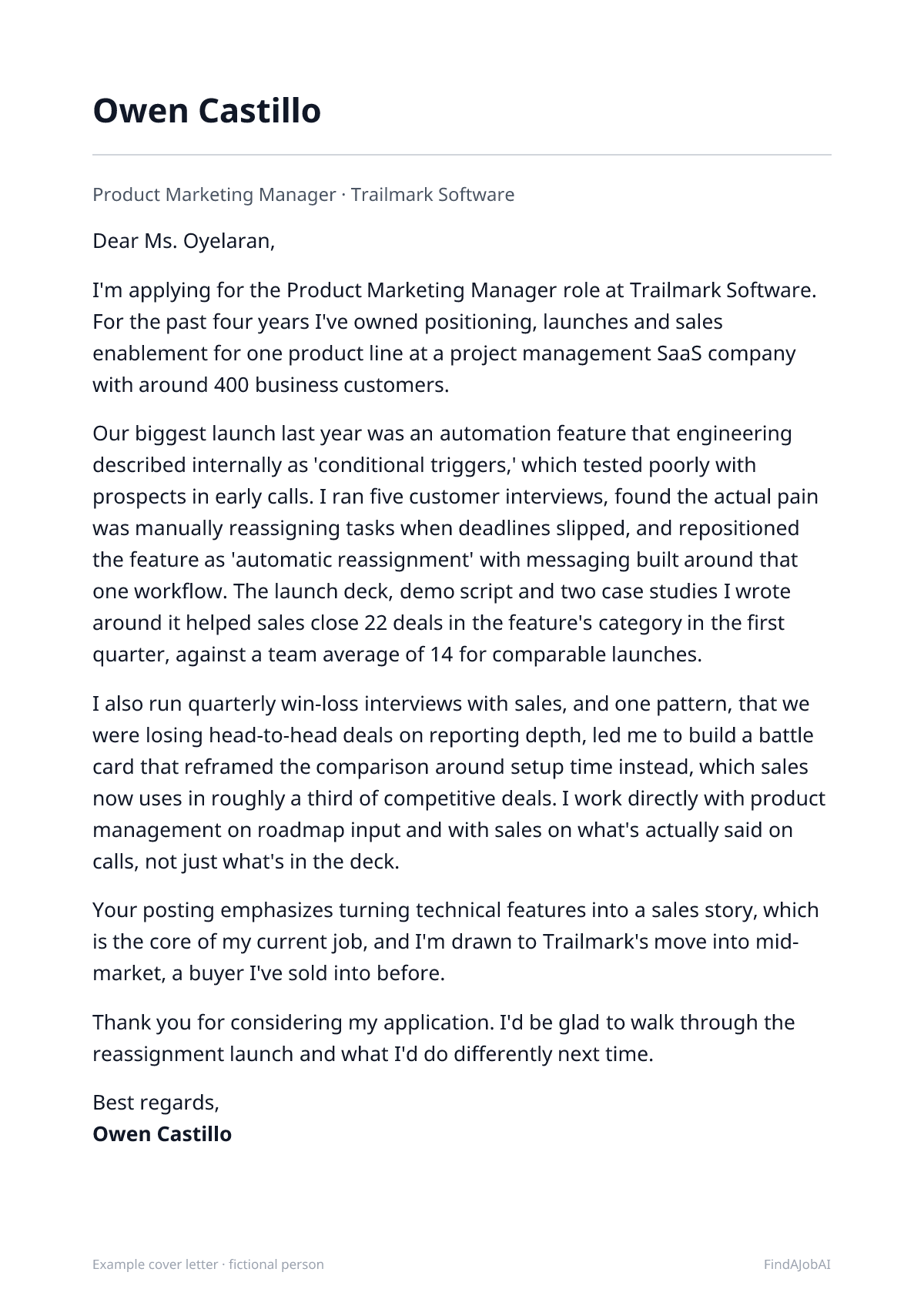
I'm applying for the Product Marketing Manager role at Trailmark Software. For the past four years I've owned positioning, launches and sales enablement for one product line at a project management SaaS company with around 400 business customers.
Our biggest launch last year was an automation feature that engineering described internally as 'conditional triggers,' which tested poorly with prospects in early calls. I ran five customer interviews, found the actual pain was manually reassigning tasks when deadlines slipped, and repositioned the feature as 'automatic reassignment' with messaging built around that one workflow. The launch deck, demo script and two case studies I wrote around it helped sales close 22 deals in the feature's category in the first quarter, against a team average of 14 for comparable launches.
I also run quarterly win-loss interviews with sales, and one pattern, that we were losing head-to-head deals on reporting depth, led me to build a battle card that reframed the comparison around setup time instead, which sales now uses in roughly a third of competitive deals. I work directly with product management on roadmap input and with sales on what's actually said on calls, not just what's in the deck.
Your posting emphasizes turning technical features into a sales story, which is the core of my current job, and I'm drawn to Trailmark's move into mid-market, a buyer I've sold into before.
Thank you for considering my application. I'd be glad to walk through the reassignment launch and what I'd do differently next time.
Best regards,
Owen Castillo
Example 2 · Career changer
Sales engineer moving into product marketing
Blair has built demo scripts and competitive comparisons for sales, without the title. The ad mentions enablement and competitive positioning.
Example letter · fictional
Dear Hiring Manager,
I'm applying for the Product Marketing Manager role at Clearpath Analytics. For five years I've worked as a sales engineer at a data visualization company, where I ended up writing most of the demo scripts and competitive materials our sales team actually uses, and I'd like to make that my primary focus.
Eighteen months ago our reps were losing a specific competitor on price comparisons that didn't reflect how our pricing actually worked once implementation was included. I built a total-cost-of-ownership comparison sheet, pulled real numbers from five closed deals, and trained the sales team on using it in calls. Win rate against that competitor rose from 31% to 44% over the next two quarters, and the sheet became the template for our other two main competitors.
I also write the technical sections of our release notes in plain language for prospects, and I track which demo flows actually lead to a second call, cutting our standard demo from 45 minutes to 25 by removing the parts nobody asked about afterward.
Your posting asks for sales enablement and competitive positioning, which is the work I've already been doing from the sales side. I'd bring both the message and a realistic sense of what a rep can actually use on a live call. I'd also sit in on a handful of customer calls in my first month, so the messaging starts from how buyers actually talk.
Thank you for your time. I'd welcome the chance to share the total-cost-of-ownership sheet and talk through how it's used.
Kind regards,
Blair Kowalczyk
Example 3 · Senior or lead
Head of product marketing applying to build a first PMM function
Roxana leads three PMMs at a mid-size SaaS company. The ad is for a head of product marketing to build the function from scratch at an earlier-stage firm.
Example letter · fictional
Dear Mr. Castellanos,
I'm applying for the Head of Product Marketing role at Fernwood Cloud. For the past three years I've led a team of three product marketers at a workflow SaaS company, and before that I spent six years as an individual contributor PMM. I'd like to build a function from its first hire.
Your ad says launches currently happen without a consistent process, and sales often learns about new features from customers first. I inherited a similar gap. I built a launch tiering system, three tiers based on revenue impact, with a fixed checklist and a two-week sales briefing window before any public release, and the number of features sales found out about after a customer did dropped from roughly half to almost none within two quarters.
The clearest proof of the function's value came from a repositioning project I led personally: our core product was being pitched as a 'collaboration tool' and losing deals to specialists. I ran twelve customer interviews, repositioned it around a narrower workflow our data showed customers actually paid for, and the new messaging, rolled out across the site and sales deck, contributed to a rise in win rate from 26% to 35% over three quarters in that segment.
I built my current team from two hires to three and run a monthly skills review with each. I haven't yet set up a PMM function from zero, without existing templates or a sales enablement tool already in place, and at Fernwood I'd expect to spend real time on that groundwork before launches speed up.
A conversation about which upcoming launch worries you most under the current process would be a good place to start.
Sincerely,
Roxana Okafor
All three letters, and the short version below, are fictional: the people, employers and numbers are invented. Borrow the structure, never the facts.
- Prefer to write it yourself? Use the free cover letter template.
- Check your CV against the job first: the free CV score shows the missing keywords.
Why the first letter works, paragraph by paragraph
Paragraph 1: Opening
States the product scope (one product line) and the size of the customer base, which tells the reader the scale of launches the writer has actually run.
Paragraph 2: The repositioning story
A concrete research step (five customer interviews), a specific reframe (feature name and workflow), and a measured sales result against a stated baseline, which is the core evidence a PMM needs to show.
Paragraph 3: Win-loss work and cross-team reach
A second, different example (a battle card from win-loss interviews) shows the writer works with both product and sales, not just one side of the role.
Paragraph 4: Why this company
Connects the ad's own phrase, turning technical features into a sales story, to the writer's daily work, and adds a specific reason tied to the company's market move.
Paragraph 5: Close
Offers to walk through the actual launch and what could be improved, showing self-assessment rather than only success.
What the career changer's letter does differently
The career changer's letter is built from enablement work done under a sales engineering title, with a measured win-rate change against a named competitor and a separate example about shortening the demo based on evidence. The letter frames sales engineering as the other half of the PMM role rather than apologizing for lacking the title.
What the senior letter does differently
A head of product marketing letter reports organizational change, not a single campaign: a launch tiering system that fixed a sales communication gap, a repositioning project with a stated win-rate shift, and an honest gap, building a function from zero, named rather than smoothed over.
Short product marketing manager cover letter: an email-ready version
Many applications arrive as an email or a small text box, and a full page doesn't fit. This version runs 120 to 150 words and keeps only what a reader needs to decide whether to reply. A product marketing manager answers a cybersecurity startup's short application form, sent as an email after the portal rejected a long attachment.
Short version · email · fictional126 words
Subject: Product Marketing Manager (launches, competitive) – Emmett Dalton
Hello Ms. Durand,
I'm applying for the Product Marketing Manager role at Ironclad Security. I have four years of experience owning launches and competitive positioning for a cloud monitoring product used by mid-size IT teams.
My clearest result was a repositioning of our main dashboard away from generic 'visibility' language toward a specific incident-response workflow, after six customer interviews showed that was the actual buying trigger. Win rate in that segment rose from 28% to 37% over two quarters.
I'd like to bring that same research-first approach to a security buyer, where the stakes of a wrong pitch are higher. My resume is attached, and I can share the repositioning brief if useful. I also keep a short competitor file for each segment.
Best,
Emmett Dalton
The short version keeps a single repositioning story and its win-rate result, cutting the launch-process and enablement details a full letter would include, and offers one named artifact, the repositioning brief, instead of a general portfolio.
Opening lines that work for product marketing manager cover letters
The first sentence decides whether the second gets read. Here are six openings, one for each situation you might be in. Pick the one that matches yours and swap in your own facts: every name and number below is invented.
1. You have a standout result
A repositioning project I led last year moved our win rate in one segment from 28% to 37% over two quarters by changing what the product claimed to do. I'd like to run that same research on your positioning.
2. The ad names a problem you've solved
Your ad mentions sales learning about new features from customers. At my current company I built a launch tiering process with a mandatory briefing window that nearly eliminated that gap, and I'd like to fix the same problem here.
3. Someone referred you
Your sales director, Renata Cruz, and I worked together on a competitive deal last quarter, from the positioning side. She mentioned you need someone who can turn technical depth into a sales story, which is why I'm applying.
4. You admire what they build
I've followed your product's last two launches as a user in your industry, and the shift in how you describe the core feature caught my attention; I'd like to help sharpen that positioning further.
5. You're new to the field or switching into it
I've spent five years as a sales engineer writing the demo scripts and competitive sheets our reps actually use. I'm ready to own that work under its real title.
6. You have senior scope or a specialism
As the PMM for one product line generating about a fifth of company revenue for four years, I built the launch process the team still follows. I'm looking for a role with a wider product surface to position.
How to write a product marketing manager cover letter
Five steps, in the order you'd write them. The shape stays the same for every job (a short opening, proof, a reason for this employer, a close), and what goes into each part is what changes with the role.
Find the launch or message this ad is actually hiring to fix
PMM ads often hint at a specific gap: inconsistent launches, sales not using the deck, losing deals to one competitor. Read for that detail and lead with a story where you solved something close to it, ideally with a similar buyer.
Open with the repositioning or launch, not the deliverable
State what you found out about how customers actually buy and what you changed in the message, in one or two sentences. The deck, battle card or landing page is the output; the insight is what makes a hiring manager keep reading.
Tie the result to a sales or adoption number with a baseline
A win rate, a deal count against a team average, or an adoption percentage is stronger than describing the deliverable itself. State the starting figure and the period, so the claim can be checked rather than taken on faith.
Show the research behind the message
Mention the customer interviews, win-loss calls or sales conversations that led to the repositioning. A PMM's credibility comes from evidence behind the words, not from writing ability alone. Name how many calls you ran and what changed in the message afterward.
Demonstrate you work both sides, product and sales
One sentence on partnering with product on roadmap input and another on what sales actually says on calls shows you sit between both functions, which is the core of the role. Close with a specific question about their current launch or sales process.
Product Marketing Manager cover letter do's and don'ts
Do
- Name one launch or one piece of messaging you built, the research behind it, and the sales or usage number that moved.
- Mention how you worked with sales and product on the same project, since PMM sits between both.
- Use the ad's own language (sales enablement, positioning, win-loss, competitive) inside a real example.
Don't
- Don't describe yourself as a 'strategic storyteller'; show the launch deck or battle card and what it changed.
- Don't count the number of launches or decks you produced; one launch that beat the team average is stronger evidence.
- Don't share your current employer's actual win rates or deal counts; round figures or use ratios as shown here.
Common product marketing manager cover letter mistakes
Each one is easy to make and quick to fix before you send the letter.
Calling yourself a 'strategic storyteller' or similar label
This phrase appears in nearly every PMM letter and proves nothing. Replace it with the launch deck, battle card or landing page you wrote and the sales result it produced.
Describing the deliverable instead of the insight behind it
'Built a new launch deck' says nothing about why it worked. Explain what you learned from customers or sales that changed the message, then the deck becomes evidence rather than the whole story.
Giving a win rate or adoption number with no baseline
'Improved win rate' means little alone. State the starting rate, the ending rate, and the period, so a hiring manager can judge the size of the change.
Writing only about messaging, never about sales enablement
A letter that never mentions sales reads as positioning-only, not full PMM scope. Add one example of training a sales team or building a tool they use on live calls.
Sharing a current employer's actual revenue or deal figures
Specific confidential numbers can create problems with a current employer. Use percentages, ratios against a team average, or figures described as approximate, as shown in these examples.
Email subject lines for product marketing manager applications
Applying by email? Put the job title, any reference number and your name in the subject line.
- Product Marketing Manager application – SaaS launches and sales enablement – Owen Castillo
- Product Marketing Manager – sales engineer with competitive positioning results – Blair Kowalczyk
- Application: Product Marketing Manager, Platform Team (Req. 3015) – Owen Castillo
Everything for Product Marketing Managers
- Product Marketing Manager resume exampleA full resume, plus bullet and summary examples
- Product Marketing Manager interview questions30 questions with sample answers
- Product Marketing Manager job descriptionDuties, skills and requirements
- Career change cover letter: template + examples
Other cover letter examples
Product Marketing Manager cover letter FAQ
What should I write in a product marketing manager cover letter?
One launch or positioning project: the research behind it, what you changed in the message, and the sales or adoption result that followed, measured against a stated baseline. Then one sentence on how you worked with sales or product on it.
How do I write a product marketing manager cover letter with no PMM title yet?
Use enablement or positioning work from sales, sales engineering or product roles, such as a battle card, demo script or competitive sheet you built. Name the result it produced and how it's used by others now.
Should a product marketing manager cover letter mention specific frameworks?
Only if attached to an example, such as how you used win-loss interviews or a positioning exercise on a real launch. Naming a framework with no story behind it reads as borrowed language rather than practice.
How we built this page
The FindAJobAI team wrote the three example letters, the short email version, the opening lines and the advice for product marketing manager roles. The people, employers and numbers in the letters are invented; the structure, the kind of evidence and the order of the paragraphs are the parts to copy.
Once we track enough live product marketing manager job ads, this page also shows the skills they ask for most, counted the same way as our in-demand skills report.
Last reviewed on November 1, 2026.