Release Manager Cover Letter Example (2026)
By FindAJobAI Team Updated How we built this page
Companies hire a release manager when releases have become slow, risky or chaotic, or when they are about to be. A strong release manager cover letter shows you have fixed that before: name the cadence you inherited, the process or tooling you changed, and what happened to deploy frequency and failed changes afterward. Then show you can keep engineers, product managers and, where needed, auditors on your side.
Release Manager cover letter template
This letter as a one-page template: an opening that names the job and your strongest fact, proof that answers the ad, a reason for this employer and a short close.
After you sign up, FindAJobAI drafts your own letter for a real job from your CV in this format, and you edit it before you send it.
Example 1 · Experienced
SaaS release manager applying to a fast-growing fintech
Konstantin runs a weekly release train for 14 teams. The ad asks for CI/CD experience, release coordination and change control for a growing fintech.
Example letter · fictional
Dear Ms. Oyelaran-Whitcombe,
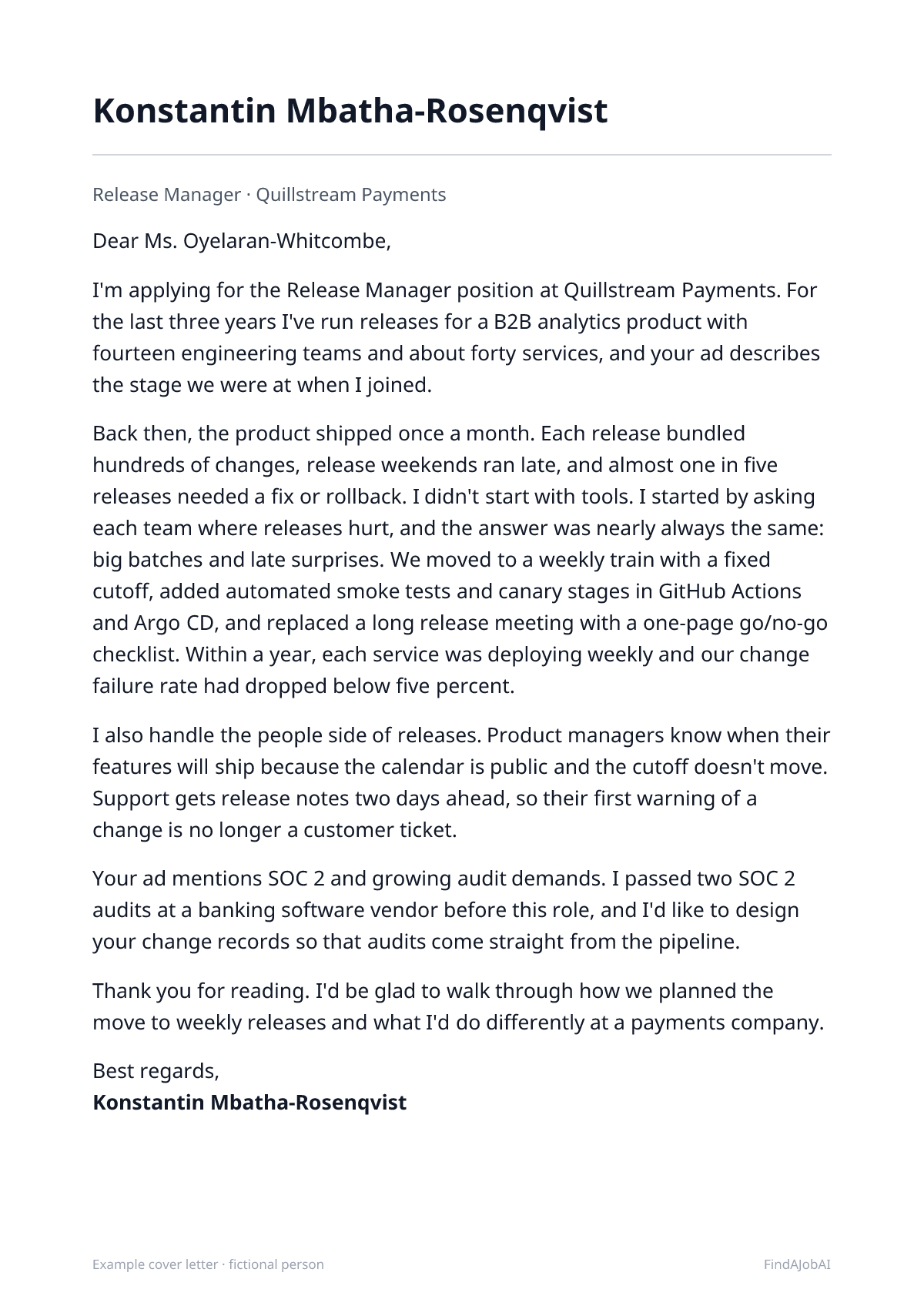
I'm applying for the Release Manager position at Quillstream Payments. For the last three years I've run releases for a B2B analytics product with fourteen engineering teams and about forty services, and your ad describes the stage we were at when I joined.
Back then, the product shipped once a month. Each release bundled hundreds of changes, release weekends ran late, and almost one in five releases needed a fix or rollback. I didn't start with tools. I started by asking each team where releases hurt, and the answer was nearly always the same: big batches and late surprises. We moved to a weekly train with a fixed cutoff, added automated smoke tests and canary stages in GitHub Actions and Argo CD, and replaced a long release meeting with a one-page go/no-go checklist. Within a year, each service was deploying weekly and our change failure rate had dropped below five percent.
I also handle the people side of releases. Product managers know when their features will ship because the calendar is public and the cutoff doesn't move. Support gets release notes two days ahead, so their first warning of a change is no longer a customer ticket.
Your ad mentions SOC 2 and growing audit demands. I passed two SOC 2 audits at a banking software vendor before this role, and I'd like to design your change records so that audits come straight from the pipeline.
Thank you for reading. I'd be glad to walk through how we planned the move to weekly releases and what I'd do differently at a payments company.
Best regards,
Konstantin Mbatha-Rosenqvist
Example 2 · Career changer
QA lead moving into release management
Henrietta leads a QA team of four and has run release testing and sign-off for two years. The ad is for a first release manager hire at a mid-size SaaS company.
Example letter · fictional
Dear Brookhollow Engineering Leadership Team,
I'm writing about the Release Manager opening at Brookhollow Learning. I've led a QA team of four at a SaaS scheduling company for three years, and for the last two, release sign-off has effectively been my job.
It happened gradually. Our releases kept slipping because nobody owned the moment between code freeze and deploy, so I started running a short readiness check every release day: open bugs, test results, migration risks and a named owner for each risky change. Within a few months, the engineering director asked me to run the release calendar too. I added a freeze date to the calendar, wrote a rollback checklist with our platform engineer and set up a GitHub Action that blocks a release tag if the regression suite has failed. Slipped releases went from about one a month to two in the past year.
I know I still have gaps. I've configured pipelines with help rather than built them from scratch, so I've spent the past six months working through a CI/CD course and maintaining our release workflows myself. I also completed ITIL 4 Foundation to learn the change management language larger teams use.
Your ad says Brookhollow wants its first dedicated release manager. Coming from QA, I already think about what can go wrong in a release and how to catch it early, and I'd bring that mindset to the whole process.
I'd welcome a conversation about where your releases hurt most today.
Kind regards,
Henrietta Adeyemi-Sundqvist
Example 3 · Senior or lead
Head of release engineering applying to a regulated health platform
Marguerite leads release engineering for 200 services at an insurer. The ad is for a director to bring continuous delivery to a health records platform.
Example letter · fictional
Dear Dr. Vasquez-Abernathy,
I'm applying for the Director of Release Engineering role at Clearharbor Health Systems. I've worked in software delivery for fifteen years, and for the last six I've led release engineering at a regulated insurance company, where my team of eight supports sixty product teams and about two hundred services.
Your ad says the platform still ships quarterly because every release goes through a long manual approval process. That was our starting point too. Engineers waited weeks for change board meetings, and auditors still found gaps because evidence lived in spreadsheets. We didn't remove controls; we moved them into the pipeline. Every production change now creates its own record linked to the ticket, the code review, the test results and the deploy, and low-risk changes are approved automatically against rules the auditors agreed in advance. Most changes now skip manual review, we've passed four state audits since, and services deploy on demand instead of once a quarter.
The hardest part wasn't technical. Compliance staff needed to trust that automation would hold the line, so I invited them into the design from the first week and gave them dashboards they could check themselves. They became our strongest advocates with leadership.
I haven't worked under HIPAA directly, and I'd expect patient data rules to shape how we handle test environments and production access.
I'd like to hear which parts of your current approval process your auditors value most, so we can keep those while removing the waiting.
Sincerely,
Marguerite Osei-Lindberg
All three letters, and the short version below, are fictional: the people, employers and numbers are invented. Borrow the structure, never the facts.
- Prefer to write it yourself? Use the free cover letter template.
- Check your CV against the job first: the free CV score shows the missing keywords.
Why the first letter works, paragraph by paragraph
Paragraph 1: Opening
States team count, service count and a direct link to the company's stage, which tells a hiring manager the writer has done this at similar scale.
Paragraph 2: Monthly to weekly
One transformation with a clear starting point, a people-first diagnosis, specific tooling changes and two results: cadence and change failure rate. That is the core evidence for a release role.
Paragraph 3: People side
Public calendars, fixed cutoffs and early release notes show the coordination skills that separate release managers from pipeline engineers.
Paragraph 4: Audit link
Answers the ad's compliance requirement with prior audits and a concrete idea, which matters at a fintech.
Paragraph 5: Close
Offers a specific walkthrough and hints at adapting the approach to payments, giving the interviewer a natural first question.
What the career changer's letter does differently
The career changer's letter shows that release management grew naturally out of QA work: a readiness check, then the calendar, a rollback checklist and a release gate in CI. She names her gap in pipeline building and shows how she is closing it, and she presents her QA instincts as a reason to hire her.
What the senior letter does differently
A senior letter shows strategy and trust-building: controls moved into the pipeline rather than removed, auditors brought into the design, and clear results in audits and cadence. The honest note about HIPAA shows judgment about what will be new.
Short release manager cover letter: an email-ready version
Many applications arrive as an email or a small text box, and a full page doesn't fit. This version runs 120 to 150 words and keeps only what a reader needs to decide whether to reply. A release manager replies to a startup CTO who posted the role in a DevOps community channel with an email address instead of an application form.
Short version · email · fictional127 words
Subject: Release Manager – mobile and API releases, staged rollouts – Caspian Eze-Halvorsen
Hi Mr. Delacroix-Mbeki,
I saw your post for a release manager at Ferngate Mobility. I've spent four years running releases for a ride-booking app, covering iOS, Android and the backend APIs behind them.
My main change was adding staged rollouts and feature flags to our mobile releases. We now release to one percent of users, then ten, then fifty, and that approach caught three crash regressions last year before most riders ever saw them. App store rejections also dropped to almost none.
Your post mentions app releases slipping because backend and mobile teams ship on different schedules. I've dealt with exactly that, and I'd be glad to share how we aligned them. My resume is attached, and I'm free for a call this week.
Thanks,
Caspian Eze-Halvorsen
The short email gives one technique with a clear result and links it to the CTO's stated problem of mobile and backend schedules drifting apart, which is enough for a busy CTO to book a call.
Opening lines that work for release manager cover letters
The first sentence decides whether the second gets read. Here are six openings, one for each situation you might be in. Pick the one that matches yours and swap in your own facts: every name and number below is invented.
1. You have a standout result
Last year I moved fourteen product teams from monthly releases to a weekly train and cut our change failure rate below five percent. I'd like to do the same at your company.
2. The ad names a problem you've solved
Your ad says releases have become a weekend-long event. I've replaced that pattern with small weekly releases, canary stages and a short go/no-go checklist.
3. Someone referred you
Your platform lead, Ingrid Oyelowo-Brandt, and I worked on the same delivery team for three years. She mentioned you need someone to bring order to releases, which is why I'm writing.
4. You admire what they build
I've used your open-source release notes tool in two companies and contributed a fix for its label grouping, so I'd enjoy joining the team that builds it.
5. You're new to the field or switching into it
After two years running release sign-off as a QA lead, I want to own the release process fully as a dedicated release manager.
6. You have senior scope or a specialism
I've led release engineering for two hundred services at a regulated insurer, and I'm looking to bring continuous delivery to a platform where audits still slow every change.
How to write a release manager cover letter
Five steps, in the order you'd write them. The shape stays the same for every job (a short opening, proof, a reason for this employer, a close), and what goes into each part is what changes with the role.
Diagnose the release problem in the ad
Release manager roles usually open because releases are slow, risky or unclear. Read the ad for clues such as quarterly cadence, frequent rollbacks, audits or many teams, and choose the part of your experience that matches that problem most closely.
Describe the before and after
Give the cadence, failure rate or lead time you started with, then explain the changes you made to process and tooling, such as smaller batches, canary stages or automated checks. Finish with the same measures after your work so the improvement is clear.
Show both speed and safety
Hiring managers worry that faster releases mean more incidents. Pair any frequency gain with a stability measure, such as change failure rate, rollbacks or severity-1 incidents, so the reader sees you improved both instead of trading one for the other.
Cover the people side
Release managers work across engineering, product, support and sometimes compliance. Add a sentence on how you kept them informed, such as public calendars, fixed cutoffs or early release notes, since coordination is often what the company is missing.
Close with their constraint
End by naming one constraint from the ad, such as audits, mobile app stores or many teams, and what you would want to understand about it first. That gives the reader an easy opening question and shows you read the posting closely.
Release Manager cover letter do's and don'ts
Do
- Give your release cadence before and after your work, plus one failure measure such as change failure rate.
- Name the specific process or tooling changes you made, not just that you improved releases.
- Show how you kept product, support and engineering informed around each release.
Don't
- Don't describe yourself only as a meeting organizer; show the decisions and results you owned.
- Don't claim faster releases without saying whether stability held up.
- Don't list every CI/CD tool you have seen; keep the ones that shaped your main story.
Common release manager cover letter mistakes
Each one is easy to make and quick to fix before you send the letter.
Calling yourself a coordinator of meetings
Meetings are a tool, not the result. Show what changed in cadence, failures or lead time because of how you ran releases.
Speed with no stability figures
Faster releases that break things are not a win. Pair deploy frequency with a failure measure so the reader trusts the improvement.
A tool list in place of a story
Naming ten CI/CD tools shows exposure, not skill. Mention the two or three that made your main result possible and what you did with them.
Ignoring compliance when the ad mentions it
If the role involves SOC 2, SOX or health data, address it directly with audits you passed or controls you designed.
A close that asks only for an interview
Use the last line to show interest in their release problem, such as where releases hurt most, so the reader has a reason to call.
Email subject lines for release manager applications
Applying by email? Put the job title, any reference number and your name in the subject line.
- Release Manager – weekly release train for 14 teams – Konstantin Mbatha-Rosenqvist
- Release Manager application – QA lead with release sign-off ownership – Henrietta Adeyemi-Sundqvist
- Application: Head of Release Engineering (Req. 6620) – regulated continuous delivery
Everything for Release Managers
- Release Manager resume exampleA full resume, plus bullet and summary examples
- Release Manager interview questions30 questions with sample answers
- Release Manager job descriptionDuties, skills and requirements
- Career change cover letter: template + examples
Other cover letter examples
Release Manager cover letter FAQ
What should I write in a release manager cover letter?
Describe one release process you improved: the cadence and problems you started with, the changes you made to process and tooling, and the results in deploy frequency and failed changes. Add how you kept stakeholders informed and link it to the company's situation.
How do I write a release manager cover letter without the job title?
Show release work you have done in QA, DevOps, project management or engineering roles, such as running release sign-off or a deploy calendar. Name any results and the skills you are building, such as pipeline configuration or change management.
Should a release manager cover letter mention DORA metrics?
Yes, if you tracked them. Deploy frequency, lead time and change failure rate are widely understood and make your results easy to compare. Explain them briefly in case the reader is a recruiter rather than an engineer.
How we built this page
The FindAJobAI team wrote the three example letters, the short email version, the opening lines and the advice for release manager roles. The people, employers and numbers in the letters are invented; the structure, the kind of evidence and the order of the paragraphs are the parts to copy.
Once we track enough live release manager job ads, this page also shows the skills they ask for most, counted the same way as our in-demand skills report.
Last reviewed on November 1, 2026.