Research Assistant Cover Letter Example (2026)
By FindAJobAI Team Updated How we built this page
A principal investigator reading a research assistant letter wants to know whether you can be trusted with their study. Show the methods you have used, how carefully you follow protocol, which tools you can analyse data in, and why this lab's questions interest you. Specific numbers about participants, samples or records do more than enthusiasm alone.
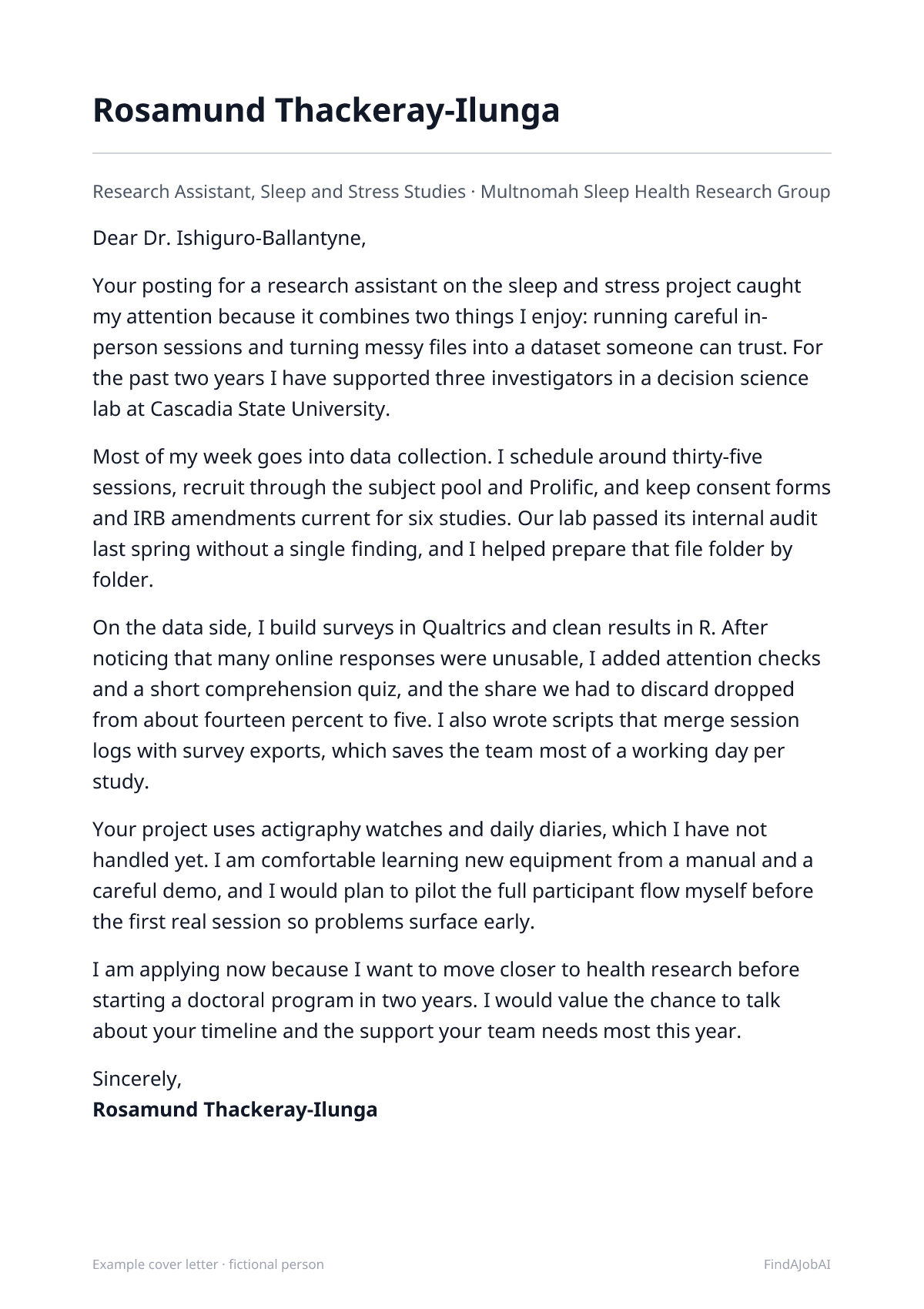
Research Assistant cover letter template
This letter as a one-page template: an opening that names the job and your strongest fact, proof that answers the ad, a reason for this employer and a short close.
After you sign up, FindAJobAI drafts your own letter for a real job from your CV in this format, and you edit it before you send it.
Example 1 · Experienced
Research assistant moving to a health psychology lab
Rosamund has two years in a decision science lab running online and in-person studies. The ad is for a research assistant on a sleep and stress project.
Example letter · fictional
Dear Dr. Ishiguro-Ballantyne,
Your posting for a research assistant on the sleep and stress project caught my attention because it combines two things I enjoy: running careful in-person sessions and turning messy files into a dataset someone can trust. For the past two years I have supported three investigators in a decision science lab at Cascadia State University.
Most of my week goes into data collection. I schedule around thirty-five sessions, recruit through the subject pool and Prolific, and keep consent forms and IRB amendments current for six studies. Our lab passed its internal audit last spring without a single finding, and I helped prepare that file folder by folder.
On the data side, I build surveys in Qualtrics and clean results in R. After noticing that many online responses were unusable, I added attention checks and a short comprehension quiz, and the share we had to discard dropped from about fourteen percent to five. I also wrote scripts that merge session logs with survey exports, which saves the team most of a working day per study.
Your project uses actigraphy watches and daily diaries, which I have not handled yet. I am comfortable learning new equipment from a manual and a careful demo, and I would plan to pilot the full participant flow myself before the first real session so problems surface early.
I am applying now because I want to move closer to health research before starting a doctoral program in two years. I would value the chance to talk about your timeline and the support your team needs most this year.
Sincerely,
Rosamund Thackeray-Ilunga
Example 2 · Entry level
Biology graduate applying for a first full-time lab job
Thaddeus graduates this June after two semesters of undergraduate research. The ad is for a research assistant in a university immunology lab.
Example letter · fictional
Dear Dr. Marchetti-Ofori,
I am writing to apply for the Research Assistant I position in your immunology lab. I will finish my biology degree at Upper Willamette College in June, and I am looking for a full-time bench role where I can build solid technique before applying to graduate programs.
For two semesters I worked in a microbial ecology lab, logging about one hundred twenty hours at the bench. I ran PCR and gels on roughly three hundred soil samples, made culture media every week and kept the freezer and autoclave logs. Later I ran eighteen ELISA plates for a graduate student, and I learned the hard way that pipetting consistency matters: my first two plates had to be repeated before my duplicate wells came within ten percent of each other.
That experience taught me to slow down, label everything twice and write notebook entries that someone else could follow. My mentor began asking me to train new volunteers on our sample handling steps, which I took as a sign the habit stuck.
Your lab's work on T cell signaling in autoimmune disease is new to me beyond my coursework, and I would expect to spend my first weeks reading the papers your team recommends and shadowing a senior member on flow cytometry. I am reliable with early mornings and long incubation days, and I would bring the same care to your mouse colony records and sample inventory.
Thank you for reading my application. My CV and a reference from my research mentor are attached, and I can start as soon as my final exams finish in early June.
Kind regards,
Thaddeus Wrenfield-Abara
Example 3 · Senior or lead
Senior research associate applying to manage a multi-site study
Ignatius coordinates data for a large public health cohort. The ad is for a study manager on a multi-site nutrition trial.
Example letter · fictional
Dear Dr. Haldane-Musa,
I am applying for the Senior Research Associate role managing your multi-site nutrition trial. I have spent eight years in public health research, and for the last five I have run data collection for a cohort of about four thousand adults across three Oregon counties, supervising five research assistants.
When I took over follow-up, completion had slipped to around seventy percent. I rebuilt our REDCap project with automated reminders, a clearer contact schedule and a short call script for assistants, and completion climbed to the mid-eighties over two waves. I also wrote the codebook that new staff now use in their first week, which cut onboarding questions noticeably.
Beyond operations, I draft analysis plans, run descriptive and regression models in Stata, and write the data and progress sections of two annual federal grant reports. Every report has gone in on time, partly because I keep a running deliverables tracker that the investigators review with me each month.
Your trial has four sites with separate coordinators, which is a step up from my single-institution cohort. I would want to start by visiting each site, comparing how they handle consent and data entry, and agreeing on one shared checklist before the next enrollment wave. I have not managed a trial budget directly, so I would lean on your finance staff while I learn your process and ask for a monthly review of spending against the plan until I am confident with it.
I would welcome a conversation about the trial's enrollment goals and where your coordinators need the most support right now.
Best regards,
Ignatius Pellegrino-Achebe
All three letters, and the short version below, are fictional: the people, employers and numbers are invented. Borrow the structure, never the facts.
- Prefer to write it yourself? Use the free cover letter template.
- Check your CV against the job first: the free CV score shows the missing keywords.
Why the first letter works, paragraph by paragraph
Paragraph 1: Opening
Names the project, explains why it fits the writer's strengths and gives current lab and tenure in a few lines.
Paragraph 2: Data collection
Puts weekly session counts, recruitment sources and a clean audit up front, which is what investigators worry about most.
Paragraph 3: Data handling
Shows a problem the writer noticed, the fix and the result in plain numbers, proving judgment as well as skill.
Paragraph 4: Honest gap
Admits no experience with actigraphy and gives a concrete plan to learn it, which reads as trustworthy.
Paragraph 5: Close
Explains the career motive and asks about the team's needs, so the reader understands how long the writer might stay.
What the entry-level letter does differently
The new graduate's letter uses lab hours, sample counts and a plate total instead of course titles. It includes a small mistake and what it taught, then links a careful notebook habit to the immunology lab's colony and inventory records, which shows awareness of daily lab work.
What the senior letter does differently
The senior letter reports team size, cohort scale and a completion rate the writer improved. It shows grant reporting discipline with a simple habit and is honest about two gaps, multi-site coordination and budgets, with a concrete first step for each.
Short research assistant cover letter: an email-ready version
Many applications arrive as an email or a small text box, and a full page doesn't fit. This version runs 120 to 150 words and keeps only what a reader needs to decide whether to reply. A research assistant emails a professor after reading that her lab is hiring for a qualitative interview study.
Short version · email · fictional120 words
Subject: Research Assistant, qualitative interviews – 45 interviews coded in NVivo – Leocadia Brannigan-Sato
Hi Dr. Brightman-Ozturk,
I read on your lab page that you are hiring a research assistant for the caregiver interview study. I have spent the past year on a housing study, where I conducted forty-five semi-structured interviews and coded them in NVivo with a second coder.
I write a short memo within a day of each interview, and our team used those memos to adjust the interview guide twice during data collection. I am also comfortable with consent conversations by phone and with participants who need extra time or a family member present.
My CV is attached. Could we schedule a short call this week to talk about your interview schedule and the support your team needs?
Best,
Leocadia Brannigan-Sato
The email names the study, gives an interview count and coding tool, and describes a memo habit that helped the team. It stays brief because the CV holds the details, and it ends with a direct request for a call.
Opening lines that work for research assistant cover letters
The first sentence decides whether the second gets read. Here are six openings, one for each situation you might be in. Pick the one that matches yours and swap in your own facts: every name and number below is invented.
1. You have a standout result
Adding two attention checks to our online surveys cut discarded responses from about fourteen percent to five, and I would like to bring that kind of care to your data collection.
2. The ad names a problem you've solved
Your lab's project on adolescent sleep is the reason I am applying, because my honors thesis looked at screen time and bedtime routines in a small student sample.
3. Someone referred you
I have run about thirty-five study sessions a week for two years, and I am looking for a lab where that experience supports health research.
4. You admire what they build
My research mentor, Dr. Lucas Brandvold, suggested I contact you because your team needs someone comfortable with both bench work and careful record keeping.
5. You're new to the field or switching into it
After coordinating follow-up for a four-thousand-person cohort, I want to apply those systems to a multi-site trial like yours.
6. You have senior scope or a specialism
I graduate in June with two semesters of molecular lab work, and your posting for a first-year research assistant matches the bench skills I want to deepen.
How to write a research assistant cover letter
Five steps, in the order you'd write them. The shape stays the same for every job (a short opening, proof, a reason for this employer, a close), and what goes into each part is what changes with the role.
Open with the study, not yourself
Name the project or lab and explain in one sentence why it matches what you have done. Investigators read many letters that start with a degree title, so leading with their research question shows you looked at the lab's work before applying.
Prove protocol discipline
Give evidence that you follow procedures exactly: audit results, error rates on data entry, reliability scores or careful notebook habits. A principal investigator's biggest risk with a new assistant is lost or unusable data, so address it directly with figures.
Show one data problem you solved
Describe a moment when you spotted an issue in data quality or workflow, the change you made and the result. This shows judgment, which separates a good assistant from someone who only follows instructions, and it gives the reader something to ask about.
Be honest about new methods
If the posting lists equipment or techniques you have not used, say so plainly and explain how you would learn them, such as piloting the procedure or shadowing a senior team member. Investigators prefer that to discovering a gap later.
Explain your timeline
Many labs hire assistants for one to three years. A short line about graduate school or long-term research plans helps the reader judge fit, as long as the rest of the letter stays focused on the work you will do now.
Research Assistant cover letter do's and don'ts
Do
- Count participants, samples, sessions or records in at least two sentences.
- Name the methods and software that appear in the posting and say how you used them.
- Mention one thing that draws you to this lab's research questions specifically.
Don't
- Don't describe unpublished findings from your current lab.
- Don't claim methods you have only read about; say you are ready to learn them.
- Don't spend most of the letter on graduate school plans instead of the job.
Common research assistant cover letter mistakes
Each one is easy to make and quick to fix before you send the letter.
Writing only about passion for science
Replace general enthusiasm with counts of participants, samples or records and the tools you used to handle them.
Sending the same letter to every lab
Mention the specific project or paper that drew you in and connect it to your experience in one or two lines.
Overstating your role in publications
Say exactly what you contributed, such as figures or methods text, and give your author position honestly.
Leaving out ethics and safety training
Mention IRB, consent or biosafety training; investigators need assistants who keep studies inside approved procedures.
Leaving the reader unsure how long you will stay
Add one sentence on your plans so the lab can judge whether the position's timeline suits you.
Email subject lines for research assistant applications
Applying by email? Put the job title, any reference number and your name in the subject line.
- Research Assistant, Sleep and Stress Studies – 2 years, Qualtrics and R – Rosamund Thackeray-Ilunga
- Research Assistant I, Immunology – BS Biology 2026, PCR and ELISA – Thaddeus Wrenfield-Abara
- Application: Senior Research Associate (Posting 4471) – Ignatius Pellegrino-Achebe
Everything for Research Assistants
- Research Assistant resume exampleA full resume, plus bullet and summary examples
- Research Assistant interview questions30 questions with sample answers
- Research Assistant job descriptionDuties, skills and requirements
- Cover letter with no experience: templates
Other cover letter examples
Research Assistant cover letter FAQ
What should a research assistant cover letter include?
Your research setting and methods, the tools you use for data, one or two numbers showing volume or care, and a sentence on why the lab's topic interests you. Keep it to one page.
Should I mention graduate school plans in a research assistant cover letter?
Briefly, yes. Investigators know many assistants go on to graduate study, and a clear plan helps them judge how long you will stay. Keep the focus on what you will do for the lab now.
Who should I address a research assistant cover letter to?
Address the principal investigator or the study manager named in the posting. If no name is given, the lab website usually lists who leads the project.
How we built this page
The FindAJobAI team wrote the three example letters, the short email version, the opening lines and the advice for research assistant roles. The people, employers and numbers in the letters are invented; the structure, the kind of evidence and the order of the paragraphs are the parts to copy.
Once we track enough live research assistant job ads, this page also shows the skills they ask for most, counted the same way as our in-demand skills report.
Last reviewed on November 1, 2026.