Rust Developer Cover Letter Example (2026)
By FindAJobAI Team Updated How we built this page
Rust job ads tend to describe a system under pressure: a service that needs more throughput per machine, C++ code that keeps producing memory bugs, or a tool that must be fast and dependable. A strong rust developer cover letter answers that pressure with one system you built or rewrote in Rust, the design choices that made it safe and fast, and the measurements that proved it.
Rust Developer cover letter template
This letter as a one-page template: an opening that names the job and your strongest fact, proof that answers the ad, a reason for this employer and a short close.
After you sign up, FindAJobAI drafts your own letter for a real job from your CV in this format, and you edit it before you send it.
Example 1 · Experienced
Rust infrastructure engineer applying to a streaming data company
Isidora rewrote a log pipeline in Rust at an observability vendor. The ad asks for Tokio, high-throughput services and profiling.
Example letter · fictional
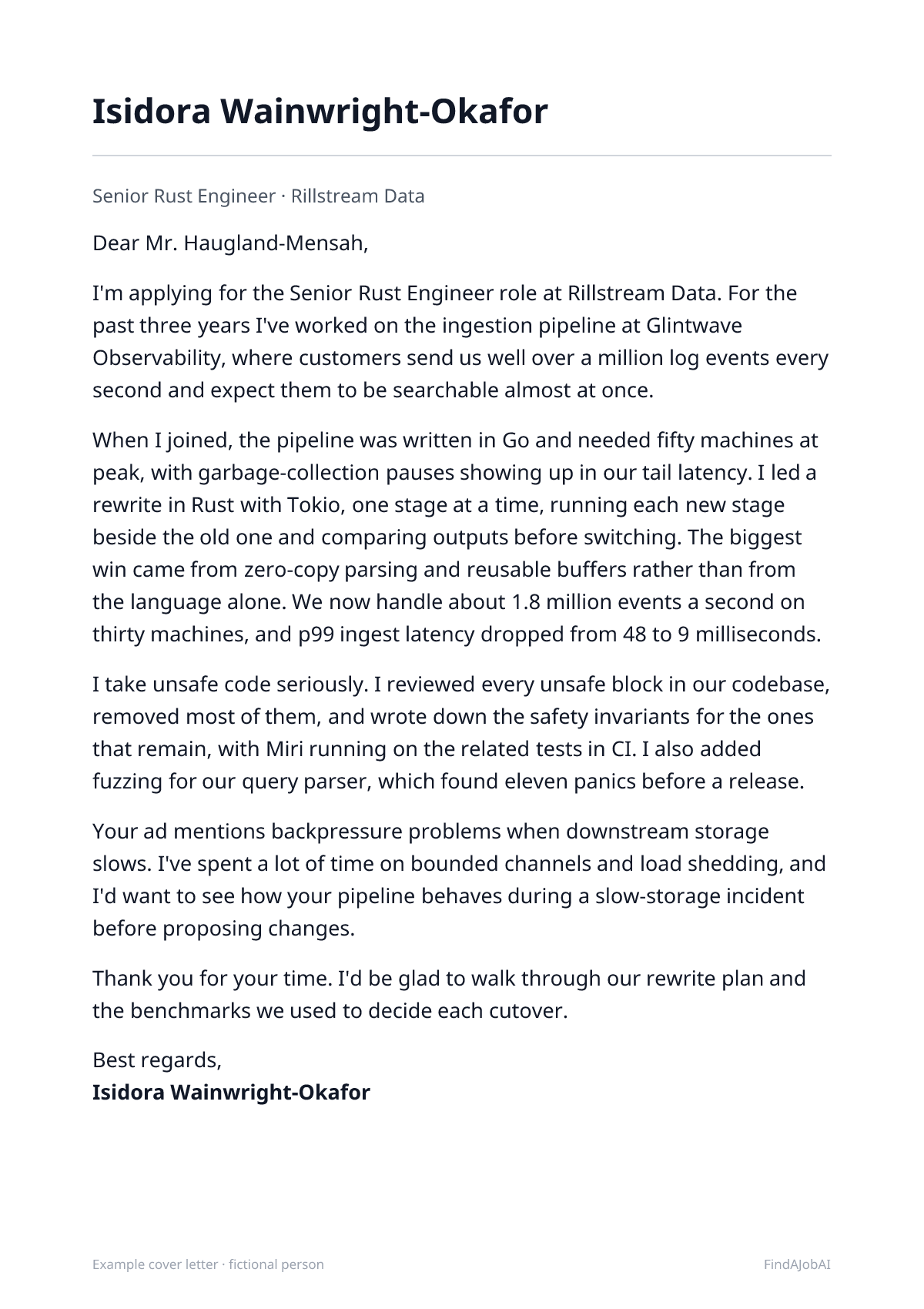
Dear Mr. Haugland-Mensah,
I'm applying for the Senior Rust Engineer role at Rillstream Data. For the past three years I've worked on the ingestion pipeline at Glintwave Observability, where customers send us well over a million log events every second and expect them to be searchable almost at once.
When I joined, the pipeline was written in Go and needed fifty machines at peak, with garbage-collection pauses showing up in our tail latency. I led a rewrite in Rust with Tokio, one stage at a time, running each new stage beside the old one and comparing outputs before switching. The biggest win came from zero-copy parsing and reusable buffers rather than from the language alone. We now handle about 1.8 million events a second on thirty machines, and p99 ingest latency dropped from 48 to 9 milliseconds.
I take unsafe code seriously. I reviewed every unsafe block in our codebase, removed most of them, and wrote down the safety invariants for the ones that remain, with Miri running on the related tests in CI. I also added fuzzing for our query parser, which found eleven panics before a release.
Your ad mentions backpressure problems when downstream storage slows. I've spent a lot of time on bounded channels and load shedding, and I'd want to see how your pipeline behaves during a slow-storage incident before proposing changes.
Thank you for your time. I'd be glad to walk through our rewrite plan and the benchmarks we used to decide each cutover.
Best regards,
Isidora Wainwright-Okafor
Example 2 · Career changer
Python data engineer moving into Rust development
Leopold has been a Python data engineer for five years and has written Rust extensions for his team. The ad is for a mid-level Rust role.
Example letter · fictional
Dear Pinecove Engineering Team,
The Rust Developer opening at Pinecove Analytics matches the direction my work has taken for the last two years. I've been a Python data engineer at a payments network for five years, and I began writing Rust when our nightly validation jobs stopped fitting in their time window.
The job checked about six million settlement records every night and took close to three hours in Python. Rather than rewrite the whole pipeline, I moved the validation core into a Rust library and exposed it to Python through PyO3, so the rest of the team kept their familiar tools. The checks now finish in a few minutes, and two colleagues have since added rules to the Rust code with my reviews.
Since then I've worked through the async chapters of the Tokio documentation, built a small HTTP service with axum for internal metrics, and contributed documentation fixes to a CSV parsing crate. I'm comfortable with ownership and error handling, and I'm still building depth in async design and performance profiling at service scale.
Your ad says the team is moving Python services to Rust gradually. That is exactly the path I followed, and I understand how to make that move without leaving Python colleagues behind.
The validation library and the metrics service are on my GitHub, and I'd be happy to walk through either one on a call, including the parts of the PyO3 boundary that took me longest to get right and what I would design differently now.
Kind regards,
Leopold Amankwah-Rasmussen
Example 3 · Senior or lead
Storage engine lead applying to a database startup
Hyacinth leads a Rust storage engine team at a cloud database company. The ad is for a principal engineer to design a new storage layer.
Example letter · fictional
Dear Dr. Vasquez-Lindholm,
I'm applying for the Principal Rust Engineer role at Tesserline Databases. For the past five years I've led the storage engine team at Quarrystone Data, where our Rust engine stores about 2.4 petabytes for roughly nine hundred customers.
Your ad says the current storage layer struggles with write amplification as datasets grow. We faced the same issue two years ago. Instead of tuning parameters again, I spent a month building a simulator that replayed real customer write patterns against different compaction strategies. That data led us to a new scheduler that prioritizes compaction by read heat, which cut write amplification by about a third and lowered tail read latency noticeably. The simulator is now part of how we evaluate every storage change.
Safety standards matter as much to me as speed. I set our rules for unsafe code, including mandatory peer reviews, Miri checks and fuzzing for every parser, and we have gone four years without a memory-safety incident in production. I also mentor engineers moving from C++, and two of them now lead parts of the engine themselves, including the write path.
I haven't built storage for time-series workloads, and I'd expect your append-heavy patterns to change some of our assumptions about compaction, caching and retention. I would plan to spend my first weeks with the engineers who run your largest customers' clusters.
I'd enjoy hearing which customer workloads hurt most today and how your team currently measures storage changes before they ship.
Sincerely,
Hyacinth Oyelaran-Brekke
All three letters, and the short version below, are fictional: the people, employers and numbers are invented. Borrow the structure, never the facts.
- Prefer to write it yourself? Use the free cover letter template.
- Check your CV against the job first: the free CV score shows the missing keywords.
Why the first letter works, paragraph by paragraph
Paragraph 1: Opening
Sets the scale, over a million events a second, so the reader understands why Rust was the right tool.
Paragraph 2: The rewrite
Shows a careful migration with side-by-side comparisons, credits the real performance cause and gives throughput, fleet size and latency figures.
Paragraph 3: Unsafe-code paragraph
Unsafe review, Miri and fuzzing show the judgment Rust teams look for beyond raw speed.
Paragraph 4: Why this company
Picks up the ad's backpressure problem and proposes learning before changing anything.
Paragraph 5: Close
Offers to discuss benchmarks and cutover decisions, which gives a concrete interview topic.
What the career changer's letter does differently
The career changer leads with a Rust library that solved a real time-window problem while keeping Python colleagues productive. Learning steps are specific, the gap in async design is stated honestly, and the experience maps directly onto the company's gradual migration.
What the senior letter does differently
This principal-level letter focuses on method: build a simulator from real data before changing the design. Safety standards with a long incident-free record and mentoring results show leadership, and the gap on time-series workloads is named openly.
Short rust developer cover letter: an email-ready version
Many applications arrive as an email or a small text box, and a full page doesn't fit. This version runs 120 to 150 words and keeps only what a reader needs to decide whether to reply. A Rust developer replies to a founder who posted the opening on a Rust community forum and asked candidates to reply by direct message.
Short version · email · fictional124 words
Subject: Rust Developer – Tokio proxy at 60,000 connections per node – Gwendolyn Okoro-Fairbanks
Hi Mr. Petrakis,
Your post on the Rust community forum about a backend role at Latchpoint caught my attention. I've spent three years writing Rust network services at a content delivery company, most recently a Tokio-based TLS proxy that sits in front of our edge caches.
That proxy now terminates about sixty thousand connections per node with rustls, and adding bounded channels for backpressure ended the out-of-memory crashes we used to see during traffic bursts.
You mentioned an inspection proxy that falls over under load spikes, which sounds very close to the problem I spent most of last year solving. My resume and GitHub are linked below, and I'm free for a short call most weekdays after two, Central European time.
Thanks,
Gwendolyn Okoro-Fairbanks
A founder reading forum replies wants a fast, credible signal. This message offers a single proxy with its connection count and one reliability fix, then links it to the load-spike problem from the post.
Opening lines that work for rust developer cover letters
The first sentence decides whether the second gets read. Here are six openings, one for each situation you might be in. Pick the one that matches yours and swap in your own facts: every name and number below is invented.
1. You have a standout result
Last year I led a Rust rewrite of a log pipeline that now handles 1.8 million events a second on 40% fewer machines. I'd like to bring that work to your streaming platform.
2. The ad names a problem you've solved
Your ad says your C++ parser keeps producing memory bugs. I replaced a similar module with Rust and ended a class of buffer overflows.
3. Someone referred you
Anouk Verhoeven, who works on your query engine, and I maintained a Rust crate together for two years. She thought my storage background would fit your team and pointed me to this opening.
4. You admire what they build
Your company's Rust tracing crate runs in all five of my team's services, and I contributed a fix for its span filtering in the autumn.
5. You're new to the field or switching into it
After five years of Python data engineering, I started writing Rust to speed up our slowest jobs. I want to make it my main language.
6. You have senior scope or a specialism
I've led a Rust storage engine team for five years, and I'm looking to design a new storage layer from its first benchmark.
How to write a rust developer cover letter
Five steps, in the order you'd write them. The shape stays the same for every job (a short opening, proof, a reason for this employer, a close), and what goes into each part is what changes with the role.
Pin down the pressure behind the Rust role
Rust roles usually exist because of a performance ceiling, a safety problem in C or C++ code, or a need for dependable tools. Read the ad for clues like throughput targets, memory bugs or rewrites, and pick the system of yours that faced the same pressure.
Describe the system before you touched it
Open the main paragraph with the starting point: machines needed at peak, crash counts, garbage-collection pauses or a job that missed its window. This gives the reader a baseline that makes your Rust work and its numbers meaningful.
Explain the design choice, not just the language
Rust alone rarely explains a big improvement. Say what you changed in the design, such as zero-copy parsing, bounded concurrency or better data layout, and why Rust made that change safer or easier to get right than the old code.
Prove it with benchmarks or production data
Give throughput, latency, memory or incident figures before and after, and name how you measured them, such as criterion benchmarks, replayed traffic or production dashboards. Rust teams are skeptical of speed claims that come without a method.
Show your safety habits and close
Add a sentence on unsafe review, fuzzing or Miri, because soundness is what Rust teams protect most. Then end with one part of their system you would want to study first, which gives the interviewer an easy question to open with.
Rust Developer cover letter do's and don'ts
Do
- Describe one Rust system, the design choices behind it and figures from benchmarks or production.
- Mention how you handled safety, such as unsafe review, fuzzing or Miri.
- Connect your work to the ad's specific bottleneck or migration.
Don't
- Don't credit Rust alone for a speedup that came from better design.
- Don't present heavy unsafe use as a strength without explaining the safeguards.
- Don't fill the letter with crate names; one or two that matter are enough.
Common rust developer cover letter mistakes
Each one is easy to make and quick to fix before you send the letter.
Crediting the language for everything
Saying Rust made it fast hides your judgment. Explain the design change behind the improvement and how Rust supported it.
Listing crates instead of outcomes
Tokio, serde, axum and rayon in one sentence read like a skills section. Keep the one that mattered most to your story.
Speed claims without measurement
Give the numbers and say how you got them, whether benchmarks, profiling or production metrics.
Avoiding the topic of unsafe code
Rust teams want to know how you treat unsafe blocks. One sentence on reviews, invariants or Miri builds trust.
Overstating side-project scale
A hobby crate is valuable, but describe its real users and load plainly rather than presenting it as production infrastructure.
Email subject lines for rust developer applications
Applying by email? Put the job title, any reference number and your name in the subject line.
- Senior Rust Engineer application – Tokio ingestion at 1.8M events/sec – Isidora Wainwright-Okafor
- Rust Developer – Python data engineer with PyO3 production library – Leopold Amankwah-Rasmussen
- Application: Rust Engineer, Streaming Platform (Req. 6142) – Isidora Wainwright-Okafor
Everything for Rust Developers
- Rust Developer resume exampleA full resume, plus bullet and summary examples
- Rust Developer interview questions30 questions with sample answers
- Rust Developer job descriptionDuties, skills and requirements
- Career change cover letter: template + examples
Other cover letter examples
Rust Developer cover letter FAQ
What should I write in a rust developer cover letter?
Pick one Rust service, library or tool you built or rewrote. Explain the problem, the design choices that mattered, such as async structure or zero-copy parsing, and the measured result. Add a line on how you handle safety and tie it to the ad.
How do I write a rust developer cover letter without a Rust job?
Show Rust you shipped anyway, such as an extension for your team, an internal tool or an open-source crate, and say who uses it. Be specific about what you have learned and honest about the areas you are still building.
Should I mention C++ or Go in a Rust cover letter?
Yes, if it explains a rewrite or shows systems depth. Many Rust teams are replacing C++ or Go components, so experience with the old code and the reason for the move is directly relevant.
How we built this page
The FindAJobAI team wrote the three example letters, the short email version, the opening lines and the advice for rust developer roles. The people, employers and numbers in the letters are invented; the structure, the kind of evidence and the order of the paragraphs are the parts to copy.
Once we track enough live rust developer job ads, this page also shows the skills they ask for most, counted the same way as our in-demand skills report.
Last reviewed on November 1, 2026.