Social Worker Cover Letter Example (2026)
By FindAJobAI team Updated How we built this page
Social worker ads usually name a population and a setting, hospital, school, child welfare agency, so the cover letter needs to show you've actually sat with that population under that setting's pressures. Name a case you carried, what you coordinated, and what changed for the person, without revealing anything that would identify them.
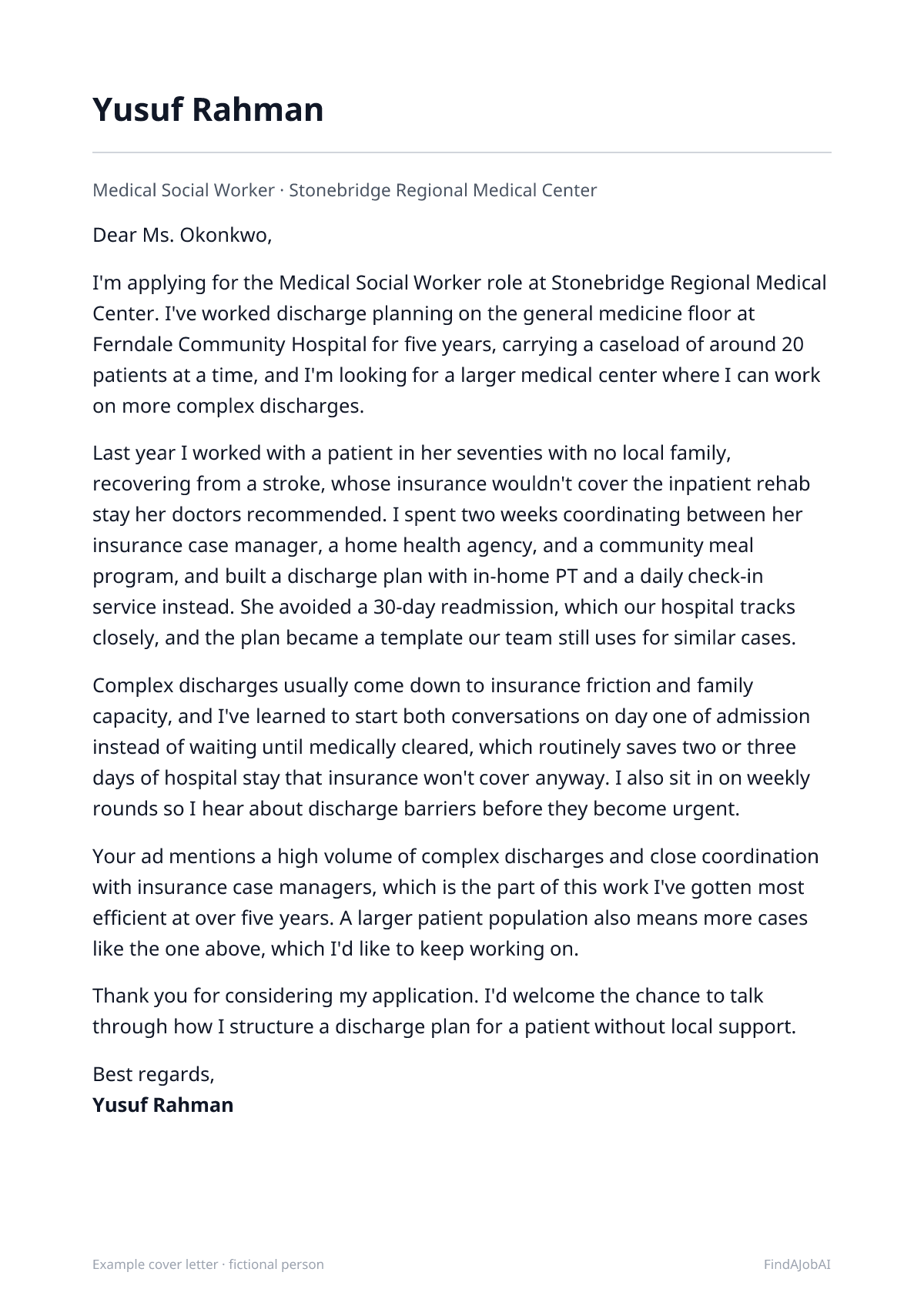
Social Worker cover letter template
This letter as a one-page template: an opening that names the job and your strongest fact, proof that answers the ad, a reason for this employer and a short close.
After you sign up, FindAJobAI drafts your own letter for a real job from your CV in this format, and you edit it before you send it.
Example 1 · Experienced
Hospital social worker applying to a larger medical center's discharge team
Yusuf handles discharge planning for a mid-size hospital's general medicine floor. The ad asks for complex discharges and insurance coordination.
Example letter · fictional
Dear Ms. Okonkwo,
I'm applying for the Medical Social Worker role at Stonebridge Regional Medical Center. I've worked discharge planning on the general medicine floor at Ferndale Community Hospital for five years, carrying a caseload of around 20 patients at a time, and I'm looking for a larger medical center where I can work on more complex discharges.
Last year I worked with a patient in her seventies with no local family, recovering from a stroke, whose insurance wouldn't cover the inpatient rehab stay her doctors recommended. I spent two weeks coordinating between her insurance case manager, a home health agency, and a community meal program, and built a discharge plan with in-home PT and a daily check-in service instead. She avoided a 30-day readmission, which our hospital tracks closely, and the plan became a template our team still uses for similar cases.
Complex discharges usually come down to insurance friction and family capacity, and I've learned to start both conversations on day one of admission instead of waiting until medically cleared, which routinely saves two or three days of hospital stay that insurance won't cover anyway. I also sit in on weekly rounds so I hear about discharge barriers before they become urgent.
Your ad mentions a high volume of complex discharges and close coordination with insurance case managers, which is the part of this work I've gotten most efficient at over five years. A larger patient population also means more cases like the one above, which I'd like to keep working on.
Thank you for considering my application. I'd welcome the chance to talk through how I structure a discharge plan for a patient without local support.
Best regards,
Yusuf Rahman
Example 2 · Career changer
Teacher's aide moving into child welfare after earning an MSW
Dominique was a special education aide for six years and just finished her MSW. The ad mentions trauma-informed care and home visits.
Example letter · fictional
Dear Hiring Manager,
I'm applying for the Child Welfare Case Worker role at Larkspur County Family Services. For six years I worked as a special education aide, and I recently completed my MSW with a 400-hour field placement at a child welfare agency, because I wanted to work directly on the family issues I kept seeing show up in the classroom.
During my field placement, I carried a reduced caseload of six families under supervision, including one family where a father's substance use had led to a safety plan. I did the home visits, documented progress against the plan, and coordinated with his outpatient treatment program; by the time my placement ended, the family had moved from a safety plan to a service plan, and my supervisor kept the case with the agency's recommendation rather than escalating it.
From the classroom, I bring six years of reading what's going on at home from how a child behaves at school, and de-escalating a child mid-crisis without raising my own voice, which I did on a near-weekly basis for one student with a documented trauma history. I'm trained in trauma-informed care and comfortable writing the kind of documentation child welfare work requires, since I wrote detailed behavior incident reports as an aide.
Your posting emphasizes trauma-informed practice and home visits, both central to my field placement, and I'd bring a classroom-level understanding of child development that most new caseworkers haven't had the chance to build yet.
Thank you for your time. My field placement supervisor, Grace Odom, LCSW, is listed as a reference and can speak to the case above.
Kind regards,
Dominique Fontaine
Example 3 · Senior or lead
Clinical supervisor applying to lead a county caseworker team
Grace supervises six caseworkers at a county agency. The ad is for a clinical supervisor to reduce caseworker turnover and standardize safety plan reviews.
Example letter · fictional
Dear Mr. Aldridge,
I'm applying for the Clinical Supervisor role at Marrow County Department of Social Services. For the last three years I've supervised a team of six caseworkers at Larkspur County Family Services, and before that I spent seven years as a frontline caseworker, so I understand both sides of the chair this role sits in.
Your ad mentions high caseworker turnover, which my own agency struggled with before I started tracking why people left. The pattern was clear: new caseworkers felt unsupported on their first high-risk home visit. I built a shadowing requirement where no caseworker does a solo high-risk visit until they've completed three with a supervisor, and paired every new hire with a mentor for their first six months. Turnover on my team dropped from about 40% in the year before I started supervising to under 15% last year.
Safety plan reviews were inconsistent across caseworkers before I standardized them. I introduced a structured review template that every caseworker uses before closing or escalating a case, with a second signature required on any plan involving a prior substance use flag. A state audit last year found zero documentation gaps on my team's cases, compared to a flagged pattern on two other teams in the same audit.
I haven't managed a caseload budget directly, since that's handled at the regional level in my current agency, and I'd want to understand how Marrow County structures that before claiming experience there.
I'd welcome a conversation about where your current team loses caseworkers and how safety plan reviews are handled today.
Sincerely,
Grace Odom
All three letters, and the short version below, are fictional: the people, employers and numbers are invented. Borrow the structure, never the facts.
- Prefer to write it yourself? Use the free cover letter template.
- Check your CV against the job first: the free CV score shows the missing keywords.
Why the first letter works, paragraph by paragraph
Paragraph 1: Opening
Names the setting, caseload size, and years of experience, which tells the reader this is someone who already carries real caseload weight, not an entry-level description.
Paragraph 2: The case that shows judgment
A specific, de-identified case with a clear obstacle (insurance denial), the coordination involved, and a measurable outcome (avoided readmission) shows clinical judgment under real constraints.
Paragraph 3: How the work actually runs
Describes a habit (starting conversations on day one, attending weekly rounds) that shows efficiency and foresight, which matters more at scale than any single success story.
Paragraph 4: Why this employer
Mirrors the ad's own language (complex discharges, insurance coordination) and explains what a larger setting offers the writer, rather than only what the writer offers the employer.
Paragraph 5: Close
Offers to discuss the writer's own process rather than repeating a general request for an interview, which signals confidence in the work itself.
What the career changer's letter does differently
The career changer's letter is built around one supervised case from her MSW field placement, with a concrete turning point (the family moved from a safety plan to a service plan) instead of a general claim about caring for children. It credits her classroom years for a specific, relevant skill, reading a child's home situation, and names a licensed reference who supervised the actual case.
What the senior letter does differently
A clinical supervisor letter reports team-wide patterns instead of individual cases: a turnover rate that moved from about 40 percent to under 15 percent, a structured safety plan review template, and a clean state audit result. It also names a real gap, caseload budgeting, rather than implying full authority over everything the role might touch.
Short social worker cover letter: an email-ready version
Many applications arrive as an email or a small text box, and a full page doesn't fit. This version runs 120 to 150 words and keeps only what a reader needs to decide whether to reply. A social worker answers a hospice agency's short online application form, sent as an email because the portal had no upload option that day.
Short version · email · fictional128 words
Subject: Hospice Social Worker (LMSW) – family support and bereavement – Teo Castellano
Hello Ms. Petrova,
I'm applying for the Hospice Social Worker role at Willowmere Hospice Care. I've worked in hospice social work for three years, supporting an average caseload of 15 families at a time through end-of-life planning and bereavement.
One family I worked with had three adult children in conflict over their father's care plan. I ran two family meetings to get everyone aligned on his wishes, which let him remain at home through his final weeks instead of an inpatient transfer the family was considering under stress.
Hospice work asks for patience with families in crisis and comfort sitting with grief, both of which I've built over three years in the field. My resume is attached, and I'm an LMSW licensed in this state.
Best,
Teo Castellano
A short application form forces one case instead of a career summary, so the short version keeps the family conflict case and its concrete outcome (staying home through the final weeks), cutting broader caseload description and training history.
Opening lines that work for social worker cover letters
The first sentence decides whether the second gets read. Here are six openings, one for each situation you might be in. Pick the one that matches yours and swap in your own facts: every name and number below is invented.
1. You have a standout result
One family I worked with had three adult children in conflict over their father's end-of-life care. Two family meetings later, he was able to remain at home through his final weeks, which is the kind of outcome I'd like to keep working toward.
2. The ad names a problem you've solved
Your ad mentions complex discharges and tight insurance timelines. At my current hospital, I start insurance and family conversations on day one of admission instead of waiting for medical clearance, which routinely saves two or three unnecessary inpatient days.
3. Someone referred you
Your intake coordinator, Marisol Vega, and I worked together on a joint case last year, and she mentioned your agency is looking for a caseworker comfortable with trauma-informed home visits, which prompted this application.
4. You admire what they build
I grew up in the foster system your agency serves, and I've wanted to do this work on the other side of it since I aged out at eighteen.
5. You're new to the field or switching into it
I spent six years as a special education aide reading what was going on at home from how a child behaved at school, and I recently finished my MSW because I wanted to work on those home situations directly.
6. You have senior scope or a specialism
As a clinical supervisor managing six caseworkers, I cut my team's turnover from about 40% to under 15% with a structured mentoring requirement. I'm looking for a team ready for that kind of structure.
How to write a social worker cover letter
Five steps, in the order you'd write them. The shape stays the same for every job (a short opening, proof, a reason for this employer, a close), and what goes into each part is what changes with the role.
Match your case to the ad's setting and population
Hospital, school, child welfare, and hospice social work each carry different pressures and require different judgment calls. Read the ad for the population and setting, then choose the case from your own experience that shows you've handled that specific kind of pressure.
Open with the case, de-identified, not your philosophy of care
Describe one real situation, the obstacle, and the outcome, in two or three sentences, changing any detail that could identify the client. A reader who sees real clinical judgment in your first paragraph trusts the rest of the letter more than a paragraph about your values.
Name the outcome in terms the setting tracks
Hospitals track readmissions, agencies track case escalations or turnover, schools track attendance or incidents. Tie your case to whatever outcome that setting already measures, so the reader can place the result in context they understand.
Work in the setting-specific skill the ad names
Home visits, court documentation, insurance coordination, or bereavement support should appear inside your case story, showing how you used the skill, not as a separate list repeating your resume. One concrete moment, such as a difficult visit or a hearing, does more than a list.
Close on caseload management or self-care if volume is mentioned
If the ad mentions high volume or understaffing, one sentence on how you manage a heavy caseload without letting cases slip signals you've thought about sustainability, which agencies read as a sign you'll stay. Keep it practical, not emotional.
Social Worker cover letter do's and don'ts
Do
- Describe one case, de-identified, with the obstacle, what you coordinated, and the outcome, rather than a general description of your caseload.
- Name the setting-specific skill the ad asks for (home visits, court documentation, insurance coordination) inside that case, not as a standalone list.
- Say how you protect yourself from burnout or manage a heavy caseload if the ad mentions high volume; agencies read this as a sign of longevity.
Don't
- Don't include any detail that could identify a real client, even indirectly; change ages, locations, and specifics while keeping the facts that matter true.
- Don't write "passionate about helping people" as your reason for the field; show one case instead.
- Don't count cases closed or home visits made; one case where your judgment mattered says more than a tally.
Common social worker cover letter mistakes
Each one is easy to make and quick to fix before you send the letter.
Including identifying details about a real client
Even a specific age, neighborhood, or family structure can identify someone. Change the details that don't matter to the story while keeping the clinical facts, like the obstacle and outcome, accurate.
Making 'passionate about helping others' the message
Every applicant in this field writes some version of this. Replace it with one case that shows the judgment behind the passion, which is what the reader actually needs to evaluate.
Describing caseload size instead of case outcomes
Carrying 25 cases says you were busy, not that you were effective. Pick the one case where your coordination or judgment changed the outcome, and describe that instead.
Ignoring the specific setting's pressures
A letter that could apply to any social work job misses the chance to show fit. Hospital discharge timelines, school reporting requirements, and child welfare court deadlines each demand different strengths; name the one that matches this ad.
Skipping documentation and compliance skills
If the ad mentions court documentation, audits, or compliance reviews, address it even briefly. Clinical judgment alone doesn't cover the paperwork that keeps a case legally sound.
Email subject lines for social worker applications
Applying by email? Put the job title, any reference number and your name in the subject line.
- Medical Social Worker application – discharge planning and insurance coordination – Yusuf Rahman
- Child Welfare Case Worker – MSW with field placement experience – Dominique Fontaine
- Application: Social Worker, Outpatient Behavioral Health (Req. 2290) – Yusuf Rahman
Everything for Social Workers
- Social Worker resume exampleA full resume, plus bullet and summary examples
- Social Worker interview questions30 questions with sample answers
- Social Worker job descriptionDuties, skills and requirements
- Career change cover letter: template + examples
Other cover letter examples
Social Worker cover letter FAQ
What should I write in a social worker cover letter?
One de-identified case that shows your judgment: the obstacle, what you coordinated, and what changed for the client. Name the setting-specific skill the ad asks for, such as home visits or court documentation, inside that case.
How do I write a social worker cover letter with no experience?
Use a supervised case from your field placement or internship, described the same way an experienced worker would describe a case, plus any directly relevant experience from a prior job, like working with the same population in a different role.
How much case detail is safe to include in a cover letter?
Change identifying details like exact age, location, and family structure while keeping the clinical facts that matter true. If you're unsure whether a detail could identify someone, leave it out or generalize it further.
How we built this page
The FindAJobAI team wrote the three example letters, the short email version, the opening lines and the advice for social worker roles. The people, employers and numbers in the letters are invented; the structure, the kind of evidence and the order of the paragraphs are the parts to copy.
Once we track enough live social worker job ads, this page also shows the skills they ask for most, counted the same way as our in-demand skills report.
Last reviewed on November 1, 2026.