Software Architect Cover Letter Example (2026)
By FindAJobAI team Updated How we built this page
Software architect ads ask for system design, cross-team influence and a track record of decisions that held up under load, so a resume full of technologies doesn't say much on its own. A cover letter should name the system, the tradeoff you made, and what happened when it was tested in production, so the reader can see how you think, not just what you've used.
Software Architect cover letter template
This letter as a one-page template: an opening that names the job and your strongest fact, proof that answers the ad, a reason for this employer and a short close.
After you sign up, FindAJobAI drafts your own letter for a real job from your CV in this format, and you edit it before you send it.
Example 1 · Experienced
Platform architect applying to a logistics software company
Darian redesigned a monolith into services at a freight-booking platform. The ad asks for migration experience and cross-team technical leadership.
Example letter · fictional
Dear Ms. Abiodun,
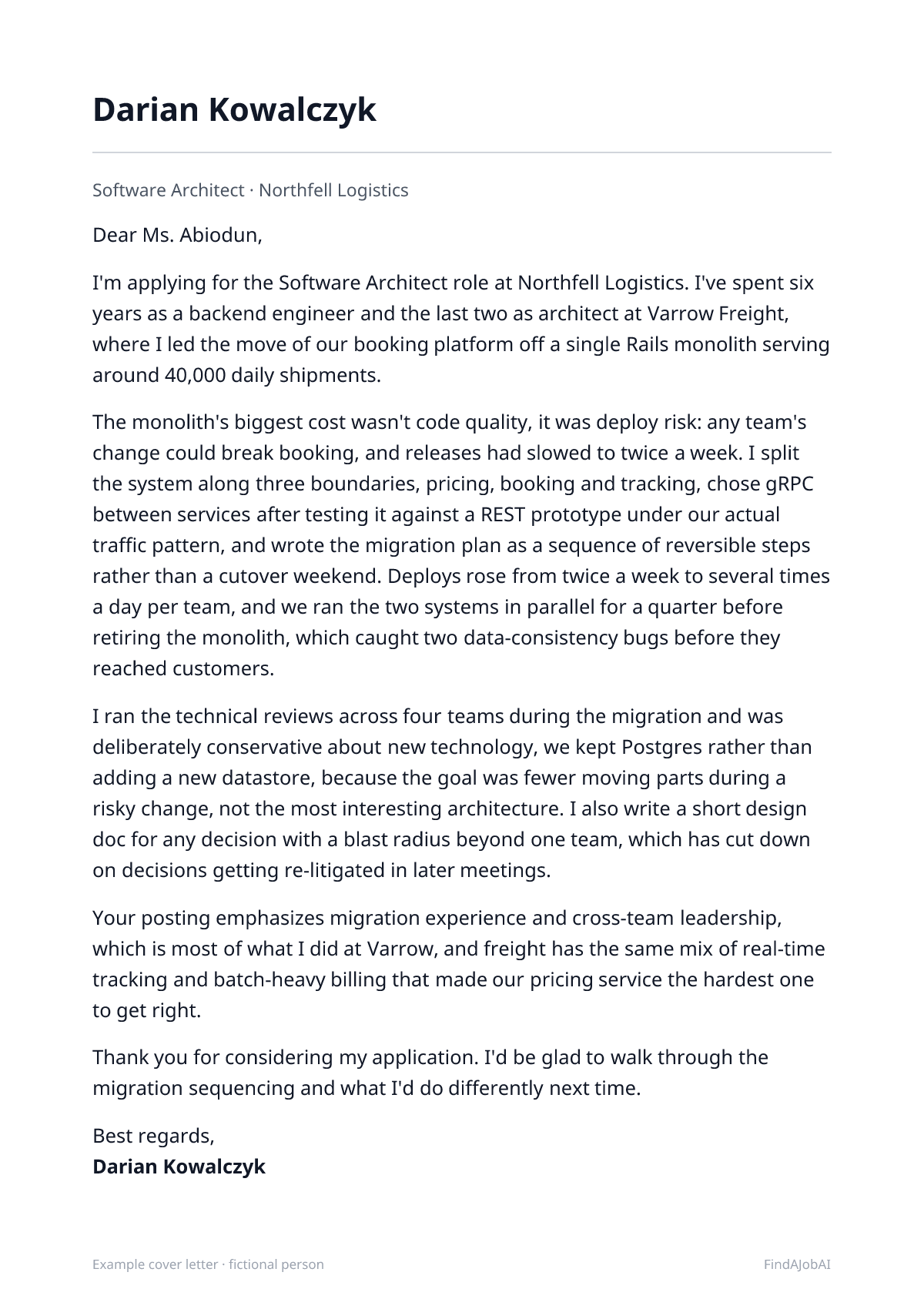
I'm applying for the Software Architect role at Northfell Logistics. I've spent six years as a backend engineer and the last two as architect at Varrow Freight, where I led the move of our booking platform off a single Rails monolith serving around 40,000 daily shipments.
The monolith's biggest cost wasn't code quality, it was deploy risk: any team's change could break booking, and releases had slowed to twice a week. I split the system along three boundaries, pricing, booking and tracking, chose gRPC between services after testing it against a REST prototype under our actual traffic pattern, and wrote the migration plan as a sequence of reversible steps rather than a cutover weekend. Deploys rose from twice a week to several times a day per team, and we ran the two systems in parallel for a quarter before retiring the monolith, which caught two data-consistency bugs before they reached customers.
I ran the technical reviews across four teams during the migration and was deliberately conservative about new technology, we kept Postgres rather than adding a new datastore, because the goal was fewer moving parts during a risky change, not the most interesting architecture. I also write a short design doc for any decision with a blast radius beyond one team, which has cut down on decisions getting re-litigated in later meetings.
Your posting emphasizes migration experience and cross-team leadership, which is most of what I did at Varrow, and freight has the same mix of real-time tracking and batch-heavy billing that made our pricing service the hardest one to get right.
Thank you for considering my application. I'd be glad to walk through the migration sequencing and what I'd do differently next time.
Best regards,
Darian Kowalczyk
Example 2 · Career changer
Senior engineer stepping up into an architect role
Jamie led the design of a payments reconciliation system without the title. The ad asks for someone to formalize architecture practice on a growing team.
Example letter · fictional
Dear Hiring Manager,
I'm applying for the Software Architect role at Castlebourne Fintech. For five years I've been a senior engineer at Milverton Pay, and for the last eighteen months I've been the de facto architect for our reconciliation system without holding that title.
Our reconciliation job was timing out as transaction volume grew, and three teams had quietly built their own workarounds around it. I proposed replacing the nightly batch job with an event-sourced ledger that reconciled incrementally, wrote the design doc, and ran it past every team that depended on the old batch output before writing code. The new system reconciled within minutes of each transaction instead of overnight, and it surfaced a long-standing discrepancy in how refunds were counted that finance had been correcting by hand.
Because I didn't have the architect title, I had to earn agreement rather than assume it: I ran design reviews open to any engineer, documented the tradeoffs I rejected and why, and set up a lightweight architecture decision log that two other teams have since adopted on their own.
Your posting says the goal is to formalize architecture practice as the team grows past its current size, which is exactly the gap I closed informally at Milverton. I'd like to do that with the authority and scope the title gives, rather than around its edges.
Thank you for your time. I can share the architecture decision log format if it's useful context. I'd also be glad to run a short open design review for your team, so you can see how I handle disagreement.
Kind regards,
Jamie Halloran
Example 3 · Senior or lead
Principal architect applying to lead architecture across a growing engineering org
Grace sets technical direction across eight teams at a healthcare scheduling company. The ad is for a first principal architect to unify a fragmenting stack.
Example letter · fictional
Dear Mr. Castellan,
I'm applying for the Principal Software Architect role at Haverbrook Health Systems. For the past three years I've set technical direction across eight teams at Quillfield Scheduling, and before that I spent seven years as a software architect on smaller platforms. I'd like to bring that experience to a company naming its first principal architect.
Your posting says four teams have each built their own authentication layer, and that this is slowing every new integration down. Quillfield had a version of that problem with scheduling logic: five teams had each implemented their own notion of appointment conflict. I wrote a shared conflict-resolution library with one team as the pilot adopter, measured their integration time against two teams that stayed on their own logic, and used that comparison to get buy-in from the remaining teams without mandating it from above. Within a year, four of the five teams had migrated, and new scheduling features that used to require changes in three codebases needed changes in one.
Architecture decisions earn trust when they're tested under real failure, not just reviewed. During the migration, I insisted we run the shared library and the old logic in parallel for one team's highest-volume client before fully cutting over, which caught a timezone-handling bug that would have double-booked appointments across a daylight-saving transition. We fixed it before any team depended on the shared library in production.
I've run architecture review for the org for three years and mentored two engineers into architect roles. I haven't worked under HIPAA directly, only adjacent compliance regimes, and at Haverbrook I'd expect to partner closely with your compliance and security teams to close that gap quickly.
I'd welcome a conversation about which of your four authentication implementations would be hardest to retire first, and why.
Sincerely,
Grace Bailey
All three letters, and the short version below, are fictional: the people, employers and numbers are invented. Borrow the structure, never the facts.
- Prefer to write it yourself? Use the free cover letter template.
- Check your CV against the job first: the free CV score shows the missing keywords.
Why the first letter works, paragraph by paragraph
Paragraph 1: Opening
States the scale of the system (around 40,000 daily shipments) and the writer's role in it, so the reader has a concrete system in mind, not an abstract title.
Paragraph 2: The tradeoff and the migration
Names the real cost (deploy risk, not code quality), the decision process (testing gRPC against a prototype under real traffic), and the safety mechanism (a reversible, phased plan) with a measurable result.
Paragraph 3: Cross-team judgment
Choosing to keep Postgres rather than add a new datastore shows restraint, which matters more at architect level than listing new technologies tried.
Paragraph 4: Why this company
Connects the ad's stated need (migration, cross-team leadership) to a specific domain parallel (tracking and billing) rather than a generic compliment.
Paragraph 5: Close
Offers to discuss the migration sequencing itself, which is the part of the work most architect interviews actually probe.
What the career changer's letter does differently
The second letter is from a senior engineer changing lanes into the architect title, so it leads with the gap between doing the work and holding the role: a system redesigned without formal authority, agreement earned through open reviews rather than assumed, and a direct statement that the ad's stated need (formalizing practice) matches the informal gap the writer already closed.
What the senior letter does differently
A principal architect letter reports organizational patterns, not one project: five duplicated implementations, a pilot-adopter strategy instead of a mandate, four of five teams migrated within a year. The parallel-run example shows judgment under real failure risk, and the compliance gap is named directly instead of glossed over.
Short software architect cover letter: an email-ready version
Many applications arrive as an email or a small text box, and a full page doesn't fit. This version runs 120 to 150 words and keeps only what a reader needs to decide whether to reply. A software architect answers a media-streaming company's short-form application question, sent by email because the recruiter requested a quick reply.
Short version · email · fictional121 words
Subject: Software Architect (distributed systems, caching) – Jarrah Lindqvist
Hello Ms. Okonjo,
I'm applying for the Software Architect role at Brindlewood Streaming. I have seven years of backend experience, the last three as architect for a video delivery platform serving regional traffic across three data centers.
My most useful decision was replacing a single shared cache with a tiered, region-aware caching layer after tracing recurring latency spikes to cross-region cache misses during peak hours. The change cut those spikes to a small fraction of their prior frequency and removed the need for a planned data-center expansion.
Streaming traffic has sharp, unpredictable peaks, and I'd like to bring that caching and capacity work to your platform. My resume is attached, and I'm glad to walk through the design.
Best,
Jarrah Lindqvist
The short version keeps one architectural decision and its measurable consequence (an avoided data-center expansion) instead of a list of systems worked on. It skips the cross-team politics of the longer letters since five sentences don't leave room for process detail.
Opening lines that work for software architect cover letters
The first sentence decides whether the second gets read. Here are six openings, one for each situation you might be in. Pick the one that matches yours and swap in your own facts: every name and number below is invented.
1. You have a standout result
One caching redesign I led last year cut cross-region latency spikes to a fraction of their prior frequency and removed the need for a planned data-center expansion. I'd like to bring that same approach to your platform.
2. The ad names a problem you've solved
Your ad mentions four teams each maintaining their own authentication layer. At my current company I led a similar consolidation across five teams, using a pilot adopter and a measured comparison rather than a mandate, and most teams migrated within a year.
3. Someone referred you
Your engineering manager, Teodor Vuksanovic, worked with me for two years on a platform migration before joining your team. He mentioned you're looking for someone who can get teams to agree on shared infrastructure without mandating it, which prompted this application.
4. You admire what they build
I've relied on your scheduling product at two previous jobs, and the way it handles conflicting bookings under high concurrency is part of why your architecture posting caught my attention.
5. You're new to the field or switching into it
I spent five years as a senior engineer solving reconciliation problems without an architect title before earning one. Setting technical direction is where I'd like to keep working, now with the scope the title carries.
6. You have senior scope or a specialism
As the engineer who has set architecture direction across eight teams for three years, I wrote the decision-review process the org still uses. I'm looking for a role with a larger, more fragmented stack to bring that same discipline to.
How to write a software architect cover letter
Five steps, in the order you'd write them. The shape stays the same for every job (a short opening, proof, a reason for this employer, a close), and what goes into each part is what changes with the role.
Identify the scale and fragmentation the ad is hinting at
Architect ads often describe a symptom: slow deploys, duplicated systems, or teams unable to agree. Read for that symptom and the number of teams or systems involved, then choose a story of yours at a similar scale, so the reader can judge whether your experience actually transfers to their mess.
Open with the tradeoff, not the title
Say what the real cost was (deploy risk, duplicated logic, latency) and what you decided to do about it, in one or two sentences. A reader who sees a specific tradeoff named up front trusts the rest of the letter more than one that opens with years of experience or a list of patterns.
Show how you got agreement, not just how you decided
Architects at this level rarely have unilateral authority. Describe a review process, a pilot adopter, a comparison you used to persuade skeptical teams, or a decision log you kept. This is usually the part interviewers probe hardest, so give it real space in the letter.
Quantify the system's outcome, not your activity
State a result in the system's own terms: deploys per week, reconciliation time, incidents avoided, or infrastructure no longer needed. Avoid counting design docs written or meetings run. If the outcome is hard to measure, describe what teams stopped having to do once the new system existed.
Name a gap honestly before closing
One sentence naming something you haven't done yet, such as an unfamiliar compliance regime or scale tier, reads as more senior than a letter claiming total readiness. Close by naming a specific question about their system you'd want to start with.
Software Architect cover letter do's and don'ts
Do
- Name one system, its scale, and the specific tradeoff you made, not just the technologies involved.
- Describe how you got other teams to agree with a decision, not just that you made one.
- State a result in the system's own terms (deploy frequency, reconciliation time, incident count).
Don't
- Don't list every technology you've touched; name the one or two central to the decision you're describing.
- Don't claim sole credit for a system multiple teams built; say what you owned within it.
- Don't present every past decision as correct; naming one tradeoff you'd revisit reads as more senior, not less.
Common software architect cover letter mistakes
Each one is easy to make and quick to fix before you send the letter.
Listing architecture patterns instead of decisions
Naming microservices, event sourcing and CQRS in a row says what you've read about, not what you've decided. Pick one pattern you actually chose, say why, and what it cost you to be wrong or right about it.
Claiming sole authorship of a multi-team system
"I architected our platform" undersells the real work, which is getting several teams to agree. Say what you owned specifically and how you earned the rest of the teams' agreement.
Describing a decision with no tradeoff
A clean story where every choice was obviously correct reads as incomplete. Name what you gave up, such as a newer technology you deliberately avoided, and why that was the right call at the time.
Measuring effort instead of system outcomes
"Wrote 12 design docs this year" describes output. Say what changed for the teams relying on the system, such as deploy frequency or incidents avoided, because of one of those decisions.
Pretending to have no gaps
A letter claiming total fluency in every area the ad lists reads as less credible at architect level. Name one real gap plainly and say how you'd close it, which signals judgment rather than weakness.
Email subject lines for software architect applications
Applying by email? Put the job title, any reference number and your name in the subject line.
- Software Architect application – platform migration, cross-team leadership – Darian Kowalczyk
- Software Architect – senior engineer formalizing architecture practice – Jamie Halloran
- Application: Principal Architect, Platform (Req. 3317) – Darian Kowalczyk
Everything for Software Architects
- Software Architect resume exampleA full resume, plus bullet and summary examples
- Software Architect interview questions30 questions with sample answers
- Software Architect job descriptionDuties, skills and requirements
- Career change cover letter: template + examples
Other cover letter examples
Software Architect cover letter FAQ
What should I write in a software architect cover letter?
One system, its scale, a specific tradeoff you made and why, and how you got other teams to agree with the decision. Close with a result in the system's own terms, such as deploy frequency or incident count, not a list of technologies.
How do I write a software architect cover letter without the title on my resume?
Describe a system you designed or redesigned as a senior engineer, including how you earned agreement from other teams without formal authority. Say directly that you're ready for the scope the title carries.
Should a software architect cover letter mention specific technologies?
Yes, but only the ones central to a tradeoff you made, such as choosing gRPC over REST after testing both. A long list of technologies without a decision attached reads as a resume restated, not a letter.
How we built this page
The FindAJobAI team wrote the three example letters, the short email version, the opening lines and the advice for software architect roles. The people, employers and numbers in the letters are invented; the structure, the kind of evidence and the order of the paragraphs are the parts to copy.
Once we track enough live software architect job ads, this page also shows the skills they ask for most, counted the same way as our in-demand skills report.
Last reviewed on November 1, 2026.