Tax Preparer Cover Letter Example (2026)
By FindAJobAI Team Updated How we built this page
Tax offices hire fast before January, and most applications look the same: a PTIN, a software name and a line about accuracy. A cover letter stands out when it shows how you handle a real client: the question that uncovered a missed credit, the notice you resolved, or the habit that keeps your returns from coming back with corrections. The cover letter examples below show three ways to do that.
Tax Preparer cover letter template
This letter as a one-page template: an opening that names the job and your strongest fact, proof that answers the ad, a reason for this employer and a short close.
After you sign up, FindAJobAI drafts your own letter for a real job from your CV in this format, and you edit it before you send it.
Example 1 · Experienced
Enrolled Agent applying to a year-round tax and accounting firm
Thaddea prepares about 400 returns a season and handles IRS notices. The ad asks for an EA with small business returns and year-round availability.
Example letter · fictional
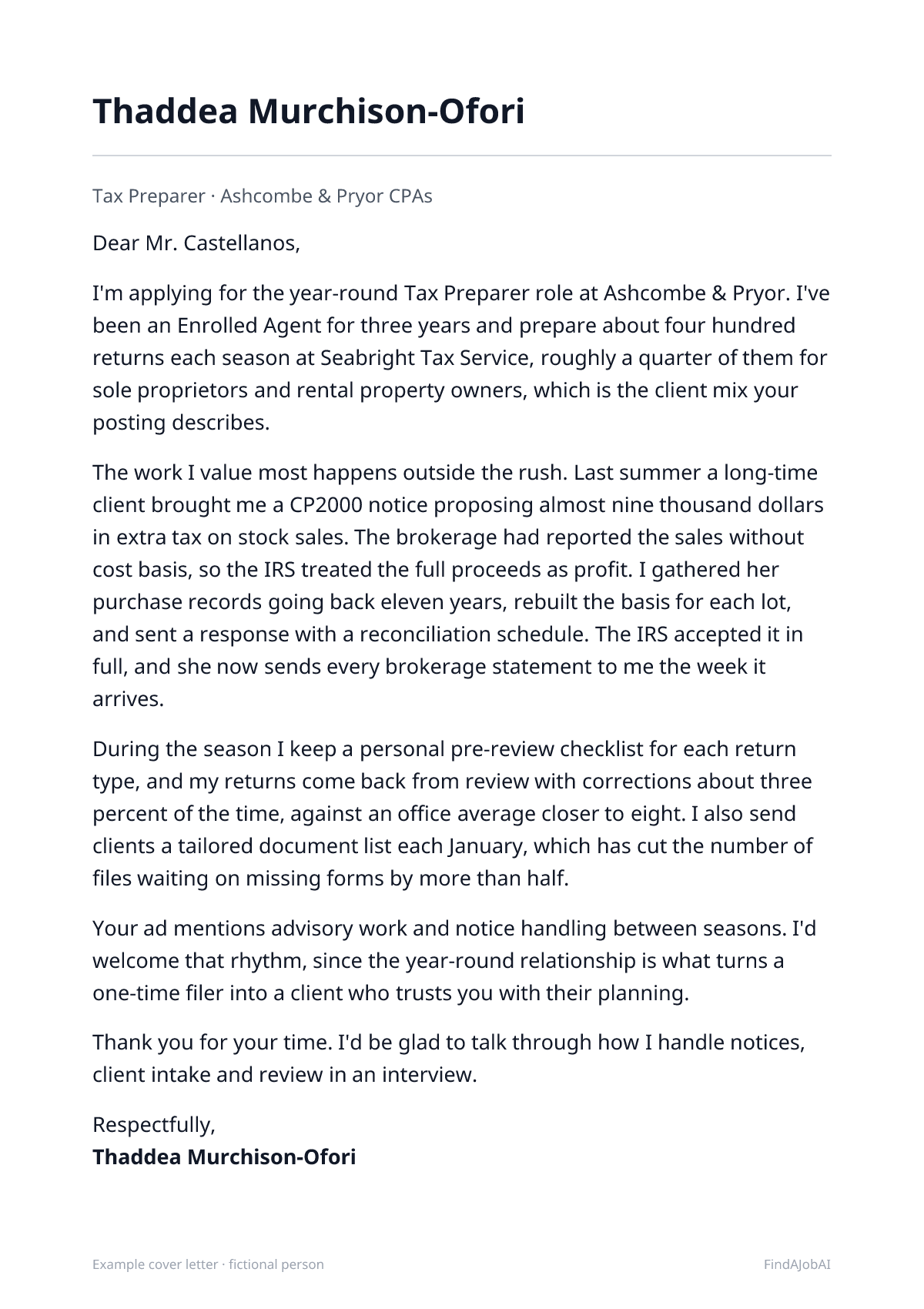
Dear Mr. Castellanos,
I'm applying for the year-round Tax Preparer role at Ashcombe & Pryor. I've been an Enrolled Agent for three years and prepare about four hundred returns each season at Seabright Tax Service, roughly a quarter of them for sole proprietors and rental property owners, which is the client mix your posting describes.
The work I value most happens outside the rush. Last summer a long-time client brought me a CP2000 notice proposing almost nine thousand dollars in extra tax on stock sales. The brokerage had reported the sales without cost basis, so the IRS treated the full proceeds as profit. I gathered her purchase records going back eleven years, rebuilt the basis for each lot, and sent a response with a reconciliation schedule. The IRS accepted it in full, and she now sends every brokerage statement to me the week it arrives.
During the season I keep a personal pre-review checklist for each return type, and my returns come back from review with corrections about three percent of the time, against an office average closer to eight. I also send clients a tailored document list each January, which has cut the number of files waiting on missing forms by more than half.
Your ad mentions advisory work and notice handling between seasons. I'd welcome that rhythm, since the year-round relationship is what turns a one-time filer into a client who trusts you with their planning.
Thank you for your time. I'd be glad to talk through how I handle notices, client intake and review in an interview.
Respectfully,
Thaddea Murchison-Ofori
Example 2 · Career changer
VITA volunteer applying for a first paid tax preparer season
Joaquin prepared returns for two seasons as a volunteer while studying accounting. The ad is for a seasonal preparer at a neighborhood tax office.
Example letter · fictional
Dear Ms. Delgado-Whitfield,
I'd like to apply for the Seasonal Tax Preparer position at Fairhaven Neighborhood Tax. For the past two filing seasons I've volunteered at a VITA site run by the Eastbrook Library, preparing about seventy returns each spring, and I'm ready to do this work as a paid preparer.
Most of my clients were families filing for the earned income credit or first-time filers who were nervous about the process. One father came in expecting a small refund and had brought only his W-2. While going through the intake questions, I asked whether anyone else in the household had worked or gone to school. His daughter had started community college, and once we added her tuition statement the education credit raised his refund by more than a thousand dollars. Moments like that taught me that the interview matters as much as the software, and I now ask every client about each person in the household.
In my second season the site coordinator asked me to quality-review other volunteers' returns, and my own returns needed corrections only twice all year. I hold an active PTIN and the IRS Annual Filing Season Program record, and I'm studying for the Enrolled Agent exam. I haven't prepared business or rental returns yet and would expect to learn those under review.
Your office serves many of the same families I met at the library, and the bilingual service your posting mentions is something I can offer in Spanish.
Thank you for considering my application. I'm available for evenings and Saturdays through April.
With appreciation,
Joaquin Abernathy-Osei
Example 3 · Senior or lead
Senior preparer applying to lead a multi-preparer tax office
Marguerite runs a three-preparer office and represents clients in audits. The ad is for an office manager and senior Enrolled Agent at a growing practice.
Example letter · fictional
Dear Ms. Thorsdottir,
Your opening for a senior Enrolled Agent to manage the new Lakeside office caught my eye because it describes the job I've grown into over fourteen seasons. At Kingsmere Tax Partners I run a three-preparer office that files about thirteen hundred returns a year, and I keep my own book of roughly six hundred clients.
When I took over the office, new seasonal preparers had their returns corrected in review about one time in nine. I wrote a two-week training plan built around our most common errors, such as missed estimated payments, wrong filing status after a divorce and depreciation left off rental returns, and paired each new preparer with me for their first twenty files. First-season correction rates fell to about one in twenty-five, and two of those preparers now train others.
Representation is the other half of my work. Over the past three years I've handled twenty-eight correspondence audits and collection cases under power of attorney. Most of them closed with no change or a reduced balance, mainly because I insist on organized records before we ever reply. That habit came from an early case where a rushed response cost a client months of extra letters.
I haven't opened an office from scratch, which this role involves, and I'd lean on your team for the setup side while I focus on staffing, training and review. I'm confident about the parts that decide whether clients come back the next year.
I'd welcome the chance to discuss how you plan to staff Lakeside for its first season.
Sincerely yours,
Marguerite Oyelaran-Steele
All three letters, and the short version below, are fictional: the people, employers and numbers are invented. Borrow the structure, never the facts.
- Prefer to write it yourself? Use the free cover letter template.
- Check your CV against the job first: the free CV score shows the missing keywords.
Why the first letter works, paragraph by paragraph
Paragraph 1: Opening
Gives the credential, season volume and client mix in two sentences, and matches them to what the posting asked for.
Paragraph 2: The notice story
Shows real tax knowledge (missing cost basis on a CP2000) and patience (eleven years of records), and ends with the result and the trust it built.
Paragraph 3: Accuracy and intake
Backs the accuracy claim with a review correction rate compared with the office average, and adds a process change that saves time.
Paragraph 4: Why this company
Connects the ad's year-round advisory work to how the writer thinks about client relationships.
Paragraph 5: Close
Keeps it short and offers to discuss two practical topics the hiring manager cares about.
What the career changer's letter does differently
The volunteer's letter rests on one intake conversation that found a missed education credit, which shows the core skill of a preparer: asking the right question. It adds credentials (PTIN, AFSP), a review role and an honest note about business returns, which makes a first paid season look like a safe hire.
What the senior letter does differently
A senior preparer's letter is judged on how other people's work improved and how clients were protected. The training plan with a measured drop in corrections shows leadership, the audit record shows representation skill, and the honest note about opening an office keeps the claims grounded.
Short tax preparer cover letter: an email-ready version
Many applications arrive as an email or a small text box, and a full page doesn't fit. This version runs 120 to 150 words and keeps only what a reader needs to decide whether to reply. A tax preparer emails a short reply to a firm's job post on a local board, which asked for a brief note and a resume.
Short version · email · fictional124 words
Subject: Tax Preparer application – 4 seasons, PTIN and AFSP – Cormac Adebayo-Fischer
Hello Ms. Halvorsen,
I'm writing about the Tax Preparer opening you posted. I've completed four filing seasons at a retail tax office, preparing about three hundred individual returns each year, and I hold an active PTIN and the AFSP record of completion for this season.
My strongest habit is the client interview. Last season, asking a client about a move for work led to a state part-year return she hadn't known she needed, which avoided a penalty notice and a second round of letters months later.
I'm available full time from early January through the April deadline, and part time for extensions in the fall. My resume is attached, and I'd be glad to meet whenever it suits your office.
Thank you,
Cormac Adebayo-Fischer
A brief note for a local post needs credentials, one proof of judgment and availability. The part-year return story shows careful questioning in two sentences, and the availability line answers the first thing a seasonal office wants to know.
Opening lines that work for tax preparer cover letters
The first sentence decides whether the second gets read. Here are six openings, one for each situation you might be in. Pick the one that matches yours and swap in your own facts: every name and number below is invented.
1. You have a standout result
Last summer I answered a CP2000 notice proposing nearly nine thousand dollars in extra tax by rebuilding eleven years of cost basis, and the IRS accepted it in full. Notice work like that is what I'd bring to your year-round team.
2. The ad names a problem you've solved
Your posting asks for a preparer who catches mistakes before review does. My returns come back with corrections about three percent of the time, and I'd like to bring that habit to your office.
3. Someone referred you
Lorcan Abiodun-Price, one of your senior preparers, reviewed returns beside me at a VITA site two seasons ago. He thought my intake notes would fit the way your office works, so I'm applying for the seasonal role.
4. You admire what they build
For two seasons I volunteered at a library tax site, where one extra intake question added more than a thousand dollars to a family's refund. I'm ready to do that work as a paid preparer.
5. You're new to the field or switching into it
Fourteen seasons in, I care most about how new preparers grow: my training plan cut first-season review corrections from about one in nine to one in twenty-five.
6. You have senior scope or a specialism
I'm an Enrolled Agent with four hundred returns a season and a client book that mostly renews itself through referrals. I'd like to build the same kind of book at your firm.
How to write a tax preparer cover letter
Five steps, in the order you'd write them. The shape stays the same for every job (a short opening, proof, a reason for this employer, a close), and what goes into each part is what changes with the role.
Lead with credentials and volume
Tax offices screen quickly for a PTIN, AFSP or Enrolled Agent status and season experience. Put your credentials and approximate returns per season in the first two sentences, along with the return types you handle, so the reader knows within seconds you meet the basic bar.
Tell one client story
Pick a moment that shows judgment: a credit found through a good intake question, a notice you resolved or a planning change that saved a penalty. Leave out names and exact personal details, but keep the tax logic clear enough that a reviewer sees you understand the rules.
Prove accuracy with a number
Accuracy is the claim every applicant makes. Back it with a review correction rate, an e-file rejection rate or the number of amended returns you've avoided. If you don't track these formally, describe the checklist or review habit that keeps your returns clean.
Match the office's clients
A neighborhood office serving families needs different strengths from a firm with small business clients. Read the posting for client types, languages and services such as bookkeeping or notices, and connect your experience to them directly in one or two sentences.
State availability and gaps plainly
Seasonal offices plan around hours, so say when you can start and which evenings or weekends you can work. If you haven't prepared certain return types, say so briefly; offices expect to train and appreciate knowing where to start.
Tax Preparer cover letter do's and don'ts
Do
- Name your credentials and season volume early: PTIN, AFSP or Enrolled Agent.
- Tell one client story that shows tax knowledge, such as a notice, a missed credit or a planning fix.
- Prove accuracy with a review correction or rejection rate.
Don't
- Don't include any real client names, amounts or identifying details.
- Don't claim experience with business or partnership returns you haven't prepared.
- Don't skip availability for a seasonal role; offices plan schedules around it.
Common tax preparer cover letter mistakes
Each one is easy to make and quick to fix before you send the letter.
Burying the credentials
If your PTIN or Enrolled Agent status appears only on the resume, a fast screener may miss it. Mention it in the first paragraph of the letter.
Calling yourself accurate with no rate to show
"Accurate and detail-oriented" is in nearly every letter. Replace it with a correction or rejection rate, or a specific review habit.
Sharing client details
Even in a positive story, names, exact amounts tied to a person or identifying facts raise privacy concerns. Keep stories general enough to protect clients.
Overstating complex return experience
Saying you handle business or partnership returns when you've only reviewed a few invites hard interview questions. Be exact about what you've prepared alone.
No start date or peak-season hours
A seasonal letter that doesn't mention hours or start date forces the office to ask. Say when you can start and how many hours you can work at peak.
Email subject lines for tax preparer applications
Applying by email? Put the job title, any reference number and your name in the subject line.
- Tax Preparer application – Enrolled Agent, Schedule C and rental returns – Thaddea Murchison-Ofori
- Seasonal Tax Preparer – 2 VITA seasons, PTIN and AFSP – Joaquin Abernathy-Osei
- Application: Year-Round Tax Preparer (Req. 1148) – Thaddea Murchison-Ofori
Everything for Tax Preparers
- Tax Preparer resume exampleA full resume, plus bullet and summary examples
- Tax Preparer interview questions30 questions with sample answers
- Tax Preparer job descriptionDuties, skills and requirements
- Career change cover letter: template + examples
Other cover letter examples
Tax Preparer cover letter FAQ
What should a tax preparer cover letter include?
Your credentials (PTIN, AFSP or EA), season volume and return types, one client story that shows your judgment, and an accuracy measure. For seasonal roles, state your availability through April.
How do I write a tax preparer cover letter with no paid experience?
Use VITA or other volunteer seasons, a tax course or a bookkeeping role. Tell one story from client intake, list your PTIN and any AFSP record, and say which return types you'd still need to learn.
Should a tax preparer mention the Enrolled Agent exam?
Yes. If you hold the credential, put it in the first paragraph. If you're studying, say which parts you've passed or plan to take, since offices value preparers who can later represent clients.
How long should a tax preparer cover letter be?
One page, about 250 to 350 words. Offices read many applications in the weeks before the season, so a short letter with one strong story and clear availability works best.
How we built this page
The FindAJobAI team wrote the three example letters, the short email version, the opening lines and the advice for tax preparer roles. The people, employers and numbers in the letters are invented; the structure, the kind of evidence and the order of the paragraphs are the parts to copy.
Once we track enough live tax preparer job ads, this page also shows the skills they ask for most, counted the same way as our in-demand skills report.
Last reviewed on November 1, 2026.