Train Conductor Cover Letter Example (2026)
By FindAJobAI Team Updated How we built this page
Railroad recruiters read conductor letters for three things: a clean safety and rules record, the kind of service and territory you know, and whether you can lead a crew and keep the paperwork right. A good letter names the trains you ran, gives one moment where your attention prevented a problem and makes your availability clear. It should read like a careful person wrote it, because that is what the job needs.
Train Conductor cover letter template
This letter as a one-page template: an opening that names the job and your strongest fact, proof that answers the ad, a reason for this employer and a short close.
After you sign up, FindAJobAI drafts your own letter for a real job from your CV in this format, and you edit it before you send it.
Example 1 · Experienced
Freight conductor applying to a regional railroad
Leocadia has five years as a road conductor on a Class I railroad. The ad is for a conductor on a regional railroad with heavy local switching.
Example letter · fictional
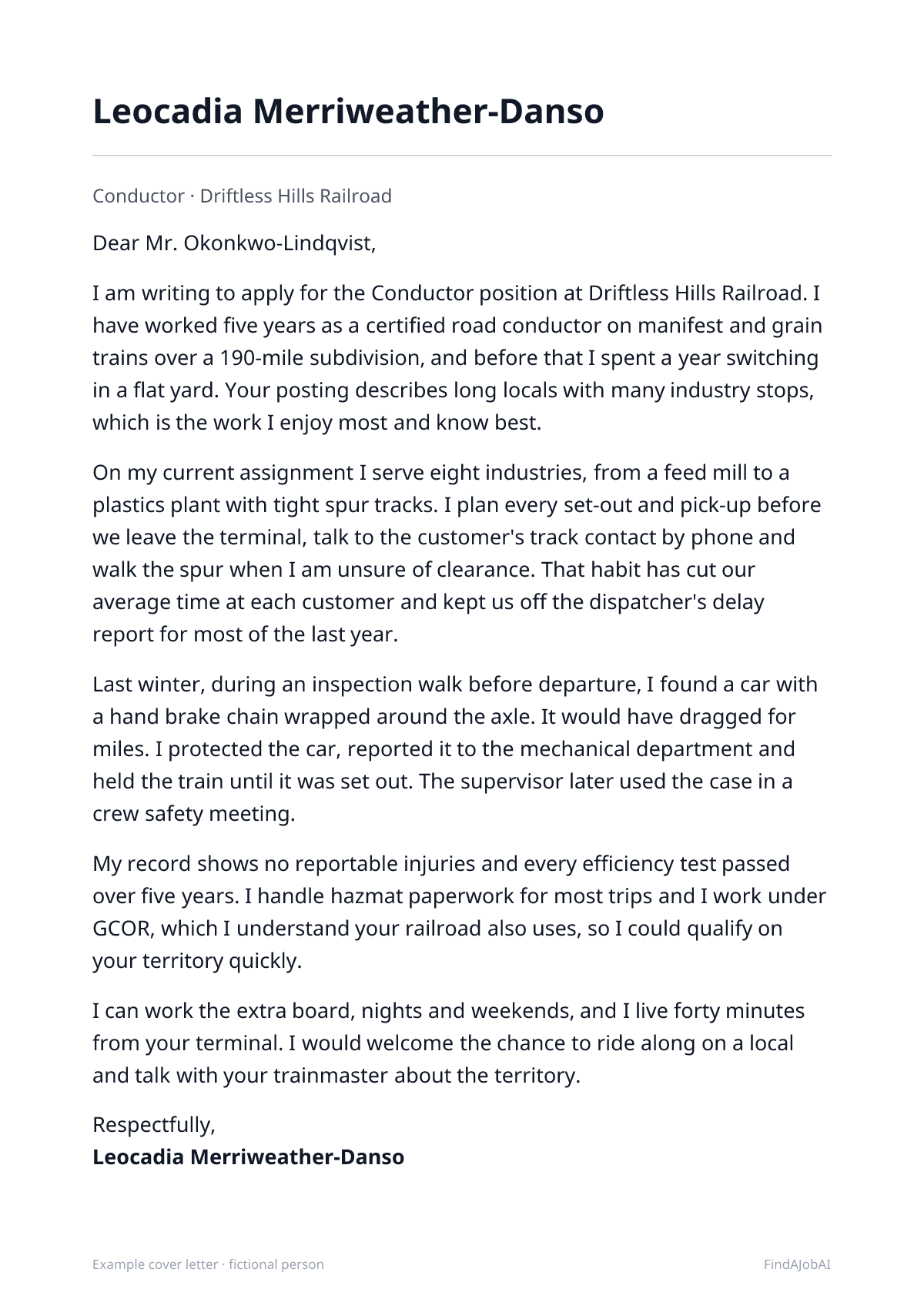
Dear Mr. Okonkwo-Lindqvist,
I am writing to apply for the Conductor position at Driftless Hills Railroad. I have worked five years as a certified road conductor on manifest and grain trains over a 190-mile subdivision, and before that I spent a year switching in a flat yard. Your posting describes long locals with many industry stops, which is the work I enjoy most and know best.
On my current assignment I serve eight industries, from a feed mill to a plastics plant with tight spur tracks. I plan every set-out and pick-up before we leave the terminal, talk to the customer's track contact by phone and walk the spur when I am unsure of clearance. That habit has cut our average time at each customer and kept us off the dispatcher's delay report for most of the last year.
Last winter, during an inspection walk before departure, I found a car with a hand brake chain wrapped around the axle. It would have dragged for miles. I protected the car, reported it to the mechanical department and held the train until it was set out. The supervisor later used the case in a crew safety meeting.
My record shows no reportable injuries and every efficiency test passed over five years. I handle hazmat paperwork for most trips and I work under GCOR, which I understand your railroad also uses, so I could qualify on your territory quickly.
I can work the extra board, nights and weekends, and I live forty minutes from your terminal. I would welcome the chance to ride along on a local and talk with your trainmaster about the territory.
Respectfully,
Leocadia Merriweather-Danso
Example 2 · Career changer
Warehouse shift lead moving into a conductor trainee role
Casimir leads a night warehouse shift and has spent years loading rail cars at a transload site. He is applying to a railroad conductor training program.
Example letter · fictional
Dear Ozaukee Lakeshore Hiring Team,
I would like to apply for your Conductor Trainee program. For four years I have led the night shift at a transload warehouse that sits on a rail spur, and I have watched your local crews switch our cars almost every week. The more I worked alongside them, the more I wanted to do that job myself.
At the warehouse I supervise eight loaders and forklift operators. I run a safety briefing at the start of every shift, check that blue flag protection is in place before anyone steps onto a car and keep the load sheets that go to the railroad. In four years our shift has had no lost-time injuries, and I helped rewrite our car-loading checklist after an inspector flagged a loose bulkhead on a boxcar.
I already work outdoors in Wisconsin winters, I am used to rotating shifts and I am comfortable using a radio. I know a training program will ask me to learn operating rules, air brakes and hand signals from the beginning, and I am ready to study for that. I have already read the public sections of the operating rulebook and practised hand signals with a conductor friend, so the first weeks of class will not be entirely new to me. I would rather arrive prepared than learn everything from zero.
I would be glad to meet your trainmaster and to complete any tests you need. My references include our site manager and one of your own local conductors, who encouraged me to apply after I helped his crew re-spot a car last month. I can start training on any date you set.
Sincerely,
Casimir Fenwright-Abiola
Example 3 · Senior or lead
Senior passenger conductor applying to lead onboard crews
Aurelio has fifteen years on commuter and intercity trains and teaches rules classes. The ad is for a lead conductor on a new regional passenger service.
Example letter · fictional
Dear Ms. Vasquez-Holloway,
I am applying for the Lead Conductor role on your new regional service. I have worked fifteen years as a passenger conductor, first on intercity routes and for the last nine years on peak commuter trains, where I lead onboard crews of up to five and serve as a district rules instructor.
A new service lives or dies on its first months of operation. When my current railroad opened an extension with four new stations, I helped write the platform procedures, rode the qualifying runs with new crews and kept a shared list of every door, signage and announcement problem we found, with the date each was raised and who owned the fix. Most were fixed before opening day, and dwell times at the new stations matched the timetable within the first month.
Riders remember how the crew handles a bad day. I have managed medical calls, a police removal and a long weather delay with a full train, and each time my priority was clear announcements, calm instructions to the crew and a complete report by the end of the shift.
As an instructor I teach rules refreshers to about forty conductors a year. I would bring that to your team through practical briefings and steady coaching of newer crews. I also know how much a new conductor learns from watching a calm senior colleague on a crowded platform, and I would make sure your first crews get that kind of example every day.
I would welcome a conversation about your opening timetable and how you plan to train the first crews and staff the early weekend schedule.
Kind regards,
Aurelio Pendergast-Mwangi
All three letters, and the short version below, are fictional: the people, employers and numbers are invented. Borrow the structure, never the facts.
- Prefer to write it yourself? Use the free cover letter template.
- Check your CV against the job first: the free CV score shows the missing keywords.
Why the first letter works, paragraph by paragraph
Paragraph 1: Opening
States certification, years and service type, then links them to the long locals named in the ad.
Paragraph 2: Daily customer work
Shows planning, customer contact and clearance checks, the core of local service, with a result the railroad tracks.
Paragraph 3: One safety catch
A specific defect found on an inspection walk proves the careful habits the letter claims.
Paragraph 4: Record and rules
Gives the safety and efficiency test record plainly and names the shared rulebook.
Paragraph 5: Availability and close
Addresses extra board and shift flexibility, then asks for a practical next step with the trainmaster.
What the career changer's letter does differently
The career changer's letter uses warehouse work next to a rail spur as genuine preparation: blue flag protection, load sheets and safety briefings carry over. It admits the rules and air brake training still ahead and shows readiness to study.
What the senior letter does differently
The senior letter moves from single trips to launching a service, leading crews and handling incidents. It ties instructor experience to the employer's real need, training a new team, and closes on the opening plan.
Short train conductor cover letter: an email-ready version
Many applications arrive as an email or a small text box, and a full page doesn't fit. This version runs 120 to 150 words and keeps only what a reader needs to decide whether to reply. A yard conductor replies by email to a terminal railroad's ad asking for a brief note and a resume.
Short version · email · fictional123 words
Subject: Yard Conductor application – remote control qualified – Henrietta Szabo-Amankwah
Hi Mr. Delacroix-Mbatha,
I am writing about the Yard Conductor opening at Menomonee Terminal Switching. I have worked three years as a remote control yard conductor in a 20-track yard, building outbound trains and switching about 250 cars a shift with a crew of two.
My record has no reportable injuries and every efficiency test passed. I check switch lists against the yard inventory before each cut, which has kept misroutes on my job well below the yard average. I hold current conductor certification and hazmat training, and I work under GCOR.
My resume is attached. I can work any shift, including nights and weekends, and could start after two weeks' notice to my current railroad. Thank you for reading.
Thanks,
Henrietta Szabo-Amankwah
The short email gives the yard size, workload, qualification and record in two short paragraphs, which is what a terminal trainmaster checks first. It ends with availability and a start date.
Opening lines that work for train conductor cover letters
The first sentence decides whether the second gets read. Here are six openings, one for each situation you might be in. Pick the one that matches yours and swap in your own facts: every name and number below is invented.
1. You have a standout result
I have run manifest and grain trains for five years without a reportable injury, and your long local jobs are exactly the work I want to do next.
2. The ad names a problem you've solved
Your posting asks for a conductor who can plan switching before reaching the customer, which is how I have worked every local I have held.
3. Someone referred you
I have watched your crews switch our transload spur for four years, and I would like to join them as a conductor trainee.
4. You admire what they build
After fifteen years leading passenger crews, I would like to help open your new regional service and train its first conductors.
5. You're new to the field or switching into it
As a remote control yard conductor I build about five outbound trains a shift, and your terminal's growth caught my attention.
6. You have senior scope or a specialism
A trainmaster on your railroad suggested I apply after we worked an interchange move together last month.
How to write a train conductor cover letter
Five steps, in the order you'd write them. The shape stays the same for every job (a short opening, proof, a reason for this employer, a close), and what goes into each part is what changes with the role.
Lead with certification and service type
Say in the first lines whether you are a certified conductor, how long you have worked and in which service: road freight, yard, local or passenger. Recruiters sort applicants on these facts first, so put them where they cannot be missed.
Show your safety record with facts
Give years without a reportable injury, efficiency tests passed or audits with no exceptions. Then add one short example, such as a defect you found on an inspection walk. Facts and a story together are far more convincing than calling yourself careful.
Match the territory and rules
Mention the rulebook you work under and the territory types you know, such as CTC, track warrant or yard limits. If the railroad uses a different rulebook, say how you would prepare. Hiring managers want to know how quickly you can qualify on their lines.
Describe how you lead a crew
Conductors are in charge of the train. Mention job briefings, coaching trainees or directing a switch crew, with one result. For passenger roles, describe how you handle riders and incidents. Keep it to two or three sentences so the letter stays short.
Finish with your shifts and boards
Railroads run around the clock. State clearly whether you can work the extra board, nights, weekends and holidays, and how far you live from the terminal. A clear answer here removes a common reason for rejection.
Train Conductor cover letter do's and don'ts
Do
- Name your certification, service type and territory in the first paragraph.
- Give one specific example where your inspection or planning prevented a problem.
- Say clearly which shifts and boards you can work.
Don't
- Don't call yourself safety-focused without a record or example to back it up.
- Don't pad the letter with railroad history or general enthusiasm for trains.
- Don't hide gaps such as a lapsed certification; explain them briefly.
Common train conductor cover letter mistakes
Each one is easy to make and quick to fix before you send the letter.
Claiming a safe record with no facts behind it
Back the claim with your injury-free years, efficiency tests or a specific catch you made.
Writing about a love of trains
Keep the focus on the job: rules, switching, paperwork and crew leadership. Enthusiasm shows best through detail.
Saying nothing about extra board or night work
State the shifts and boards you can work. Many applicants are rejected because this is unclear.
Ignoring the service type in the ad
Freight, yard and passenger work differ. Point to the experience that matches the posting.
Glossing over a lapsed conductor certification
If your certification lapsed, say so briefly and explain how you will requalify.
Email subject lines for train conductor applications
Applying by email? Put the job title, any reference number and your name in the subject line.
- Conductor application – Leocadia Merriweather-Danso
- Conductor Trainee – warehouse shift lead on a rail spur – Casimir Fenwright-Abiola
- Application: Road Conductor, Local Service (Ref. DHR-417) – Leocadia Merriweather-Danso
Everything for Train Conductors
- Train Conductor resume exampleA full resume, plus bullet and summary examples
- Train Conductor interview questions30 questions with sample answers
- Train Conductor job descriptionDuties, skills and requirements
- Career change cover letter: template + examples
Other cover letter examples
Train Conductor cover letter FAQ
What should a train conductor cover letter include?
Your certification status, service type, territory and rulebook, your safety record, one example of careful work, and your availability for extra board, nights and weekends.
How do I write a conductor cover letter with no railroad experience?
Show transferable work such as warehouse, trucking or military logistics, focusing on safety briefings, shift work and following procedures. Be honest that you will learn rules and air brakes in training.
How long should a train conductor cover letter be?
One page, about 250 to 350 words. Recruiters want your record, one example and your availability, not a long story.
How we built this page
The FindAJobAI team wrote the three example letters, the short email version, the opening lines and the advice for train conductor roles. The people, employers and numbers in the letters are invented; the structure, the kind of evidence and the order of the paragraphs are the parts to copy.
Once we track enough live train conductor job ads, this page also shows the skills they ask for most, counted the same way as our in-demand skills report.
Last reviewed on November 1, 2026.