Web Designer Cover Letter Example (2026)
By FindAJobAI team Updated How we built this page
Web designer ads usually point to a portfolio link and leave it at that, so the cover letter has to do something the portfolio can't: explain a decision you made, a constraint you worked around, and what changed once the design shipped.
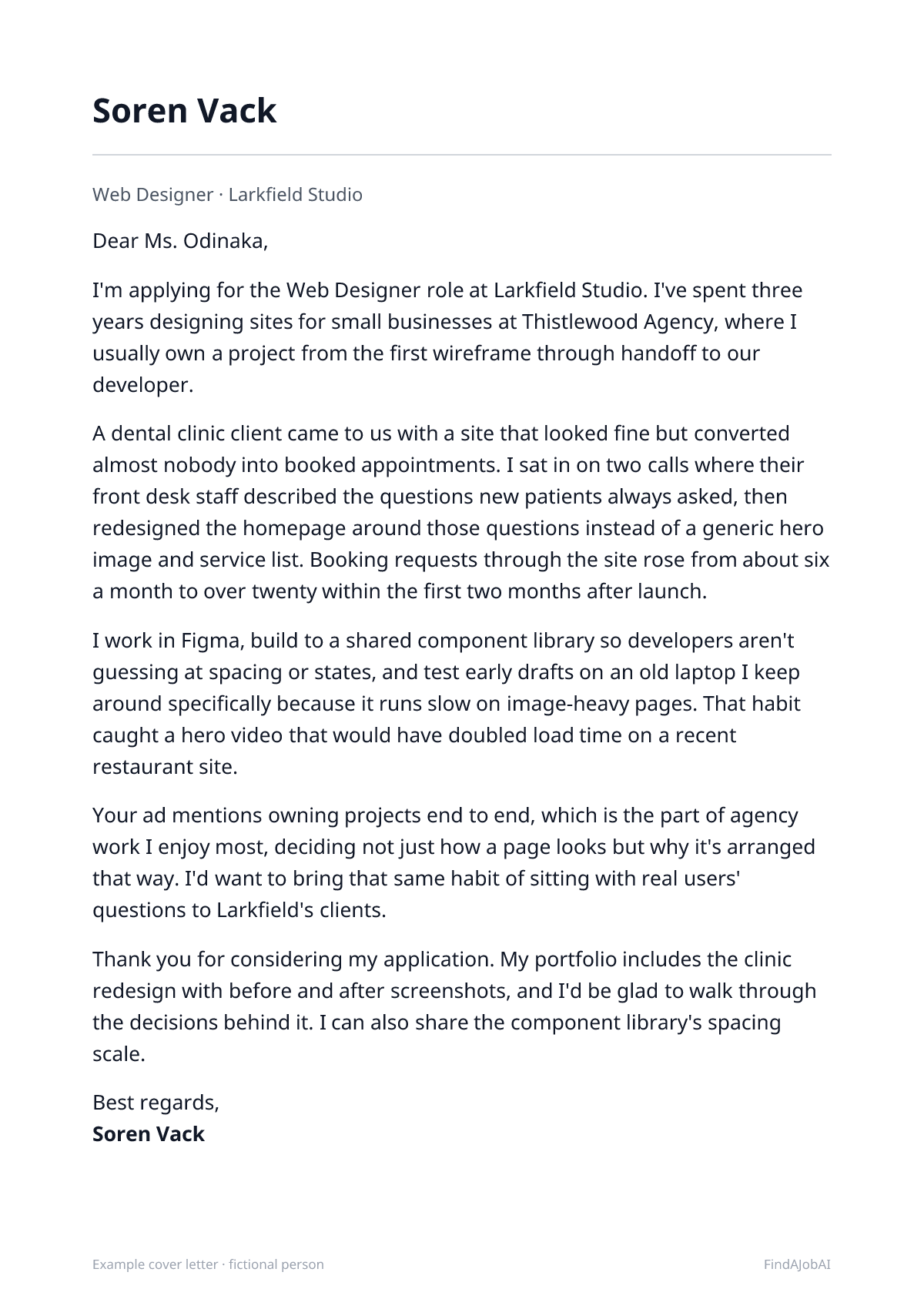
Web Designer cover letter template
This letter as a one-page template: an opening that names the job and your strongest fact, proof that answers the ad, a reason for this employer and a short close.
After you sign up, FindAJobAI drafts your own letter for a real job from your CV in this format, and you edit it before you send it.
Example 1 · Experienced
Agency web designer applying to a boutique studio
Soren designs small business sites at a marketing agency. The ad wants someone who can own a project from wireframe to launch.
Example letter · fictional
Dear Ms. Odinaka,
I'm applying for the Web Designer role at Larkfield Studio. I've spent three years designing sites for small businesses at Thistlewood Agency, where I usually own a project from the first wireframe through handoff to our developer.
A dental clinic client came to us with a site that looked fine but converted almost nobody into booked appointments. I sat in on two calls where their front desk staff described the questions new patients always asked, then redesigned the homepage around those questions instead of a generic hero image and service list. Booking requests through the site rose from about six a month to over twenty within the first two months after launch.
I work in Figma, build to a shared component library so developers aren't guessing at spacing or states, and test early drafts on an old laptop I keep around specifically because it runs slow on image-heavy pages. That habit caught a hero video that would have doubled load time on a recent restaurant site.
Your ad mentions owning projects end to end, which is the part of agency work I enjoy most, deciding not just how a page looks but why it's arranged that way. I'd want to bring that same habit of sitting with real users' questions to Larkfield's clients.
Thank you for considering my application. My portfolio includes the clinic redesign with before and after screenshots, and I'd be glad to walk through the decisions behind it. I can also share the component library's spacing scale.
Best regards,
Soren Vack
Example 2 · Career changer
Print designer moving into web design
Jocelyn taught herself Webflow and rebuilt a bakery's site after years in print. The ad asks for responsive design and basic HTML and CSS.
Example letter · fictional
Dear Hiring Manager,
I'm applying for the Junior Web Designer role at Hollowbrook Creative. For six years I designed menus, packaging and print ads at a small studio, and over the past year I've moved that same attention to layout and type into web design.
A regular client, a neighborhood bakery, had a site built years ago that didn't work on phones, which was most of her traffic. I rebuilt it in Webflow, kept her existing brand colors and photography, and designed around a simple ordering flow instead of the old multi-page menu. Mobile visitors who placed an online order rose noticeably once the new site was live, and she now gets fewer phone calls asking what's in stock.
Since then I've completed a responsive design course and written enough HTML and CSS to adjust a Webflow build by hand when the visual editor won't do what I want. I understand grid systems and type hierarchy from print, which has made spacing and alignment on the web come easily.
Your posting asks for responsive design and comfort with HTML and CSS basics, both of which I've now used on a live client site, not just a class project. I'd bring a print designer's eye for detail along with a working knowledge of how a page actually gets built.
Thank you for your time. My portfolio includes the bakery site with its mobile and desktop views side by side, and I'd welcome a conversation. I can also bring the print portfolio that led to this move.
Kind regards,
Jocelyn Ramsey
Example 3 · Senior or lead
Design lead applying to run a small in-house web team
Astrid leads three designers at a travel company. The ad is for a design lead who will set a component system and work with product managers.
Example letter · fictional
Dear Mr. Benally,
I'm applying for the Web Design Lead role at Marrowfield Travel. For two years I've led a team of three designers at Juniper Routes, a travel booking site, after four years there as a senior designer, and I'd like to bring that experience to a smaller in-house team.
Your ad mentions that every new page currently gets its own one-off components. Juniper Routes had the same issue when I started leading the team. I built a shared component library in Figma tied to our developers' code library, set a review step so new components had to be justified before being added, and we cut our page build time from around two weeks to about five days once designers stopped reinventing buttons and cards.
The clearest result came from our booking confirmation page. Customer support told us confused customers were calling to ask if their booking had actually gone through. I redesigned the page around one clear confirmation message and a visible next step, and support calls about booking status dropped by about a third within a month.
I hire and mentor my own designers and run weekly critique, but I haven't yet set a design system from scratch for a team this size, and I'd expect to spend real time with your product managers early on to learn how decisions currently get made before changing anything.
I'd welcome a conversation about which pages currently cause the most support calls or drop-off, since that's usually where a design lead can show value fastest.
Sincerely,
Astrid Kowalczyk
All three letters, and the short version below, are fictional: the people, employers and numbers are invented. Borrow the structure, never the facts.
- Prefer to write it yourself? Use the free cover letter template.
- Check your CV against the job first: the free CV score shows the missing keywords.
Why the first letter works, paragraph by paragraph
Paragraph 1: Opening
Names the kind of client (small business) and the part of the process the writer owns, wireframe to handoff, which matters more to a studio than a list of software.
Paragraph 2: The redesign that changed a result
A specific problem (bookings), a method (listening to front desk staff instead of guessing), and a before and after number tied to the business, not to page views.
Paragraph 3: Process and a habit
Naming a shared component library and a deliberate slow-laptop test shows craft and foresight, not just taste.
Paragraph 4: Why this studio
Mirrors the ad's phrase about owning projects end to end and says why that appeals to the writer specifically.
Paragraph 5: Close
Offers the portfolio piece most relevant to the claim made in paragraph two, so the reader knows exactly what to open first.
What the career changer's letter does differently
The career changer's letter starts from a real client project completed before any job title changed, with a before and after description readers can picture (a bakery site that didn't work on phones). It names a course and a specific new skill, HTML and CSS edits inside Webflow, and ties a print background directly to layout skills the ad wants.
What the senior letter does differently
A design lead letter reports a team's habits, a shared component library, a review step for new components, and a build time cut from two weeks to five days. The support-call example shows design decisions changing a business outcome, and the gap, running a system from scratch, is named plainly.
Short web designer cover letter: an email-ready version
Many applications arrive as an email or a small text box, and a full page doesn't fit. This version runs 120 to 150 words and keeps only what a reader needs to decide whether to reply. A web designer answers a nonprofit's short application form after the ad said to apply by email due to a hiring freeze delay.
Short version · email · fictional126 words
Subject: Web Designer (Webflow) – donation page redesign – Declan Osei
Hello Mr. Farnsworth,
I'm applying for the Web Designer role at Bramblewood Trust. I have four years of experience designing sites in Webflow, most recently for a regional arts nonprofit.
My most relevant project was a donation page redesign. The old page asked for too much information up front and lost most visitors before they finished giving. I cut the form to three fields and moved the suggested amounts above the fold, and completed donations rose noticeably within the first month.
Nonprofit sites live or die by how easy it is to say yes, and that's the kind of problem I'd like to keep solving. The portfolio linked on my resume includes the donation page, and I'd be glad to talk it through.
Best,
Declan Osei
A short application keeps one project with a clear before and after, the donation page, and drops the agency background since there's no room for it. Naming the nonprofit's core problem, making it easy to say yes, shows the writer understands the sector without needing a full paragraph to say so.
Opening lines that work for web designer cover letters
The first sentence decides whether the second gets read. Here are six openings, one for each situation you might be in. Pick the one that matches yours and swap in your own facts: every name and number below is invented.
1. You have a standout result
A donation page redesign I shipped last year cut the form to three fields, and completed donations rose noticeably within the first month. I'd like to do similar work for your site.
2. The ad names a problem you've solved
Your ad mentions a backlog of page requests that take weeks to turn around. At my current job I built a component library that cut our build time from two weeks to about five days.
3. Someone referred you
Your product manager, Fenella Okonkwo-Reyes, and I worked together on a conference app two years ago. She mentioned your team needs someone comfortable owning a project end to end, which is why I'm writing.
4. You admire what they build
I've booked through your site twice as a customer, and the checkout flow is cleaner than most sites in your category; I'd like to help keep it that way as you grow.
5. You're new to the field or switching into it
I spent six years designing packaging and print ads, then taught myself Webflow and rebuilt a client's site around a simpler mobile ordering flow. Web design is where I want to keep solving problems like that.
6. You have senior scope or a specialism
As design lead for a three-person team for two years, I built the component system the company still uses. I'm looking for a role where I can set that kind of foundation from the start.
How to write a web designer cover letter
Five steps, in the order you'd write them. The shape stays the same for every job (a short opening, proof, a reason for this employer, a close), and what goes into each part is what changes with the role.
Pick the project that matches what the ad asks for
Web designer ads vary: some want visual polish, others want responsive builds, others want someone who can own a project solo. Read the ad for what it emphasizes and choose a project of yours that answered that specific need, not just your best-looking one.
Open with the problem the design solved
Say what was wrong with the old page or what the business needed, before describing the redesign. A reader who sees a real problem in your first paragraph will keep reading to find out what you did about it.
Describe one decision, not the whole process
Pick a single choice, cutting a form to three fields, rebuilding a navigation, redesigning a confirmation screen, and explain why you made it. One well-explained decision says more about your judgment than a full list of deliverables.
Name your tools inside the project, not as a list
Mention Figma, Webflow, Sketch or whatever the ad names while describing what you built with it. Say how you handled a real constraint, like a slow-loading image or a developer handoff, so the tool name is backed by a specific use.
Point to the portfolio piece that proves your claim
Close by naming the exact project in your portfolio that matches the story you told, so the reader doesn't have to search for it. If the work was for a current employer, offer to walk through it rather than attaching confidential files.
Web Designer cover letter do's and don'ts
Do
- Describe one design decision and the problem it solved, not a list of tools you're comfortable with.
- Name the software the ad names (Figma, Webflow, Sketch) inside a real project, not as a bare list.
- Point to one portfolio piece and say what to look at there, so the reader doesn't have to guess.
Don't
- Don't call yourself "creative with an eye for design"; show the eye with one before and after.
- Don't list every tool you've opened once; name the one you used for the project you're describing.
- Don't attach large image files to the email; link to a hosted portfolio instead.
Common web designer cover letter mistakes
Each one is easy to make and quick to fix before you send the letter.
Calling yourself creative instead of showing it
"Creative with an eye for detail" could describe anyone. Replace it with one project where a specific choice, a layout, a color, a flow, solved a real problem for a real user or client.
Naming every piece of software you've touched
A row of Figma, Sketch, XD, Webflow and Framer suggests shallow use of each. Name the one the ad asks for and describe a project built in it, which is more convincing than a longer list.
Describing the design but not what happened after launch
A redesign described only by what it looks like leaves out whether it worked. Add what changed once it shipped: more bookings, fewer support calls, a faster build time, anything measurable.
Sending heavy image files or an unlinked portfolio
Large attachments can get an email flagged or bounced. Link to a hosted portfolio and name the one piece most relevant to this job so busy reviewers know exactly what to open.
Writing as if the portfolio speaks for itself
A portfolio shows what you made but not why. Use the letter to explain the reasoning behind one piece, the constraint you were working with and the decision you made because of it.
Email subject lines for web designer applications
Applying by email? Put the job title, any reference number and your name in the subject line.
- Web Designer application – end-to-end site projects – Soren Vack
- Junior Web Designer – Webflow, HTML and CSS, print background – Jocelyn Ramsey
- Application: Web Designer, Marketing Team (Req. 2240) – Soren Vack
Everything for Web Designers
- Web Designer resume exampleA full resume, plus bullet and summary examples
- Web Designer interview questions30 questions with sample answers
- Web Designer job descriptionDuties, skills and requirements
- Career change cover letter: template + examples
Other cover letter examples
Web Designer cover letter FAQ
What should I write in a web designer cover letter?
One project where a design decision solved a real problem: what was wrong with the old page, what you changed, and what happened after launch. Then say which tool you used and point to the matching portfolio piece.
How do I write a web designer cover letter with no professional experience?
Use a real project, even unpaid, such as a redesign for a friend's business or a nonprofit, and describe the before and after. Name a course or tool you learned and show it working on that live project, not just a class exercise.
Should a web designer cover letter mention specific software?
Yes, but inside the story of a project rather than as a standalone list. Naming Figma or Webflow while describing what you built with it is more convincing than listing five tools with no context.
How we built this page
The FindAJobAI team wrote the three example letters, the short email version, the opening lines and the advice for web designer roles. The people, employers and numbers in the letters are invented; the structure, the kind of evidence and the order of the paragraphs are the parts to copy.
Once we track enough live web designer job ads, this page also shows the skills they ask for most, counted the same way as our in-demand skills report.
Last reviewed on November 1, 2026.