Workforce Planner Cover Letter Example (2026)
By FindAJobAI Team Updated How we built this page
A workforce planner cover letter has to show that your forecasts are trusted and that your staffing plans changed something a leader cares about: service level, overtime, wait times or hiring costs. Skip the list of planning terms. Describe the size of the operation, one model you improved and how you explained it to people outside the planning team.
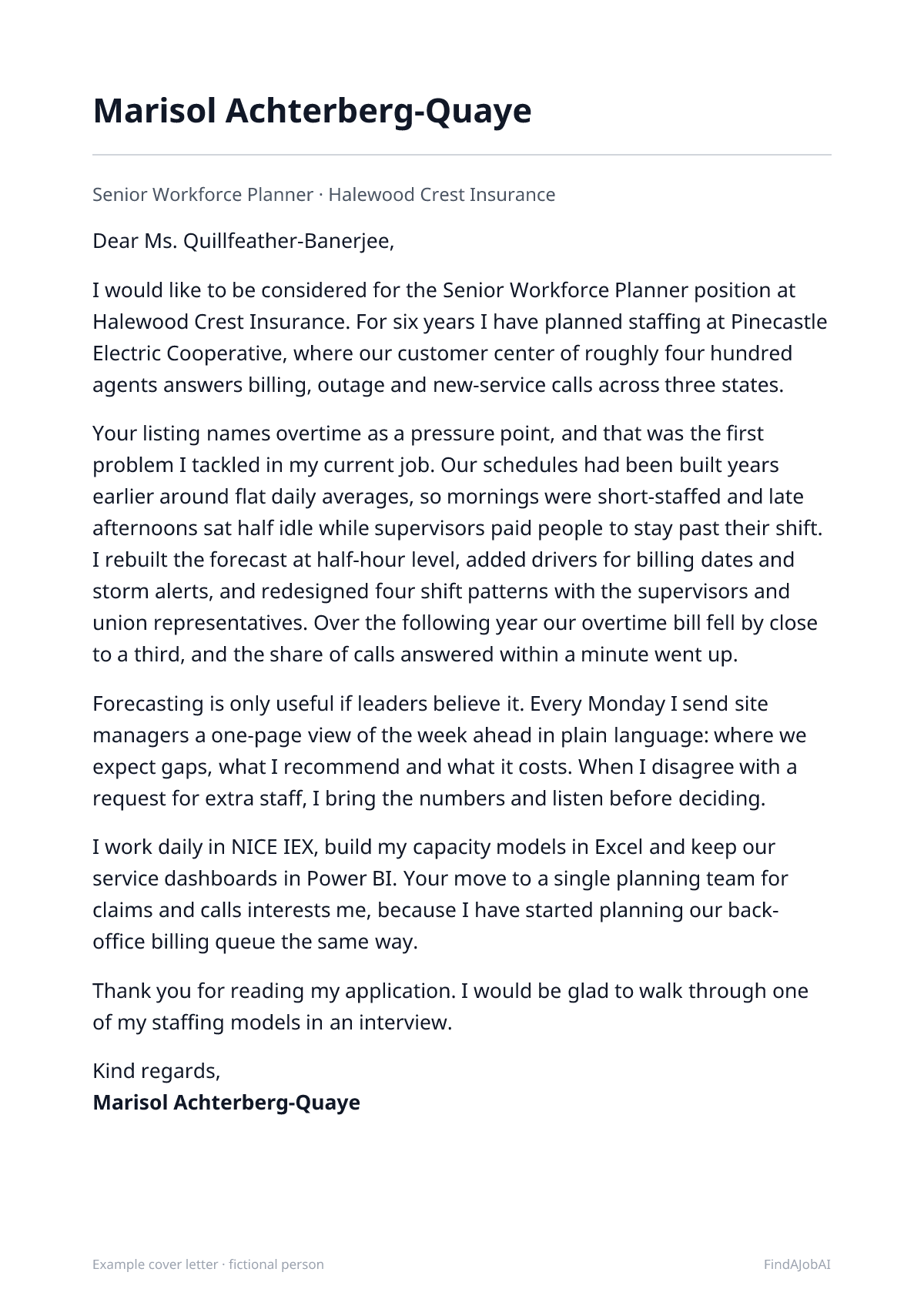
Workforce Planner cover letter template
This letter as a one-page template: an opening that names the job and your strongest fact, proof that answers the ad, a reason for this employer and a short close.
After you sign up, FindAJobAI drafts your own letter for a real job from your CV in this format, and you edit it before you send it.
Example 1 · Experienced
Contact center planner applying to a larger insurer
Marisol plans staffing for a 400-agent utility call center and wants a senior planner job at an insurer that mentions overtime costs.
Example letter · fictional
Dear Ms. Quillfeather-Banerjee,
I would like to be considered for the Senior Workforce Planner position at Halewood Crest Insurance. For six years I have planned staffing at Pinecastle Electric Cooperative, where our customer center of roughly four hundred agents answers billing, outage and new-service calls across three states.
Your listing names overtime as a pressure point, and that was the first problem I tackled in my current job. Our schedules had been built years earlier around flat daily averages, so mornings were short-staffed and late afternoons sat half idle while supervisors paid people to stay past their shift. I rebuilt the forecast at half-hour level, added drivers for billing dates and storm alerts, and redesigned four shift patterns with the supervisors and union representatives. Over the following year our overtime bill fell by close to a third, and the share of calls answered within a minute went up.
Forecasting is only useful if leaders believe it. Every Monday I send site managers a one-page view of the week ahead in plain language: where we expect gaps, what I recommend and what it costs. When I disagree with a request for extra staff, I bring the numbers and listen before deciding.
I work daily in NICE IEX, build my capacity models in Excel and keep our service dashboards in Power BI. Your move to a single planning team for claims and calls interests me, because I have started planning our back-office billing queue the same way.
Thank you for reading my application. I would be glad to walk through one of my staffing models in an interview.
Kind regards,
Marisol Achterberg-Quaye
Example 2 · Career changer
Contact center team lead moving into a first planning role
Dashiell has led a team of 18 agents for four years and applies for a junior workforce planner job at a travel booking company.
Example letter · fictional
Dear Mr. Okafor-Brennan,
Please accept my application for the Workforce Planner role at Seawind Holiday Reservations. I have spent four years as a team lead at Bridgeport Cable Services, and the part of my job I look forward to most each week is the spreadsheet where I plan who works when.
Our planning team sets the overall headcount, but team leads build the detailed rota. I started tracking my own team's calls by hour and noticed that Mondays after nine were always overloaded while Thursday afternoons were quiet. I moved two late starts and one day off with the agents' agreement, and our team's answer times on Mondays improved within a month, without anyone losing a preferred day off or a childcare slot. The planning team asked to see my sheet and later copied the idea for two other teams.
Since then I have taken an online course in contact center forecasting, learned how Erlang C turns volume and handle time into staff numbers, and built a small practice model using our public holiday data. I know a full planning role covers far more than one team, and I expect to learn your tools and calendar quickly from your senior planners.
I also bring something models cannot: I know what a schedule change feels like for an agent with childcare or a second job. I believe that view helps a planner design shifts people will actually keep.
I would welcome the chance to discuss how I could grow into your planning team, and I am happy to share the practice model I built. My resume is attached.
Best regards,
Dashiell Ferreira-Lindqvist
Example 3 · Senior or lead
Senior planner applying to lead a national planning team
Philippa leads planning for a 1,500-seat bank operation and applies to run workforce planning for a retailer's customer and store support teams.
Example letter · fictional
Dear Mr. Castellanos-Ward,
I am applying for the Head of Workforce Planning role at Larkspur Lane Retail Group. For eleven years I have worked in planning, and since 2021 I have led a team of seven planners and analysts at Corrigan Bay Savings Bank, covering about fifteen hundred staff in phone, chat and card dispute teams.
Your posting describes a planning function split across customer service and store support, with each group keeping its own spreadsheets. We were in the same position three years ago. Each team had its own forecast method, its own shrinkage figure and its own story for finance, so budget meetings turned into arguments about whose numbers were right. I agreed one set of planning standards with the operations directors, moved every team into a single WFM system and set a monthly calendar where forecasts, hiring and training dates are reviewed together. Budget debates now start from shared figures, and our hiring classes arrive when the volume does.
I care about growing planners as much as building models. Each analyst on my team owns a line of business, presents to its leaders and has a development plan; two have since been promoted into senior roles.
With seasonal peaks and store openings, your planning team faces a harder calendar than a bank. I would begin by learning how stores and contact centers share demand, then agree the few measures that matter most for the holiday season.
I would value the chance to discuss your plans for the planning function, the measures your directors care about most and how I could lead the team through its next peak season.
Sincerely,
Philippa Nakashima-Oduya
All three letters, and the short version below, are fictional: the people, employers and numbers are invented. Borrow the structure, never the facts.
- Prefer to write it yourself? Use the free cover letter template.
- Check your CV against the job first: the free CV score shows the missing keywords.
Why the first letter works, paragraph by paragraph
Paragraph 1: Opening
Names the employer, the size of the center and the call types, so the reader can compare the operation with their own straight away.
Paragraph 2: Overtime story
Answers the listing's main concern with the cause, the planning changes and a clear before and after result.
Paragraph 3: Trust and reporting
Shows the planner explains plans to managers in plain language, which is half of the job in most companies.
Paragraph 4: Tools
Names the WFM, modeling and dashboard tools and links them to the employer's own plans for back-office work.
Paragraph 5: Close
Offers to walk through a real model, a confident and specific ask that suits an analytical role.
What the career changer's letter does differently
The career changer turns rota building as a team lead into planning proof: hourly call tracking, shifted start times and a result the planning team copied. He is honest about what he still needs to learn and adds the agent's view as a strength.
What the senior letter does differently
A senior letter moves from personal forecasting to running a function: shared standards, one WFM system, a monthly planning calendar and developing analysts, with a careful plan for the retailer's seasonal peaks.
Short workforce planner cover letter: an email-ready version
Many applications arrive as an email or a small text box, and a full page doesn't fit. This version runs 120 to 150 words and keeps only what a reader needs to decide whether to reply. A workforce planner emails a hospital operations director after a former colleague mentions an opening for a nurse staffing planner.
Short version · email · fictional133 words
Subject: Nurse staffing planner – 5 years of contact center planning, ready for hospital rosters
Hi Ms. Haverford,
Ruben Takahashi, who worked with me at Mokulua Telecom, told me you are hiring a nurse staffing planner, and I wanted to introduce myself. For five years I have forecast demand and built schedules for a contact center of about three hundred agents, keeping weekly forecast error under five percent.
I know hospital staffing has rules a call center does not, such as skill mix, ratios and union agreements, and I would expect to learn them from your nursing leaders. What I bring is careful forecasting, clear reports in Excel and Power BI, and patience when explaining a roster change to the people who work it.
My resume is attached. I am free for a call on any weekday morning and could start within three weeks.
Thank you,
Ingeborg Salazar-Whitcombe
The short email names the referral, gives the planner's scale and forecast accuracy in one line, admits the hospital rules are new and ends with availability and a start date.
Opening lines that work for workforce planner cover letters
The first sentence decides whether the second gets read. Here are six openings, one for each situation you might be in. Pick the one that matches yours and swap in your own facts: every name and number below is invented.
1. You have a standout result
Every Monday I send our site managers a one-page staffing outlook for the week, and in six years they have rarely had to ask what it means.
2. The ad names a problem you've solved
Your posting mentions overtime costs. At my utility call center, a half-hour forecast and four new shift patterns cut our overtime bill by about a third.
3. Someone referred you
Ruben Takahashi, a former colleague, suggested I write to you about your nurse staffing planner opening.
4. You admire what they build
After four years building rotas for my own team of eighteen agents, I want to plan staffing for a whole contact center.
5. You're new to the field or switching into it
I led a planning team that moved three business lines onto one forecast method, and I would like to do the same for your service and store teams.
6. You have senior scope or a specialism
A staffing plan only works if agents can live with it, so I design shifts with supervisors and the people who work them.
How to write a workforce planner cover letter
Five steps, in the order you'd write them. The shape stays the same for every job (a short opening, proof, a reason for this employer, a close), and what goes into each part is what changes with the role.
Open with the size of your operation
Start with the number of agents, sites, queues or yearly contacts you plan for. A hiring manager needs to see quickly whether your experience matches the scale of their operation, so put it in the first two sentences rather than saving it for the resume.
Tell one planning story with a result
Pick one forecast or staffing change you led, such as new shift patterns, a better driver in the forecast or a hiring plan timed to attrition. Explain the problem, what you changed and what happened to service level, overtime or answer times afterward.
Show that leaders trust your numbers
Planners are judged on whether managers act on their plans. Describe how you present forecasts or staffing gaps to site leaders or finance, and how you handle disagreements about headcount. One concrete routine, like a weekly outlook, is enough to make the point.
Name your tools and methods
List the WFM systems, modeling methods and reporting tools you use, such as NICE IEX, Verint, Erlang C, Excel or Power BI. If the employer uses a different tool, say which similar one you know and how quickly you have learned new systems before.
Close with a specific offer
End by offering to walk through a staffing model, a forecast review or a schedule design in the interview. A concrete offer suits an analytical role better than a general request for a meeting, and keeps the close short and confident.
Workforce Planner cover letter do's and don'ts
Do
- Give the size of the operation, such as agents, sites or annual volume.
- Describe one forecast or staffing change and its result.
- Name the WFM and modeling tools you use.
- Show how you explain plans to managers and finance.
Don't
- Don't list planning terms without an example.
- Don't claim savings you cannot explain in an interview.
- Don't forget the people who work the schedules you design.
Common workforce planner cover letter mistakes
Each one is easy to make and quick to fix before you send the letter.
A list of planning buzzwords
Words like forecasting and capacity mean little alone. Tie them to one real change and its result.
No scale or accuracy
Give agents covered and forecast error so the reader can judge how complex your planning work has been.
Ignoring the business result
Link your plans to service level, overtime, wait times or hiring cost, the figures leaders actually watch.
Forgetting the people on the schedule
Show that you design shifts with supervisors and agents, since plans that staff cannot keep fail quickly.
Generic letter for every employer
Mention the employer's industry, seasonal peaks or channels so the letter reads as written for this planning team.
Email subject lines for workforce planner applications
Applying by email? Put the job title, any reference number and your name in the subject line.
- Senior Workforce Planner – 6 years, 400-agent center, overtime cut – Marisol Achterberg-Quaye
- Workforce Planner application – team lead with hourly rota planning – Dashiell Ferreira-Lindqvist
- Application: Senior Workforce Planner, Halewood Crest Insurance
Everything for Workforce Planners
- Workforce Planner resume exampleA full resume, plus bullet and summary examples
- Workforce Planner interview questions30 questions with sample answers
- Workforce Planner job descriptionDuties, skills and requirements
- Career change cover letter: template + examples
Other cover letter examples
Workforce Planner cover letter FAQ
Do workforce planners need a cover letter?
It is often optional, but a short letter helps you explain a forecast or staffing result in context, which a resume bullet cannot fully do. Many planning managers read letters for candidates with similar resumes.
What should a workforce planner cover letter include?
The size of the operation you plan for, one forecast or staffing change and its result, the tools you use and an example of explaining plans to managers or finance.
How do I write a workforce planner cover letter with no planning experience?
Use related work such as building rotas as a team lead, real-time monitoring or reporting. Describe one pattern you found in volume data and what you changed, and mention any forecasting course you have taken.
How we built this page
The FindAJobAI team wrote the three example letters, the short email version, the opening lines and the advice for workforce planner roles. The people, employers and numbers in the letters are invented; the structure, the kind of evidence and the order of the paragraphs are the parts to copy.
Once we track enough live workforce planner job ads, this page also shows the skills they ask for most, counted the same way as our in-demand skills report.
Last reviewed on November 1, 2026.