Astronomer Resume Example (2026)
By FindAJobAI Team Updated How we built this page
Astronomer resumes and CVs are read by faculty search committees, observatory and space agency hiring panels and, more and more, data science teams in industry. They want to see which objects and methods you study, which telescopes, instruments and surveys you have used, how much code you write and whether your work led to papers, data releases or tools others depend on.
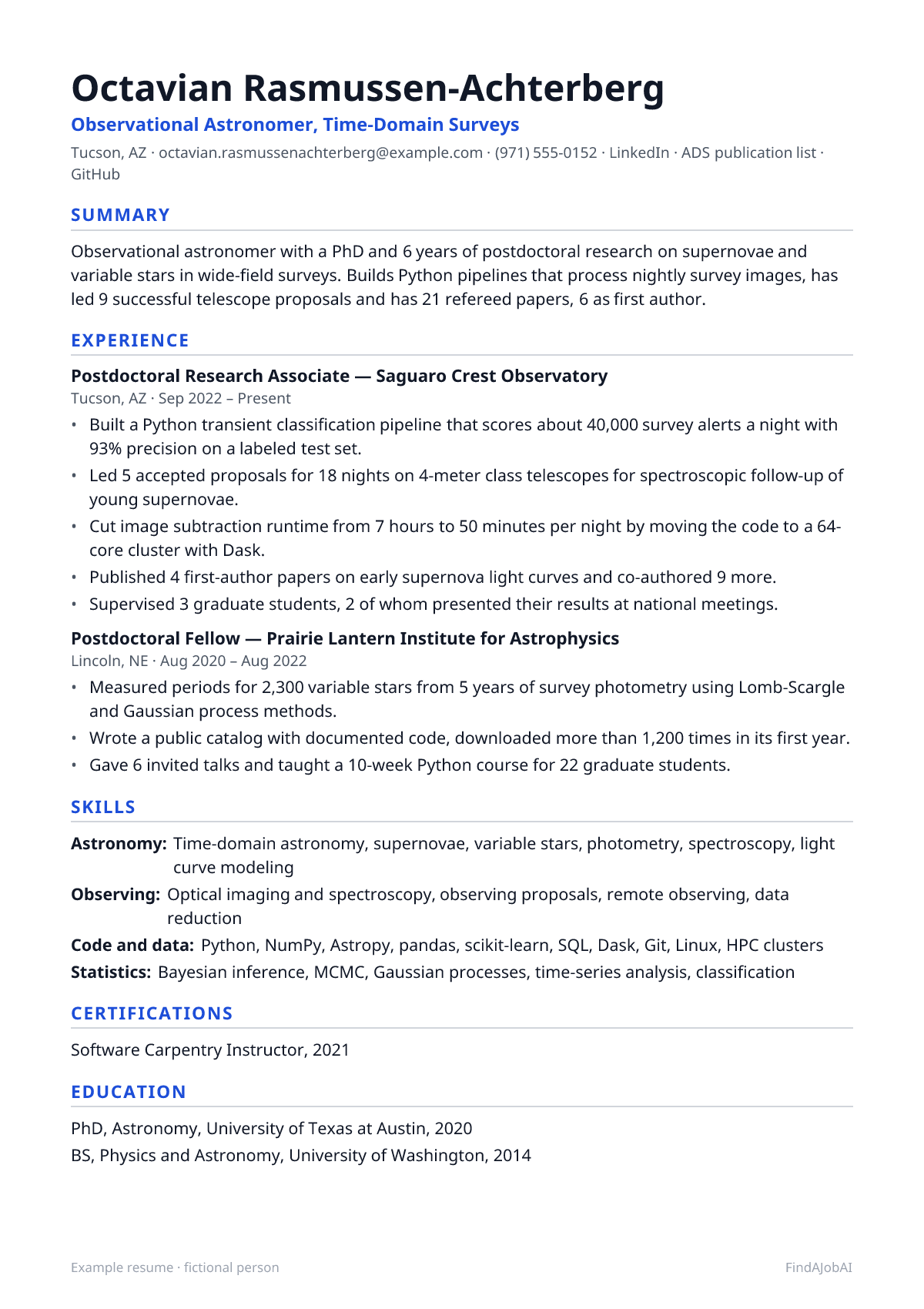
The example below belongs to an observational astronomer with a PhD and two postdocs who works on time-domain surveys. Each bullet links an observing program, pipeline or analysis to a concrete outcome, such as a data release, a paper count or a measured speed-up, so readers in research and industry can judge the work quickly.
Astronomer resume template
This example as a one-page template: one column, standard headings and plain text, the format applicant tracking systems read most reliably.
After you sign up, Create my CV builds your own resume in this same one-column layout, from your real experience.
Mid-level astronomer resume example
A complete one-page example for a fictional astronomer: every bullet pairs an action with what changed because of it.
Example resume · fictional person
Octavian Rasmussen-Achterberg
Observational Astronomer, Time-Domain Surveys
Tucson, AZ · [email protected] · (971) 555-0152 · LinkedIn · ADS publication list · GitHub
Summary
Observational astronomer with a PhD and 6 years of postdoctoral research on supernovae and variable stars in wide-field surveys. Builds Python pipelines that process nightly survey images, has led 9 successful telescope proposals and has 21 refereed papers, 6 as first author.
Experience
Postdoctoral Research Associate, Saguaro Crest Observatory
Tucson, AZ · Sep 2022 – Present
- Built a Python transient classification pipeline that scores about 40,000 survey alerts a night with 93% precision on a labeled test set.
- Led 5 accepted proposals for 18 nights on 4-meter class telescopes for spectroscopic follow-up of young supernovae.
- Cut image subtraction runtime from 7 hours to 50 minutes per night by moving the code to a 64-core cluster with Dask.
- Published 4 first-author papers on early supernova light curves and co-authored 9 more.
- Supervised 3 graduate students, 2 of whom presented their results at national meetings.
Postdoctoral Fellow, Prairie Lantern Institute for Astrophysics
Lincoln, NE · Aug 2020 – Aug 2022
- Measured periods for 2,300 variable stars from 5 years of survey photometry using Lomb-Scargle and Gaussian process methods.
- Wrote a public catalog with documented code, downloaded more than 1,200 times in its first year.
- Gave 6 invited talks and taught a 10-week Python course for 22 graduate students.
Skills
- Astronomy: Time-domain astronomy, supernovae, variable stars, photometry, spectroscopy, light curve modeling
- Observing: Optical imaging and spectroscopy, observing proposals, remote observing, data reduction
- Code and data: Python, NumPy, Astropy, pandas, scikit-learn, SQL, Dask, Git, Linux, HPC clusters
- Statistics: Bayesian inference, MCMC, Gaussian processes, time-series analysis, classification
Certifications
- Software Carpentry Instructor, 2021
Education
- PhD, Astronomy, University of Texas at Austin, 2020
- BS, Physics and Astronomy, University of Washington, 2014
Fictional example by the FindAJobAI team: the person, employers and numbers are invented. Keep the structure; use your own work and numbers you can explain in an interview.
Entry-level astronomer resume example
A new astronomy graduate whose undergraduate research, observing nights and code carry the resume. Bullets turn class and lab hours into what graduate programs, observatories and data employers screen for.
Entry-level example resume · fictional person
Perpetua Lindholm-Asante
Astronomy Graduate, Research Assistant
Madison, WI · [email protected] · (971) 555-0163 · LinkedIn · GitHub
Summary
Astronomy and physics graduate with 2 years of research on eclipsing binary stars. Reduces CCD photometry with Astropy, has observed for 30 nights on a campus telescope and writes tested, documented Python code.
Education
- BS, Astronomy and Physics, University of Wisconsin–Madison, 2026 (GPA 3.8)
Experience
Undergraduate Research Assistant, Lakeshore Prism Observatory
Madison, WI · Sep 2024 – May 2026
- Observed 12 eclipsing binary systems over 30 nights on a 1-meter telescope, logging conditions and calibration frames each night.
- Wrote a Python photometry script with Astropy and photutils that cut reduction time per night from 5 hours to 40 minutes.
- Fitted light curves for 8 binaries and measured orbital periods to within 0.01% of published values.
- Presented a poster at 1 national meeting and 2 campus research days.
Skills
- Observing: CCD imaging, calibration frames, telescope control software, observing logs
- Code and data: Python, Astropy, photutils, NumPy, Matplotlib, Git, LaTeX
- Analysis: Aperture photometry, period finding, curve fitting, error analysis
Projects
- Senior thesis: searched 2 years of public survey data for 5 new variable stars and confirmed 3 with follow-up imaging.
- Built a small web page of nightly sky conditions used by 15 students in the observing class.
Senior astronomer resume example
A survey science lead with fifteen years who runs a data system for a large survey. Bullets cover team leadership, budgets, data releases, partnerships and the science the system enables.
Senior example resume · fictional person
Hieronymus Okwuosa-Brandvold
Survey Science Lead, Wide-Field Imaging
Pasadena, CA · [email protected] · (971) 555-0174 · LinkedIn · ADS publication list
Summary
Astronomer with 15 years in observatory and university research, now leading a 12-person team that runs the data system for a wide-field imaging survey. Manages a multi-year grant budget, delivers public data releases and works with partner institutions in the US, Chile and Europe.
Experience
Survey Science Lead, Coastal Sierra Astronomical Consortium
Pasadena, CA · Jan 2019 – Present
- Lead 12 scientists and engineers running a pipeline that processes about 4 TB of images a night.
- Delivered 3 public data releases on schedule, each used in more than 150 papers by outside teams.
- Managed a $6.8 million multi-year grant budget and reported progress to 2 funding agencies.
- Cut alert latency from 20 minutes to 4 minutes by redesigning the streaming system with 2 engineers.
Staff Astronomer, Coastal Sierra Astronomical Consortium
Pasadena, CA · Jun 2013 – Dec 2018
- Designed calibration methods that improved survey photometric accuracy from 2% to 0.8%.
- Published 14 papers on galaxy clusters and survey methods, 5 as first author.
- Served on 4 time allocation committees reviewing about 300 proposals in total.
Skills
- Leadership: Team management, grant budgets, data release planning, partner coordination, hiring
- Survey science: Wide-field imaging, photometric calibration, alert streams, galaxy clusters
- Code and data: Python, C++, SQL, Kafka, cloud and HPC computing, Git
Certifications
- Project Management Professional (PMP), 2020
Education
- PhD, Astrophysics, California Institute of Technology, 2011
- BS, Physics, Rice University, 2005
How to write an astronomer resume
Five steps, in the order a recruiter reads the page. The format around them stays plain for every job: one column, standard headings, newest role first.
Header: name, target title and links
Use “Astronomer”, “Astrophysicist” or “Research Scientist” to match the posting, then city, phone, email and LinkedIn. Add your ADS or Google Scholar list and GitHub.
Summary: what you do and your best proof
Open with your degree, research area and years after your PhD. Add your main methods or tools and one result, such as papers, telescope time won or a pipeline others use.
Experience: newest first, a result in every bullet
Write each bullet as project, method and result: nights observed, objects measured, pipeline built, proposal won or paper published. Avoid long scientific background in bullets.
Skills: grouped, in the ad's words
Group skills into astronomy areas, observing, code and data, and statistics. Keep only tools you could use well from the first week.
Education and certifications
List degrees, schools and years, with your thesis title for research roles. Put teaching certificates, carpentry or project management training in certifications.
Skills to put on an astronomer resume
Hard skills are the tools and methods of the job; soft skills are how you work with people. Each comes with one way to prove it, because a skill named only in a list counts for little. Add the ones you really have.
Hard skills
- Observational planning
- Name the telescopes, instruments and nights you planned and the data you collected.
- Proposal writing
- Give the number of proposals won, your role and the time or funds awarded.
- Photometry and spectroscopy
- Name the methods and the precision or sample size you reached.
- Python and Astropy
- List libraries you use and a tool or pipeline that others ran.
- Statistical inference
- Mention Bayesian, MCMC or time-series methods and a result they improved.
- Machine learning
- Name the model, the data volume and a measured score on held-out data.
- Large data handling
- Give data volumes per night or in total and how you processed them.
- High-performance computing
- Show clusters or cloud jobs you ran and the speed-up you gained.
- Scientific writing
- Count papers and citations and name any data releases or catalogs.
- Instrument calibration
- Describe calibration work and the accuracy it achieved.
Soft skills
- Explaining science to the public
- Give outreach events, audience sizes or media work.
- Collaboration
- Name large teams or consortia you worked in and your role.
- Mentoring
- Mention students you supervised and what they achieved.
- Persistence
- Describe a program that met bad weather or failures and still produced results.
- Time management
- Show how you balanced observing runs, papers and teaching.
- Scientific honesty
- Describe reporting uncertainties and null results openly.
- Teaching
- Name courses or workshops you taught and how they were rated.
Astronomer resume bullet examples: weak vs strong
The same work, written two ways. The strong version names the tool, the scope and a result; the numbers are examples, yours must be real.
Weak: Did observations at telescopes.
Strong: Planned and ran 22 nights of remote spectroscopy, collecting usable spectra for 140 transients with under 4% time lost to errors.
Gives volume, quality and efficiency of observing time.
Weak: Wrote telescope proposals.
Strong: Won 9 of 13 competitive telescope proposals as principal investigator, securing 31 nights over 5 semesters.
Shows a success rate that grant and hiring panels value.
Weak: Analyzed survey data.
Strong: Fitted light curves for 850 supernovae with a Bayesian model in Stan, reducing distance scatter by 12% compared with the standard fit.
Names the method, the sample size and the improvement.
Weak: Made a data pipeline.
Strong: Built an automated reduction pipeline in Python that processes 300 GB of images a night with 99.5% uptime over 2 years.
Shows scale and reliability, which data teams look for.
Weak: Gave outreach talks.
Strong: Ran 14 public stargazing nights for about 1,500 visitors and trained 8 student volunteers to lead them.
Adds scale and leadership to outreach.
Weak: Wrote papers on stars.
Strong: Published 6 first-author papers on stellar variability, cited about 310 times in total.
Combines authorship, count and impact.
15 more astronomer resume bullet examples
Grouped by area of the job, so you can find the ones closest to your work. Keep the shape (action, scope, result) and replace the invented numbers with your own.
Observing and instruments
- Completed 15 remote observing runs with under 5% of time lost to setup or software errors.
- Commissioned a new spectrograph mode over 6 nights and wrote its 25-page user guide.
- Coordinated follow-up of 60 transients across 4 telescopes on 3 continents in 1 season.
- Built calibration frames for 200 nights of archive data, raising usable data by 18%.
Data and software
- Moved a legacy IDL pipeline to Python, cutting code size by 40% and adding 120 unit tests.
- Trained a random forest classifier on 25,000 labeled light curves with an F1 score of 0.91.
- Designed a PostgreSQL database for 3 million source detections with queries under 2 seconds.
- Released 4 open-source packages on GitHub that gained about 600 stars in total.
Research results
- Discovered 7 new supernovae within 2 days of explosion during a 2-year survey.
- Measured the expansion rate in a sample of 300 galaxies with a 3% statistical uncertainty.
- Led a 40-author collaboration paper that combined data from 5 observatories.
Teaching and outreach
- Taught introductory astronomy labs to 90 students a semester for 3 years.
- Ran a summer research program for 10 undergraduates, 4 of whom later entered PhD programs.
- Wrote 12 public articles on new discoveries for an observatory blog with 20,000 monthly readers.
- Organized a 3-day data science workshop for 50 astronomers from 14 institutions.
Astronomer resume summary examples
Two or three lines on what you do and your strongest proof. Start from the one closest to your level and use your own facts.
Astronomy graduate with a BS and 2 years of undergraduate research on eclipsing binary stars. Reduces CCD photometry with Astropy, writes tested Python code and has observed on a 1-meter campus telescope for 30 nights.
Observational astronomer with a PhD and 6 years of postdoctoral research on time-domain surveys. Builds survey pipelines in Python, wins telescope time and publishes steadily, with 21 refereed papers.
Astronomer and survey science lead with 15 years in observatory and university research. Leads a 12-person team running a wide-field survey data system, manages grant budgets and works with partners in the US and Europe.
Common astronomer resume mistakes
Each one is easy to make and quick to fix before you apply.
Naming telescopes without saying what you did there
Add nights observed, instruments used and the data or results each program produced.
Hiding coding work behind science goals
List languages, libraries and pipelines plainly, with data volumes and speed-ups.
Sending a full academic CV to a tech company
Cut it to two pages, keep a paper count and a few key papers and lead with data results.
Skipping proposal success rates
Give proposals won and time awarded, because they show peers trust your science.
ATS tips for an astronomer resume
Applicant tracking systems turn your file into text that recruiters search, mostly for the skills and titles in the ad. They rarely reject a resume on their own; one that parses badly or misses the ad's words just doesn't come up.
- Name the objects and methods you study in the first lines, because search committees sort by research area.
- List the telescopes, instruments and surveys you have used, with nights or data volumes where possible.
- Show your code: languages, libraries, pipelines and public repositories that others use.
- For faculty and observatory jobs, add full publication, proposal and funding sections.
- For industry data roles, translate research into data size, model performance and runtime gains.
For the format itself, run the free ATS resume checklist.
Everything for Astronomers
- Astronomer cover letter examplesThree example letters and a short email version
- Astronomer interview questions30 questions with sample answers
- Astronomer job descriptionDuties, skills and requirements
- How to tailor your resume without lying
Other resume examples
Astronomer resume FAQ
What should I put on an astronomer resume?
Your research area, telescopes and instruments used, observing proposals won, data pipelines and code, papers and citations, grants, teaching, mentoring and outreach, plus programming and statistics skills.
Is an astronomer resume different from an academic CV?
Yes. A resume for industry is one or two pages and leads with data, code and results. An academic CV is longer and lists every paper, talk, proposal, grant and teaching role.
How do I move from astronomy to data science on my resume?
Lead with data volume, statistical methods, machine learning, pipelines and software tools. Explain each project as a data problem with a measurable result and keep the astronomy context short.
How we built this page
The FindAJobAI team wrote the three example resumes, the bullets, the skills and the advice for astronomer roles. The people, employers and numbers in the examples are invented; the structure, the tools and the way each bullet is built are the parts to copy.
Once we track enough live astronomer job ads, this page also shows the skills they ask for most, counted the same way as our in-demand skills report.
Last reviewed on November 1, 2026.