Audiologist Resume Example (2026)
By FindAJobAI Team Updated How we built this page
Audiologist job ads repeat a familiar list: comprehensive audiometry, tympanometry, otoacoustic emissions, hearing aid selection and fitting, and counseling for patients and families. Almost every candidate copies that list onto the page. What sets a resume apart is the evidence behind it: how many evaluations you complete each week, whether you verify fittings with real-ear measurement, how many patients keep wearing their devices and which special populations you serve.
The sample below follows a clinical audiologist with six years in an ENT practice and a hospital hearing center. Each bullet counts patients, tests or fittings and ties the work to an outcome such as fewer returns, faster referrals or better device use.
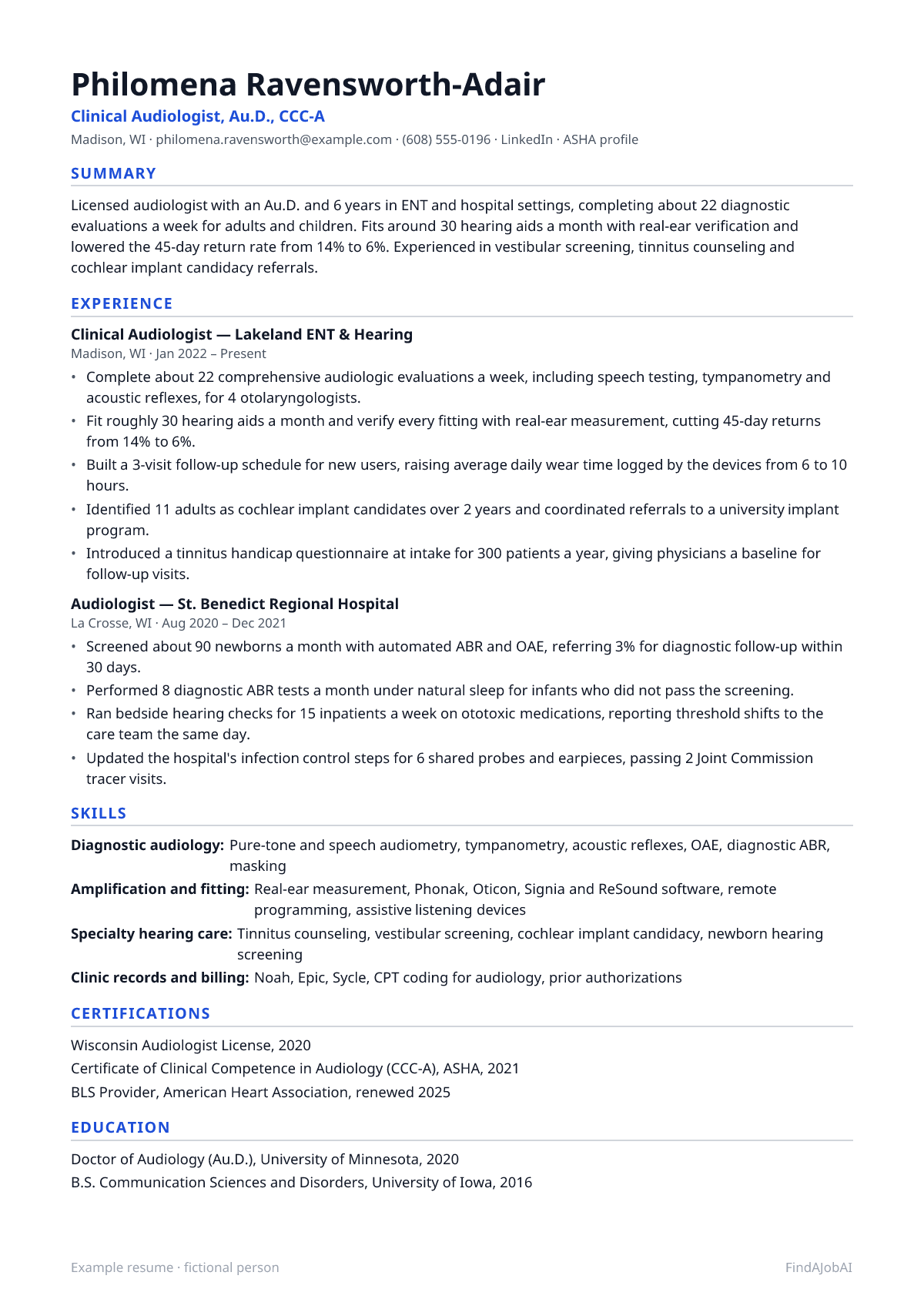
Audiologist resume template
This example as a one-page template: one column, standard headings and plain text, the format applicant tracking systems read most reliably.
After you sign up, Create my CV builds your own resume in this same one-column layout, from your real experience.
Mid-level audiologist resume example
A complete one-page example for a fictional audiologist: every bullet pairs an action with what changed because of it.
Example resume · fictional person
Philomena Ravensworth-Adair
Clinical Audiologist, Au.D., CCC-A
Madison, WI · [email protected] · (608) 555-0196 · LinkedIn · ASHA profile
Summary
Licensed audiologist with an Au.D. and 6 years in ENT and hospital settings, completing about 22 diagnostic evaluations a week for adults and children. Fits around 30 hearing aids a month with real-ear verification and lowered the 45-day return rate from 14% to 6%. Experienced in vestibular screening, tinnitus counseling and cochlear implant candidacy referrals.
Experience
Clinical Audiologist, Lakeland ENT & Hearing
Madison, WI · Jan 2022 – Present
- Complete about 22 comprehensive audiologic evaluations a week, including speech testing, tympanometry and acoustic reflexes, for 4 otolaryngologists.
- Fit roughly 30 hearing aids a month and verify every fitting with real-ear measurement, cutting 45-day returns from 14% to 6%.
- Built a 3-visit follow-up schedule for new users, raising average daily wear time logged by the devices from 6 to 10 hours.
- Identified 11 adults as cochlear implant candidates over 2 years and coordinated referrals to a university implant program.
- Introduced a tinnitus handicap questionnaire at intake for 300 patients a year, giving physicians a baseline for follow-up visits.
Audiologist, St. Benedict Regional Hospital
La Crosse, WI · Aug 2020 – Dec 2021
- Screened about 90 newborns a month with automated ABR and OAE, referring 3% for diagnostic follow-up within 30 days.
- Performed 8 diagnostic ABR tests a month under natural sleep for infants who did not pass the screening.
- Ran bedside hearing checks for 15 inpatients a week on ototoxic medications, reporting threshold shifts to the care team the same day.
- Updated the hospital's infection control steps for 6 shared probes and earpieces, passing 2 Joint Commission tracer visits.
Skills
- Diagnostic audiology: Pure-tone and speech audiometry, tympanometry, acoustic reflexes, OAE, diagnostic ABR, masking
- Amplification and fitting: Real-ear measurement, Phonak, Oticon, Signia and ReSound software, remote programming, assistive listening devices
- Specialty hearing care: Tinnitus counseling, vestibular screening, cochlear implant candidacy, newborn hearing screening
- Clinic records and billing: Noah, Epic, Sycle, CPT coding for audiology, prior authorizations
Certifications
- Wisconsin Audiologist License, 2020
- Certificate of Clinical Competence in Audiology (CCC-A), ASHA, 2021
- BLS Provider, American Heart Association, renewed 2025
Education
- Doctor of Audiology (Au.D.), University of Minnesota, 2020
- B.S. Communication Sciences and Disorders, University of Iowa, 2016
Fictional example by the FindAJobAI team: the person, employers and numbers are invented. Keep the structure; use your own work and numbers you can explain in an interview.
Entry-level audiologist resume example
A new Au.D. graduate whose experience comes from rotations and a fourth-year externship. Education leads the page, and each externship bullet counts real patients, tests and fittings rather than describing coursework.
Entry-level example resume · fictional person
Tobias Okonkwo-Lindgren
Audiologist, Au.D.
Columbus, OH · [email protected] · (614) 555-0134 · LinkedIn
Summary
Newly licensed audiologist with an Au.D. from Ohio State University and a 12-month externship at a hospital hearing center. Completed about 15 evaluations a week under supervision for adults and children, and fitted 60 hearing aids with real-ear verification. Interested in pediatric diagnostics and cochlear implant support.
Education
- Doctor of Audiology (Au.D.), Ohio State University, 2026
- B.A. Speech and Hearing Science, Miami University, 2022
Experience
Audiology Extern, Olentangy Hearing Institute
Columbus, OH · Jul 2025 – May 2026
- Completed about 15 audiologic evaluations a week under supervision, writing reports signed by 3 preceptors.
- Fitted 60 hearing aids across the year with real-ear checks, meeting prescriptive targets on the first session for 80%.
- Assisted with 20 diagnostic ABR sessions for infants referred from newborn screening.
Graduate Clinician, Buckeye University Speech and Hearing Clinic
Columbus, OH · Sep 2023 – May 2025
- Tested about 6 patients a week in the university clinic, including play audiometry for 2 preschoolers.
- Ran a hearing screening event for 140 older adults at a local senior center with 4 classmates.
Skills
- Audiometric evaluation: Pure-tone and speech testing, tympanometry, OAE, play audiometry, visual reinforcement audiometry
- First fittings: Real-ear measurement, Phonak and Oticon software, care and use orientation
- Patient communication: Plain-language results, family counseling, conversational Spanish
Certifications
- Ohio Audiologist License, 2026
- BLS Provider card, American Heart Association, 2026
Clinical Hours and Research
- Clinical practicum: 1,900 supervised hours across adult, pediatric and vestibular rotations.
- Capstone project: compared speech-in-noise scores before and after fitting for 24 new hearing aid users.
Senior audiologist resume example
A lead audiologist fourteen years in who now runs a team and a pediatric program. The bullets move from individual tests to protocols, staff, students, inventory and payer relationships.
Senior example resume · fictional person
Annelise Montgomery-Achebe
Lead Audiologist, Au.D., F-AAA
Charlotte, NC · [email protected] · (704) 555-0179 · LinkedIn
Summary
Lead audiologist with 14 years of practice, directing 5 audiologists and 3 hearing aid specialists across 2 offices that see about 140 patients a week. Built a pediatric diagnostic program, wrote clinic-wide fitting and verification protocols and precepts 2 Au.D. externs a year. Manages device inventory and works with the billing team on payer contracts.
Experience
Lead Audiologist, Piedmont Hearing & Balance
Charlotte, NC · Sep 2018 – Present
- Direct 5 audiologists and 3 hearing aid specialists across 2 offices handling about 140 visits a week.
- Wrote a clinic-wide fitting protocol requiring real-ear verification, lowering device returns from 12% to 5% in 18 months.
- Launched a pediatric diagnostic program with sedated and natural-sleep ABR, serving about 160 children a year.
- Precept 2 Au.D. externs a year; all 8 externs since 2022 passed the Praxis exam on the first attempt.
Staff Audiologist, Carolina Coast ENT
Wilmington, NC · Aug 2012 – Mar 2018
- Completed about 25 diagnostic evaluations a week for 5 ENT physicians.
- Performed videonystagmography for 6 dizzy patients a week and wrote reports for the referring doctor.
- Fitted around 300 hearing aids a year and ran a monthly repair clinic for existing users.
Skills
- Audiology leadership: Staff supervision, clinical protocols, extern precepting, peer chart review
- Advanced diagnostics: Sedated and natural-sleep ABR, VNG, vHIT, ECochG, cochlear implant candidacy
- Practice operations: Device inventory, manufacturer contracts, payer credentialing, Noah and Sycle reporting
Certifications
- North Carolina Audiologist License, 2012
- Board Certified in Audiology, American Board of Audiology, 2016
- Fellow, American Academy of Audiology
Education
- Doctor of Audiology (Au.D.), University of North Carolina at Chapel Hill, 2012
How to write an audiologist resume
Five steps, in the order a recruiter reads the page. The format around them stays plain for every job: one column, standard headings, newest role first.
Header: name, target title and links
Use “Audiologist” or the exact title from the posting, and add Au.D. and CCC-A or board certification after your name so credentials are seen first.
Summary: what you do and your best proof
State your degree, license, years in practice, settings and populations, weekly evaluations and monthly fittings, plus one outcome such as lower returns.
Experience: newest first, a result in every bullet
Open each bullet with the test or service, add the volume and the method, then the result: verified targets, return rates, referrals made or wear time.
Skills: grouped, in the ad's words
Group into diagnostics, amplification, specialty care and systems. Name manufacturer software and verification equipment exactly, since postings list them.
Education and certifications
List the Au.D. with year and your undergraduate degree, then the state license and certifications. New graduates should add supervised hours and the externship setting.
Skills to put on an audiologist resume
Hard skills are the tools and methods of the job; soft skills are how you work with people. Each comes with one way to prove it, because a skill named only in a list counts for little. Add the ones you really have.
Hard skills
- Pure-tone and speech audiometry
- Give evaluations per week and how often results needed retesting.
- Clinical masking
- Mention complex cases such as asymmetric or conductive losses you tested.
- Tympanometry and acoustic reflexes
- Say which referral decisions your middle ear results supported.
- Otoacoustic emissions
- Name the setting, such as newborn or school screening, and volume.
- Auditory brainstem response
- Count diagnostic ABR sessions and the age groups tested.
- Hearing aid selection and fitting
- Give monthly fittings and a return or satisfaction figure.
- Real-ear verification
- State that you verify every fitting and how closely you meet targets.
- Pediatric audiometry
- Name VRA or play audiometry and the ages you test.
- Vestibular assessment
- Mention VNG or vHIT tests a week and who referred the patients.
- Tinnitus management
- Describe the approach and a follow-up questionnaire result.
- Cochlear implant candidacy
- Count patients referred or programmed.
- Audiology billing and coding
- Point to clean claims, prior authorizations or coding audits.
Soft skills
- Counseling on hearing loss
- Describe helping a patient or family accept a new diagnosis.
- Explaining audiograms simply
- Show how you made results clear to patients without jargon.
- Patience with first-time users
- Mention follow-up steps that kept new users wearing their devices.
- Physician collaboration
- Give an example of a referral or report that helped an ENT decision.
- Comfort with young children
- Describe keeping a toddler engaged long enough to finish testing.
- Ethical device recommendations
- Show how you matched technology to needs and budget.
- Precepting students
- Count externs or graduate clinicians you supervised.
Audiologist resume bullet examples: weak vs strong
The same work, written two ways. The strong version names the tool, the scope and a result; the numbers are examples, yours must be real.
Weak: Did hearing tests.
Strong: Ran full diagnostic batteries for 25 adults a week, with fewer than 1 in 20 retested because of inconsistent responses.
Shows volume and how reliable the testing is.
Weak: Fitted hearing aids.
Strong: Selected and fitted 35 devices a month, matching prescriptive targets within 5 dB at key frequencies on real-ear checks.
Proves fittings are verified, not just programmed.
Weak: Counseled patients.
Strong: Led a monthly group class for 12 new hearing aid users and their partners, lowering first-month help calls by a quarter.
Turns counseling into a measured result.
Weak: Worked with children.
Strong: Tested about 10 children a week aged 6 months to 5 years using visual reinforcement and play audiometry.
Names the techniques and the age range.
Weak: Handled tinnitus patients.
Strong: Provided sound therapy and counseling for 40 tinnitus patients a year, with 70% reporting lower questionnaire scores at 3 months.
Shows a follow-up measure for a hard-to-treat problem.
Weak: Helped the clinic grow.
Strong: Opened Saturday fitting slots twice a month, adding 18 hearing aid consultations a month without extra staff.
Links a scheduling idea to clinic volume.
15 more audiologist resume bullet examples
Grouped by area of the job, so you can find the ones closest to your work. Keep the shape (action, scope, result) and replace the invented numbers with your own.
Diagnostics
- Ran speech-in-noise testing for 20 patients a week to guide device and microphone choices.
- Flagged 7 asymmetric hearing losses in a year for MRI referral, one of which revealed a vestibular schwannoma.
- Completed wideband tympanometry for 12 children a week referred with suspected middle ear fluid.
- Kept audiometer and booth calibration logs for 3 test rooms, passing every annual check.
Fitting and follow-up
- Programmed 25 rechargeable hearing aids a month and taught charging routines with a printed one-page guide.
- Offered remote fine-tuning to 60 rural patients, saving each an average 90-minute round trip per adjustment.
- Followed up with every new user at 2 and 6 weeks, keeping attendance at those visits above 85%.
- Fitted remote microphones for 9 students and briefed their teachers on classroom use.
Pediatric and occupational hearing
- Tested about 30 nursing home residents a quarter on site with portable audiometry.
- Co-led a hearing conservation program for 400 factory workers, reviewing annual audiograms for standard threshold shifts.
- Provided custom musician earplugs and counseling to 25 local performers a year.
- Worked with 2 speech-language pathologists on joint plans for 15 children with hearing loss.
Hearing clinic workflow
- Cut hearing aid repair turnaround from 3 weeks to 9 days by setting up in-office cleaning and minor repairs.
- Reviewed 50 prior authorization denials and rewrote the clinic's documentation template, halving repeat denials.
- Trained 4 front desk staff to triage device problems by phone, freeing 5 audiologist hours a week.
Audiologist resume summary examples
Two or three lines on what you do and your strongest proof. Start from the one closest to your level and use your own facts.
Newly licensed audiologist with an Au.D. and a 12-month externship at a hospital hearing center. Completed about 15 adult and pediatric evaluations a week under supervision and fitted 60 hearing aids with real-ear verification during the year.
Licensed audiologist with 6 years in ENT and hospital clinics, testing about 22 patients a week and fitting 30 hearing aids a month with real-ear checks. Reduced device returns, set up new-user follow-up and coordinates cochlear implant referrals.
Lead audiologist with 14 years of practice, directing 5 audiologists and 3 hearing aid specialists across 2 offices. Sets clinical protocols, manages a pediatric diagnostic program, precepts Au.D. students and oversees device inventory and payer contracts.
Common audiologist resume mistakes
Each one is easy to make and quick to fix before you apply.
Copying the test battery from the job ad
Every audiologist runs pure tones and tympanometry. Add how many patients you test and what your results led to.
Fittings counted without verification
Employers want to know you check fittings on the ear. Say that you use real-ear measurement and how close you get to targets.
Sounding like a hearing aid sales rep
Lead with patient outcomes such as wear time and returns, and keep unit totals as supporting detail only.
Leaving out pediatric or balance work
These skills are scarce and often requested. Name the ages, methods and number of patients if you have them.
License buried under education
State licensure is a hiring requirement. Put the license and certification near your name or summary.
ATS tips for an audiologist resume
Applicant tracking systems turn your file into text that recruiters search, mostly for the skills and titles in the ad. They rarely reject a resume on their own; one that parses badly or misses the ad's words just doesn't come up.
- Name the tests you run and the populations you serve, since postings often filter for pediatric or vestibular experience.
- Say whether you verify fittings with real-ear measurement, because many employers ask for it by name.
- Show outcomes such as return rates, wear time or follow-up attendance instead of only the number of fittings.
- List your state license and CCC-A or ABA board certification near the top of the page.
- Include the manufacturer software and practice systems you know, such as Noah or Sycle.
For the format itself, run the free ATS resume checklist.
Everything for Audiologists
- Audiologist cover letter examplesThree example letters and a short email version
- Audiologist interview questions30 questions with sample answers
- Audiologist job descriptionDuties, skills and requirements
- How to tailor your resume without lying
Other resume examples
Audiologist resume FAQ
What should an audiologist put on a resume?
Your license and certification, the tests you perform, the patient groups you see, how many evaluations and fittings you complete, and results such as lower return rates or better device wear time.
Should an audiologist list the Au.D. externship?
Yes, especially in the first few years. Give the setting, the length, the number of evaluations and fittings, and any special areas such as pediatrics or balance testing.
How do I show hearing aid sales without sounding like a salesperson?
Focus on patient outcomes. Mention verified fittings, follow-up visits, return rates and satisfaction, and add unit numbers only as supporting detail.
How we built this page
The FindAJobAI team wrote the three example resumes, the bullets, the skills and the advice for audiologist roles. The people, employers and numbers in the examples are invented; the structure, the tools and the way each bullet is built are the parts to copy.
Once we track enough live audiologist job ads, this page also shows the skills they ask for most, counted the same way as our in-demand skills report.
Last reviewed on November 1, 2026.