Benefits Specialist Cover Letter Example (2026)
By FindAJobAI Team Updated How we built this page
Benefits specialist ads list open enrollment, leave administration and compliance, but the hiring manager reading your letter wants to know two things: will employees trust your answers, and will the details be right. The letter should name one program or problem, the number of employees affected and the result, such as fewer errors or faster leave decisions.
Benefits Specialist cover letter template
This letter as a one-page template: an opening that names the job and your strongest fact, proof that answers the ad, a reason for this employer and a short close.
After you sign up, FindAJobAI drafts your own letter for a real job from your CV in this format, and you edit it before you send it.
Example 1 · Experienced
Manufacturing benefits specialist applying to a hospital system
Henrike runs enrollment, leave and carrier billing for a manufacturer with six plants. The ad asks for leave experience and vendor management.
Example letter · fictional
Dear Ms. Kowalczyk-Reyes,
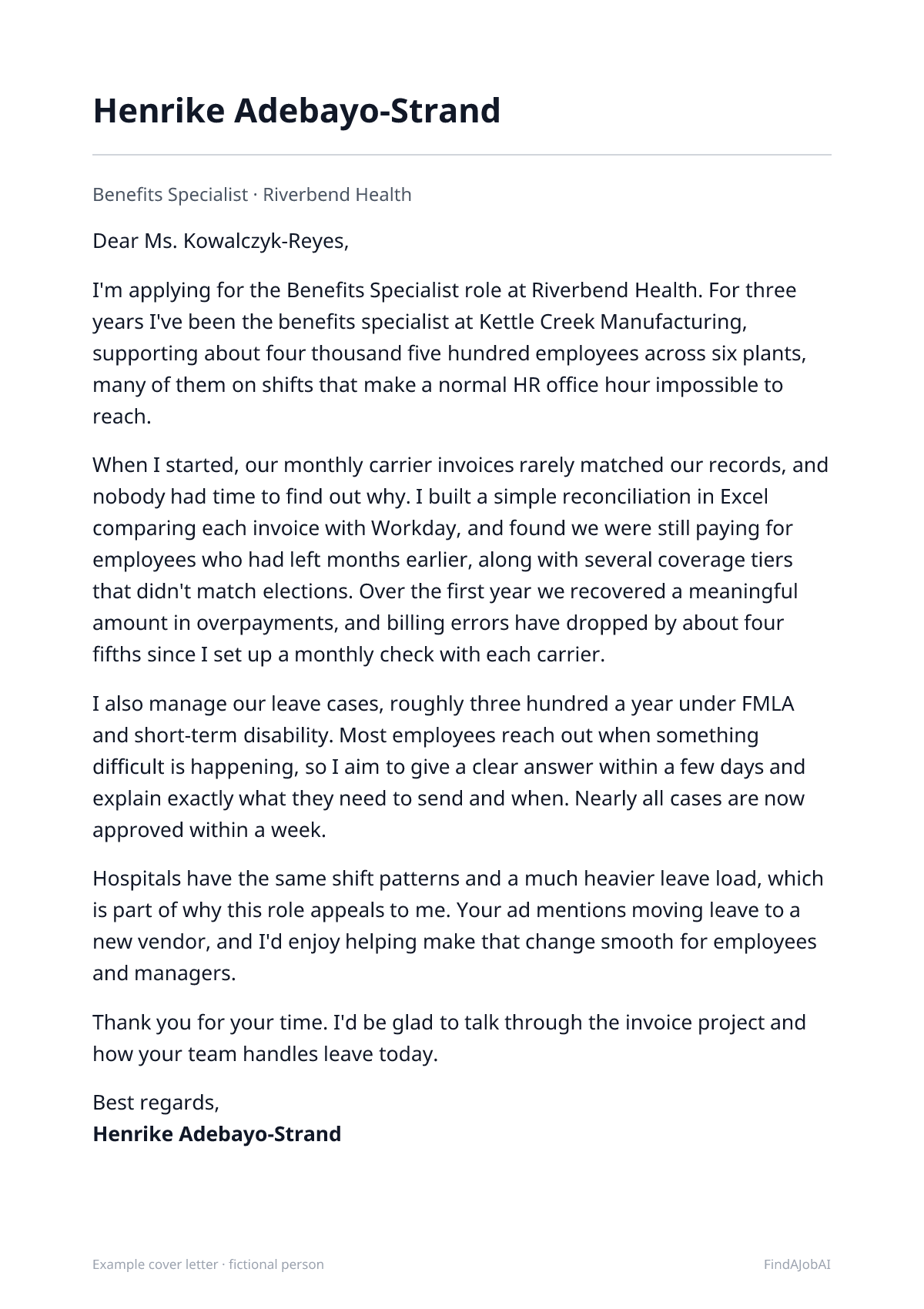
I'm applying for the Benefits Specialist role at Riverbend Health. For three years I've been the benefits specialist at Kettle Creek Manufacturing, supporting about four thousand five hundred employees across six plants, many of them on shifts that make a normal HR office hour impossible to reach.
When I started, our monthly carrier invoices rarely matched our records, and nobody had time to find out why. I built a simple reconciliation in Excel comparing each invoice with Workday, and found we were still paying for employees who had left months earlier, along with several coverage tiers that didn't match elections. Over the first year we recovered a meaningful amount in overpayments, and billing errors have dropped by about four fifths since I set up a monthly check with each carrier.
I also manage our leave cases, roughly three hundred a year under FMLA and short-term disability. Most employees reach out when something difficult is happening, so I aim to give a clear answer within a few days and explain exactly what they need to send and when. Nearly all cases are now approved within a week.
Hospitals have the same shift patterns and a much heavier leave load, which is part of why this role appeals to me. Your ad mentions moving leave to a new vendor, and I'd enjoy helping make that change smooth for employees and managers.
Thank you for your time. I'd be glad to talk through the invoice project and how your team handles leave today.
Best regards,
Henrike Adebayo-Strand
Example 2 · Career changer
Health insurance service representative moving into HR benefits
Joaquin answers member calls for a health insurer and has completed an HR certificate. The ad is for a benefits specialist at a mid-size software company.
Example letter · fictional
Dear Hiring Manager,
I'm applying for the Benefits Specialist role at Northgate Software. For four years I've worked as a member services representative at Bluepine Health Plans, answering calls from employees of client companies about coverage, claims, deductibles and enrollment problems.
Many of the calls I took were really about mistakes made before the member ever called: an enrollment that never reached us, a dependent added late, a life event that wasn't processed. I started keeping notes on the most common causes and shared them with our employer services team, who turned them into a checklist for HR contacts at client companies. Calls about missing coverage from those clients dropped noticeably over the next renewal period.
Working on the insurer's side made me want to help employees earlier, before problems start. This year I completed an HR certificate with courses on benefits administration, ERISA, COBRA and FMLA, and I volunteered to help a small nonprofit prepare its open enrollment materials, including a one-page plan comparison its staff said was the first they had fully understood.
Your ad asks for someone who can explain plans clearly and work well with carriers. I know how carriers think and what they need, and I've spent four years explaining coverage to people who are often worried or frustrated.
Thank you for considering my application. I'd be happy to talk about how I'd support your employees during open enrollment, and what I learned on the carrier side about the questions employees ask most often when coverage changes.
Sincerely,
Joaquin Ellingsen-Abara
Example 3 · Senior or lead
Benefits lead applying to manage benefits at a national retailer
Marguerite manages renewals and leave for a twelve-thousand-person healthcare employer. The ad is for a benefits manager at a national retailer.
Example letter · fictional
Dear Mr. Abernathy-Cole,
I'm applying for the Benefits Manager role at Cartwheel Stores. I'm the senior benefits specialist at Plainsview Care, where I manage renewals, vendors and leave for about twelve thousand employees and mentor two coordinators. I'd like to bring that experience to a large hourly workforce like yours.
Two years ago our plan costs were rising faster than our budget. I led a broker search, then worked with the new broker on plan design changes that kept coverage strong while shifting more people to a plan that better matched how they used care. Total costs fell by several percent in the first year, and employee complaints about coverage didn't rise. I presented the options to our leadership team with clear trade-offs, which made a difficult decision much easier to agree on.
I also moved our leave administration from three state-by-state processes to a single vendor. It took careful planning with payroll and managers, but average approval time dropped from almost two weeks to about five days, and employees now have one place to go. Managers also receive the same simple updates, which has cut the number of calls our team gets about case status.
I haven't managed benefits for a workforce spread across many states with high turnover, which I know brings eligibility and communication challenges. I'd expect to learn quickly from your store operations team how employees prefer to get information.
I'd welcome a conversation about your renewal priorities, how your stores share benefits information today, and where employees find benefits hardest to understand.
Sincerely,
Marguerite Oyelowo-Hansen
All three letters, and the short version below, are fictional: the people, employers and numbers are invented. Borrow the structure, never the facts.
- Prefer to write it yourself? Use the free cover letter template.
- Check your CV against the job first: the free CV score shows the missing keywords.
Why the first letter works, paragraph by paragraph
Paragraph 1: Opening
Gives the population and the shift-based workforce in two sentences, setting the scale and the service challenge.
Paragraph 2: The invoice project
Shows initiative on an unglamorous problem, with money recovered and errors reduced, which proves accuracy and ownership.
Paragraph 3: Leave cases
Adds empathy and speed with case volume, the human side hiring managers want to see alongside accuracy.
Paragraph 4: Why this company
Connects hospital shift work and a leave vendor change to her experience, so the fit is specific.
Paragraph 5: Close
Offers to discuss her main project and asks about their leave process, keeping the focus on their needs.
What the career changer's letter does differently
The career changer's letter turns insurer experience into benefits evidence: he spotted the root causes of member problems and helped fix them upstream. The HR certificate and volunteer enrollment work show the move is planned, and his carrier knowledge becomes an advantage.
What the senior letter does differently
A lead-level letter covers strategy: a broker search, plan design and a leave process overhaul, each with a visible effect. Naming the gap, no experience with a high-turnover national workforce, keeps the letter honest and shows she understands what will be different.
Short benefits specialist cover letter: an email-ready version
Many applications arrive as an email or a small text box, and a full page doesn't fit. This version runs 120 to 150 words and keeps only what a reader needs to decide whether to reply. A benefits specialist emails a recruiter after seeing a job post shared in a local HR association newsletter.
Short version · email · fictional124 words
Subject: Benefits Specialist role – open enrollment and leave – Benedikta Okafor-Lund
Hello Ms. Varga,
I saw the Benefits Specialist opening at Lakeside Credit Union in our HR association newsletter. I've worked in benefits for three years at a school district of about two thousand staff, handling open enrollment, leave cases and carrier billing.
My most useful project rewrote our enrollment guides in plain language and added short evening sessions for staff who couldn't attend during the day. Active elections rose clearly the next year, and enrollment questions to our office dropped by about a quarter. I've also kept our carrier billing clean, with monthly checks that catch errors early.
My resume is attached. I'd be glad to talk about the role and how your team supports employees during enrollment each year.
Best regards,
Benedikta Okafor-Lund
The short version names where the writer found the role, then keeps one enrollment improvement with two results. It drops the leave and billing detail a full letter would carry and leaves those for the resume.
Opening lines that work for benefits specialist cover letters
The first sentence decides whether the second gets read. Here are six openings, one for each situation you might be in. Pick the one that matches yours and swap in your own facts: every name and number below is invented.
1. You have a standout result
A monthly invoice check I set up recovered overpayments and cut billing errors by about four fifths, and I'd like to bring that care to Riverbend's benefits team.
2. The ad names a problem you've solved
Your ad mentions moving leave administration to a new vendor. I've managed hundreds of leave cases a year and helped through a similar change, and I'd like to make yours smooth.
3. Someone referred you
Your HR director, Wendeline Achebe-Moore, and I worked together on a benefits fair last year. She suggested I apply for this role.
4. You admire what they build
I've banked with Lakeside for years and have always noticed how well staff are treated. I'd like to help keep that true through clear, reliable benefits.
5. You're new to the field or switching into it
After four years answering health insurance calls and finishing an HR certificate, I'm ready to help employees with benefits before problems start.
6. You have senior scope or a specialism
As the person employees call when coverage goes wrong, I've learned that most problems start with a small enrollment mistake. I'm looking for a team that wants to prevent them.
How to write a benefits specialist cover letter
Five steps, in the order you'd write them. The shape stays the same for every job (a short opening, proof, a reason for this employer, a close), and what goes into each part is what changes with the role.
Read the ad for the main benefits focus
Benefits specialist roles differ: some focus on enrollment and service, others on leave, vendors or compliance. Find the main focus in the ad, then pick an example from your work that matches it and the size of the workforce described.
Open with a problem you solved
Start with a benefits problem such as billing errors, low enrollment or slow leave decisions. Hiring managers want people who fix things, not only process forms, so name the problem first in one or two plain sentences before describing what you did.
Give numbers without private details
Mention the number of employees, cases or dollars involved and the result. Never include anything that could identify an employee or their health, since benefits teams value discretion as much as accuracy and will read your letter with that in mind.
Show how you support employees
Add a line on how you help people during enrollment or leave, such as quick responses or plain-language guides. Benefits work affects people at stressful moments, and hiring managers want to know employees will trust your answers.
Close with their workforce in mind
End with a question about their employees, such as shift workers, remote staff or several states. This shows you understand that benefits communication depends on who the employees are and gives the hiring manager a natural topic for a first conversation.
Benefits Specialist cover letter do's and don'ts
Do
- Name one benefits program or problem with the number of employees involved.
- Show accuracy with a measured result, such as errors cut or money recovered.
- Mention how you support employees during leave or enrollment.
Don't
- Don't include any employee's medical or personal details, even without names.
- Don't list every law you know; mention the ones you used in real work.
- Don't describe yourself as a people person; show service with a result.
Common benefits specialist cover letter mistakes
Each one is easy to make and quick to fix before you send the letter.
Listing tasks instead of results
Saying you ran enrollment or processed leave describes the job. Add what improved, such as completion rates, errors or approval times.
Including employee details
Even an anonymous case story can be too specific. Describe types and volumes of cases instead of individual situations.
A wall of legal acronyms
Listing ERISA, COBRA, FMLA and ACA without context reads as filler. Mention one or two inside real work examples.
Ignoring the employee experience
Benefits roles are service roles too. Show how you communicate with employees, not just how you process data.
Generic interest in HR
Saying you want to grow in HR doesn't explain why benefits. Name the part of benefits work you enjoy and why it fits this company.
Email subject lines for benefits specialist applications
Applying by email? Put the job title, any reference number and your name in the subject line.
- Benefits Specialist application – enrollment, leave and carrier billing – Henrike Adebayo-Strand
- Benefits Specialist – insurance service background, HR certificate – Joaquin Ellingsen-Abara
- Application: Benefits Specialist, People Operations (Req. 7184) – Henrike Adebayo-Strand
Everything for Benefits Specialists
- Benefits Specialist resume exampleA full resume, plus bullet and summary examples
- Benefits Specialist interview questions30 questions with sample answers
- Benefits Specialist job descriptionDuties, skills and requirements
- Career change cover letter: template + examples
Other cover letter examples
Benefits Specialist cover letter FAQ
What should a benefits specialist cover letter include?
One benefits program or problem you handled, the number of employees involved and the result, plus how you support employees during enrollment or leave. Mention the systems and rules the ad lists.
How do I move into benefits from insurance or customer service?
Show how you explained coverage or solved enrollment problems, then add HR or benefits training. Insurance experience is valuable because you understand carriers and what employees struggle with.
Should I mention compliance in a benefits specialist cover letter?
Yes, briefly and in context. Mention a task such as COBRA notices or ACA reporting with a clean result, rather than a list of laws.
How we built this page
The FindAJobAI team wrote the three example letters, the short email version, the opening lines and the advice for benefits specialist roles. The people, employers and numbers in the letters are invented; the structure, the kind of evidence and the order of the paragraphs are the parts to copy.
Once we track enough live benefits specialist job ads, this page also shows the skills they ask for most, counted the same way as our in-demand skills report.
Last reviewed on November 1, 2026.