BI Developer Cover Letter Example (2026)
By FindAJobAI Team Updated How we built this page
BI developer roles usually open because reports are slow, numbers disagree between departments, or people still rebuild the same spreadsheets every Monday. A strong BI developer cover letter shows one data model or reporting system you built, how many people relied on it, and what it saved in time or settled in arguments about the numbers.
BI Developer cover letter template
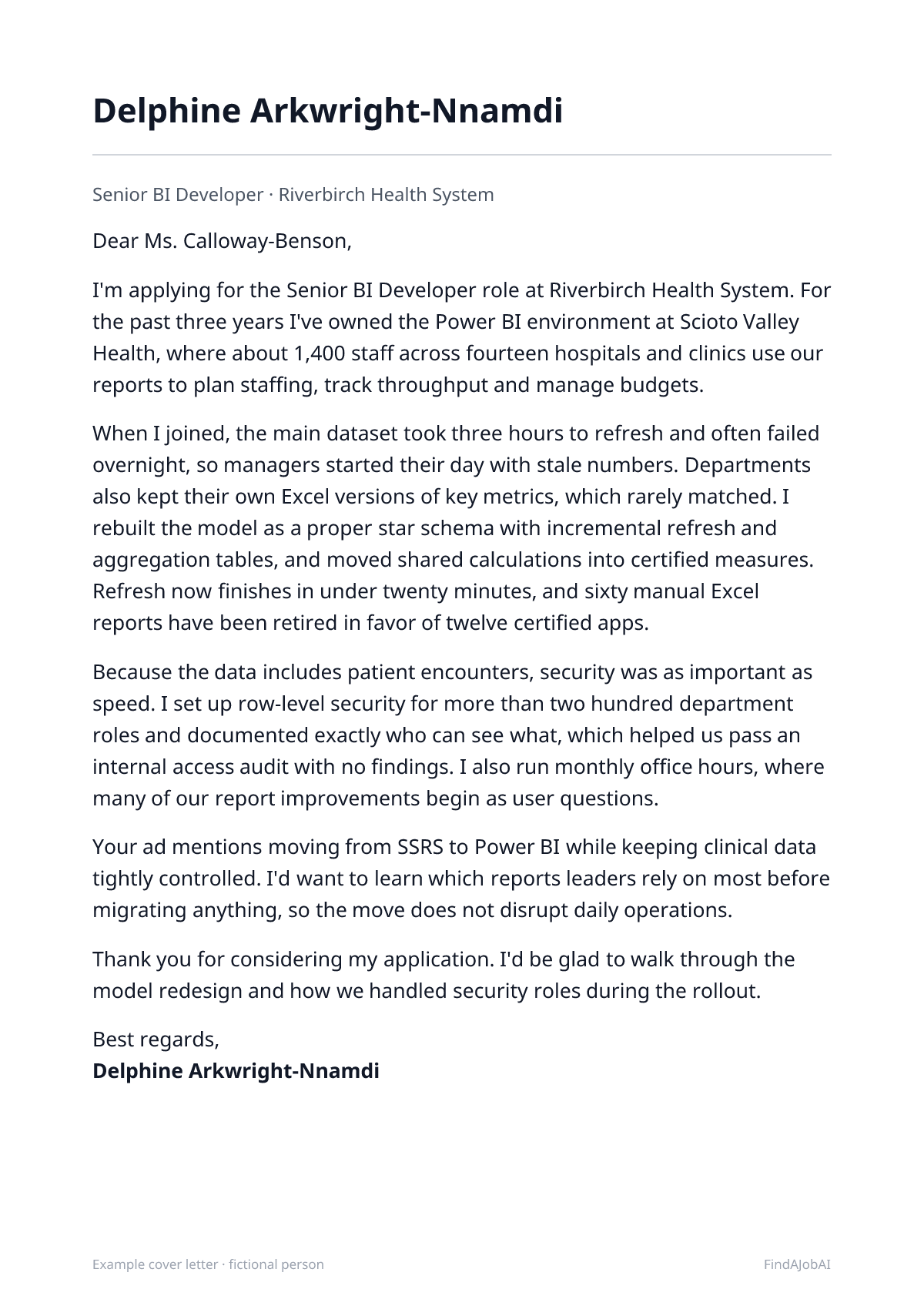
This letter as a one-page template: an opening that names the job and your strongest fact, proof that answers the ad, a reason for this employer and a short close.
After you sign up, FindAJobAI drafts your own letter for a real job from your CV in this format, and you edit it before you send it.
Example 1 · Experienced
Power BI developer applying to a healthcare network
Delphine rebuilt the reporting model at a hospital network. The ad asks for Power BI, SQL Server and secure reporting on clinical data.
Example letter · fictional
Dear Ms. Calloway-Benson,
I'm applying for the Senior BI Developer role at Riverbirch Health System. For the past three years I've owned the Power BI environment at Scioto Valley Health, where about 1,400 staff across fourteen hospitals and clinics use our reports to plan staffing, track throughput and manage budgets.
When I joined, the main dataset took three hours to refresh and often failed overnight, so managers started their day with stale numbers. Departments also kept their own Excel versions of key metrics, which rarely matched. I rebuilt the model as a proper star schema with incremental refresh and aggregation tables, and moved shared calculations into certified measures. Refresh now finishes in under twenty minutes, and sixty manual Excel reports have been retired in favor of twelve certified apps.
Because the data includes patient encounters, security was as important as speed. I set up row-level security for more than two hundred department roles and documented exactly who can see what, which helped us pass an internal access audit with no findings. I also run monthly office hours, where many of our report improvements begin as user questions.
Your ad mentions moving from SSRS to Power BI while keeping clinical data tightly controlled. I'd want to learn which reports leaders rely on most before migrating anything, so the move does not disrupt daily operations.
Thank you for considering my application. I'd be glad to walk through the model redesign and how we handled security roles during the rollout.
Best regards,
Delphine Arkwright-Nnamdi
Example 2 · Career changer
Financial analyst moving into BI development
Thaddea has been a financial analyst for five years and built her team's reporting model in Power BI. The ad is for a BI developer.
Example letter · fictional
Dear Copperleaf Data Team,
The BI Developer opening at Copperleaf Manufacturing describes the work I have been doing alongside my analyst role for the past two years. I've been a financial analyst at a building materials company for five years, and I've become the person finance turns to when a report needs rebuilding.
It began with our monthly close pack, which took three of us about two days to assemble from exports and spreadsheets. I learned SQL and Power BI, worked with IT to get read access to the ERP database, and built a small star schema for actuals, budgets and forecasts. The close pack now refreshes itself, and the team spends those two days on analysis instead of copying numbers. Plant managers also began using the report directly, which was never the plan but became its biggest benefit.
Since then I've passed the PL-300 exam, learned Power Query and Tabular Editor, and started using dbt on a personal project to understand modern data pipelines. I know I still have more to learn about large-scale pipelines and performance tuning on big models.
Your ad says the BI team supports finance and operations closely. I understand how finance thinks about numbers, reconciliations and month-end deadlines, which I believe would help me build reports those teams trust and keep using.
I'm happy to share an anonymized version of the close pack model, explain how I reconciled it to the general ledger each month, and walk through it on a call whenever it suits you.
Kind regards,
Thaddea Moreland-Asante
Example 3 · Senior or lead
BI team lead applying to unify reporting at a retailer
Isembard leads a BI team at a national retailer. The ad is for a BI manager to bring several reporting teams onto one semantic layer.
Example letter · fictional
Dear Mr. Fairclough-Adeyemi,
I'm applying for the BI Development Manager role at Brightwell Outfitters. For the past five years I've led the BI team at Northfield Home Stores, where about three thousand employees across four hundred stores and head office use our reports every week.
Your ad says each department keeps its own version of sales and margin, and meetings start with arguments about whose number is right. Northfield had the same problem. Rather than build another set of reports, I worked with finance to agree on definitions for the twenty measures that mattered most, then built a certified semantic layer where those measures live once. We grew it to around 140 governed measures, and executive meetings now spend their time on decisions instead of reconciliations.
I also led our move from on-premises SSAS to Power BI Premium, which retired six servers and cut licensing and hosting costs substantially. Along the way I introduced version control and deployment pipelines for reports, and release errors dropped from several a month to almost none. My team of five handles requests through a visible backlog, so departments can see what is coming and when.
I haven't worked in apparel, and I'd expect seasonal assortments, markdowns and returns to add modeling challenges that I would need to understand quickly with your merchandising team.
I'd welcome a conversation about which department's numbers cause the most debate today, why that is, and what a single trusted set of measures would let your leadership team do differently.
Sincerely,
Isembard Nakashima-Oyelaran
All three letters, and the short version below, are fictional: the people, employers and numbers are invented. Borrow the structure, never the facts.
- Prefer to write it yourself? Use the free cover letter template.
- Check your CV against the job first: the free CV score shows the missing keywords.
Why the first letter works, paragraph by paragraph
Paragraph 1: Opening
Gives the number of report users and what they do with the reports, which tells a healthcare reader the writer has supported similar operations.
Paragraph 2: The star schema rebuild
Explains stale data and conflicting spreadsheets, the modeling fix and the refresh-time and retired-report figures.
Paragraph 3: Security paragraph
Row-level security and an audit result matter for clinical data, and office hours show attention to users.
Paragraph 4: Why this company
Engages with the SSRS migration in the ad and puts learning about critical reports first.
Paragraph 5: Close
Offers to discuss model design and security roles, both central to the role.
What the career changer's letter does differently
The career changer shows real BI work done as an analyst: a star schema on ERP data that turned a two-day task into an automatic refresh and drew in new users. A certification and dbt practice show steady learning, and the gap in large-scale tuning is stated plainly.
What the senior letter does differently
This leadership letter starts with agreement on definitions before any technology, which is the real fix for conflicting numbers. The migration savings, release discipline and visible backlog show a manager who runs BI as a service, and the apparel gap is named honestly.
Short BI developer cover letter: an email-ready version
Many applications arrive as an email or a small text box, and a full page doesn't fit. This version runs 120 to 150 words and keeps only what a reader needs to decide whether to reply. A BI developer replies to a finance director who posted the opening in a regional data community newsletter and asked for replies by email.
Short version · email · fictional123 words
Subject: BI Developer – SQL Server warehouse and Power BI for distribution – Henrietta Obiora-Lindgren
Hi Mr. Wetherby,
Your newsletter post about a BI developer role at Westgate Logistics caught my eye. For three years I've built SQL Server warehouses and Power BI reports at a consumer goods distributor, covering nine source systems and about two hundred daily users.
My most useful project was a route profitability dashboard for thirty managers. It brought delivery costs and margins together for the first time, and it helped the company drop eleven routes that were losing money every week.
You mentioned margin reports that arrive a month late, which is exactly the gap that our warehouse closed for the sales leaders I supported. My resume is attached, and I'm free for a short call most mornings this week.
Thanks,
Henrietta Obiora-Lindgren
A finance director wants to know whether you can make numbers timely and useful. This email offers a single dashboard with its users and a money result, then names the late margin reports from the post.
Opening lines that work for BI developer cover letters
The first sentence decides whether the second gets read. Here are six openings, one for each situation you might be in. Pick the one that matches yours and swap in your own facts: every name and number below is invented.
1. You have a standout result
Our main reporting dataset used to take three hours to refresh. I rebuilt it to finish in under twenty minutes for 1,400 staff, and I'd like to bring that work to your team.
2. The ad names a problem you've solved
Your ad says departments argue about whose sales number is right. I built a certified semantic layer that ended those arguments at a national retailer.
3. Someone referred you
Marisol Ortega in your finance team and I worked on month-end reporting together for three years. She mentioned your BI team is hiring.
4. You admire what they build
Your company's open-source Power BI documentation tool runs in our deployment pipeline, and I contributed a fix for its measure export last year.
5. You're new to the field or switching into it
After five years as a financial analyst, I built my team's reporting model in Power BI and SQL. I want to do BI development full time.
6. You have senior scope or a specialism
I've led a BI team serving three thousand employees, and I'm looking to bring several reporting teams onto one set of numbers.
How to write a BI developer cover letter
Five steps, in the order you'd write them. The shape stays the same for every job (a short opening, proof, a reason for this employer, a close), and what goes into each part is what changes with the role.
Find the reporting pain in the ad
BI developer roles exist because reports are slow, numbers conflict or work is still manual. Read the ad for clues such as migrations, single source of truth or Excel, and choose the model or report of yours that fixed a similar problem for a team you can name.
Describe how reporting worked before you
Open the main paragraph with the starting point, such as overnight refreshes that failed, departments with their own spreadsheets or a close pack built by hand. A clear before picture lets non-technical readers, like finance or operations leaders, see the value immediately.
Show the model, not just the dashboard
Explain one design choice behind the report: a star schema, certified measures, incremental refresh or a new pipeline. That shows you are a developer who builds reliable foundations, not only someone who arranges visuals on a canvas.
Quantify users, speed and time saved
BI results are easy to measure. Give the number of report users, refresh or load times before and after, and hours of manual work removed. Pick figures you can explain in detail during an interview, and say where they came from.
Close with trust and governance
Mention reconciliation, security or certified datasets, because people only use reports they trust. Finish by naming one report or metric you would want to understand first, which shows curiosity and gives the reader an easy opening question.
BI Developer cover letter do's and don'ts
Do
- Describe one model or reporting system you built, with users and data volume.
- Give refresh, load-time or hours-saved figures that show the effect.
- Mention security or governance when the data is sensitive.
Don't
- Don't describe yourself as a dashboard designer only; show the pipelines and models.
- Don't attach screenshots containing real company data.
- Don't list every chart type you can build.
Common BI developer cover letter mistakes
Each one is easy to make and quick to fix before you send the letter.
Presenting yourself as a chart builder
Visuals are the last step. Show the SQL, models and pipelines behind your reports so the reader sees developer skills.
Leaving out who used the reports
A dashboard nobody opens has no value. Give user counts and what changed in their work.
Vague claims about faster reporting
Give refresh or load times before and after, and the change that produced them.
Ignoring data security
Employers with sensitive data want to hear about row-level security and access control. Add one line.
Sharing real data in examples
Never attach screenshots of an employer's data. Use anonymized or public-data versions instead.
Email subject lines for BI developer applications
Applying by email? Put the job title, any reference number and your name in the subject line.
- Senior BI Developer – Power BI model for 1,400 hospital staff – Delphine Arkwright-Nnamdi
- BI Developer – financial analyst with ERP star schema and PL-300 – Thaddea Moreland-Asante
- Application: BI Developer, Clinical Reporting (Req. 2716) – Delphine Arkwright-Nnamdi
Everything for BI Developers
- BI Developer resume exampleA full resume, plus bullet and summary examples
- BI Developer interview questions30 questions with sample answers
- BI Developer job descriptionDuties, skills and requirements
- Career change cover letter: template + examples
Other cover letter examples
BI Developer cover letter FAQ
What should I write in a BI developer cover letter?
Describe one data model, pipeline or reporting system you built, how many people used it, and the result in refresh time, hours saved or consistent numbers. Mention security if relevant and connect your work to the tools and teams in the ad.
How do I write a BI developer cover letter coming from an analyst role?
Lead with reporting you built yourself, such as a model on top of an ERP or CRM database, and show who used it. Mention certifications and practice projects briefly, and present your business knowledge as an advantage.
Should I mention Power BI or Tableau specifically?
Yes, name the tool the ad asks for if you have used it, and tie it to a real result. If you used a different tool, explain that the modeling and SQL skills carry over and show you have started learning theirs.
How we built this page
The FindAJobAI team wrote the three example letters, the short email version, the opening lines and the advice for BI developer roles. The people, employers and numbers in the letters are invented; the structure, the kind of evidence and the order of the paragraphs are the parts to copy.
Once we track enough live BI developer job ads, this page also shows the skills they ask for most, counted the same way as our in-demand skills report.
Last reviewed on November 1, 2026.