CNC Machinist Cover Letter Example (2026)
By FindAJobAI Team Updated How we built this page
Most machine shops hire on skill tests and a walk through the floor, but a short letter helps when you're moving up from operator, changing industries or applying for a lead role. A good CNC machinist letter names the machines and controls you know, the tolerances and materials you've held, and one job where you solved a real problem at the spindle.
CNC Machinist cover letter template
This letter as a one-page template: an opening that names the job and your strongest fact, proof that answers the ad, a reason for this employer and a short close.
After you sign up, FindAJobAI drafts your own letter for a real job from your CV in this format, and you edit it before you send it.
Example 1 · Experienced
Setup machinist applying to a medical device contract manufacturer
Ottilie runs 5-axis setups at an aerospace job shop. The ad wants a setup machinist for titanium implant components held to tight tolerances.
Example letter · fictional
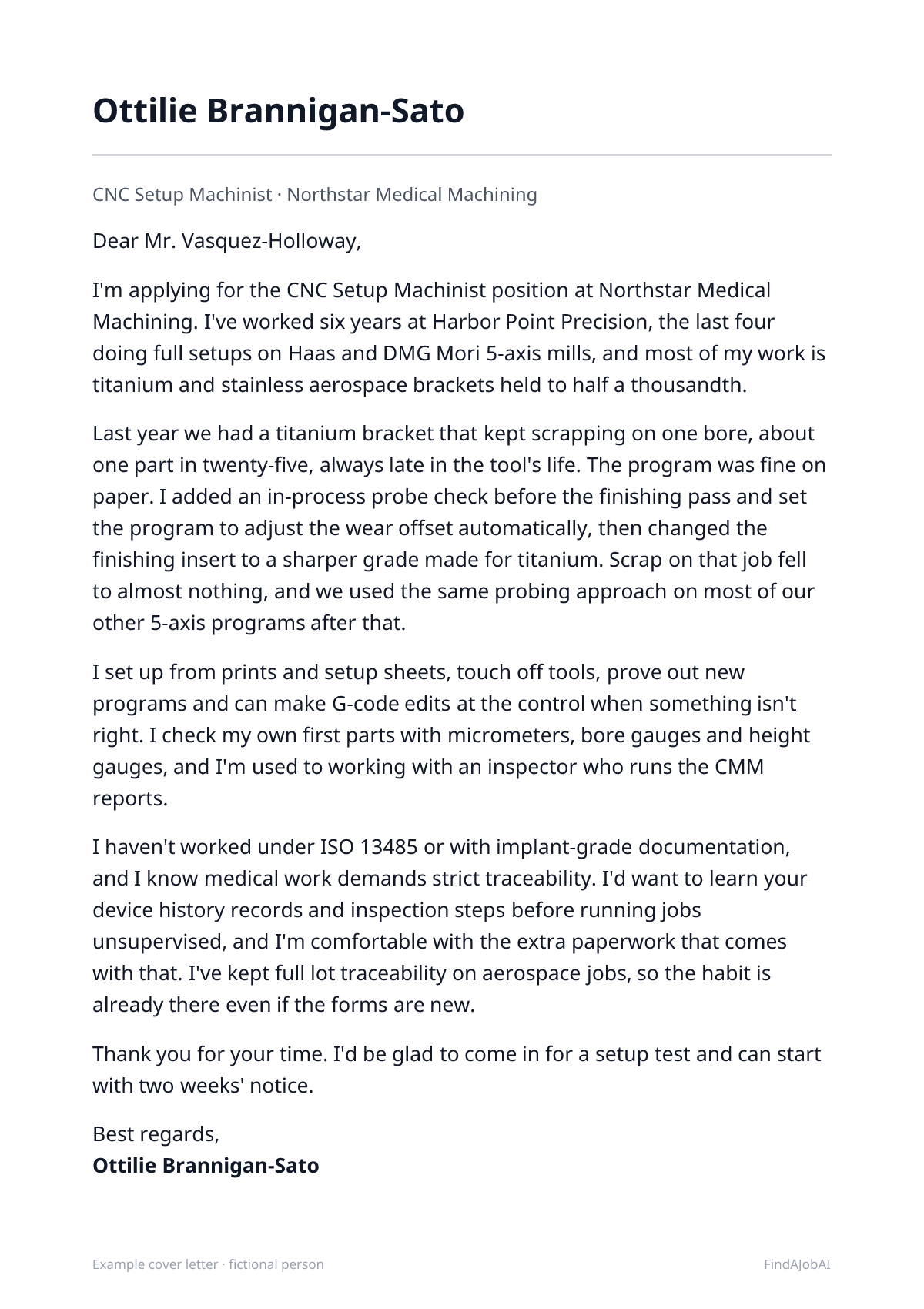
Dear Mr. Vasquez-Holloway,
I'm applying for the CNC Setup Machinist position at Northstar Medical Machining. I've worked six years at Harbor Point Precision, the last four doing full setups on Haas and DMG Mori 5-axis mills, and most of my work is titanium and stainless aerospace brackets held to half a thousandth.
Last year we had a titanium bracket that kept scrapping on one bore, about one part in twenty-five, always late in the tool's life. The program was fine on paper. I added an in-process probe check before the finishing pass and set the program to adjust the wear offset automatically, then changed the finishing insert to a sharper grade made for titanium. Scrap on that job fell to almost nothing, and we used the same probing approach on most of our other 5-axis programs after that.
I set up from prints and setup sheets, touch off tools, prove out new programs and can make G-code edits at the control when something isn't right. I check my own first parts with micrometers, bore gauges and height gauges, and I'm used to working with an inspector who runs the CMM reports.
I haven't worked under ISO 13485 or with implant-grade documentation, and I know medical work demands strict traceability. I'd want to learn your device history records and inspection steps before running jobs unsupervised, and I'm comfortable with the extra paperwork that comes with that. I've kept full lot traceability on aerospace jobs, so the habit is already there even if the forms are new.
Thank you for your time. I'd be glad to come in for a setup test and can start with two weeks' notice.
Best regards,
Ottilie Brannigan-Sato
Example 2 · Career changer
Auto mechanic moving into CNC machining
Jasper spent seven years as an auto technician and just finished a machining certificate. The ad is for a CNC operator trainee on second shift.
Example letter · fictional
Dear Ms. Pietrowski,
I'm writing to apply for the CNC Operator Trainee position on second shift at Midstate Fabrication & Machine. I worked seven years as an automotive technician before finishing a CNC machining certificate at Lakeland Technical College this spring, and I want to spend the rest of my career making parts instead of replacing them.
At the dealership, I measured brake rotors, checked crankshaft journals with micrometers and followed torque specs every day, so precision measurement isn't new to me. In the program I ran Haas mills and lathes, wrote basic G-code for lathe parts, and made a three-piece vise assembly that held two thousandths. My instructor asked me to help other students set tool offsets during our final term.
One habit from auto work that I think matters in a shop is checking before assuming. When a car came back with the same problem, I learned to retest from the start instead of trusting my first answer. In the machining lab I did the same when a part came out of tolerance: I checked the tool, the offset and the fixture before touching the program, and it was usually a worn insert. That patience saved material in the lab, and I'd bring the same approach to your production jobs, where a wrong guess costs real money.
Your posting says trainees learn setups after mastering operation and inspection. I'd like to follow that path, and I'm happy to work second shift and overtime while I learn.
Thank you for considering my application. I have my own basic measuring tools and can start right away.
Sincerely,
Jasper Okonkwo-Dahl
Example 3 · Senior or lead
Lead machinist applying to run a 5-axis cell
Radomir programs and proves out new jobs at a defense shop. The ad is for a cell lead over six machines and two shifts of machinists.
Example letter · fictional
Dear Ms. Abernathy-Kowalczyk,
I'm applying for the 5-Axis Cell Lead position at Ironwood Aerospace Components. I've been a machinist for fourteen years, the last five as the lead programmer at Cascade Defense Machining, where I program titanium and Inconel parts in Mastercam and prove out every new job before it goes to production.
When I took over new job launches, too many first articles failed and parts sat waiting while programs were reworked. I started running every program through simulation, writing a setup sheet with photos and probing steps, and proving out the first part myself with the machinist who would run it. Over about a year, most new jobs passed first article on the first submission, and the machinists told me the setup sheets saved them hours on second shift.
I've also worked to raise spindle time. By standardizing fixtures across three machines and adding a pallet system, we cut the time machines sat idle between jobs, which mattered more to our delivery dates than any cycle time trick. I track spindle hours weekly on a simple board so the machinists can see the effect of their own changes, and they now suggest most of the improvements themselves.
I haven't formally supervised people or handled scheduling for a whole cell. I'd want to learn how your planners set priorities and spend time on both shifts before changing how work is assigned. I'd also keep programming part of my week, since staying close to the machines is how I spot problems early.
Thank you for reading. I'd welcome a chance to talk about your cell's current bottlenecks and upcoming programs.
Kind regards,
Radomir Castellanos-Webb
All three letters, and the short version below, are fictional: the people, employers and numbers are invented. Borrow the structure, never the facts.
- Prefer to write it yourself? Use the free cover letter template.
- Check your CV against the job first: the free CV score shows the missing keywords.
Why the first letter works, paragraph by paragraph
Paragraph 1: Opening
Names years, machine brands, axis count, materials and tolerance in two sentences, which places her at setup level immediately.
Paragraph 2: The scrap problem she solved
A real spindle-side fix with probing, offsets and insert choice shows practical problem solving, and the result spread across the shop's programs.
Paragraph 3: What she does day to day
Setups, prove-outs, G-code edits and checking her own first parts describe exactly what a setup machinist role needs.
Paragraph 4: Honest gap
Medical documentation is new to her, so she says so and shows respect for traceability, a real concern for a device manufacturer.
Paragraph 5: Close
Offers a setup test and notice period, matching how shops actually evaluate machinists.
What the career changer's letter does differently
The mechanic's letter turns auto repair into machining-relevant evidence: daily micrometer work, torque discipline and retesting before assuming. He adds certificate projects with a tolerance and makes clear he expects to start as an operator and earn setup work.
What the senior letter does differently
A lead machinist letter should show improvements to how a whole cell works, not just personal skill. Radomir's prove-out process and fixture standardization helped every machinist and the delivery schedule, and he names his missing supervisory experience plainly.
Short CNC machinist cover letter: an email-ready version
Many applications arrive as an email or a small text box, and a full page doesn't fit. This version runs 120 to 150 words and keeps only what a reader needs to decide whether to reply. A CNC machinist applies through a staffing agency's online form with a short message box, so the note is written as a brief email.
Short version · email · fictional121 words
Subject: CNC Lathe Machinist – 5 years Okuma and Mazak setups – Evangelina Thorsby
Hi Mr. Lindgren,
I'm applying for the CNC Lathe Machinist role at Brightwater Industrial Parts. I have five years setting up and running Okuma and Mazak lathes with live tooling and bar feeders, mostly stainless and alloy steel shafts and fittings held to a few tenths on critical diameters.
At my current shop I cut setup time on our repeat jobs by building saved tool lists and quick-change tooling for about twenty part numbers, so most changeovers now take half as long. I check my own first parts and keep SPC charts on critical features.
I'm looking for a day shift role closer to home. My resume is attached, and I'm available for a skills test this week.
Thanks,
Evangelina Thorsby
The short version leads with machine brands, lathe features and tolerances, then one setup improvement that saves the shop time, and closes with a practical reason for the move and an offer of a skills test.
Opening lines that work for CNC machinist cover letters
The first sentence decides whether the second gets read. Here are six openings, one for each situation you might be in. Pick the one that matches yours and swap in your own facts: every name and number below is invented.
1. You have a standout result
A titanium bracket kept scrapping on one bore until I added an in-process probe check and an automatic wear offset. That kind of fix at the spindle is what I'd bring to your shop.
2. The ad names a problem you've solved
Your posting asks for a setup machinist who can hold tight tolerances in titanium on 5-axis mills, which is what I've done for the last four years on Haas and DMG Mori machines.
3. Someone referred you
Your second-shift lead, Ambrose Kettering, and I trained together at a contract shop years ago, and he told me you're adding a setup machinist to your 5-axis cell.
4. You admire what they build
I've used a precision vise made by your company in every shop I've worked in, and I'd like to help make parts with that same quality on your floor.
5. You're new to the field or switching into it
After seven years of measuring rotors and crank journals as an auto technician, I finished a CNC machining certificate and want to make precision parts full time.
6. You have senior scope or a specialism
Five years of programming and proving out titanium and Inconel jobs have prepared me to lead your 5-axis cell and help every machinist get good parts on the first run.
How to write a CNC machinist cover letter
Five steps, in the order you'd write them. The shape stays the same for every job (a short opening, proof, a reason for this employer, a close), and what goes into each part is what changes with the role.
Name machines, controls and your level early
Haas, Fanuc, Mazak, Okuma and DMG Mori machines, and operator, setup or programmer roles, tell a shop what you can do on day one. Put these in your first two sentences so the reader doesn't have to dig through the resume to place you.
State tolerances and materials plainly
Shops quote jobs by material and tolerance. Say the tightest tolerances you hold routinely and the materials you cut, such as titanium, stainless or Inconel, using real numbers rather than words like precise or tight.
Tell one problem you solved at the machine
Pick a job with scrap, chatter, poor finish or drifting dimensions. Explain what you checked, what you changed, such as tooling, offsets, probing or toolpaths, and the result. This shows the judgment that separates a machinist from an operator.
Show you check your own work
Machinists are trusted with quality between formal inspections, often for a whole shift. Mention the gauges you use, how often you measure and any first-article, SPC or CMM work you do, so the reader trusts you with expensive material and customer parts.
Offer a setup or skills test
Many shops judge machinists at the machine, not on paper. Close by offering to come in for a setup or skills test, and state your shift preference and start date so scheduling the next step is easy for the hiring manager.
CNC Machinist cover letter do's and don'ts
Do
- Name the machines, controls and axis count you've worked with.
- State the tolerances and materials you've held, in plain numbers.
- Tell one problem you solved at the machine, such as scrap, chatter or a drifting dimension.
Don't
- Don't claim programming skills beyond what you can show in a setup test.
- Don't send a letter that only says you 'operated CNC machines'.
- Don't skip your inspection skills; shops expect machinists to check their own parts.
Common CNC machinist cover letter mistakes
Each one is easy to make and quick to fix before you send the letter.
Writing 'detail-oriented' with no numbers
Every applicant says it. Replace it with the tolerance you hold and a dimension drift or print error you caught before a batch of parts was ruined.
Overstating programming skills
Shops often test programming in the interview. Describe the level you actually work at, such as G-code edits or full CAM programming, with one example.
Ignoring the shop's industry
Aerospace, medical and automotive shops have different documentation and tolerance demands. Mention how your experience fits theirs or what you'd need to learn.
Forgetting shift and start date
Many machining jobs are tied to a specific shift. Say which shifts you can work and when you can start so the hiring manager can move quickly.
Email subject lines for CNC machinist applications
Applying by email? Put the job title, any reference number and your name in the subject line.
- CNC Setup Machinist application – 5-axis titanium, Haas/DMG Mori – Ottilie Brannigan-Sato
- CNC Operator Trainee (2nd shift) – machining certificate graduate – Jasper Okonkwo-Dahl
- Application: CNC Setup Machinist (Req. 8841) – Ottilie Brannigan-Sato
Everything for CNC Machinists
- CNC Machinist resume exampleA full resume, plus bullet and summary examples
- CNC Machinist interview questions30 questions with sample answers
- CNC Machinist job descriptionDuties, skills and requirements
- Career change cover letter: template + examples
Other cover letter examples
CNC Machinist cover letter FAQ
What should a CNC machinist cover letter include?
Your machines and controls, whether you set up or operate, the materials and tolerances you hold, and one problem you solved at the machine. Mention inspection tools and end with availability for a setup or skills test.
How do I write a CNC cover letter with no machining experience?
Point to any precision work you've done, such as mechanic, maintenance or fabrication jobs, plus machining coursework with projects and tolerances. Say you expect to start as an operator and learn setups on the shop's schedule.
Should a CNC machinist mention specific software?
Yes, if you use it. Name CAM software like Mastercam or Fusion 360 and the level you work at, from editing posted code to full programming. Don't list software you've only seen once.
How we built this page
The FindAJobAI team wrote the three example letters, the short email version, the opening lines and the advice for CNC machinist roles. The people, employers and numbers in the letters are invented; the structure, the kind of evidence and the order of the paragraphs are the parts to copy.
Once we track enough live CNC machinist job ads, this page also shows the skills they ask for most, counted the same way as our in-demand skills report.
Last reviewed on November 1, 2026.