Crane Operator Cover Letter Example (2026)
By FindAJobAI Team Updated How we built this page
Lifting contractors hire operators they can trust with expensive loads and people's lives. A short letter that names your crane types and certifications, gives one lift you planned or stopped for a good reason and states your safety record will be read more closely than a bare resume.
Crane Operator cover letter template
This letter as a one-page template: an opening that names the job and your strongest fact, proof that answers the ad, a reason for this employer and a short close.
After you sign up, FindAJobAI drafts your own letter for a real job from your CV in this format, and you edit it before you send it.
Example 1 · Experienced
Hydraulic crane operator applying to an industrial lifting company
Rurik has run hydraulic truck cranes for seven years on commercial sites. The ad is for refinery and plant work and lists crawler experience as a plus.
Example letter · fictional
Dear Mr. Kowalczyk-Reyes,
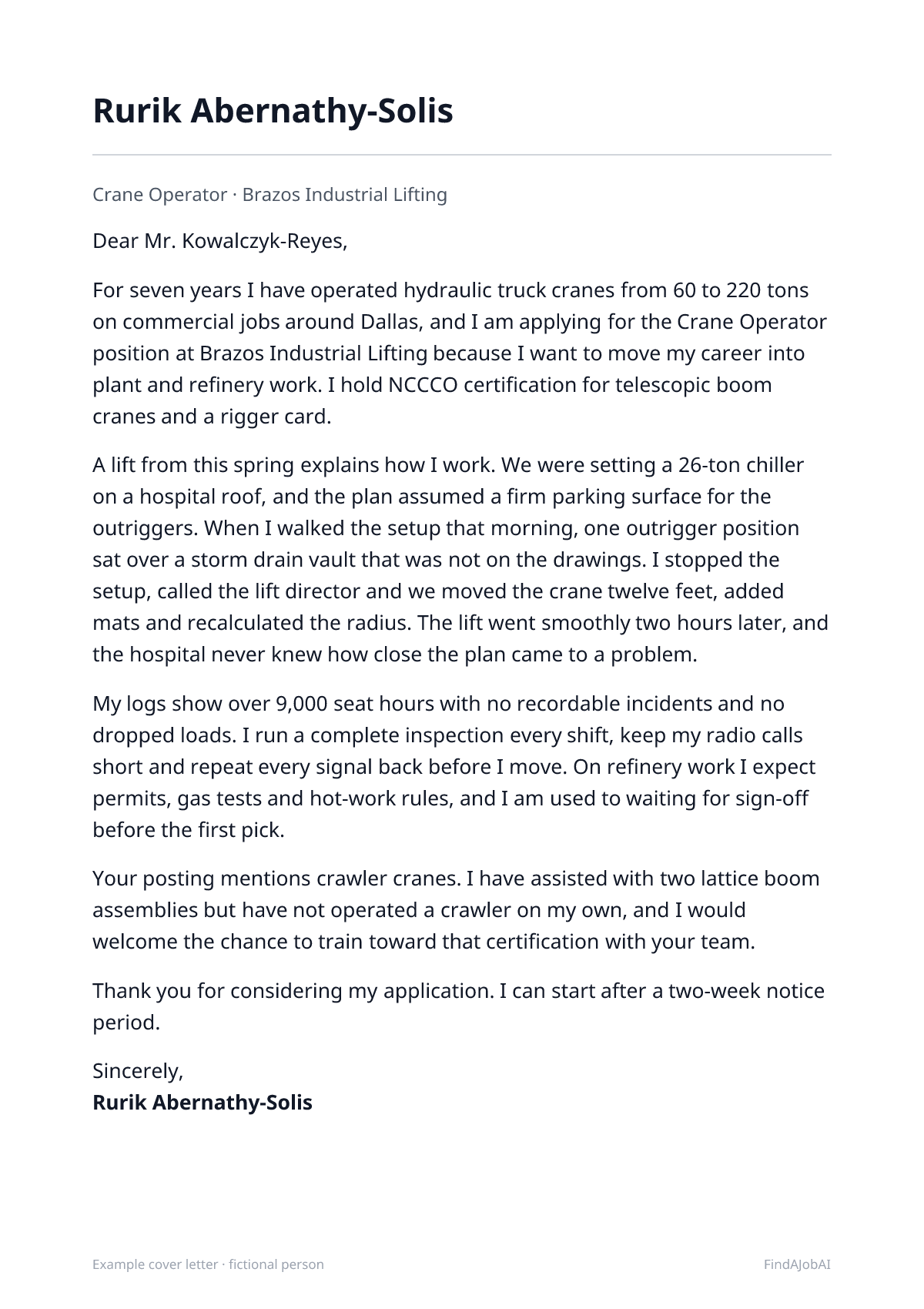
For seven years I have operated hydraulic truck cranes from 60 to 220 tons on commercial jobs around Dallas, and I am applying for the Crane Operator position at Brazos Industrial Lifting because I want to move my career into plant and refinery work. I hold NCCCO certification for telescopic boom cranes and a rigger card.
A lift from this spring explains how I work. We were setting a 26-ton chiller on a hospital roof, and the plan assumed a firm parking surface for the outriggers. When I walked the setup that morning, one outrigger position sat over a storm drain vault that was not on the drawings. I stopped the setup, called the lift director and we moved the crane twelve feet, added mats and recalculated the radius. The lift went smoothly two hours later, and the hospital never knew how close the plan came to a problem.
My logs show over 9,000 seat hours with no recordable incidents and no dropped loads. I run a complete inspection every shift, keep my radio calls short and repeat every signal back before I move. On refinery work I expect permits, gas tests and hot-work rules, and I am used to waiting for sign-off before the first pick.
Your posting mentions crawler cranes. I have assisted with two lattice boom assemblies but have not operated a crawler on my own, and I would welcome the chance to train toward that certification with your team.
Thank you for considering my application. I can start after a two-week notice period.
Sincerely,
Rurik Abernathy-Solis
Example 2 · Career changer
Forklift lead moving into a crane oiler and trainee role
Hedda has led a warehouse forklift team for four years and finished a crane operator course. The ad is for an oiler who will train toward operating.
Example letter · fictional
Dear Tri-County Hiring Team,
I am applying for the Crane Oiler and Operator Trainee role at Tri-County Crane Rental. For four years I have led a team of nine forklift drivers at a busy distribution center, and last month I completed a crane operator training course with 80 hours in the seat.
Warehouse work taught me how quickly a heavy load becomes a hazard. As team lead I run our daily equipment checks, and two years ago I noticed a reach truck mast chain stretching unevenly. I tagged it out, the mechanic found a cracked link, and our manager made my inspection sheet standard across three shifts. Our team has had no injuries and almost no product damage since I took over the group. I also learned to plan each shift around the heaviest loads first, while everyone is fresh and the dock is quiet.
The crane course confirmed that this is the work I want. I enjoyed learning load charts and outrigger setup, and I passed the written telescopic boom exam on my first attempt. I know an oiler starts with greasing, inspections, cribbing and rigging, and I am ready to learn that properly before asking for more time in the cab.
I hold a forklift certification, a clean driving record and a signal person card earned during the course. I can work early starts and travel to sites across the region. I already own steel-toe boots and a hard hat.
Thank you for reading my letter. I would be glad to come in for a practical assessment.
Best regards,
Hedda Lindqvist-Moreau
Example 3 · Senior or lead
Tower crane operator applying to lead a downtown high-rise crane
Oswin has run tower cranes for eleven years on residential towers. The posting is for a lead operator on a busy mixed-use high-rise.
Example letter · fictional
Dear Ms. Wexford-Achebe,
Eleven years in tower crane cabs, most of them on residential high-rises between 25 and 40 floors, have prepared me for the Lead Tower Crane Operator role at Meridian Spire Construction. I hold NCCCO tower crane certification and a rigger card, and I have assisted on fourteen crane climbs.
On my last project the crane served two separate trades all day, and both foremen believed their picks came first. Concrete buckets and curtain wall panels kept colliding in the schedule, and we were losing an hour or more every morning. I began a ten-minute call at six each day with both foremen and the superintendent, and we split the crane time into fixed blocks posted in the site office. Waiting time dropped sharply, and the curtain wall crew finished their floors two weeks ahead of plan.
In the cab I rely on calm radio discipline. Most of my picks on a downtown site are blind, so I insist on a dedicated signal person, a clear channel and a repeat-back on every call. I have stopped lifts for wind more times than I can count, and I would rather lose an hour than swing a panel in a gust. I also keep a written log of every stopped lift so the superintendent can see exactly why time was lost.
I have not yet worked with a luffing jib crane in an oversailing agreement with neighbors, and I would want to learn your permit conditions before the first climb. I would welcome a conversation about your schedule.
Sincerely,
Oswin Delacroix-Ferro
All three letters, and the short version below, are fictional: the people, employers and numbers are invented. Borrow the structure, never the facts.
- Prefer to write it yourself? Use the free cover letter template.
- Check your CV against the job first: the free CV score shows the missing keywords.
Why the first letter works, paragraph by paragraph
Paragraph 1: Opening
States crane types, tonnage range, years and certification in the first two sentences.
Paragraph 2: Storm drain story
Shows the operator caught a ground hazard the plan missed and handled it with the lift director.
Paragraph 3: Seat hours and habits
Gives seat hours and habits such as repeating signals back, which a contractor checks first.
Paragraph 4: Honest gap
Admits no solo crawler time while showing interest in the bonus skill from the ad.
Paragraph 5: Close
Brief, with a clear notice period.
What the career changer's letter does differently
The career changer uses forklift leadership to prove inspection habits and load awareness, then adds a finished crane course and a written exam. She asks to start as an oiler rather than claiming operating skill she has not built yet.
What the senior letter does differently
A lead operator letter shows coordination, not just control: a daily call that ended crane-time fights. It adds blind-pick discipline and admits the permit details he still needs to learn.
Short crane operator cover letter: an email-ready version
Many applications arrive as an email or a small text box, and a full page doesn't fit. This version runs 120 to 150 words and keeps only what a reader needs to decide whether to reply. An operator answers a short posting from a crane rental firm that asked for crane types, certifications and availability by email.
Short version · email · fictional131 words
Subject: Mobile Crane Operator – NCCCO telescopic boom, 6 years, CDL – available now
Hello Mr. Szabo-Harlan,
I am applying for the Mobile Crane Operator opening at Ridgeback Crane Hire. I have six years on 40 to 130 ton hydraulic cranes, hold NCCCO telescopic boom certification and a Class A CDL, and my resume is attached.
Most of my work is same-day rental jobs: rooftop units, trusses, steel and signs. I set up four or five times a week on unfamiliar ground, and I have kept a clean record with no incidents or dropped loads in six years of daily work.
I am available to start immediately, can travel for multi-day jobs and am happy to take a seat test whenever it suits your yard. My current supervisor is happy to speak with you about my work. Thank you for your time.
Thanks,
Dagny Okafor-Lindell
The short email answers the rental firm's three questions, crane types, certifications and availability, and adds a clean record and readiness for a seat test.
Opening lines that work for crane operator cover letters
The first sentence decides whether the second gets read. Here are six openings, one for each situation you might be in. Pick the one that matches yours and swap in your own facts: every name and number below is invented.
1. You have a standout result
One outrigger position on our lift plan sat over a storm drain vault, and catching it before setup is the kind of judgment I bring to every job.
2. The ad names a problem you've solved
Four years leading a forklift team have taught me to respect heavy loads, and a finished crane course has shown me where I want to go next.
3. Someone referred you
I have logged more than 9,000 seat hours on hydraulic cranes without a recordable incident or a dropped load.
4. You admire what they build
Your rigging foreman, Anselm Thackeray, mentioned at a safety training that you need an operator for the spring plant shutdown.
5. You're new to the field or switching into it
Most of my picks on downtown towers are blind, so radio discipline and a trusted signal person are the core of how I work.
6. You have senior scope or a specialism
I have set up on four or five unfamiliar sites a week for six years, and every one starts with a walk of the ground.
How to write a crane operator cover letter
Five steps, in the order you'd write them. The shape stays the same for every job (a short opening, proof, a reason for this employer, a close), and what goes into each part is what changes with the role.
Lead with crane types and certification
Open with the cranes you run, the tonnage range, your years in the seat and the certifications you hold. Contractors and rental yards often screen out applicants in seconds if the right crane type is missing, so put these facts in the first two sentences.
Tell one lift story that shows judgment
Choose a lift where you spotted a problem with ground, wind, rigging or the plan and fixed it with the team. Describe what you saw, what you did and how the lift ended. A story about stopping or changing a lift proves more than one about a fast day.
Put your safety record in numbers
Give seat hours, years without recordable incidents or dropped loads and the daily habits behind them, such as full inspections or repeating every signal. Safety records affect insurance and client trust, so a number reassures the reader quickly.
Be honest about cranes you have not run
If the ad lists a crane type or lift you have only assisted with, say so and show you want to train toward it. Employers will see your real skill in the seat test, and honesty protects you, the crew and the employer on the first job.
Close with availability and licenses
State when you can start, whether you can travel or work overtime and if you hold a CDL for driving truck cranes. Rental yards plan crews week by week, so these details often decide who gets called in for a seat test first.
Crane Operator cover letter do's and don'ts
Do
- Name each crane type and certification you hold.
- Tell one lift story that shows judgment, not just control.
- Give your safety record in hours or years.
Don't
- Don't claim crane types you are not certified on.
- Don't describe risky shortcuts as speed or skill.
- Don't leave out travel and overtime availability.
Common crane operator cover letter mistakes
Each one is easy to make and quick to fix before you send the letter.
Listing "heavy equipment" without crane types
Name each crane type, the tonnage range and the certification you hold for it.
Bragging about speed with no safety detail
Pair any pace claim with your inspection habits and incident record.
Claiming certifications that have lapsed
Give the renewal year, or say you are scheduled to recertify.
Writing a long work history
Keep four or five short paragraphs and let the resume carry the job list.
Leaving out travel and overtime
Lifting work follows projects and shutdowns, so say when and where you can work.
Email subject lines for crane operator applications
Applying by email? Put the job title, any reference number and your name in the subject line.
- Crane Operator application – 7 years hydraulic cranes, NCCCO – Rurik Abernathy-Solis
- Crane Oiler and Trainee application – forklift lead, crane course done – Hedda Lindqvist-Moreau
- Application: Lead Tower Crane Operator – Oswin Delacroix-Ferro
Everything for Crane Operators
- Crane Operator resume exampleA full resume, plus bullet and summary examples
- Crane Operator interview questions30 questions with sample answers
- Crane Operator job descriptionDuties, skills and requirements
- Career change cover letter: template + examples
Other cover letter examples
Crane Operator cover letter FAQ
Do crane operators need a cover letter?
Many rental companies hire through phone calls and seat tests, but larger contractors and union halls often accept letters with online applications. A short one with your crane types and safety record helps you get the seat test.
What should I write in a crane operator cover letter with no experience?
Mention your training course and seat hours, any certifications or written exams passed, and earlier work with forklifts or heavy equipment. Ask for an oiler or trainee role so you can learn the crane properly.
Should a crane operator mention certifications in the cover letter?
Yes. Name each certification with crane type once, since it is often a legal requirement and the first thing an employer checks.
How we built this page
The FindAJobAI team wrote the three example letters, the short email version, the opening lines and the advice for crane operator roles. The people, employers and numbers in the letters are invented; the structure, the kind of evidence and the order of the paragraphs are the parts to copy.
Once we track enough live crane operator job ads, this page also shows the skills they ask for most, counted the same way as our in-demand skills report.
Last reviewed on November 1, 2026.