Instructional Coach Cover Letter Example (2026)
By FindAJobAI Team Updated How we built this page
Principals and district leaders read an instructional coach's letter for signs that teachers will trust you and that classrooms will change because of your work. Name the grades, subjects and number of teachers you support, describe your coaching model in plain words, tell one story where a teacher's practice changed and show how you keep coaching separate from evaluation. Student results help, but present them as shared with the teachers you coached.
Instructional Coach cover letter template
This letter as a one-page template: an opening that names the job and your strongest fact, proof that answers the ad, a reason for this employer and a short close.
After you sign up, FindAJobAI drafts your own letter for a real job from your CV in this format, and you edit it before you send it.
Example 1 · Experienced
Middle school math coach applying to a new district
Rosalind coaches 26 math and science teachers in two middle schools. A nearby district wants a coach to support a new math curriculum.
Example letter · fictional
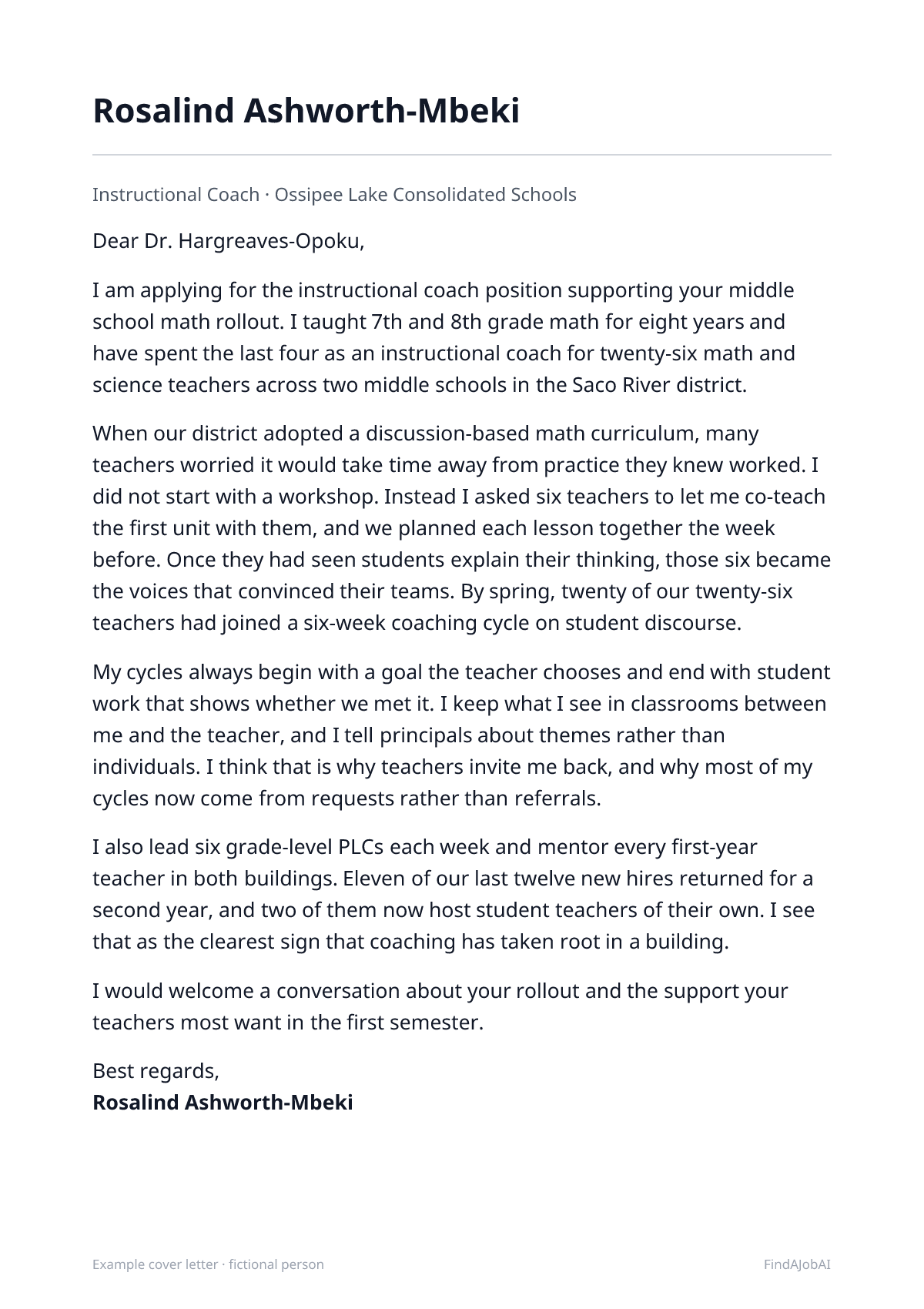
Dear Dr. Hargreaves-Opoku,
I am applying for the instructional coach position supporting your middle school math rollout. I taught 7th and 8th grade math for eight years and have spent the last four as an instructional coach for twenty-six math and science teachers across two middle schools in the Saco River district.
When our district adopted a discussion-based math curriculum, many teachers worried it would take time away from practice they knew worked. I did not start with a workshop. Instead I asked six teachers to let me co-teach the first unit with them, and we planned each lesson together the week before. Once they had seen students explain their thinking, those six became the voices that convinced their teams. By spring, twenty of our twenty-six teachers had joined a six-week coaching cycle on student discourse.
My cycles always begin with a goal the teacher chooses and end with student work that shows whether we met it. I keep what I see in classrooms between me and the teacher, and I tell principals about themes rather than individuals. I think that is why teachers invite me back, and why most of my cycles now come from requests rather than referrals.
I also lead six grade-level PLCs each week and mentor every first-year teacher in both buildings. Eleven of our last twelve new hires returned for a second year, and two of them now host student teachers of their own. I see that as the clearest sign that coaching has taken root in a building.
I would welcome a conversation about your rollout and the support your teachers most want in the first semester.
Best regards,
Rosalind Ashworth-Mbeki
Example 2 · Entry level
Grade-level lead applying for a first instructional coach role
Desmond has taught 4th and 5th grade for seven years and leads his grade team. He wants his first job as an elementary literacy coach.
Example letter · fictional
Dear Mrs. Kingsbury-Nartey,
I would like to apply for the elementary literacy coach position at Cape Elizabeth Shoreline Elementary. I have taught 4th and 5th grade for seven years, and for the last three I have led a team of four teachers through weekly planning and data meetings.
Leading that team has slowly turned into coaching. Each week we look at a short reading check together, sort students by what they still need and plan small groups for the next week. At first I brought the plan to the meeting. Now I bring the student work and ask questions, and my colleagues build the plan themselves, which they follow far more closely. Last year our grade moved fourteen of twenty-two students who began below benchmark in reading up to grade level by spring.
I have also mentored three first-year teachers. I visit each one weekly, but I never arrive with a checklist. We agree on one thing to watch for, such as how quickly students start independent reading, and talk about what I saw that afternoon. All three are still teaching at our school, and one now leads our 4th grade team.
Last year I presented small-group reading strategies to about seventy teachers at two district training days and completed cognitive coaching foundation training over the summer. I know that coaching adults across a whole building is different from leading my own team, and I would welcome guidance from your principal and current coaches as I learn it.
Thank you for your time. I would be glad to model a small-group lesson as part of the interview.
Sincerely,
Desmond Quillfeather-Agyei
Example 3 · Senior or lead
Coaching coordinator applying to lead professional learning for a larger district
Evangeline leads 14 coaches who support 400 teachers in 17 schools. A larger district wants a director to rebuild its coaching program.
Example letter · fictional
Dear Superintendent Ellsworth-Bampoe,
Please accept my application for director of instructional coaching at Androscoggin Bend Unified Schools. I lead fourteen coaches in the Presumpscot Valley district who support about four hundred teachers in seventeen schools, and before that I spent seven years as a literacy coach in three elementary buildings.
Your posting describes a coaching program that teachers see as optional extra work. Ours had the same reputation. Each school ran coaching differently, many coaches spent their days covering classes or running errands for the office, and only about ninety teachers a year took part. I worked with principals to agree a simple model: six-week cycles with a teacher-chosen goal, a check of student work at the start and end, and protected coaching time that could not be borrowed for other duties. We wrote a one-page coaching menu so teachers could choose what they wanted help with. Within three years, about two hundred sixty teachers a year were joining cycles by choice, many of them on a colleague's recommendation.
Coaches need coaching too. Every new coach in our district now completes a ten-day induction and joins monthly practice labs where we watch short coaching videos and give each other feedback. I have trained twenty-two coaches this way, and four have since become assistant principals.
Each term I report to the superintendent on teacher participation, changes seen in classrooms and student growth on district benchmarks, always presented school by school so principals can see their own picture and plan the next term with their coach.
I would welcome the chance to hear what your teachers and principals want from coaching and to share how we rebuilt ours.
Kind regards,
Evangeline Moorcroft-Danquah
All three letters, and the short version below, are fictional: the people, employers and numbers are invented. Borrow the structure, never the facts.
- Prefer to write it yourself? Use the free cover letter template.
- Check your CV against the job first: the free CV score shows the missing keywords.
Why the first letter works, paragraph by paragraph
Paragraph 1: Opening
Gives teaching background, coaching years, number of teachers and schools, so the reader sees scale and credibility.
Paragraph 2: Curriculum story
Shows how the coach won over worried teachers through co-teaching instead of mandates.
Paragraph 3: Coaching model
Explains teacher-chosen goals, student evidence and confidentiality, which builds trust with readers.
Paragraph 4: PLC and new teachers
Adds team leadership and a retention result principals care about.
Paragraph 5: Close
Asks about teachers' needs in the rollout, keeping the focus on the district's goal.
What the entry-level letter does differently
The first-time coach letter shows coaching habits already in use: asking questions instead of handing over plans, mentoring without a checklist and presenting to peers. Admitting that building-wide coaching will be new makes the step up credible.
What the senior letter does differently
This senior letter answers the posting's weak-program problem with a district model, protected time and a participation result. The coach induction paragraph shows the writer builds coaches, and term reporting shows accountability to leaders.
Short instructional coach cover letter: an email-ready version
Many applications arrive as an email or a small text box, and a full page doesn't fit. This version runs 120 to 150 words and keeps only what a reader needs to decide whether to reply. A science teacher replies through an education job board to a charter school that asked for a short note before a demo lesson.
Short version · email · fictional123 words
Subject: Science Instructional Coach – 10 yrs teaching, PLC lead – Leopold Wexford-Antwi
Hi Ms. Pemberton-Aidoo,
I am writing about the science instructional coach opening at Casco Lighthouse Charter Academy. I have taught high school biology and chemistry for ten years and lead our science PLC of six teachers.
This year our team wrote four common lab assessments together and now meets every Thursday to plan reteaching from the results. I also mentor two new science teachers, visiting each one weekly with a single shared focus for the visit, and I recently finished a coaching certificate course that included twenty hours of recorded coaching practice with feedback.
I would be happy to lead the demo lesson or coaching conversation you mentioned. Would next Tuesday or Wednesday afternoon work for you and your team?
Thanks,
Leopold Wexford-Antwi
Charter schools hiring quickly want teaching depth, team leadership and readiness for a demo. This email gives years and subjects, a PLC result and mentoring work, then offers dates for the demo lesson.
Opening lines that work for instructional coach cover letters
The first sentence decides whether the second gets read. Here are six openings, one for each situation you might be in. Pick the one that matches yours and swap in your own facts: every name and number below is invented.
1. You have a standout result
Twenty of our twenty-six middle school teachers chose to join a coaching cycle last spring, and that started with six who let me co-teach.
2. The ad names a problem you've solved
The best compliment a coach can get is a teacher asking for a second cycle, and most of my cycles now begin that way.
3. Someone referred you
For three years I have led my grade team's data meetings, and the moment I stopped bringing the plan, the team began to own it.
4. You admire what they build
Coaching only works when teachers choose it, and I rebuilt a district program around that idea.
5. You're new to the field or switching into it
Winifred Castellane-Osei, a math teacher at your middle school, encouraged me to apply for this coaching role.
6. You have senior scope or a specialism
I spent eight years teaching middle school math before I coached a single teacher, and I still plan every cycle as a teacher first.
How to write an instructional coach cover letter
Five steps, in the order you'd write them. The shape stays the same for every job (a short opening, proof, a reason for this employer, a close), and what goes into each part is what changes with the role.
Show your teaching credibility
Open with your own teaching years, grades and subjects before your coaching experience. Teachers trust coaches who have stood in front of a similar class, and principals know that, so a strong teaching record in the first paragraph makes everything after it more convincing.
Explain your coaching model
Describe in one or two plain sentences how you coach, such as six-week cycles with a teacher-chosen goal and student work at the start and end. A clear model shows you have a method and helps the reader imagine how you would work with their staff.
Tell a story of changed practice
Pick one teacher or team whose teaching changed with your support and say what you did, such as co-teaching or video review. Then give the evidence from students. Keep the teacher as the hero of the story, since good coaching makes the teacher look capable.
Address trust and confidentiality
Explain how you keep coaching separate from evaluation and how you share themes with principals without naming individuals. Many teachers are wary of coaches, and leaders need someone who can earn trust in a building rather than add pressure to already busy staff.
Offer a sample lesson or coaching chat
Close by offering to model a lesson or hold a sample coaching conversation during the interview. It shows confidence, gives the panel a practical way to judge you and matches how many schools already hire coaches, through a short demo with real teachers.
Instructional Coach cover letter do's and don'ts
Do
- Give the number of teachers, grades and subjects you coach or lead.
- Describe your coaching model in one or two plain sentences.
- Tell one story where a teacher's practice changed, with evidence from students.
Don't
- Don't describe coaching as fixing weak teachers.
- Don't claim student gains as yours alone.
- Don't fill the letter with education jargon and program names.
Common instructional coach cover letter mistakes
Each one is easy to make and quick to fix before you send the letter.
Presenting yourself as the teachers' expert fixer
Describe coaching as a partnership where teachers set goals and you support them.
Workshops with no classroom follow-up
Mention the visits, cycles or co-teaching that followed your sessions and what changed.
Claiming student gains alone
Present results as shared and name the classrooms or teams involved.
A letter full of program acronyms
Explain what you did in plain words that any principal or parent board member understands.
Skipping how you work with principals
Show how you agree priorities with leaders while keeping teacher conversations confidential.
Email subject lines for instructional coach applications
Applying by email? Put the job title, any reference number and your name in the subject line.
- Instructional Coach – 26 math and science teachers, 2 middle schools – Rosalind Ashworth-Mbeki
- Elementary Literacy Coach – grade-level lead, mentor to 3 new teachers – Desmond Quillfeather-Agyei
- Coaching Coordinator – 14 coaches, 17 schools – Evangeline Moorcroft-Danquah
Everything for Instructional Coaches
- Instructional Coach resume exampleA full resume, plus bullet and summary examples
- Instructional Coach interview questions30 questions with sample answers
- Instructional Coach job descriptionDuties, skills and requirements
- Cover letter with no experience: templates
Other cover letter examples
Instructional Coach cover letter FAQ
What should an instructional coach cover letter include?
The grades, subjects and number of teachers you support, your coaching model, one story of changed practice, how you keep coaching non-evaluative, PLC or new teacher work and your own teaching background.
How do I write an instructional coach cover letter as a teacher?
Show coaching you already do, such as leading data meetings, mentoring new teachers or presenting at training days. Give numbers and explain how you help colleagues reach their own plans.
Should an instructional coach cover letter mention test scores?
Only with care. Use your school's own assessments, say which classrooms were involved and describe the results as shared with the teachers rather than yours alone.
How we built this page
The FindAJobAI team wrote the three example letters, the short email version, the opening lines and the advice for instructional coach roles. The people, employers and numbers in the letters are invented; the structure, the kind of evidence and the order of the paragraphs are the parts to copy.
Once we track enough live instructional coach job ads, this page also shows the skills they ask for most, counted the same way as our in-demand skills report.
Last reviewed on November 1, 2026.