Private Investigator Cover Letter Example (2026)
By FindAJobAI Team Updated How we built this page
Agency owners read private investigator cover letters with one question in mind: will this person bring back facts a lawyer can use, gathered within the law? Show your license status, the case types you know and one assignment where patience and careful notes made the difference.
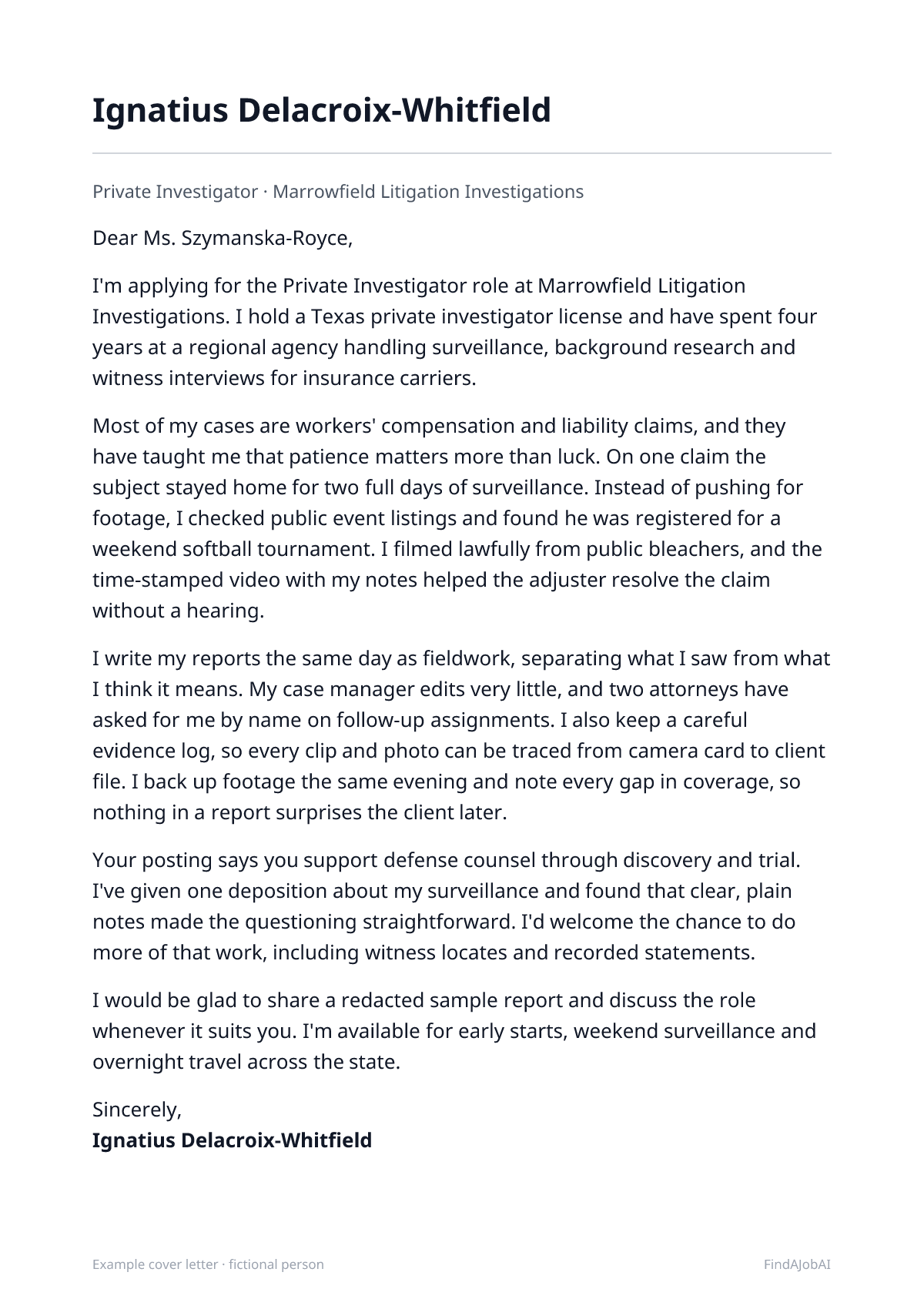
Private Investigator cover letter template
This letter as a one-page template: an opening that names the job and your strongest fact, proof that answers the ad, a reason for this employer and a short close.
After you sign up, FindAJobAI drafts your own letter for a real job from your CV in this format, and you edit it before you send it.
Example 1 · Experienced
Licensed insurance investigator applying to a litigation support agency
Ignatius has four years of surveillance and claims work for insurers. The ad is for an investigator supporting defense attorneys in civil cases.
Example letter · fictional
Dear Ms. Szymanska-Royce,
I'm applying for the Private Investigator role at Marrowfield Litigation Investigations. I hold a Texas private investigator license and have spent four years at a regional agency handling surveillance, background research and witness interviews for insurance carriers.
Most of my cases are workers' compensation and liability claims, and they have taught me that patience matters more than luck. On one claim the subject stayed home for two full days of surveillance. Instead of pushing for footage, I checked public event listings and found he was registered for a weekend softball tournament. I filmed lawfully from public bleachers, and the time-stamped video with my notes helped the adjuster resolve the claim without a hearing.
I write my reports the same day as fieldwork, separating what I saw from what I think it means. My case manager edits very little, and two attorneys have asked for me by name on follow-up assignments. I also keep a careful evidence log, so every clip and photo can be traced from camera card to client file. I back up footage the same evening and note every gap in coverage, so nothing in a report surprises the client later.
Your posting says you support defense counsel through discovery and trial. I've given one deposition about my surveillance and found that clear, plain notes made the questioning straightforward. I'd welcome the chance to do more of that work, including witness locates and recorded statements.
I would be glad to share a redacted sample report and discuss the role whenever it suits you. I'm available for early starts, weekend surveillance and overnight travel across the state.
Sincerely,
Ignatius Delacroix-Whitfield
Example 2 · Career changer
Insurance claims adjuster moving into field investigation
Philippa has six years as a property and casualty claims adjuster. The ad is for an entry-level investigator at an agency that will sponsor her licensing hours.
Example letter · fictional
Dear Mr. Ferreira-Gallagher,
I'm applying for the Investigator Trainee position at Sterling Gate Investigative Group. For six years I've worked as a property and casualty claims adjuster, and in that time I've referred dozens of files to investigators and read every report they returned.
Reading those reports showed me what good investigation looks like from the client side. The useful ones were specific, honest about gaps and delivered on time. On one theft claim I noticed that receipts from three different stores used the same unusual font. I documented the detail, referred the file, and the investigator's records work confirmed the receipts were not genuine.
My current role has given me skills that carry over directly: recorded statements, coverage rules, careful file notes and steady conversations with people who are upset or evasive. I'm used to deadlines set by state regulations and to explaining findings to managers and attorneys in plain language.
I understand that I still need supervised field hours for a license. I've completed an online surveillance fundamentals course, studied the state's recording and trespass rules, and I'm ready for early mornings, long sits in a car and weekend work. Your posting says trainees shadow senior investigators for the first months, which is exactly how I'd like to learn the practical field side. I'm also comfortable with long drives across the region, and I keep my own records organized enough for a supervisor to review at any time.
I'd welcome a conversation about the trainee program and how my claims background could help your insurance clients.
Best regards,
Philippa Ndiaye-Corwin
Example 3 · Senior or lead
Senior investigator applying to lead a case management team
Barnaby has twelve years in investigations, the last five leading corporate fraud cases. The ad is for a senior case manager supervising eight investigators.
Example letter · fictional
Dear Mrs. Haverford-Tanaka,
I'm applying for the Senior Case Manager role at Wexborough Risk and Investigations. I've worked as a licensed investigator for twelve years, and for the last five I've led corporate fraud and employee misconduct cases for a national agency, coordinating up to four investigators on larger matters.
One case shaped how I run teams. A manufacturer suspected a purchasing manager of steering contracts to a relative. I split the work so one investigator handled corporate filings, another ran lawful surveillance and I conducted interviews with the client's counsel present. Our combined report linked the supplier to the manager through property records, and the client resolved the matter with documented evidence rather than suspicion.
I've also improved how our office writes. I introduced a standard report structure and a peer review step before anything reaches a client. Revision requests from attorneys dropped noticeably, and newer investigators tell me the template helps them see what matters. I also keep a running budget for each case, so clients hear early when hours are likely to run over.
Your posting describes eight investigators across several states. I haven't supervised a team that large, so I'd start by reviewing open cases with each person, learning their strengths and the licensing rules in each state, then set weekly case reviews and a shared budget tracker. I'd also join field days in each state during the first quarter, because supervising well means understanding the conditions investigators actually face on the road.
I'd value the chance to talk about your caseload and how you'd like the team to grow.
Sincerely,
Barnaby Osei-Kristiansen
All three letters, and the short version below, are fictional: the people, employers and numbers are invented. Borrow the structure, never the facts.
- Prefer to write it yourself? Use the free cover letter template.
- Check your CV against the job first: the free CV score shows the missing keywords.
Why the first letter works, paragraph by paragraph
Paragraph 1: Opening
States the license and the case types straight away, the first two things an agency owner screens for.
Paragraph 2: The surveillance story
Shows patience, lawful research and filming from a public place, with an outcome the client valued.
Paragraph 3: Reports and evidence
Proves the writing and chain-of-custody habits that make findings usable, with outside signs of trust from attorneys.
Paragraph 4: Why this agency
Links the posting's litigation focus to his deposition experience and the extra tasks he wants to take on.
Paragraph 5: Close
Offers a redacted sample report, a practical next step that lets the reader judge his writing directly.
What the career changer's letter does differently
The adjuster's letter uses the client side of investigations as a strength: she knows what makes a report useful. It is honest that licensing hours are still needed and shows the legal study already done.
What the senior letter does differently
A senior investigator letter shifts from personal fieldwork to case strategy, report quality and supervision. It admits the gap in team size and answers it with a clear plan for the first weeks.
Short private investigator cover letter: an email-ready version
Many applications arrive as an email or a small text box, and a full page doesn't fit. This version runs 120 to 150 words and keeps only what a reader needs to decide whether to reply. A licensed investigator replies by email to an agency owner who posted a contract surveillance opening.
Short version · email · fictional131 words
Subject: Contract Surveillance Investigator – licensed, 3 years field work – Celestine Dumont-Agyeman
Dear Mr. Thornbury-Achike,
I'm writing about the contract Surveillance Investigator opening at Ember Hollow Investigations. I hold a current state investigator license and have worked surveillance cases for three years, mostly for insurance carriers.
I work from a fully equipped vehicle with two cameras, and I send reports with time-stamped video within one day of fieldwork. On a recent disability claim, steady notes over three separate days gave the adjuster a clear and fair picture of the claimant's routine, which helped close the file without dispute. I also keep my equipment, insurance and license renewals current, so I can start on short notice.
I'm available for early starts, weekends and travel across the region. I'd be glad to send a redacted sample report and talk this week.
Kind regards,
Celestine Dumont-Agyeman
The short email leads with license, years and equipment, then one example of patient, documented work, which fits an agency owner who needs to fill a contract quickly.
Opening lines that work for private investigator cover letters
The first sentence decides whether the second gets read. Here are six openings, one for each situation you might be in. Pick the one that matches yours and swap in your own facts: every name and number below is invented.
1. You have a standout result
I hold a Texas investigator license and have spent four years filming, researching and interviewing for insurance carriers, and I'd like to bring that work to your litigation team.
2. The ad names a problem you've solved
After six years reading investigators' reports as a claims adjuster, I know what a client needs from one, and I'm ready to write them myself.
3. Someone referred you
Your posting asks for an investigator who can sit quietly for ten hours and still write a clear report that evening. That describes most of my working weeks.
4. You admire what they build
Your senior investigator, Odalys Brennan-Mwangi, suggested I apply after we covered the same multi-day surveillance on adjoining files last month.
5. You're new to the field or switching into it
My reports have been used in three depositions and one trial without a single question about how the evidence was gathered.
6. You have senior scope or a specialism
As lead investigator on corporate fraud cases for five years, I plan the work, coordinate the team and sign off on every report.
How to write a private investigator cover letter
Five steps, in the order you'd write them. The shape stays the same for every job (a short opening, proof, a reason for this employer, a close), and what goes into each part is what changes with the role.
Lead with license and case types
In your first lines, give your license status and the state it covers, then the kinds of cases you know, such as insurance claims, litigation support or corporate fraud. Agency owners screen for both immediately, so answering early keeps your letter in the right pile.
Tell one lawful, patient case story
Pick an assignment where careful research or steady surveillance produced a useful result. Describe what you checked, how you stayed inside the law and what the client could do with the findings. Change details so the client and subject cannot be identified.
Prove clients rely on your reports
Mention how fast you deliver reports, how you separate facts from analysis and whether attorneys or adjusters request you again. Clients judge investigators mainly through their written work, so one sentence about report quality carries real weight.
Connect to the agency's clients
Read the posting for the agency's main client types and match them to your background. If they support defense attorneys, mention depositions or statements; if they serve insurers, mention claims surveillance. One clear link shows you understand their business.
Close with availability and a sample
Finish with your availability for early starts, weekends and travel, and offer a redacted sample report. That gives the owner a quick way to judge your writing and makes it easy to invite you to an interview straight away.
Private Investigator cover letter do's and don'ts
Do
- State your license, the state it covers, or exactly where you are in the licensing process.
- Tell one case story that shows patience and lawful methods, with details changed to protect the client.
- Mention how quickly and clearly you write reports, because clients judge investigators by them.
Don't
- Don't hint at pretexting, hacking or getting protected records; it disqualifies you at once.
- Don't name real clients, subjects or case numbers.
- Don't present the job as dramatic; agencies hire for patience and accuracy.
Common private investigator cover letter mistakes
Each one is easy to make and quick to fix before you send the letter.
Sounding like a movie detective
Drop dramatic language. Describe research, patience, lawful methods and clear reports instead.
Hinting at illegal methods
Never suggest pretexting, tracking devices on private vehicles or accessing protected records. Stress legal limits.
Sharing identifiable case details
Remove names, places and dates that could point to a real client or subject. Discretion is part of the job.
Skipping license status
Owners need to know whether they can assign you work. State the license or the hours you still need.
Email subject lines for private investigator applications
Applying by email? Put the job title, any reference number and your name in the subject line.
- Private Investigator – Texas licensed, 4 years insurance surveillance – Ignatius Delacroix-Whitfield
- Investigator Trainee – 6 years claims adjusting – Philippa Ndiaye-Corwin
- Senior Case Manager – 12 years investigations, team lead – Barnaby Osei-Kristiansen
Everything for Private Investigators
- Private Investigator resume exampleA full resume, plus bullet and summary examples
- Private Investigator interview questions30 questions with sample answers
- Private Investigator job descriptionDuties, skills and requirements
- Career change cover letter: template + examples
Other cover letter examples
Private Investigator cover letter FAQ
What should a private investigator cover letter include?
Your license status, the case types you handle, one assignment that shows lawful, patient work, how you write reports and your availability for irregular hours and travel. Keep client details anonymous.
How do I write a private investigator cover letter without a license yet?
Say where you are in the licensing process and lean on related work: claims, law enforcement, security, paralegal or military roles. Show research skills, careful notes and knowledge of privacy laws.
Can I describe real cases in a private investigator cover letter?
Only in general terms. Change or remove details that could identify the client or subject, and focus on your method and the type of outcome rather than names or places.
How we built this page
The FindAJobAI team wrote the three example letters, the short email version, the opening lines and the advice for private investigator roles. The people, employers and numbers in the letters are invented; the structure, the kind of evidence and the order of the paragraphs are the parts to copy.
Once we track enough live private investigator job ads, this page also shows the skills they ask for most, counted the same way as our in-demand skills report.
Last reviewed on November 1, 2026.