Product Analyst Cover Letter Example (2026)
By FindAJobAI Team Updated How we built this page
Product analyst ads ask for SQL and an event analytics tool, but the people reading your letter are usually product managers who want to know one thing: did a squad build something different because of you? The letter is where you name the product question, the data you used and the feature that shipped, changed or got dropped.
Product Analyst cover letter template
This letter as a one-page template: an opening that names the job and your strongest fact, proof that answers the ad, a reason for this employer and a short close.
After you sign up, FindAJobAI drafts your own letter for a real job from your CV in this format, and you edit it before you send it.
Example 1 · Experienced
SaaS product analyst applying to a project management tool
Rosalind analyzes onboarding and retention for a B2B scheduling app. The ad asks for experiment design and work with several product squads.
Example letter · fictional
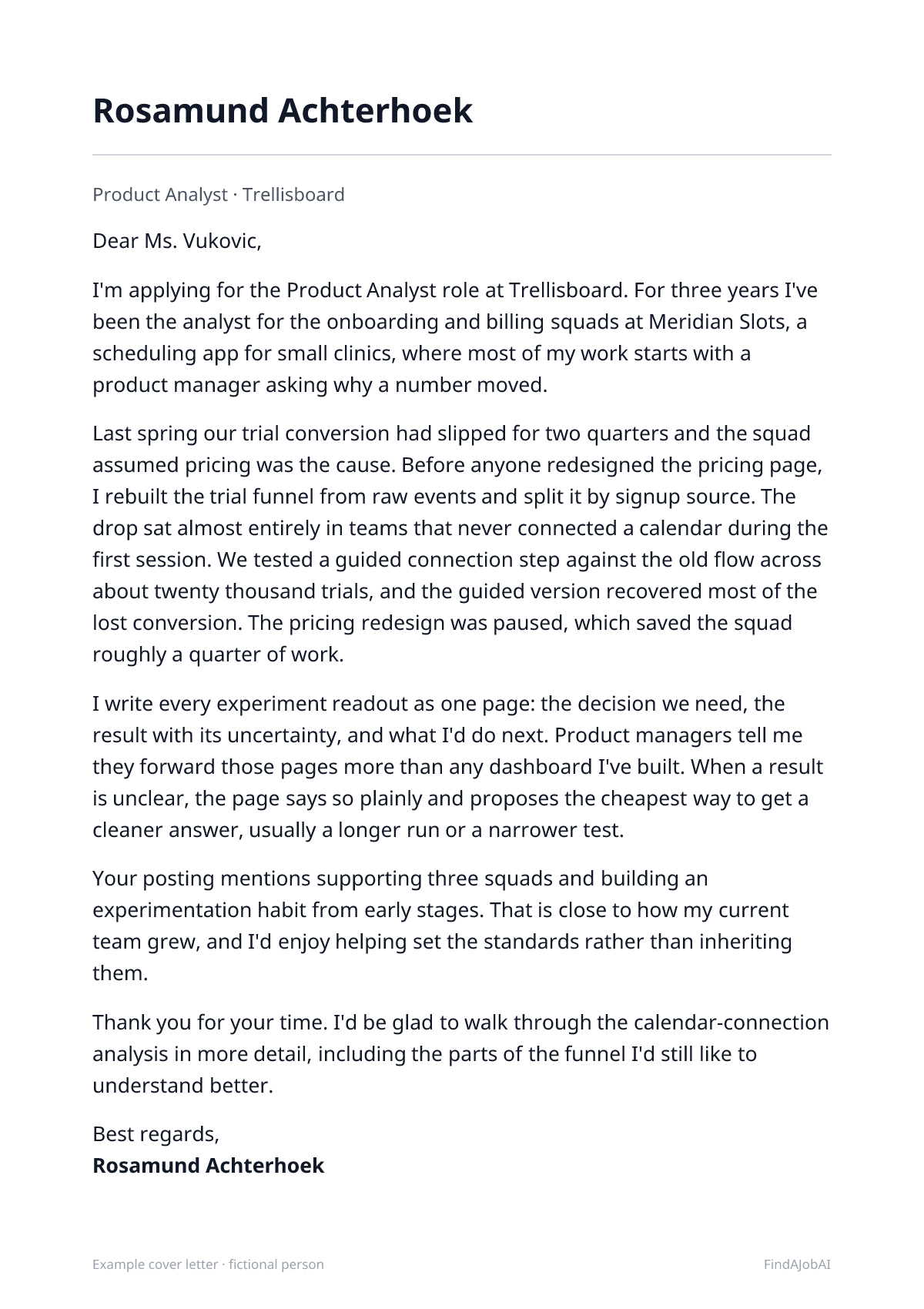
Dear Ms. Vukovic,
I'm applying for the Product Analyst role at Trellisboard. For three years I've been the analyst for the onboarding and billing squads at Meridian Slots, a scheduling app for small clinics, where most of my work starts with a product manager asking why a number moved.
Last spring our trial conversion had slipped for two quarters and the squad assumed pricing was the cause. Before anyone redesigned the pricing page, I rebuilt the trial funnel from raw events and split it by signup source. The drop sat almost entirely in teams that never connected a calendar during the first session. We tested a guided connection step against the old flow across about twenty thousand trials, and the guided version recovered most of the lost conversion. The pricing redesign was paused, which saved the squad roughly a quarter of work.
I write every experiment readout as one page: the decision we need, the result with its uncertainty, and what I'd do next. Product managers tell me they forward those pages more than any dashboard I've built. When a result is unclear, the page says so plainly and proposes the cheapest way to get a cleaner answer, usually a longer run or a narrower test.
Your posting mentions supporting three squads and building an experimentation habit from early stages. That is close to how my current team grew, and I'd enjoy helping set the standards rather than inheriting them.
Thank you for your time. I'd be glad to walk through the calendar-connection analysis in more detail, including the parts of the funnel I'd still like to understand better.
Best regards,
Rosamund Achterhoek
Example 2 · Career changer
Customer support lead moving into product analytics
Emeka leads a support team at a meal-kit company and taught himself SQL to analyze ticket data. The ad wants funnel reporting and curiosity about users.
Example letter · fictional
Dear Hiring Team,
I'm applying for the Product Analyst role at Harvest Crate. For four years I've worked in customer support at Plateful, a meal-kit subscription, and for the last two I've led a team of eight agents. Over that time I've become the person product managers ask when they want to know what users are actually struggling with.
Last year I noticed a rise in tickets about skipped deliveries that customers said they never requested. I exported a few months of ticket tags, learned enough SQL to join them against the app's order events, and found that most cases came from one Android version where the skip button sat too close to the confirm button. I shared the pattern with the mobile squad, they moved the button in the next release, and those tickets dropped sharply within a month. It was the first time I saw how much a careful look at data could change a product, and it is the work I want to do every day.
Since then I've finished an online SQL and statistics course and built a small project reading a public A/B test dataset, writing my own ship or no-ship recommendation.
Your ad asks for someone who can connect product data to how customers feel. I'd bring the habit of starting from real user complaints, plus growing technical skills I'm using every week, and a lot of patience for messy data.
Thank you for considering my application. I'm happy to share the skipped-delivery analysis and the queries behind it.
Sincerely,
Emeka Lindgren
Example 3 · Senior or lead
Product analytics lead applying to head analytics at a fintech
Anneke leads four product analysts at a travel booking site. The ad is for a lead who will set metrics and experiment standards at a growing fintech.
Example letter · fictional
Dear Mr. Haddad,
I'm applying for the Product Analytics Lead role at Coinwell. I lead a team of four product analysts at Wayfarer Bookings, where I joined as the second analyst six years ago, and I'd like to help a younger product organization build the measurement habits we had to learn the slow way.
When I took over the team, each squad defined success its own way, and planning meetings spent more time arguing about numbers than deciding. I worked with product leadership to agree on a small metrics tree, with one top metric and a handful of inputs each squad could own, and we rebuilt our core models so every dashboard used the same definitions. Planning now starts from shared numbers, and squads can see how their work feeds the company goal.
I also introduced an experimentation review: every test needs a stated decision, a power estimate and guardrail metrics before launch. In the first year the share of tests ending inconclusive fell noticeably, and product managers stopped running tests they couldn't learn from.
I've hired three analysts and coach each of them toward owning a product area end to end. I haven't worked in a regulated financial product, so I'd expect to learn quickly how compliance shapes what you can test and track, and I'd lean on your legal and risk partners early rather than late. I'd also want to spend my first weeks sitting with each squad to see how they use data today.
I'd welcome a conversation about where your squads currently disagree on numbers and which decisions feel hardest to measure today.
Sincerely,
Anneke Szabo-Whitfield
All three letters, and the short version below, are fictional: the people, employers and numbers are invented. Borrow the structure, never the facts.
- Prefer to write it yourself? Use the free cover letter template.
- Check your CV against the job first: the free CV score shows the missing keywords.
Why the first letter works, paragraph by paragraph
Paragraph 1: Opening
Names the squads she supports and the kind of question she answers, so the reader knows her scope before the example.
Paragraph 2: The funnel finding
Shows her checking an assumption before the team built, with the test size and the work it saved, which is what product managers value most.
Paragraph 3: Readout format
Describes how she communicates results, a one-page decision document, which tells the reader she writes for product managers rather than for analysts.
Paragraph 4: Why this company
Mirrors the ad's squad structure and early experimentation stage with a reason she wants that stage specifically.
Paragraph 5: Close
Offers to go deeper on the single analysis she described instead of a general request for a call.
What the career changer's letter does differently
The career changer's letter starts from a real pattern he found in support tickets, joined to product data with self-taught SQL, and a release that changed because of it. Naming the course and the test-reading project shows the technical side is growing on purpose, and his support background becomes an advantage instead of a gap.
What the senior letter does differently
A lead-level letter describes systems rather than single analyses: a metrics tree, shared definitions and an experimentation review with a visible effect. Naming the gap, no regulated finance experience, keeps the letter credible and shows she understands how the new domain will change the work.
Short product analyst cover letter: an email-ready version
Many applications arrive as an email or a small text box, and a full page doesn't fit. This version runs 120 to 150 words and keeps only what a reader needs to decide whether to reply. A product analyst replies to a recruiter's message about a role at a language-learning app, attaching a resume by email.
Short version · email · fictional128 words
Subject: Product Analyst role – retention and experiment analysis – Mateus Kowalczyk
Hi Ms. Oyelaran,
Thanks for reaching out about the Product Analyst role at Lingotide. I have three years of experience analyzing retention and experiments for a habit-tracking app, working with two product squads.
My strongest project looked at why new users stopped after their first week. Cohort analysis showed users who set a daily reminder kept going far longer, so we tested a reminder prompt during onboarding, and week-two retention rose clearly for the test group. The squad rolled the prompt out to all new users the following month, and it is still live today.
I work mainly in SQL, Amplitude and Python. My resume is attached, and I'd be glad to talk through the reminder test and how I'd approach retention questions at Lingotide.
Best,
Mateus Kowalczyk
The short version keeps one cohort finding and the test it led to, dropping the readout format and the second example a full letter would include. Answering a recruiter's message, it can open with thanks and stay brief.
Opening lines that work for product analyst cover letters
The first sentence decides whether the second gets read. Here are six openings, one for each situation you might be in. Pick the one that matches yours and swap in your own facts: every name and number below is invented.
1. You have a standout result
A funnel rebuild I did last spring showed our trial drop came from a missing calendar step, not pricing, and it saved my squad a quarter of redesign work. I'd like to do that kind of checking for Trellisboard.
2. The ad names a problem you've solved
Your ad describes squads that each define success differently. I helped my current company agree on one metrics tree, and I'd like to help your team reach the same shared starting point.
3. Someone referred you
Your senior product manager, Dagny Reyes-Albright, and I worked together on a retention project at a previous company. She told me your team was hiring an analyst, which is why I'm writing.
4. You admire what they build
I've used Lingotide daily for eight months, and the way your streak reminders changed over that time made me curious about the analysis behind them.
5. You're new to the field or switching into it
I've led a support team for two years, and the questions I care about most are the ones where tickets point to a product problem. I'm ready to answer those with data full time.
6. You have senior scope or a specialism
As the analyst product managers call when a metric moves without warning, I've learned to check the tracking before the theory. I'm looking for a team that values that habit.
How to write a product analyst cover letter
Five steps, in the order you'd write them. The shape stays the same for every job (a short opening, proof, a reason for this employer, a close), and what goes into each part is what changes with the role.
Find the product area and stage the ad describes
Product analyst roles differ by area, such as growth, onboarding, monetization or core features, and by how mature experimentation is. Read the ad for both, then choose an example from your work that matches the area and the stage it describes.
Open with the assumption you tested
State what the team believed about a metric before your analysis, in one or two sentences. Product managers reading the letter want to see that you check beliefs before they turn into builds, so lead with that moment rather than with your tool list.
Connect the analysis to a product decision
Describe the method in a sentence, then the decision: a feature shipped, a flow changed, a redesign paused. Include the user count or test size so the reader can judge the result, and round figures from your current employer rather than sharing exact totals.
Show how you share results
Product analysts are judged on whether squads act on their work. Describe your readout format, such as a one-page decision memo, and who reads it. This tells the hiring manager you write for product managers, not only for other analysts.
Close with a question about their product
End by naming a product question you'd want to explore at the new company, or ask which metric their squads find hardest to move. A specific close reads as interest in their product rather than a generic request for an interview.
Product Analyst cover letter do's and don'ts
Do
- Name the product question, the data you used and the feature that shipped, changed or was dropped.
- Give the test size or user count in your main example so the reader can judge the result.
- Describe how you write up results for product managers, such as a one-page readout.
Don't
- Don't list every analytics tool you've opened; name the ones you used inside one real analysis.
- Don't present a correlation as the reason a metric moved without saying how you checked it.
- Don't share your current employer's internal revenue or user totals; use rates and rounded figures.
Common product analyst cover letter mistakes
Each one is easy to make and quick to fix before you send the letter.
Leading with dashboards instead of decisions
Saying you built many dashboards tells the reader little. Name one feature decision your work changed and let the tools appear inside that story.
Reporting a test win without its size
A lift with no sample size can't be judged. Give the number of users or sessions and whether the variant shipped, so the result reads as trustworthy.
Ignoring the product managers you'd serve
Product analyst work is shared work. Mention how many squads you support and how you prioritize their requests, so the reader can picture you in their team.
Writing like a data engineer
Pipeline details belong in an interview, not the letter. Keep the focus on the product question and the user behavior you found.
Claiming certainty you didn't have
Product data is noisy. Mention how you handled uncertainty, such as a holdout or a confidence interval, instead of presenting every finding as proven.
Email subject lines for product analyst applications
Applying by email? Put the job title, any reference number and your name in the subject line.
- Product Analyst application – onboarding funnels and experiments – Rosamund Achterhoek
- Product Analyst – support lead with SQL and product data experience – Emeka Lindgren
- Application: Product Analyst, Growth Squads (Req. 4417) – Rosamund Achterhoek
Everything for Product Analysts
- Product Analyst resume exampleA full resume, plus bullet and summary examples
- Product Analyst interview questions30 questions with sample answers
- Product Analyst job descriptionDuties, skills and requirements
- Career change cover letter: template + examples
Other cover letter examples
Product Analyst cover letter FAQ
What should I write in a product analyst cover letter?
One product question you answered with data: what the team assumed, how you checked it, and the feature decision that followed. Add a sentence on how you share results with product managers.
How do I write a product analyst cover letter with no analyst experience?
Use a role where you saw user problems up close, such as support, operations or QA, and describe one time you used data to explain one. Mention a course or project that shows your SQL and statistics are developing.
Should I mention experimentation in a product analyst cover letter?
Yes, if the ad mentions A/B testing. Give one test with its size, result and whether it shipped, rather than a general claim that you run experiments.
How we built this page
The FindAJobAI team wrote the three example letters, the short email version, the opening lines and the advice for product analyst roles. The people, employers and numbers in the letters are invented; the structure, the kind of evidence and the order of the paragraphs are the parts to copy.
Once we track enough live product analyst job ads, this page also shows the skills they ask for most, counted the same way as our in-demand skills report.
Last reviewed on November 1, 2026.