Talent Acquisition Specialist Cover Letter Example (2026)
By FindAJobAI Team Updated How we built this page
A talent acquisition cover letter is read by people who write job pitches for a living. They notice quickly whether you can sell a role, measure a funnel and work with demanding hiring managers. The letter works best when it reads like a short case study of one hiring problem you solved.
Talent Acquisition Specialist cover letter template
This letter as a one-page template: an opening that names the job and your strongest fact, proof that answers the ad, a reason for this employer and a short close.
After you sign up, FindAJobAI drafts your own letter for a real job from your CV in this format, and you edit it before you send it.
Example 1 · Experienced
In-house recruiter applying to a fast-growing logistics company
Rosamund recruits for a healthcare services firm. The ad wants someone to fix slow hiring for warehouse and operations roles at new sites.
Example letter · fictional
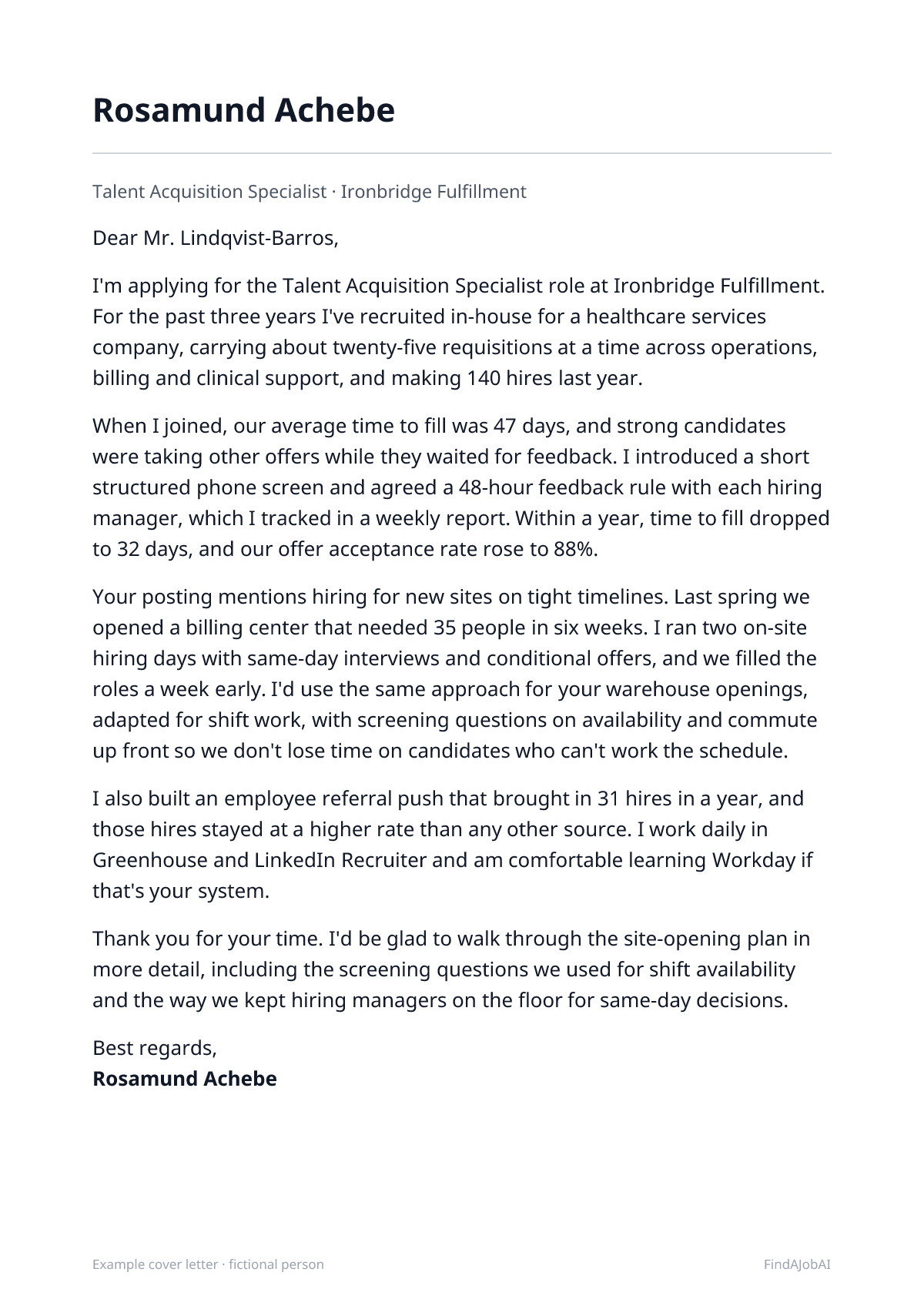
Dear Mr. Lindqvist-Barros,
I'm applying for the Talent Acquisition Specialist role at Ironbridge Fulfillment. For the past three years I've recruited in-house for a healthcare services company, carrying about twenty-five requisitions at a time across operations, billing and clinical support, and making 140 hires last year.
When I joined, our average time to fill was 47 days, and strong candidates were taking other offers while they waited for feedback. I introduced a short structured phone screen and agreed a 48-hour feedback rule with each hiring manager, which I tracked in a weekly report. Within a year, time to fill dropped to 32 days, and our offer acceptance rate rose to 88%.
Your posting mentions hiring for new sites on tight timelines. Last spring we opened a billing center that needed 35 people in six weeks. I ran two on-site hiring days with same-day interviews and conditional offers, and we filled the roles a week early. I'd use the same approach for your warehouse openings, adapted for shift work, with screening questions on availability and commute up front so we don't lose time on candidates who can't work the schedule.
I also built an employee referral push that brought in 31 hires in a year, and those hires stayed at a higher rate than any other source. I work daily in Greenhouse and LinkedIn Recruiter and am comfortable learning Workday if that's your system.
Thank you for your time. I'd be glad to walk through the site-opening plan in more detail, including the screening questions we used for shift availability and the way we kept hiring managers on the floor for same-day decisions.
Best regards,
Rosamund Achebe
Example 2 · Career changer
Software sales rep moving into talent acquisition
Cornelius sold software for four years and interviewed every new rep on his team. The ad is for an entry-level TA specialist at a SaaS firm.
Example letter · fictional
Dear Lumenfield Talent Team,
I'm applying for the Talent Acquisition Specialist I role at Lumenfield Analytics. I've spent four years in software sales, and the part of the job I enjoyed most was helping my manager hire, so I'd like to make recruiting my full-time work.
As our team grew from six to fourteen reps, my manager asked me to join interview panels and later to run first-round calls. I screened about forty candidates over eighteen months, wrote a short role-play exercise that became part of every interview, and pushed for consistent scorecards so decisions weren't based on gut feel. Seven of the reps we hired in that period are still on the team. I also kept a simple spreadsheet of every candidate I screened, with source, stage and outcome, so my manager could see where our best hires came from and where interviews stalled.
Sales taught me the habits a recruiter needs: building a pipeline, keeping notes in a CRM, following up without being pushy, and handling a no without taking it personally. I'm comfortable with Salesforce and have started learning Greenhouse and LinkedIn Recruiter through a sourcing course.
Your posting mentions sales and customer success hiring. I know those roles from the inside and can explain to candidates what a quota and a typical week really look like, which I think helps both acceptance and retention. Candidates who know what they are signing up for tend to stay, and the reps I helped hire told me later that the honest role-play made their decision easier.
Thank you for considering my application. I'd welcome the chance to talk about how I could support your hiring plans.
Kind regards,
Cornelius Mbeki-Harrington
Example 3 · Senior or lead
Senior TA partner applying to lead recruiting at a scale-up
Octavia leads hiring for three product groups. The ad is for a head of talent acquisition to build a team and reduce agency spend.
Example letter · fictional
Dear Ms. Szczepanski,
I'm applying for the Head of Talent Acquisition role at Harborlight Health Tech. I've worked in recruiting for ten years and currently lead hiring for three product groups at a payments company, with two recruiters and a coordinator. We made 95 hires last year against a plan of 100.
Your posting says agency fees are a large share of the hiring budget. We had the same problem when I took over senior engineering searches. I built a sourcing playbook, trained my recruiters on technical screens, and agreed with finance which roles would stay with agencies. Over two years we cut agency spend by $410,000 while keeping time to fill for senior roles roughly level.
The work I'm proudest of is interviewer training. Hiring managers were writing scorecards days late, and decisions drifted toward whoever spoke last in the debrief. I trained 120 interviewers on structured questions and scorecards, and on-time scorecard completion more than doubled within six months.
I haven't built a team from the very first hire or recruited clinical staff, and I'd lean on your clinical leaders to learn what good looks like there. I'd want my first month to focus on the hiring plan, the agency contracts and the roles that have been open longest. I'd also sit in on a few debriefs early to see how decisions are made today, and meet each department head to hear where hiring has let them down.
I'd welcome a conversation about your hiring plan for next year, which roles have been hardest to fill so far, and how your hiring managers currently share interview feedback with recruiters.
Sincerely,
Octavia Rennick
All three letters, and the short version below, are fictional: the people, employers and numbers are invented. Borrow the structure, never the facts.
- Prefer to write it yourself? Use the free cover letter template.
- Check your CV against the job first: the free CV score shows the missing keywords.
Why the first letter works, paragraph by paragraph
Paragraph 1: Opening
Gives requisition load, industry and annual hires in two sentences, which are the numbers a TA lead compares candidates on.
Paragraph 2: The time-to-fill fix
Names the problem, the two changes made and the measured result, including how the writer tracked it.
Paragraph 3: Matching the site-opening need
Answers the ad's main worry with a close example, a billing center filled early, and a plan to adapt it.
Paragraph 4: Quality of hire
The referral program adds a retention angle, so the reader sees quality, not only speed.
Paragraph 5: Close
Offers to go deeper on the plan that matters most to this employer instead of ending with a stock phrase.
What the career changer's letter does differently
The career changer's letter turns interview panel work into recruiting evidence: forty screens, a new exercise, scorecards and seven hires who stayed. It then links sales habits to recruiting tasks and uses inside knowledge of sales roles as a real advantage for this specific employer.
What the senior letter does differently
A leadership letter talks about systems: a sourcing playbook, a split of work with agencies, interviewer training and a first-month plan. The results are business numbers, money saved and scorecards completed on time, and the gaps are named with a sensible way to cover them.
Short talent acquisition specialist cover letter: an email-ready version
Many applications arrive as an email or a small text box, and a full page doesn't fit. This version runs 120 to 150 words and keeps only what a reader needs to decide whether to reply. A talent acquisition specialist answers a recruiter's InMail about a contract TA role at a renewable energy company.
Short version · email · fictional135 words
Subject: TA Specialist contract – high-volume technician hiring – Valentin Osei-Brandt
Hi Mr. Delgado-Price,
Thank you for your message about the twelve-month Talent Acquisition Specialist contract at Windmark Renewables. I've recruited for five years in total, most recently filling field technician and operations roles for a utility services company.
Last year we needed 60 technicians for a new region in under two months. I partnered with four community colleges, ran three on-site hiring days and moved offers to same-day approval. We filled 58 roles on time, and 90-day retention for that group stayed above our company average, which mattered more to the operations team than the speed.
I work daily in Workday Recruiting and LinkedIn Recruiter, I'm comfortable with high-volume screening tools, and I could start in three weeks. My resume is attached. Would a call on Tuesday or Wednesday afternoon suit you?
Best,
Valentin Osei-Brandt
A reply to a recruiter's message should be quick to read and easy to act on. It confirms relevant experience, gives one high-volume hiring story with numbers, names the tools and offers a start date and two times to talk.
Opening lines that work for talent acquisition specialist cover letters
The first sentence decides whether the second gets read. Here are six openings, one for each situation you might be in. Pick the one that matches yours and swap in your own facts: every name and number below is invented.
1. You have a standout result
I cut our average time to fill from 47 days to 32 by adding structured screens and a 48-hour feedback rule. I'd like to bring that kind of practical fix to your recruiting team.
2. The ad names a problem you've solved
Last spring I filled 35 roles for a new billing center a week ahead of schedule, and your new-site hiring plans are why I'm applying.
3. Someone referred you
Your engineering manager, Tobiah Rasmussen, told me at a meetup that you're growing the recruiting team, and he suggested I apply.
4. You admire what they build
After four years in software sales and eighteen months running first-round interviews for my team, I want recruiting to be my full-time job.
5. You're new to the field or switching into it
As the only recruiter at a 300-person company, I built our hiring process from spreadsheets to an ATS. I'm now looking for a larger team where I can specialize.
6. You have senior scope or a specialism
I've hired 95 people this year across three product groups, and I'd like to bring that experience to building your recruiting function.
How to write a talent acquisition specialist cover letter
Five steps, in the order you'd write them. The shape stays the same for every job (a short opening, proof, a reason for this employer, a close), and what goes into each part is what changes with the role.
Learn the company's hiring situation first
Read the job ad, the careers page and recent news. A company opening new sites, cutting agency costs or hiring its first engineers each needs different strengths. Choose the one story from your own work that best matches that situation.
Open with your load and results
In the first paragraph, state the roles you recruit for, how many requisitions you carry and how many hires you made last year. TA leaders use these figures to judge whether you can handle their volume.
Tell one hiring story with a metric
Describe a hiring problem, what you changed and the result, such as time to fill, offer acceptance or retention. Mention how you measured it, since a recruiter who tracks their funnel is more convincing than one who only reports hires.
Show how you work with hiring managers
Explain one way you improve the partnership with hiring managers: intake meetings, feedback deadlines, interviewer training or clearer job descriptions. Give the result it had. Managers' trust is often what separates a good recruiter from an average one.
Close with tools and a next step
Name your ATS and sourcing tools in one sentence, say you can learn theirs if they differ, and offer to discuss a plan for their most pressing roles. Keep the final paragraph short and specific.
Talent Acquisition Specialist cover letter do's and don'ts
Do
- Give your requisition load, hires per year and one funnel metric that you improved.
- Show how you work with hiring managers, such as intake meetings or feedback rules.
- Mention quality of hire, such as acceptance or retention, alongside speed.
Don't
- Don't write that you love connecting people; show a hiring problem you solved.
- Don't send a letter that sounds like a weak job ad; recruiters notice generic copy immediately.
- Don't share confidential candidate or salary details from current employers.
Common talent acquisition specialist cover letter mistakes
Each one is easy to make and quick to fix before you send the letter.
Copying job ad language back to the reader
Recruiters write job ads all day and spot recycled phrases instantly. Use your own words and a real example instead.
Reporting hires without context
A total hire count means little alone. Add the role types, the time frame and one quality measure such as retention.
Ignoring candidate experience
Companies care how candidates feel about the process. Mention a survey score or a communication change you made.
Naming candidates or exact salaries from your current job
Avoid naming candidates, exact salaries or internal plans from your current employer. Use rounded figures and general descriptions.
Leaving out compliance awareness
For roles covering several regions or federal contracts, one line on EEO, OFCCP or GDPR shows you know the rules recruiters follow.
Email subject lines for talent acquisition specialist applications
Applying by email? Put the job title, any reference number and your name in the subject line.
- Talent Acquisition Specialist application – 32-day time to fill, 140 hires – Rosamund Achebe
- TA Specialist I – sales rep with interview panel experience – Cornelius Mbeki-Harrington
- Application: Senior Talent Acquisition Partner (Req. TA-4406) – Rosamund Achebe
Everything for Talent Acquisition Specialists
- Talent Acquisition Specialist resume exampleA full resume, plus bullet and summary examples
- Talent Acquisition Specialist interview questions30 questions with sample answers
- Talent Acquisition Specialist job descriptionDuties, skills and requirements
- Career change cover letter: template + examples
Other cover letter examples
Talent Acquisition Specialist cover letter FAQ
What should a talent acquisition cover letter include?
Your requisition load and hires, one hiring problem you solved with a measured result, how you partner with hiring managers, and the ATS and sourcing tools you use.
How do I get into talent acquisition without recruiting experience?
Use interviewing, screening or onboarding work from another role, such as sitting on interview panels or training new staff. Show numbers and connect skills like pipeline building to recruiting.
Should a TA cover letter mention diversity hiring?
If you have done real work on it, yes. Describe a specific step, such as structured scorecards or new sourcing partners, and its effect, without sharing private candidate data.
How we built this page
The FindAJobAI team wrote the three example letters, the short email version, the opening lines and the advice for talent acquisition specialist roles. The people, employers and numbers in the letters are invented; the structure, the kind of evidence and the order of the paragraphs are the parts to copy.
Once we track enough live talent acquisition specialist job ads, this page also shows the skills they ask for most, counted the same way as our in-demand skills report.
Last reviewed on November 1, 2026.