Athletic Trainer Resume Example (2026)
By FindAJobAI Team Updated How we built this page
Athletic trainer postings ask for BOC certification, a state license and proof that you can cover practices and games for a full roster on your own. Athletic directors and team physicians read for the sports you cover, how many athletes you care for, how you handle concussions and emergencies, and how quickly injured athletes return safely.
The example below belongs to a certified athletic trainer with seven years in college and high school athletics. Each bullet names the team or setting, the care delivered and a measured result, such as athletes covered, days lost to injury, rehab completion or emergency drills run.
Athletic Trainer resume template
This example as a one-page template: one column, standard headings and plain text, the format applicant tracking systems read most reliably.
After you sign up, Create my CV builds your own resume in this same one-column layout, from your real experience.
Mid-level athletic trainer resume example
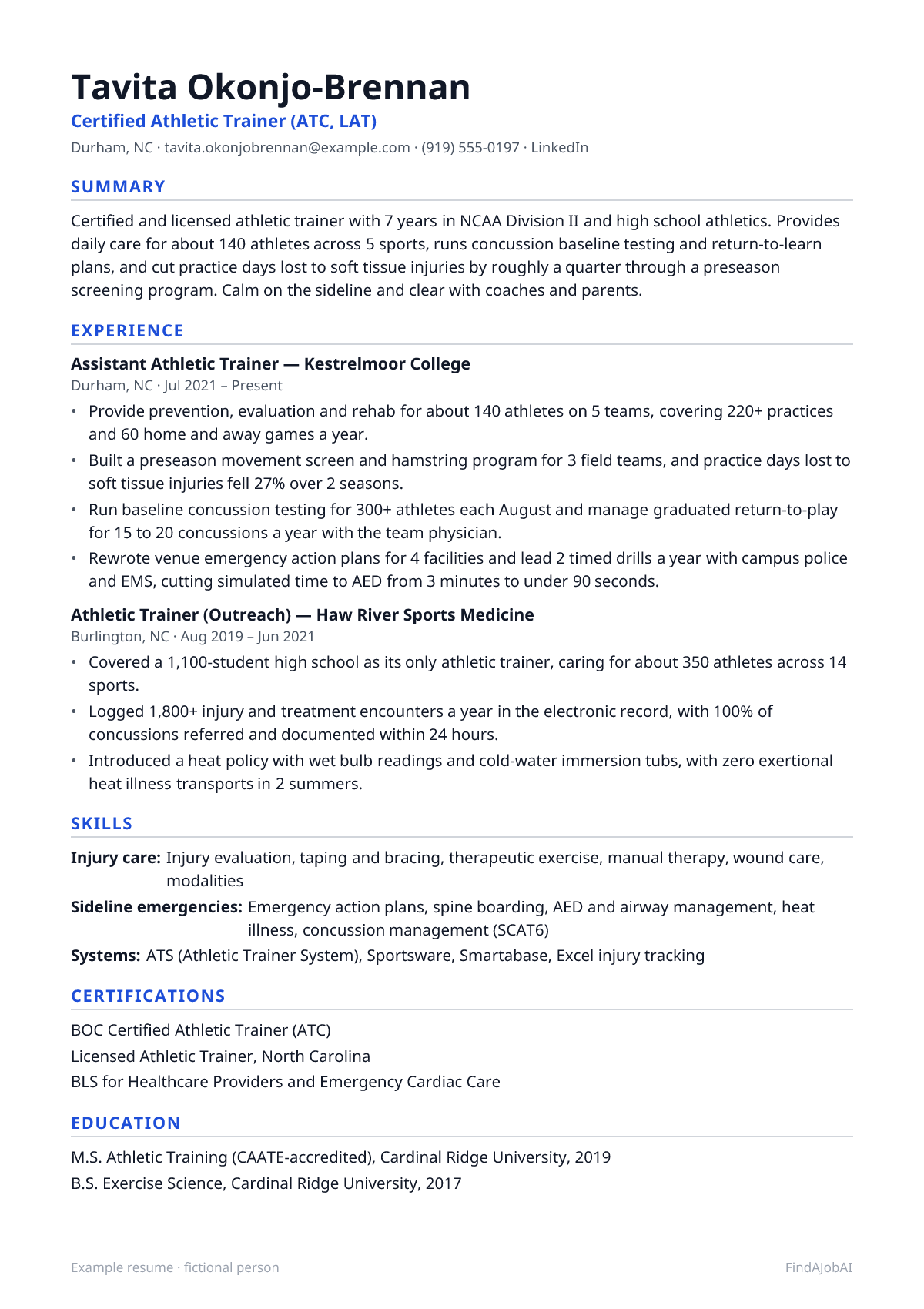
A complete one-page example for a fictional athletic trainer: every bullet pairs an action with what changed because of it.
Example resume · fictional person
Tavita Okonjo-Brennan
Certified Athletic Trainer (ATC, LAT)
Durham, NC · [email protected] · (919) 555-0197 · LinkedIn
Summary
Certified and licensed athletic trainer with 7 years in NCAA Division II and high school athletics. Provides daily care for about 140 athletes across 5 sports, runs concussion baseline testing and return-to-learn plans, and cut practice days lost to soft tissue injuries by roughly a quarter through a preseason screening program. Calm on the sideline and clear with coaches and parents.
Experience
Assistant Athletic Trainer, Kestrelmoor College
Durham, NC · Jul 2021 – Present
- Provide prevention, evaluation and rehab for about 140 athletes on 5 teams, covering 220+ practices and 60 home and away games a year.
- Built a preseason movement screen and hamstring program for 3 field teams, and practice days lost to soft tissue injuries fell 27% over 2 seasons.
- Run baseline concussion testing for 300+ athletes each August and manage graduated return-to-play for 15 to 20 concussions a year with the team physician.
- Rewrote venue emergency action plans for 4 facilities and lead 2 timed drills a year with campus police and EMS, cutting simulated time to AED from 3 minutes to under 90 seconds.
Athletic Trainer (Outreach), Haw River Sports Medicine
Burlington, NC · Aug 2019 – Jun 2021
- Covered a 1,100-student high school as its only athletic trainer, caring for about 350 athletes across 14 sports.
- Logged 1,800+ injury and treatment encounters a year in the electronic record, with 100% of concussions referred and documented within 24 hours.
- Introduced a heat policy with wet bulb readings and cold-water immersion tubs, with zero exertional heat illness transports in 2 summers.
Skills
- Injury care: Injury evaluation, taping and bracing, therapeutic exercise, manual therapy, wound care, modalities
- Sideline emergencies: Emergency action plans, spine boarding, AED and airway management, heat illness, concussion management (SCAT6)
- Systems: ATS (Athletic Trainer System), Sportsware, Smartabase, Excel injury tracking
Certifications
- BOC Certified Athletic Trainer (ATC)
- Licensed Athletic Trainer, North Carolina
- BLS for Healthcare Providers and Emergency Cardiac Care
Education
- M.S. Athletic Training (CAATE-accredited), Cardinal Ridge University, 2019
- B.S. Exercise Science, Cardinal Ridge University, 2017
Fictional example by the FindAJobAI team: the person, employers and numbers are invented. Keep the structure; use your own work and numbers you can explain in an interview.
Entry-level athletic trainer resume example
A newly certified athletic trainer from a master's program. Education and clinical rotations come first, and a student aide job stays because it shows sideline routines and taping volume.
Entry-level example resume · fictional person
Osric Valdemaro
Athletic Trainer (Newly Certified, ATC)
Raleigh, NC · [email protected] · (919) 555-0198 · LinkedIn
Summary
Newly certified athletic trainer with 4 clinical rotations in college football, high school athletics, an orthopedic clinic and a summer sports camp. Covered up to 90 athletes under a preceptor and worked 2 years as a student aide for basketball and soccer. Seeking a first full-time role in high school or college athletics.
Education
- M.S. Athletic Training (CAATE-accredited), Orrin Bay University, 2026
- BOC Certified Athletic Trainer (ATC), 2026; North Carolina license pending
Experience
Student Athletic Training Aide, Orrin Bay University Athletics
Raleigh, NC · Aug 2024 – May 2026
- Prepared water, ice and kits for 2 teams of about 55 athletes, at 150+ practices and games a season.
- Taped ankles and wrists for up to 20 athletes before practice under the supervision of 2 staff athletic trainers.
- Kept the treatment room cleaning and whirlpool logs current, with 0 findings in 2 department safety checks.
Youth Sports Camp Counselor, Lumbee Ridge Sports Camp
Pembroke, NC · Jun 2022 – Aug 2023
- Supervised groups of 12 campers aged 10 to 14 in daily outdoor sports sessions over 2 summers.
- Reported 30+ minor injuries to the camp nurse with clear written notes, maintaining CPR and first aid cards.
Skills
- Clinical: Injury evaluation, taping and bracing, therapeutic exercise, wound care, concussion screening
- Emergency: Spine motion restriction, AED, cold-water immersion, emergency action plans
- Documentation: ATS, SOAP notes, injury reports
Athletic training rotations
- College football, 1 season: covered practices for about 90 athletes with a preceptor, including 3 on-field spine and airway drills.
- High school athletics, 1 semester: evaluated ankle and knee injuries for 8 sports and wrote 40+ home exercise plans.
- Orthopedic clinic, 8 weeks: assisted with post-surgical rehab for 6 to 8 patients a day.
Senior athletic trainer resume example
A head athletic trainer with fifteen years who now leads a staff and sets department policy. Bullets show staff, budget and policy results while still naming hands-on care.
Senior example resume · fictional person
Leontyne Ramsdell-Ito
Head Athletic Trainer
Carrboro, NC · [email protected] · (919) 555-0199 · LinkedIn
Summary
Head athletic trainer with 15 years in NCAA athletics. Leads 6 athletic trainers and 2 graduate assistants covering 19 sports and about 480 athletes, manages a $310,000 sports medicine budget and co-writes concussion, heat and mental health referral policies with team physicians.
Experience
Head Athletic Trainer, Brackenridge University
Carrboro, NC · Jan 2019 – Present
- Lead 6 athletic trainers and 2 graduate assistants covering 19 sports, with every practice and home event staffed for 6 straight years.
- Manage a $310,000 annual budget for supplies, equipment and insurance claims, holding spending flat for 3 years while adding 2 sports.
- Co-wrote a mental health referral pathway with campus counseling that connected 64 athletes to care in its first year.
- Moved injury records to Smartabase across 19 teams, giving coaches next-day availability reports for 480 athletes.
Associate Athletic Trainer, Brackenridge University
Carrboro, NC · Aug 2014 – Dec 2018
- Served as primary athletic trainer for football, covering 115 athletes and 12 games a season.
- Started a return-to-learn plan with academic advising that covered 25 concussed athletes a year.
- Precepted 16 master's students, all of whom passed the BOC exam within 2 attempts.
Athletic Trainer, Neuse Valley High School
Zebulon, NC · Aug 2011 – Jul 2014
- Covered about 400 athletes in 15 sports as the school's only athletic trainer.
- Raised funds for 2 AEDs placed at outdoor fields, with response drills held every preseason.
Skills
- Leadership: Staff scheduling, budgets, policy writing, preceptor supervision, insurance coordination
- Clinical: Football sideline care, concussion management, post-surgical rehab, emergency planning
- Systems: Smartabase, ATS, Excel budgeting, NCAA sports medicine handbook compliance
Certifications
- BOC Certified Athletic Trainer (ATC)
- Licensed Athletic Trainer, North Carolina
- Certified Strength and Conditioning Specialist (CSCS)
Education
- M.S. Kinesiology, Brackenridge University, 2014
- B.S. Athletic Training, Cardinal Ridge University, 2011
How to write an athletic trainer resume
Five steps, in the order a recruiter reads the page. The format around them stays plain for every job: one column, standard headings, newest role first.
Header: name, target title and links
Use “Athletic Trainer” or “Certified Athletic Trainer (ATC)” to match the posting, and add your state license and emergency cardiac care right below your name.
Summary: what you do and your best proof
Open with credentials, years and setting, then the sports and number of athletes you cover. Add one result, such as days lost to injury or a concussion program, and one line about how you work with coaches.
Experience: newest first, a result in every bullet
Write each bullet as the athletes, the care given and the result. Athletes covered, practices and games, days lost, return-to-play timing and drill response times are what athletic directors track.
Skills: grouped, in the ad's words
Group skills by clinical care, emergency care and systems. Name your injury tracking software and the concussion tool you use, since many departments filter for them.
Education and certifications
List your CAATE-accredited degree with the year, then BOC certification and state license. New graduates can add clinical rotations with the sport, length and number of athletes covered.
Skills to put on an athletic trainer resume
Hard skills are the tools and methods of the job; soft skills are how you work with people. Each comes with one way to prove it, because a skill named only in a list counts for little. Add the ones you really have.
Hard skills
- Injury evaluation
- Name the injuries you assess most often and how you refer to the team physician.
- Concussion management
- Mention the baseline tool, the return-to-play steps and how many cases you handle a year.
- Emergency action planning
- Give the number of venues covered and how often you run drills with EMS.
- Rehabilitation and return to sport
- Describe the criteria you use and the outcome athletes reached.
- Taping and bracing
- State your daily volume and any time saved before practice.
- Heat illness prevention
- Name the policy, the wet bulb readings and cold-water immersion you use.
- Injury documentation
- Name the system and show completeness, such as audits or reporting times.
- Injury prevention programs
- Mention the screen or warm-up program and the change in days lost.
- Spine motion restriction
- Say how often you practise it with your staff and local EMS.
- Modalities and manual therapy
- List the modalities and techniques you use within your license.
Soft skills
- Communication with coaches
- Describe how and when you share athlete availability each day.
- Calm under pressure
- Give an example of a serious on-field injury and your response.
- Working with parents
- Explain how you talk through injuries with parents of younger athletes.
- Judgment
- Show a time you held an athlete out despite pressure, and what followed.
- Teaching
- Mention students or aides you supervised and what they learned.
- Organization
- Explain how you cover overlapping practices and travel schedules.
Athletic Trainer resume bullet examples: weak vs strong
The same work, written two ways. The strong version names the tool, the scope and a result; the numbers are examples, yours must be real.
Weak: Taped athletes before practice.
Strong: Taped and braced 40 to 50 athletes before each practice, cutting pre-practice wait from 25 minutes to 10 with a sign-up board and 2 student aides.
Shows volume and a simple fix with a before-and-after measure.
Weak: Handled concussions.
Strong: Managed 18 concussions in one season using SCAT6 and a 5-stage return-to-play plan, with every athlete cleared by the team physician before full contact.
Names the tool, the protocol and the physician sign-off that schools look for.
Weak: Did rehab with injured athletes.
Strong: Guided 11 ACL reconstruction athletes through criteria-based rehab, with 9 returning to their sport within 10 months of surgery.
Gives the injury, the method and a return-to-sport figure.
Weak: Responsible for emergency plans.
Strong: Wrote venue-specific emergency action plans for 6 fields and gyms and rehearsed them each preseason with coaches and local EMS.
Turns a vague duty into specific venues and a repeated drill.
Weak: Talked to coaches about injuries.
Strong: Sent a daily injury availability report to 7 head coaches by 2 p.m., so practice plans reflected every athlete's limits.
Shows communication as a reliable routine with a clear audience.
Weak: Kept injury records.
Strong: Documented about 2,000 treatment notes a year in Sportsware, passing 3 annual compliance reviews with no missing concussion forms.
Turns record keeping into a yearly count and a clean compliance result.
15 more athletic trainer resume bullet examples
Grouped by area of the job, so you can find the ones closest to your work. Keep the shape (action, scope, result) and replace the invented numbers with your own.
Sideline and emergency care
- Responded to 4 suspected cervical spine injuries over 3 football seasons using the venue plan, with every athlete transported safely.
- Placed cold-water immersion tubs at 3 practice sites and trained 20 coaches on heat illness warning signs.
- Ran 6 preseason emergency drills a year, with average time from collapse to AED under 2 minutes.
- Covered 25 away games a season with travel kits checked against a 40-item list before each trip.
- Recognized 2 cases of exertional sickling during conditioning and activated EMS within 1 minute.
Rehab and injury prevention
- Led a 12-minute injury prevention warm-up for 3 women's teams, coinciding with 5 fewer ACL injuries over 4 seasons.
- Ran daily rehab for 15 to 20 injured athletes in a shared clinic, keeping sessions under 45 minutes.
- Used hop and strength testing to guide return to sport for 22 lower-limb injuries.
- Built 30 written home programs for athletes in the off-season, with 80% completing check-ins.
- Tracked weekly training load for 60 runners, flagging 9 at high risk for stress injuries.
Department administration
- Processed 90 secondary insurance claims a year for athletes, with 95% paid on first submission.
- Kept a $45,000 supply budget on target for 4 seasons by ordering against injury trends.
- Supervised 8 student aides a year, writing training checklists for taping and field setup.
- Coordinated 350 preparticipation physicals each summer with 4 volunteer physicians.
- Sent weekly injury summaries to 2 team physicians, cutting follow-up calls by about half.
Athletic Trainer resume summary examples
Two or three lines on what you do and your strongest proof. Start from the one closest to your level and use your own facts.
Newly certified athletic trainer with clinical rotations in college football, high school athletics and an orthopedic clinic. Covered up to 90 athletes under a preceptor and brings 2 years as a student aide for basketball and soccer.
Certified and licensed athletic trainer with 7 years in college and high school athletics. Cares for about 140 athletes on 5 teams, runs concussion testing and return-to-play plans, and lowered soft tissue injury days lost with a preseason screen.
Head athletic trainer with 15 years in NCAA athletics. Leads a staff of 6 athletic trainers covering 19 sports, manages a sports medicine budget and works with team physicians on policies for concussion, heat and mental health referrals.
Common athletic trainer resume mistakes
Each one is easy to make and quick to fix before you apply.
Calling yourself a trainer without ATC
Personal trainer and athletic trainer are different jobs. Use your full title and BOC credential so screeners see the healthcare role.
No roster size or sports named
Covered athletics says little. State the sports, the number of athletes and whether you were the only athletic trainer on site.
Leaving out emergency planning
Emergency readiness is a key concern for schools. Mention the plans you wrote, the drills you ran and response times.
Claiming you cleared athletes alone
In most settings a physician signs off on return to play. Describe your role in the protocol and credit the team physician.
Injury figures without context
A drop in injuries means little alone. Say how many athletes, which teams and over how many seasons.
ATS tips for an athletic trainer resume
Applicant tracking systems turn your file into text that recruiters search, mostly for the skills and titles in the ad. They rarely reject a resume on their own; one that parses badly or misses the ad's words just doesn't come up.
- Put ATC, your state license and BLS near your name, since schools and clinics screen for them before anything else.
- Name the sports and the number of athletes you cover, and say whether you are the only athletic trainer on site.
- Show emergency readiness with specifics: emergency action plans written, drills run and response times.
- Use return-to-play figures carefully and credit the team physician, who clears athletes in most settings.
- List the injury tracking system you use, because many athletic departments filter for experience with it.
For the format itself, run the free ATS resume checklist.
Everything for Athletic Trainers
- Athletic Trainer cover letter examplesThree example letters and a short email version
- Athletic Trainer interview questions30 questions with sample answers
- Athletic Trainer job descriptionDuties, skills and requirements
- How to tailor your resume without lying
Other resume examples
Athletic Trainer resume FAQ
Should an athletic trainer resume list every sport covered?
List the sports with the largest rosters or highest injury risk, such as football, soccer or wrestling, and give a total number of athletes. A full list of fourteen sports takes space without telling the reader much more.
How do I show results on an athletic trainer resume?
Use figures your department already tracks: days lost to injury, concussion return-to-play timing, rehab completion, emergency drill times and documentation audits. Say how many athletes and seasons the figure covers.
Do I need certifications beyond ATC?
The BOC credential, a state license where required and emergency cardiac care are the basics. Extra credentials such as CSCS or a manual therapy course help for some roles, but list them only if you hold them.
How we built this page
The FindAJobAI team wrote the three example resumes, the bullets, the skills and the advice for athletic trainer roles. The people, employers and numbers in the examples are invented; the structure, the tools and the way each bullet is built are the parts to copy.
Once we track enough live athletic trainer job ads, this page also shows the skills they ask for most, counted the same way as our in-demand skills report.
Last reviewed on November 1, 2026.