Computer Vision Engineer Resume Example (2026)
By FindAJobAI Team Updated How we built this page
Vision hiring managers read resumes looking for models that worked outside the lab. A computer vision engineer resume should name the task (detection, segmentation, tracking), the data work behind it, where the model ran, and figures such as recall on real-world slices, frames per second on the target device or labeling time saved.
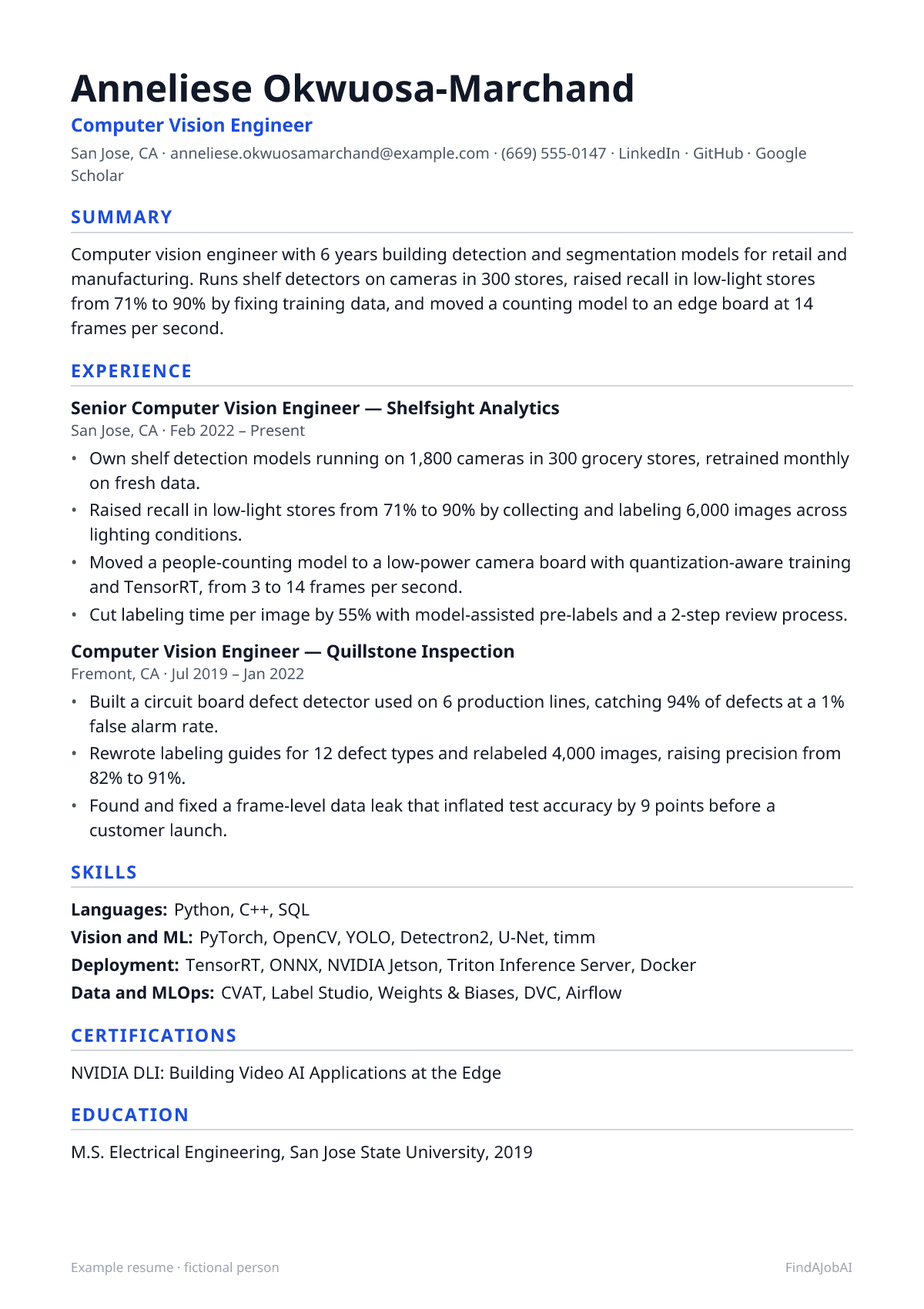
The example below belongs to a computer vision engineer with six years across a retail analytics company and a manufacturing inspection startup. Each bullet ties a model or data decision to deployment conditions and a measured result.
Computer Vision Engineer resume template
This example as a one-page template: one column, standard headings and plain text, the format applicant tracking systems read most reliably.
After you sign up, Create my CV builds your own resume in this same one-column layout, from your real experience.
Mid-level computer vision engineer resume example
A complete one-page example for a fictional computer vision engineer: every bullet pairs an action with what changed because of it.
Example resume · fictional person
Anneliese Okwuosa-Marchand
Computer Vision Engineer
San Jose, CA · [email protected] · (669) 555-0147 · LinkedIn · GitHub · Google Scholar
Summary
Computer vision engineer with 6 years building detection and segmentation models for retail and manufacturing. Runs shelf detectors on cameras in 300 stores, raised recall in low-light stores from 71% to 90% by fixing training data, and moved a counting model to an edge board at 14 frames per second.
Experience
Senior Computer Vision Engineer, Shelfsight Analytics
San Jose, CA · Feb 2022 – Present
- Own shelf detection models running on 1,800 cameras in 300 grocery stores, retrained monthly on fresh data.
- Raised recall in low-light stores from 71% to 90% by collecting and labeling 6,000 images across lighting conditions.
- Moved a people-counting model to a low-power camera board with quantization-aware training and TensorRT, from 3 to 14 frames per second.
- Cut labeling time per image by 55% with model-assisted pre-labels and a 2-step review process.
Computer Vision Engineer, Quillstone Inspection
Fremont, CA · Jul 2019 – Jan 2022
- Built a circuit board defect detector used on 6 production lines, catching 94% of defects at a 1% false alarm rate.
- Rewrote labeling guides for 12 defect types and relabeled 4,000 images, raising precision from 82% to 91%.
- Found and fixed a frame-level data leak that inflated test accuracy by 9 points before a customer launch.
Skills
- Languages: Python, C++, SQL
- Vision and ML: PyTorch, OpenCV, YOLO, Detectron2, U-Net, timm
- Deployment: TensorRT, ONNX, NVIDIA Jetson, Triton Inference Server, Docker
- Data and MLOps: CVAT, Label Studio, Weights & Biases, DVC, Airflow
Certifications
- NVIDIA DLI: Building Video AI Applications at the Edge
Education
- M.S. Electrical Engineering, San Jose State University, 2019
Fictional example by the FindAJobAI team: the person, employers and numbers are invented. Keep the structure; use your own work and numbers you can explain in an interview.
Entry-level computer vision engineer resume example
A recent graduate whose thesis and internship carry the page. Education comes first, and each project gives the data, metric and use.
Entry-level example resume · fictional person
Thelonius Abara-Westergaard
Computer Vision Engineer
Ann Arbor, MI · [email protected] · (734) 555-0198 · GitHub · LinkedIn
Summary
Entry-level computer vision engineer with an M.S. in Computer Science and a thesis on small-object detection in drone imagery. Built segmentation models for crop monitoring during an internship and is comfortable with PyTorch, OpenCV and CVAT. Seeking a first applied vision role.
Education
- M.S. Computer Science, University of Michigan, 2026
Experience
Computer Vision Intern, Greenrow Aerial
Ann Arbor, MI · May 2026 – Aug 2026
- Trained a U-Net to segment weeds in 2,400 drone images, reaching 0.78 IoU on held-out fields.
- Split data by field instead of by tile, removing a leak that had inflated scores by 7 points.
- Wrote a labeling guide for 3 weed types used by 4 annotators.
Graduate Research Assistant, University of Michigan
Ann Arbor, MI · Sep 2024 – May 2026
- Improved small-object detection recall by 11% on a public drone dataset with tiled inference.
- Presented results at 1 regional workshop and released code with 140 GitHub stars.
Skills
- Languages: Python, C++
- Vision tools: PyTorch, OpenCV, YOLO, U-Net, MediaPipe
- Data tools: CVAT, Weights & Biases, Git
Projects
- Bike lane monitor (YOLO, OpenCV): counted cyclists from 2 public webcams for a city advocacy group.
- Sign language letters (PyTorch, MediaPipe): recognised 24 hand shapes in real time on a laptop webcam.
Senior computer vision engineer resume example
A leader whose impact is team direction and evaluation standards. Bullets cover metrics, hiring and process, with team and customer scale up front.
Senior example resume · fictional person
Rosamond Achterberg-Ifeanyi
Senior Computer Vision Engineer
Boston, MA · [email protected] · (857) 555-0123 · LinkedIn · Google Scholar
Summary
Head of computer vision with 12 years in machine learning and 8 in vision. Leads 7 engineers building inspection systems for 11 factories, moved evaluation to customer-agreed recall targets, and halved escalations in a year.
Experience
Head of Computer Vision, Quarrybrook Inspection Systems
Boston, MA · Jan 2021 – Present
- Lead 7 engineers building defect detection for 11 factories in 3 countries.
- Replaced accuracy reporting with recall at agreed false alarm rates per defect type, cutting customer escalations by 52%.
- Introduced dataset versioning and video-level splits, making 100% of production models reproducible.
- Hired 4 engineers and mentored 2 juniors into owning production models.
Senior Machine Learning Engineer, Charlesgate Medical Imaging
Cambridge, MA · Mar 2016 – Dec 2020
- Built a lung nodule detection model reviewed by 30 radiologists, rated helpful in 82% of reading sessions.
- Added confidence display and uncertainty flags after 12 reading-room observations.
- Cut inference time from 9 seconds to 2 seconds per scan with mixed precision on GPUs.
Software Engineer, Bayside Robotics
Waltham, MA · Jun 2013 – Feb 2016
- Wrote C++ camera calibration tools used on 40 warehouse robots.
- Built an OpenCV barcode reader that cut misreads by 35%.
Skills
- Languages: Python, C++, CUDA
- Vision and ML: PyTorch, OpenCV, Detectron2, MONAI, vision transformers
- Deployment: TensorRT, Triton, ONNX Runtime, Kubernetes
- Leadership: Evaluation design, hiring, roadmap planning, customer reviews
Education
- Ph.D. Electrical Engineering, Boston University, 2013
How to write a computer vision engineer resume
Five steps, in the order a recruiter reads the page. The format around them stays plain for every job: one column, standard headings, newest role first.
Header: name, target title and links
Use “Computer Vision Engineer” or “Perception Engineer” as the headline. Link GitHub, papers or demos you can explain line by line.
Summary: what you do and your best proof
Open with the vision tasks and industries you work in, then one real-world accuracy result and one deployment or data result.
Experience: newest first, a result in every bullet
Write each bullet as model or data task, method, result: what it detected or segmented, how you built or fixed it, and the measured outcome in real conditions.
Skills: grouped, in the ad's words
Group skills into languages, vision and ML frameworks, deployment tools and data tooling. Spell out PyTorch, OpenCV and TensorRT exactly.
Education and certifications
List degrees with thesis topics if they involve vision. Without experience, add projects with real images, a clear metric and who used them.
Skills to put on a computer vision engineer resume
Hard skills are the tools and methods of the job; soft skills are how you work with people. Each comes with one way to prove it, because a skill named only in a list counts for little. Add the ones you really have.
Hard skills
- Object detection
- Name the model family, classes and mAP on a realistic test set.
- Segmentation
- Give IoU or Dice scores and what the masks were used for.
- PyTorch
- Describe a training pipeline you built and the experiments it supported.
- OpenCV
- Mention classical processing you used, such as calibration or pre-processing.
- Data labeling
- Give images labeled, guides written and agreement or throughput gains.
- Evaluation design
- Explain the metric you chose and the slices you reported.
- Edge deployment
- Name the device and give latency or frames per second before and after.
- Model optimization
- Mention quantization, pruning or distillation and the accuracy trade-off.
- Video and tracking
- Describe a tracker you used and identity switch or speed results.
- MLOps
- Mention experiment tracking, dataset versioning and retraining schedules.
- C++
- Give a performance-critical component you wrote and its speed gain.
Soft skills
- Working with domain experts
- Describe how feedback from radiologists, operators or growers changed a model.
- Honest reporting
- Mention a time you corrected an inflated result before launch.
- Customer communication
- Give an example of setting realistic accuracy expectations.
- Mentoring
- Name engineers you coached and what they now own.
- Prioritization
- Show how you chose data work over bigger models when it paid off more.
- Writing
- Mention evaluation reports or papers you wrote and who used them.
Computer Vision Engineer resume bullet examples: weak vs strong
The same work, written two ways. The strong version names the tool, the scope and a result; the numbers are examples, yours must be real.
Weak: Trained detection models.
Strong: Trained a YOLO detector for 40 product classes, reaching 0.86 mAP at 0.5 IoU on a test set drawn from 25 stores.
Gives the task, classes, metric and a realistic test set.
Weak: Improved model accuracy.
Strong: Fixed inconsistent labels for 2 defect types, raising precision from 82% to 91% without changing the model.
Shows the data-first fix and its gain.
Weak: Deployed models to edge.
Strong: Quantized a segmentation model to INT8 for Jetson Orin, cutting latency from 85ms to 24ms with a 1-point accuracy drop.
Names the hardware and the trade-off.
Weak: Built a labeling pipeline.
Strong: Set up Label Studio with model-assisted pre-labels and reviews, tripling throughput to 1,500 images a day.
Gives tooling and a throughput figure.
Weak: Reduced costs.
Strong: Added frame skipping and batching to a cloud video service, cutting GPU spend by 38% with no recall loss.
Connects engineering to money saved.
Weak: Worked with customers.
Strong: Agreed recall-at-1%-false-alarm targets with 4 factory customers, cutting escalations by 50% in a year.
Shows metric design with users.
15 more computer vision engineer resume bullet examples
Grouped by area of the job, so you can find the ones closest to your work. Keep the shape (action, scope, result) and replace the invented numbers with your own.
Models and accuracy
- Trained an instance segmentation model for 15 part types, reaching 0.81 mask mAP on factory images.
- Built a multi-camera tracker for 60 warehouse aisles, cutting identity switches by 45%.
- Fine-tuned a vision transformer on 8,000 medical images, raising sensitivity from 84% to 90%.
- Added night-time infrared data to a vehicle detector, cutting false detections by 50%.
Data and evaluation
- Built a gold set of 1,200 images to score labeling vendors on every batch.
- Added 6 evaluation slices covering lighting, distance and camera angle to every release report.
- Removed 3,400 duplicate images found with perceptual hashing before retraining.
- Cut annotator disagreement from 18% to 6% with a revised guide and examples.
Deployment and cost
- Exported 5 models to ONNX and TensorRT, serving 900 camera streams on 12 GPUs.
- Distilled a large detector into a mobile model running at 30 frames per second on mid-range phones.
- Cut cloud inference cost by 38% with frame skipping and dynamic batching.
Collaboration and delivery
- Shipped a 6-week damage detection pilot for a logistics customer that led to a 3-year contract.
- Ran monthly error reviews with 4 customer sites, turning 20 reported failures into new training data.
- Added on-device face and plate blurring for 2,000 cameras to meet city privacy rules.
- Wrote 9 internal evaluation reports used by product managers to plan releases.
Computer Vision Engineer resume summary examples
Two or three lines on what you do and your strongest proof. Start from the one closest to your level and use your own facts.
Recent M.S. graduate in computer science with a thesis on small-object detection in drone images and an internship building segmentation models for crop monitoring. Comfortable with PyTorch, OpenCV and data labeling tools.
Computer vision engineer with 6 years in retail and manufacturing. Runs detectors on cameras in 300 stores, raised low-light recall from 71% to 90% with better data, and deployed a counting model to edge boards at 14 frames per second.
Head of computer vision with 12 years in machine learning and 8 in vision. Leads 7 engineers building inspection systems for 11 factories, redesigned evaluation around customer-agreed metrics, and halved escalations.
Common computer vision engineer resume mistakes
Each one is easy to make and quick to fix before you apply.
Only benchmark numbers
Add results on real deployment data, especially hard slices like low light or distant objects.
No data work shown
Include images labeled, guides written or leaks fixed, since vision teams spend most time on data.
Missing hardware details
Say where models ran and give latency, memory or frame rate figures.
Architecture name lists
Keep only models you used and tie each to a result.
Ignoring privacy
For camera products, mention blurring, retention or consent work you did.
ATS tips for a computer vision engineer resume
Applicant tracking systems turn your file into text that recruiters search, mostly for the skills and titles in the ad. They rarely reject a resume on their own; one that parses badly or misses the ad's words just doesn't come up.
- Name the vision task and model family, such as detection with YOLO or segmentation with U-Net.
- Report metrics on realistic slices like lighting, site or camera, not only overall scores.
- Show data work with images labeled, guides written or leaks found, since teams value it highly.
- Give latency and hardware for deployed models, such as milliseconds on Jetson or frames per second on a phone.
- Link papers or GitHub only if they show work you can explain in depth.
For the format itself, run the free ATS resume checklist.
Everything for Computer Vision Engineers
- Computer Vision Engineer cover letter examplesThree example letters and a short email version
- Computer Vision Engineer interview questions30 questions with sample answers
- Computer Vision Engineer job descriptionDuties, skills and requirements
- How to tailor your resume without lying
Other resume examples
Computer Vision Engineer resume FAQ
What should a computer vision engineer resume include?
Vision tasks and models, frameworks such as PyTorch and OpenCV, data labeling and cleaning, evaluation metrics, and deployment details like TensorRT or edge hardware. Add papers or open-source work if relevant.
How do I show computer vision skills from research?
Describe research models like product work: the data you labeled, how you split it, the metric and what it enabled. Add any step toward production, such as serving a model as a web service.
Should I list mAP scores on my resume?
Yes, with context. State the threshold and what the test set represents, and pair it with a real-world result such as recall in a hard condition.
How we built this page
The FindAJobAI team wrote the three example resumes, the bullets, the skills and the advice for computer vision engineer roles. The people, employers and numbers in the examples are invented; the structure, the tools and the way each bullet is built are the parts to copy.
Once we track enough live computer vision engineer job ads, this page also shows the skills they ask for most, counted the same way as our in-demand skills report.
Last reviewed on November 1, 2026.