Supply Chain Analyst Resume Example (2026)
By FindAJobAI Team Updated How we built this page
Supply chain analyst jobs sit between planning, purchasing, warehouses and finance. A hiring manager reading your resume wants to see that you can pull messy data out of an ERP, find where inventory or freight money is leaking, and get buyers or planners to act on what you found. Tools matter, but outcomes matter more: fill rate, days of supply, forecast error and cost per shipment.
The example below belongs to an analyst with five years at a consumer goods distributor and a contract manufacturer. Each bullet names the data or tool, the decision it changed and the number that moved afterward.
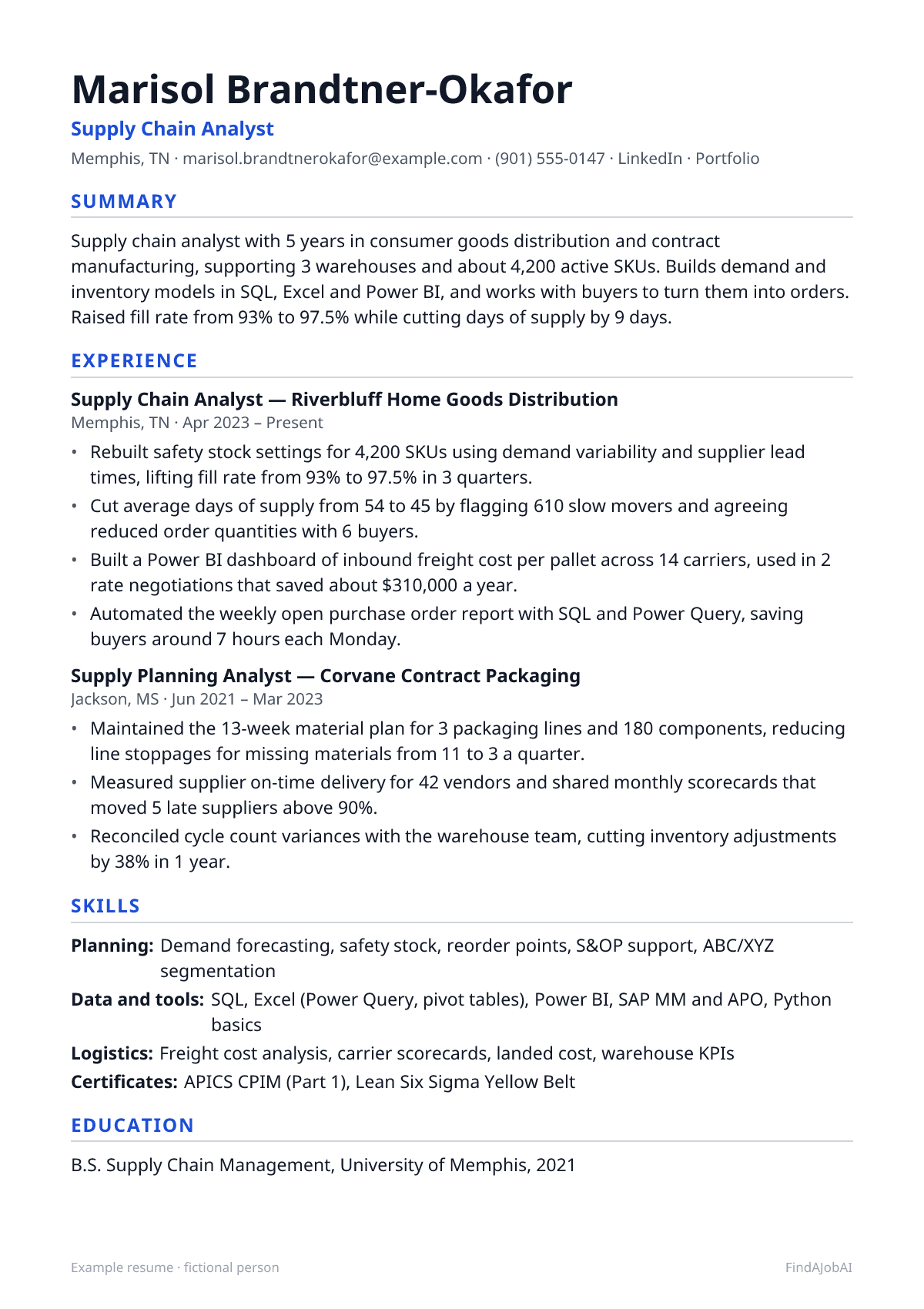
Supply Chain Analyst resume template
This example as a one-page template: one column, standard headings and plain text, the format applicant tracking systems read most reliably.
After you sign up, Create my CV builds your own resume in this same one-column layout, from your real experience.
Mid-level supply chain analyst resume example
A complete one-page example for a fictional supply chain analyst: every bullet pairs an action with what changed because of it.
Example resume · fictional person
Marisol Brandtner-Okafor
Supply Chain Analyst
Memphis, TN · [email protected] · (901) 555-0147 · LinkedIn · Portfolio
Summary
Supply chain analyst with 5 years in consumer goods distribution and contract manufacturing, supporting 3 warehouses and about 4,200 active SKUs. Builds demand and inventory models in SQL, Excel and Power BI, and works with buyers to turn them into orders. Raised fill rate from 93% to 97.5% while cutting days of supply by 9 days.
Experience
Supply Chain Analyst, Riverbluff Home Goods Distribution
Memphis, TN · Apr 2023 – Present
- Rebuilt safety stock settings for 4,200 SKUs using demand variability and supplier lead times, lifting fill rate from 93% to 97.5% in 3 quarters.
- Cut average days of supply from 54 to 45 by flagging 610 slow movers and agreeing reduced order quantities with 6 buyers.
- Built a Power BI dashboard of inbound freight cost per pallet across 14 carriers, used in 2 rate negotiations that saved about $310,000 a year.
- Automated the weekly open purchase order report with SQL and Power Query, saving buyers around 7 hours each Monday.
Supply Planning Analyst, Corvane Contract Packaging
Jackson, MS · Jun 2021 – Mar 2023
- Maintained the 13-week material plan for 3 packaging lines and 180 components, reducing line stoppages for missing materials from 11 to 3 a quarter.
- Measured supplier on-time delivery for 42 vendors and shared monthly scorecards that moved 5 late suppliers above 90%.
- Reconciled cycle count variances with the warehouse team, cutting inventory adjustments by 38% in 1 year.
Skills
- Planning: Demand forecasting, safety stock, reorder points, S&OP support, ABC/XYZ segmentation
- Data and tools: SQL, Excel (Power Query, pivot tables), Power BI, SAP MM and APO, Python basics
- Logistics: Freight cost analysis, carrier scorecards, landed cost, warehouse KPIs
- Certificates: APICS CPIM (Part 1), Lean Six Sigma Yellow Belt
Education
- B.S. Supply Chain Management, University of Memphis, 2021
Fictional example by the FindAJobAI team: the person, employers and numbers are invented. Keep the structure; use your own work and numbers you can explain in an interview.
Entry-level supply chain analyst resume example
A new graduate with one planning internship. Education comes first, and each line shows data work tied to a real inventory or logistics decision.
Entry-level example resume · fictional person
Desmond Ichikawa-Lafleur
Supply Chain Analyst
Columbus, OH · [email protected] · (614) 555-0129 · LinkedIn · GitHub
Summary
Supply chain graduate with a 6-month planning internship at a regional food distributor and a capstone on warehouse slotting. Uses SQL, Excel and Power BI to shape order and inventory data, and passed APICS CPIM Part 1. Ready to support buyers, planners and logistics teams.
Education
- B.S. Logistics Management, Ohio State University, 2026
Experience
Supply Planning Intern, Harrowgate Fresh Foods
Columbus, OH · Jan 2026 – Jun 2026
- Built an Excel reorder tool for 250 dry goods SKUs using 52 weeks of sales, adopted by 2 buyers for weekly orders.
- Flagged 37 items with more than 90 days of supply, and buyers paused orders on 21 of them.
- Cleaned 1,400 item master records with missing case sizes, fixing pallet counts on inbound loads.
Capstone Project: Warehouse Slotting, Ohio State University
Columbus, OH · Aug 2025 – Dec 2025
- Modeled pick frequency for 3,000 locations in a partner warehouse and proposed moving 120 fast movers closer to packing.
- Estimated a 14% cut in picker walking distance and presented it to the site manager.
Skills
- Data: SQL, Excel (XLOOKUP, pivot tables, Power Query), Power BI, Python basics
- Planning: Reorder points, safety stock, ABC analysis, days of supply
- Languages: English, French (professional)
Certificates
- APICS CPIM Part 1, 2026
- Microsoft Power BI Data Analyst (PL-300), 2026
Senior supply chain analyst resume example
A senior analyst leading a small analytics team for a national distributor. Bullets cover network and inventory models, working capital and influence on S&OP decisions.
Senior example resume · fictional person
Annika Mulvaney-Osei
Senior Supply Chain Analyst
Rotterdam, Netherlands · [email protected] · (312) 555-0178 · LinkedIn
Summary
Senior supply chain analyst with 11 years in retail and industrial distribution, leading a 4-person team supporting S&OP for $600 million in annual purchases across 6 distribution centers. Builds network, inventory and freight models that shaped 2 warehouse consolidations and released $18 million of working capital.
Experience
Senior Supply Chain Analyst, Vandermeer Industrial Supply
Rotterdam, Netherlands · Mar 2020 – Present
- Lead 4 analysts producing the monthly S&OP pack for 6 distribution centers and $600 million in purchases.
- Built a network model comparing 3 consolidation options, supporting the closure of 1 site and saving €2.4 million a year in rent and transfers.
- Introduced multi-echelon safety stock for 9,000 SKUs, releasing $18 million of inventory while holding 98% line fill.
- Set up a weekly forecast review with 5 category teams that cut forecast bias from +11% to +3% in 12 months.
Supply Chain Analyst, Bramwell Outdoor Retail
Denver, CO · Jul 2015 – Feb 2020
- Planned store allocations for 140 stores and 2 seasonal drops a year, cutting end-of-season markdown stock by 17%.
- Moved 22 import lanes to a new forwarder after a landed cost study that saved $1.1 million a year.
- Wrote SQL reports on vendor lead times used in 3 annual supplier reviews.
Skills
- Planning: S&OP, multi-echelon inventory, demand sensing, allocation, scenario planning
- Network and logistics: Network design, landed cost, carrier and forwarder tenders, transfer cost models
- Tools: SQL, Python (pandas), Power BI, SAP IBP, Llamasoft Supply Chain Guru
- Leadership: Team coaching, executive reporting, cross-functional workshops, Dutch and English
Education
- M.Sc. Supply Chain Management, Erasmus University Rotterdam, 2015
- ASCM CSCP, 2018
How to write a supply chain analyst resume
Five steps, in the order a recruiter reads the page. The format around them stays plain for every job: one column, standard headings, newest role first.
Header: name, target title and links
Use “Supply Chain Analyst”, or the exact title in the ad, such as “Inventory Analyst” or “Logistics Analyst”. Add LinkedIn and a portfolio link if you can share a sample dashboard.
Summary: what you do and your best proof
Open with your years, industry and scope in SKUs, sites or spend. Name your main tools, then close with one result such as fill rate or working capital.
Experience: newest first, a result in every bullet
Write each bullet as data, action and outcome. Say what you analyzed, who acted on it and which measure changed, such as fill rate, stock days or freight cost.
Skills: grouped, in the ad's words
Group skills into planning, data and tools, logistics and certificates. Spell out ERP names and modules exactly as job ads do.
Education and certifications
List your degree, school and year. Add APICS or ASCM certifications and any Power BI or SQL credentials, with a capstone if you are a recent graduate.
Skills to put on a supply chain analyst resume
Hard skills are the tools and methods of the job; soft skills are how you work with people. Each comes with one way to prove it, because a skill named only in a list counts for little. Add the ones you really have.
Hard skills
- Demand forecasting
- Say which method you used and how forecast error changed for which items.
- Safety stock and reorder points
- Give the SKU count and the fill rate or stock days that moved.
- SQL
- Describe a query or data feed you built and who uses it.
- Excel and Power Query
- Mention a model or report you automated and the hours it saved.
- Power BI or Tableau
- Name a dashboard, its audience and a decision it supported.
- ERP systems
- List SAP, Oracle or NetSuite modules you pulled data from or maintained.
- Freight cost analysis
- Show cost per pallet, lane or unit and the savings it backed.
- Supplier performance
- Give the number of vendors tracked and how on-time delivery changed.
- Inventory accuracy
- Mention cycle count work and adjustments reduced.
- Network modeling
- Describe sites or lanes compared and the option chosen.
- S&OP support
- Explain the reports you prepared and the meeting they fed.
Soft skills
- Influencing buyers
- Show a recommendation buyers actually adopted.
- Clear writing
- Mention a one-page summary or scorecard managers read monthly.
- Curiosity
- Describe a strange number you chased down to a root cause.
- Prioritizing
- Give an example of choosing which SKUs or suppliers to fix first.
- Working with operations
- Note time spent with warehouse or plant teams to check the data.
- Handling pressure
- Describe a shortage or disruption where your analysis guided a quick decision.
Supply Chain Analyst resume bullet examples: weak vs strong
The same work, written two ways. The strong version names the tool, the scope and a result; the numbers are examples, yours must be real.
Weak: Worked on inventory levels.
Strong: Reset safety stock for 4,200 SKUs from demand variability and lead times, raising fill rate from 93% to 97.5%.
Names the method, the scope and the service level that improved.
Weak: Made reports for buyers.
Strong: Replaced a manual open order spreadsheet with a SQL feed that saves 6 buyers about 7 hours every week.
Turns a report into time saved for named users.
Weak: Helped reduce freight costs.
Strong: Compared cost per pallet across 14 carriers and backed 2 rate negotiations worth about $310,000 a year.
Shows the analysis and the money it supported.
Weak: Watched vendor deliveries.
Strong: Published monthly on-time scorecards for 42 vendors, moving 5 late suppliers above 90% within 2 quarters.
Gives the number of suppliers and a measurable change.
Weak: Improved forecasts.
Strong: Added promotion and seasonality flags to the forecast model, cutting weighted forecast error from 34% to 26% for the top 300 items.
Explains what changed and how error was measured.
Weak: Responsible for excess stock.
Strong: Found 610 slow-moving SKUs and agreed smaller order quantities with buyers, cutting days of supply by 9 days.
Moves from duty to an outcome with stock days.
15 more supply chain analyst resume bullet examples
Grouped by area of the job, so you can find the ones closest to your work. Keep the shape (action, scope, result) and replace the invented numbers with your own.
Inventory and planning
- Segmented 3,500 SKUs into ABC/XYZ classes and set review cycles for each, cutting planner workload by 20%.
- Raised reorder points on 85 critical spare parts, ending 4 months of stockouts at 2 plants.
- Cut obsolete stock by $640,000 by tracking 120 end-of-life items through a 6-month sell-down plan.
- Reduced forecast error for the top 200 items from 31% to 24% by adding weather and promotion data.
Logistics and freight
- Analyzed 18 months of LTL invoices and found $96,000 in duplicate or misrated charges.
- Built a lane cost model for 40 outbound routes that shifted 9 lanes from LTL to full truckload.
- Tracked carrier on-time pickup for 12 carriers and dropped 2 that stayed below 85%.
- Compared 3 port routings for Asian imports and cut average transit time by 6 days.
Reporting and automation
- Replaced 5 manual Excel reports with 1 Power BI app used by 30 planners and buyers.
- Wrote a Python script that matches 8,000 purchase order lines to receipts nightly, cutting mismatches by 70%.
- Built an exception report for late inbound orders that buyers clear within 1 day.
Suppliers and cost
- Ran a landed cost comparison of 4 suppliers that moved $2.3 million of annual spend to a nearshore vendor.
- Measured lead time variability for 60 suppliers and used it to set new safety stock rules.
- Supported a supplier consolidation from 14 to 8 corrugate vendors, saving about 6% on packaging.
- Joined quarterly reviews with 10 key suppliers using a scorecard of 5 delivery and quality measures.
Supply Chain Analyst resume summary examples
Two or three lines on what you do and your strongest proof. Start from the one closest to your level and use your own facts.
Supply chain graduate with a 6-month planning internship at a food distributor, where I built an Excel reorder tool for 250 SKUs. Comfortable with SQL, pivot tables and Power BI, and finished APICS CPIM Part 1. Looking for an analyst role close to buyers and warehouses.
Supply chain analyst with 5 years in distribution and packaging, supporting 3 warehouses and 4,200 SKUs. Builds safety stock, freight and supplier models in SQL and Power BI, raising fill rate to 97.5% and cutting 9 days of supply.
Senior supply chain analyst with 11 years across retail and industrial distribution, leading a 4-person analytics team that supports S&OP for $600 million in annual purchases. Owns network and inventory models used in 2 warehouse consolidations and cut working capital by $18 million.
Common supply chain analyst resume mistakes
Each one is easy to make and quick to fix before you apply.
Listing tools with no outcome
SQL and Power BI are expected. Show what your queries and dashboards changed for buyers or managers.
Hiding the scope of your work
Supporting 300 SKUs and 9,000 SKUs are very different roles. Add SKUs, sites, suppliers or spend.
Using vague words like streamlined
Replace them with the measure you moved, such as days of supply or cost per pallet.
Claiming savings you cannot explain
Only include savings you can walk through in an interview, with the method behind them.
Leaving out who used your analysis
Analysts succeed when others act. Mention buyers, planners or carriers who used your work.
ATS tips for a supply chain analyst resume
Applicant tracking systems turn your file into text that recruiters search, mostly for the skills and titles in the ad. They rarely reject a resume on their own; one that parses badly or misses the ad's words just doesn't come up.
- Quote the scope you support in SKUs, warehouses, suppliers or annual spend so a reader can size your role.
- Name the service and cost measures you moved, such as fill rate, days of supply, forecast error or freight cost per unit.
- List your ERP and data tools exactly, like SAP, Oracle, SQL and Power BI, because applicant systems filter on them.
- Show who acted on your analysis, such as buyers, planners or carriers, since analysis that nobody uses is not a result.
- Keep one page for under 8 years of experience and put certifications like CPIM or CSCP near the skills.
For the format itself, run the free ATS resume checklist.
Everything for Supply Chain Analysts
- Supply Chain Analyst cover letter examplesThree example letters and a short email version
- Supply Chain Analyst interview questions30 questions with sample answers
- Supply Chain Analyst job descriptionDuties, skills and requirements
- How to tailor your resume without lying
Other resume examples
Supply Chain Analyst resume FAQ
What should a supply chain analyst resume include?
The scope you support, the planning, inventory or logistics problems you analyzed, the tools you used and the numbers that changed afterward. Add certifications such as APICS CPIM or CSCP and any ERP you know well.
How do I write a supply chain analyst resume with no experience?
Use internships, class projects and part-time warehouse or retail jobs. Show a model or dashboard you built, the data it used and what it found, and list SQL, Excel and any ERP you have practiced on.
Which skills matter most for supply chain analysts?
Excel and SQL for pulling and shaping data, a reporting tool such as Power BI or Tableau, and a working grasp of forecasting, safety stock and freight costs. Clear writing for buyers and managers matters as much as the models.
How we built this page
The FindAJobAI team wrote the three example resumes, the bullets, the skills and the advice for supply chain analyst roles. The people, employers and numbers in the examples are invented; the structure, the tools and the way each bullet is built are the parts to copy.
Once we track enough live supply chain analyst job ads, this page also shows the skills they ask for most, counted the same way as our in-demand skills report.
Last reviewed on November 1, 2026.