Surgical Assistant Resume Example (2026)
By FindAJobAI Team Updated How we built this page
A surgical assistant works across the table from the surgeon as first assistant: positioning and prepping the patient, providing exposure with retractors, controlling bleeding, driving the camera in laparoscopic cases, and closing incisions. Hiring managers and surgeons read these resumes for the specialties you cover, your case volume, your certification and whether you can work independently on closure and vein harvest.
The example below is a certified surgical first assistant with seven years in the operating room, four of them as a first assistant in general, orthopedic and robotic surgery at a 300-bed hospital. Each bullet names the procedure type, the volume and one outcome, so a surgical services director can judge your scope in seconds.
Surgical Assistant resume template
This example as a one-page template: one column, standard headings and plain text, the format applicant tracking systems read most reliably.
After you sign up, Create my CV builds your own resume in this same one-column layout, from your real experience.
Mid-level surgical assistant resume example
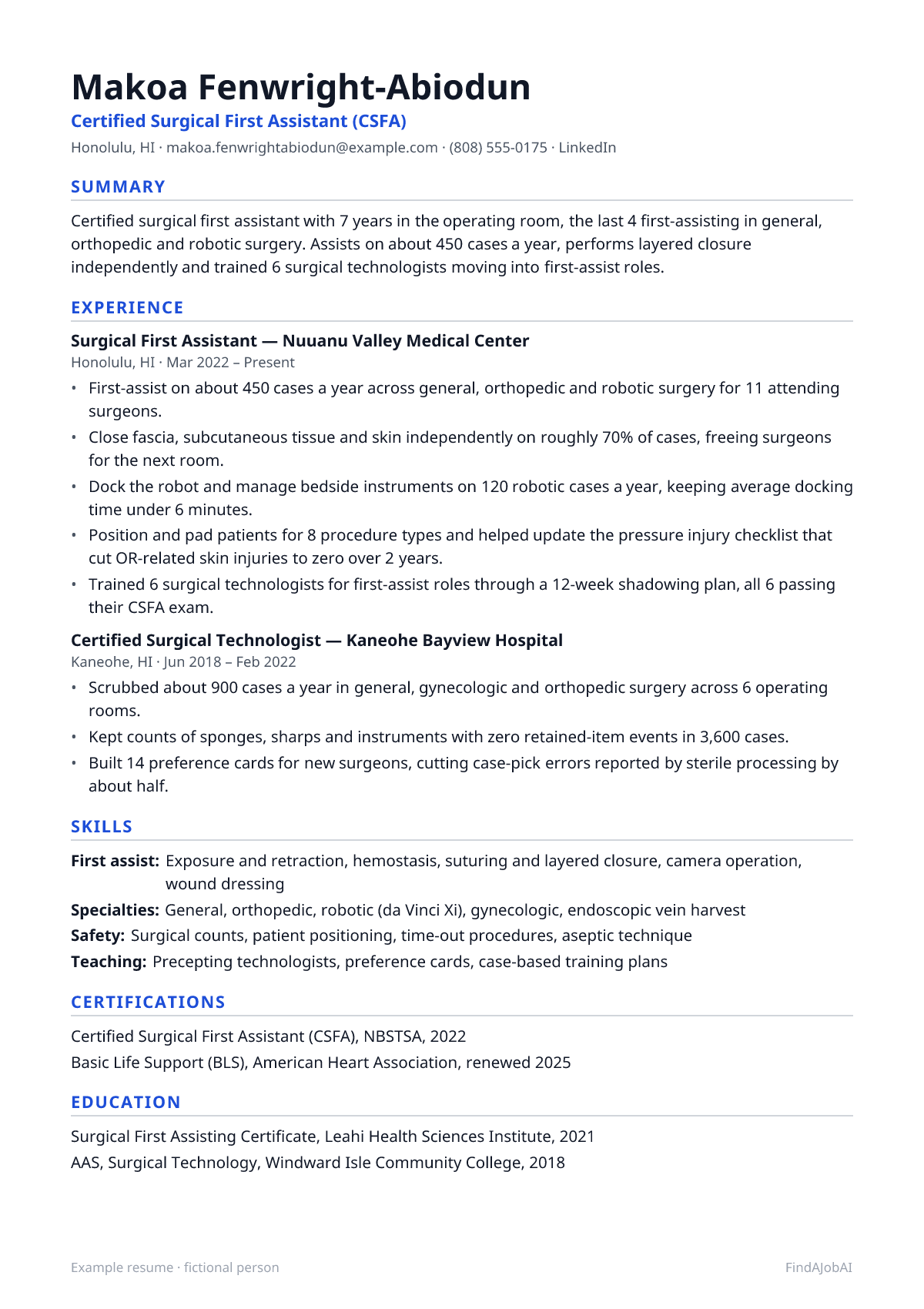
A complete one-page example for a fictional surgical assistant: every bullet pairs an action with what changed because of it.
Example resume · fictional person
Makoa Fenwright-Abiodun
Certified Surgical First Assistant (CSFA)
Honolulu, HI · [email protected] · (808) 555-0175 · LinkedIn
Summary
Certified surgical first assistant with 7 years in the operating room, the last 4 first-assisting in general, orthopedic and robotic surgery. Assists on about 450 cases a year, performs layered closure independently and trained 6 surgical technologists moving into first-assist roles.
Experience
Surgical First Assistant, Nuuanu Valley Medical Center
Honolulu, HI · Mar 2022 – Present
- First-assist on about 450 cases a year across general, orthopedic and robotic surgery for 11 attending surgeons.
- Close fascia, subcutaneous tissue and skin independently on roughly 70% of cases, freeing surgeons for the next room.
- Dock the robot and manage bedside instruments on 120 robotic cases a year, keeping average docking time under 6 minutes.
- Position and pad patients for 8 procedure types and helped update the pressure injury checklist that cut OR-related skin injuries to zero over 2 years.
- Trained 6 surgical technologists for first-assist roles through a 12-week shadowing plan, all 6 passing their CSFA exam.
Certified Surgical Technologist, Kaneohe Bayview Hospital
Kaneohe, HI · Jun 2018 – Feb 2022
- Scrubbed about 900 cases a year in general, gynecologic and orthopedic surgery across 6 operating rooms.
- Kept counts of sponges, sharps and instruments with zero retained-item events in 3,600 cases.
- Built 14 preference cards for new surgeons, cutting case-pick errors reported by sterile processing by about half.
Skills
- First assist: Exposure and retraction, hemostasis, suturing and layered closure, camera operation, wound dressing
- Specialties: General, orthopedic, robotic (da Vinci Xi), gynecologic, endoscopic vein harvest
- Safety: Surgical counts, patient positioning, time-out procedures, aseptic technique
- Teaching: Precepting technologists, preference cards, case-based training plans
Certifications
- Certified Surgical First Assistant (CSFA), NBSTSA, 2022
- Basic Life Support (BLS), American Heart Association, renewed 2025
Education
- Surgical First Assisting Certificate, Leahi Health Sciences Institute, 2021
- AAS, Surgical Technology, Windward Isle Community College, 2018
Fictional example by the FindAJobAI team: the person, employers and numbers are invented. Keep the structure; use your own work and numbers you can explain in an interview.
Entry-level surgical assistant resume example
A surgical technologist who has just finished a first assisting program. The resume puts the new certificate and supervised first-assist cases first, then frames scrub experience around tasks that carry over.
Entry-level example resume · fictional person
Iolana Brightwater-Osei
Surgical Assistant (first assisting certificate, CSFA exam scheduled)
Hilo, HI · [email protected] · (808) 555-0176 · LinkedIn
Summary
Surgical technologist with 3 years of scrub experience and a newly earned surgical first assisting certificate. Has first-assisted on 140 supervised clinical cases in general and gynecologic surgery and is looking for a first surgical assistant role.
Education
- Surgical First Assisting Certificate, Hamakua Allied Health Academy, 2025
- AAS, Surgical Technology, Big Island Community College, 2022
Experience
Certified Surgical Technologist, Puna Coast Regional Hospital
Hilo, HI · Aug 2022 – Present
- Scrub about 750 cases a year in general, gynecologic and urologic surgery across 4 operating rooms.
- Kept accurate counts on every case and caught 2 count discrepancies before closure in 3 years.
- Updated 9 surgeon preference cards after equipment changes so trays matched the plan.
Surgical First Assistant Student (clinical rotation), Puna Coast Regional Hospital
Hilo, HI · Jan 2025 – Oct 2025
- First-assisted under supervision on 140 cases, including 60 laparoscopic cholecystectomies and 35 hysterectomies.
- Performed skin closure on 90 cases and subcuticular closure on 40 after surgeon sign-off.
- Drove the laparoscopic camera on about 80 cases, keeping the operative field centered as surgeons moved.
Skills
- First assist: Retraction, camera operation, suctioning, skin and subcuticular closure, dressing
- Scrub: Sterile field setup, instrument passing, counts, specimen handling
- Safety: Aseptic technique, time-out participation, positioning support
Certifications
- Certified Surgical Technologist (CST), NBSTSA, 2022
- BLS Provider card, American Heart Association, issued 2025
Senior surgical assistant resume example
A lead surgical assistant in cardiac surgery. The bullets move from assisting single cases to leading a team, running vein harvest, building training and working on outcomes with surgeons.
Senior example resume · fictional person
Desmond Kalaniopua-Strand
Lead Surgical Assistant, Cardiac and Vascular Surgery (CSA)
Honolulu, HI · [email protected] · (808) 555-0177 · LinkedIn
Summary
Lead surgical assistant with 14 years in the operating room, 10 in cardiac and vascular surgery. Assists on about 300 open-heart cases a year, performs endoscopic vein harvest independently and leads a team of 7 first assistants across 3 cardiac rooms.
Experience
Lead Surgical Assistant, Cardiac Surgery, Moanalua Heights Heart Institute
Honolulu, HI · Jan 2019 – Present
- Lead 7 surgical assistants covering 3 cardiac operating rooms and an on-call rota for emergency cases.
- Perform endoscopic vein harvest on about 220 bypass cases a year, with a harvest-site infection rate under 1%.
- Assist on roughly 300 open-heart cases a year, including valve repair and replacement, aortic and bypass surgery.
- Built a 6-month vein harvest training program used to sign off 5 assistants for independent harvesting.
Surgical Assistant, Leeward Shores Medical Center
Waipahu, HI · May 2014 – Dec 2018
- First-assisted on about 400 cases a year in vascular, thoracic and general surgery.
- Closed chest and leg incisions independently on most cardiac cases after the surgeon finished the main repair.
- Joined the OR safety committee and helped introduce a 2-person count reconciliation at closing.
Certified Surgical Technologist, Leeward Shores Medical Center
Waipahu, HI · Jul 2011 – Apr 2014
- Scrubbed about 800 cases a year, moving to the cardiac team in the final 18 months.
- Prepared bypass and valve setups for 4 cardiac surgeons and kept their preference cards current.
Skills
- Cardiac and vascular: Endoscopic vein harvest, radial artery harvest, sternal closure, cannulation support
- Leadership: Team of 7, on-call rotas, competency sign-off, peer review
- Safety and quality: Infection prevention, count reconciliation, surgical site infection tracking
- Teaching: Training programs, precepting, simulation sessions
Certifications
- Certified Surgical Assistant (CSA), NSAA, 2014
- Advanced Cardiovascular Life Support (ACLS), renewed 2025
Education
- BS, Health Sciences, Kapiolani Pacific University, 2016
- Surgical Assisting Diploma, Oahu Allied Surgical College, 2014
How to write a surgical assistant resume
Five steps, in the order a recruiter reads the page. The format around them stays plain for every job: one column, standard headings, newest role first.
Header: name, target title and links
Use "Surgical Assistant" or "Surgical First Assistant" as the posting does, and add your credential (CSFA, CSA or SA-C) next to your name.
Summary: what you do and your best proof
State your years in the OR, your certification, the specialties you assist in, your yearly case volume and which tasks you perform independently.
Experience: newest first, a result in every bullet
Lead each bullet with the procedure type or task, then the volume and a result such as faster turnover, independent closure or a clean safety record.
Skills: grouped, in the ad's words
Group skills into first assist, specialties, safety and teaching, and name surgical platforms and techniques exactly, since postings often filter on them.
Education and certifications
List your surgical assisting program and any surgical technology degree with years. Put certifications, BLS and ACLS in their own section.
Skills to put on a surgical assistant resume
Hard skills are the tools and methods of the job; soft skills are how you work with people. Each comes with one way to prove it, because a skill named only in a list counts for little. Add the ones you really have.
Hard skills
- Surgical exposure and retraction
- Name the specialties and procedures where you provide exposure, with yearly case counts.
- Hemostasis techniques
- Mention cautery, ties, clips and hemostatic agents you use and the case types involved.
- Suturing and layered closure
- Give the share of cases you close independently and the layers you handle.
- Laparoscopic camera operation
- State how many laparoscopic cases you drive the camera for and in which specialties.
- Robotic bedside assisting
- Name the platform, your yearly robotic cases and your docking or exchange times.
- Patient positioning and padding
- List the positions you set up and any safety result tied to pressure injuries.
- Endoscopic vein harvest
- Give yearly harvest numbers and any wound complication rate you track.
- Aseptic technique
- Show how you protect the sterile field, with infection or break-in-technique data if available.
- Surgical counts
- Give the number of cases and your retained-item record.
- Wound care and dressing
- Mention the dressing types you apply and any post-op wound outcome you follow.
- Instrument and equipment knowledge
- Name specialty trays, power tools or energy devices you handle confidently.
- Emergency response in the OR
- Describe your role in unplanned bleeding or conversion to open surgery.
Soft skills
- Anticipating the surgeon
- Describe how you prepare for each surgeon's habits before the first incision.
- Calm under pressure
- Give an example of a sudden bleed or emergency where you stayed steady.
- Clear speaking in the OR
- Show how you call out counts, concerns or equipment problems early.
- Stamina and focus
- Mention long cases or call shifts you handle without losing accuracy.
- Teamwork with anesthesia and nursing
- Show coordination on positioning, turnover or emergencies.
- Teaching others
- Give the number of technologists or students you have precepted.
- Speaking up for safety
- Describe a time you paused a case to correct a count or sterile break.
Surgical Assistant resume bullet examples: weak vs strong
The same work, written two ways. The strong version names the tool, the scope and a result; the numbers are examples, yours must be real.
Weak: Assisted surgeons in the OR.
Strong: First-assisted 11 surgeons on roughly 450 general, orthopedic and robotic procedures a year, covering exposure, hemostasis and closure.
Gives scope, specialties and the specific tasks you own.
Weak: Closed incisions.
Strong: Performed independent layered closure on about 7 in 10 cases after surgeon sign-off, so attendings could start the next case sooner.
Shows trust from surgeons and why it matters to the schedule.
Weak: Worked on robotic cases.
Strong: Handled bedside docking and instrument exchanges on 120 da Vinci cases a year with docking times consistently below 6 minutes.
Names the platform, the volume and a measurable standard.
Weak: Positioned patients.
Strong: Set up and padded patients for 8 positions, from lateral decubitus to lithotomy, and co-wrote a skin check that ended OR pressure injuries for 2 years.
Adds patient-safety ownership and a result.
Weak: Helped train new staff.
Strong: Ran a 12-week shadowing plan for 6 surgical technologists moving into first assisting, and all of them passed the CSFA exam.
Proves teaching with an outcome.
Weak: Did counts during surgery.
Strong: Maintained sponge, sharps and instrument counts on 3,600 cases with no retained-item events.
Turns a routine duty into a strong safety record.
15 more surgical assistant resume bullet examples
Grouped by area of the job, so you can find the ones closest to your work. Keep the shape (action, scope, result) and replace the invented numbers with your own.
First assisting
- Provided retraction and suction on 60 open colectomies a year, adjusting exposure as the surgeon moved through each step.
- Placed trocars under supervision on 45 laparoscopic cases after completing the hospital's competency sign-off.
- Harvested the radial artery on 30 bypass cases a year with no hand ischemia events recorded.
- Applied hemostatic clips and cautery on about 200 cases a year as directed, reducing time spent on bleeding control.
Robotic and minimally invasive surgery
- Completed bedside training on 2 robotic platforms and assisted on 150 robotic cases in the first year.
- Cut average robotic turnover by 7 minutes by pre-draping arms during the previous case's closure.
- Drove the 30-degree camera on 300 laparoscopic cases a year in general and bariatric surgery.
- Troubleshot insufflation and light source faults during 12 cases without conversion to open surgery.
Safety and quality
- Audited positioning on 40 lateral cases a quarter and shared findings at 4 department meetings a year.
- Reported 3 near-miss count discrepancies through the safety system, leading to a new closing count script.
- Kept surgical site infection rates for assisted cases under the department's 2% target for 3 years.
- Checked implant lot numbers on 250 orthopedic cases a year, with every implant record matching the chart.
Teaching and teamwork
- Precepted 9 surgical assisting students from 2 local programs through their clinical cases.
- Led monthly 30-minute suturing practice for 12 technologists using skin pads in the skills lab.
- Covered a 1-in-4 on-call rota for emergency and trauma cases for 5 years.
Surgical Assistant resume summary examples
Two or three lines on what you do and your strongest proof. Start from the one closest to your level and use your own facts.
Surgical technologist with 3 years of scrub experience and a newly earned surgical first assisting certificate. Has first-assisted on 140 supervised clinical cases in general and gynecologic surgery and is ready for a first surgical assistant role.
Certified surgical first assistant with 7 years in the OR, first-assisting on about 450 general, orthopedic and robotic cases a year, closing independently and precepting technologists.
Lead surgical assistant with 14 years in cardiac and vascular surgery, assisting on 300 open-heart cases a year, performing endoscopic vein harvest and leading a team of 7 first assistants.
Common surgical assistant resume mistakes
Each one is easy to make and quick to fix before you apply.
Reading like a scrub tech resume
Lead with tasks done at the patient's side: exposure, hemostasis, closure and camera work, not instrument passing.
Missing yearly case numbers
Give cases per year and per specialty so a surgical director can compare your volume with theirs.
Hiding the independent scope
Say clearly which tasks you perform without the surgeon's hands on, such as closure or vein harvest.
Credential buried at the bottom
Put CSFA, CSA or SA-C beside your name, since credentialing often depends on it.
Skipping robotic platforms
Name the robotic system and your bedside volume, because many hospitals hire specifically for robotics.
ATS tips for a surgical assistant resume
Applicant tracking systems turn your file into text that recruiters search, mostly for the skills and titles in the ad. They rarely reject a resume on their own; one that parses badly or misses the ad's words just doesn't come up.
- Open with your certification (CSFA, CSA or SA-C) and your yearly case volume.
- List the specialties and platforms you assist in, such as orthopedics, cardiac or da Vinci robotic surgery.
- Say which tasks you perform independently, such as closure or vein harvest, so surgeons know your scope.
- Include safety outcomes such as count records or pressure injury rates, since they matter to OR leaders.
- Show teaching or precepting, because many first assistants also train technologists and new hires.
For the format itself, run the free ATS resume checklist.
Everything for Surgical Assistants
- Surgical Assistant cover letter examplesThree example letters and a short email version
- Surgical Assistant interview questions30 questions with sample answers
- Surgical Assistant job descriptionDuties, skills and requirements
- How to tailor your resume without lying
Other resume examples
Surgical Assistant resume FAQ
What is the difference between a surgical assistant and a surgical technologist?
A surgical technologist sets up the sterile field, passes instruments and keeps counts, while a surgical assistant works directly on the patient alongside the surgeon: retracting, controlling bleeding, suturing and closing. Many surgical assistants start as technologists and then complete a first assisting program.
Which certification should a surgical assistant list?
List whichever you hold: the CSFA from the NBSTSA, the CSA from the NSAA, or the SA-C from the ABSA. Include the year, and add BLS or ACLS. Some states and hospitals require one of these for credentialing, so put it near the top.
How do I show surgical assistant experience with numbers?
Count cases per year, specialties, surgeons supported and robotic cases, and add safety results such as count records. If you close independently, give the share of cases. Approximate yearly figures are fine as long as they are honest.
How we built this page
The FindAJobAI team wrote the three example resumes, the bullets, the skills and the advice for surgical assistant roles. The people, employers and numbers in the examples are invented; the structure, the tools and the way each bullet is built are the parts to copy.
Once we track enough live surgical assistant job ads, this page also shows the skills they ask for most, counted the same way as our in-demand skills report.
Last reviewed on November 1, 2026.