Analytics Engineer Cover Letter Example (2026)
By FindAJobAI team Updated How we built this page
Analytics engineer ads usually list dbt, a warehouse like Snowflake or BigQuery, and some version of git. That's a short list, so your letter should do the part a tool list can't: show a model you built that other people trusted enough to build on, and a mess you cleaned up before it caused a bad decision.
Analytics Engineer cover letter template
This letter as a one-page template: an opening that names the job and your strongest fact, proof that answers the ad, a reason for this employer and a short close.
After you sign up, FindAJobAI drafts your own letter for a real job from your CV in this format, and you edit it before you send it.
Example 1 · Experienced
Analytics engineer applying to a subscription software company
Milo rebuilt a company's revenue models in dbt. The ad asks for dbt, Snowflake and tests analysts can trust.
Example letter · fictional
Dear Mr. Okonjo,
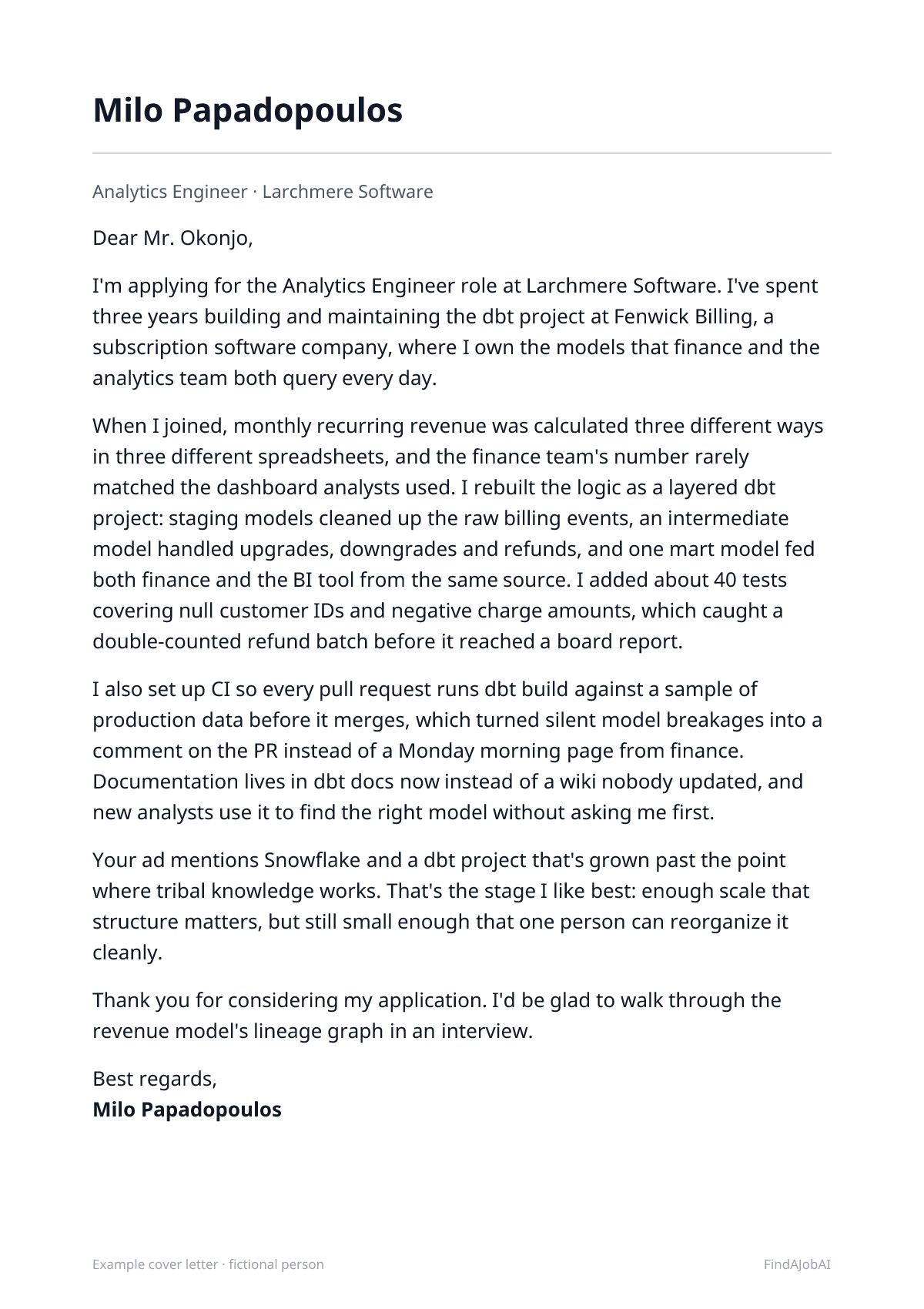
I'm applying for the Analytics Engineer role at Larchmere Software. I've spent three years building and maintaining the dbt project at Fenwick Billing, a subscription software company, where I own the models that finance and the analytics team both query every day.
When I joined, monthly recurring revenue was calculated three different ways in three different spreadsheets, and the finance team's number rarely matched the dashboard analysts used. I rebuilt the logic as a layered dbt project: staging models cleaned up the raw billing events, an intermediate model handled upgrades, downgrades and refunds, and one mart model fed both finance and the BI tool from the same source. I added about 40 tests covering null customer IDs and negative charge amounts, which caught a double-counted refund batch before it reached a board report.
I also set up CI so every pull request runs dbt build against a sample of production data before it merges, which turned silent model breakages into a comment on the PR instead of a Monday morning page from finance. Documentation lives in dbt docs now instead of a wiki nobody updated, and new analysts use it to find the right model without asking me first.
Your ad mentions Snowflake and a dbt project that's grown past the point where tribal knowledge works. That's the stage I like best: enough scale that structure matters, but still small enough that one person can reorganize it cleanly.
Thank you for considering my application. I'd be glad to walk through the revenue model's lineage graph in an interview.
Best regards,
Milo Papadopoulos
Example 2 · Career changer
BI analyst moving into analytics engineering
Rosalind writes SQL and builds Power BI reports but wants to own the modeling layer. The ad values git and testing.
Example letter · fictional
Dear Hiring Manager,
I'm applying for the Analytics Engineer role at Nettlebrook Health. I've worked as a BI analyst for four years at a dental clinic network, writing the SQL behind our Power BI reports, and I'm ready to move from building reports to building the models underneath them.
Our appointment data lived across three systems, and every analyst wrote their own version of a no-show rate query, with small differences that produced different numbers in different reports. I taught myself dbt on a personal project, then proposed and built a small models layer at work: one staging model per source system, one mart for appointments, tested for duplicate visit IDs and impossible date ranges. Our no-show rate finally matched across every report, and two other analysts now build their dashboards on my mart instead of writing their own joins.
I've also learned git properly this year, moving my SQL out of shared folders and into pull requests that a colleague reviews before anything changes production reports. It's slower than editing a query directly, but we've caught two logic errors in review that would have reached a clinic director's dashboard otherwise.
Healthcare data has its own mess, codes that change meaning, visits that get backdated, and I'd like to bring the modeling discipline I built for appointments to a bigger, messier dataset with a team that already works this way.
Thank you for your time. I can share the appointment mart's test suite as a sample of how I structure a project.
Kind regards,
Rosalind Hargrove
Example 3 · Senior or lead
Analytics engineering lead applying to grow a two-person team
Hollis leads three analytics engineers at a logistics company. The ad is for a lead who sets standards and hires.
Example letter · fictional
Dear Ms. Okafor,
I'm applying for the Analytics Engineering Lead role at Corvidae Freight. I've led a team of three analytics engineers at Marrowgate Logistics for two years, and before that spent five years as an individual contributor building dbt projects. I'd like to take on a smaller team and shape how it grows.
Your ad mentions two analytics engineers today with a dbt project that's outgrown its original structure. I inherited a similar situation: one enormous dbt project with no clear staging layer, models named inconsistently, and tests added only after incidents. I split it into domains, shipping routes, billing, and fleet maintenance, each with its own staging and mart models and a shared set of naming conventions, and required a test plan on every new model's pull request. Incident-driven fixes to broken dashboards dropped from a weekly occurrence to roughly one a month.
I also set up a rotation where each engineer owns one domain and reviews another's pull requests, which spreads knowledge of the warehouse past any one person. When a model I didn't own broke a fuel-cost dashboard before a budget meeting, the on-call engineer traced it through our lineage docs and fixed it in under an hour without needing me.
I haven't yet hired into a team this size from scratch, and I've mostly worked with Snowflake rather than BigQuery, which your stack uses; I'd want to get hands-on with that quickly.
I'd welcome a conversation about which domain you'd want modeled first and how your two engineers currently split their work.
Sincerely,
Hollis Fentiman
All three letters, and the short version below, are fictional: the people, employers and numbers are invented. Borrow the structure, never the facts.
- Prefer to write it yourself? Use the free cover letter template.
- Check your CV against the job first: the free CV score shows the missing keywords.
Why the first letter works, paragraph by paragraph
Paragraph 1: Opening
Names the exact ownership (the dbt project) and who depends on it (finance and analytics), which tells the reader this is a builder, not just a SQL writer.
Paragraph 2: The model that fixed a trust problem
A specific business number (monthly recurring revenue) that disagreed across teams, the layered fix, and a concrete catch (a double-counted refund) that shows the tests did real work.
Paragraph 3: Process, not just models
CI on pull requests and documentation in dbt docs show the writer thinks about the team's workflow, not only their own code.
Paragraph 4: Why this company
Matches the ad's stage of growth (past tribal knowledge) to the kind of project the writer prefers, which reads as self-awareness rather than flattery.
Paragraph 5: Close
Offers a lineage graph walkthrough: a concrete, low-effort next step that's specific to how analytics engineers explain their work.
What the career changer's letter does differently
The BI analyst's letter starts from the reporting-layer problem (the same metric calculated differently) she already knew from the report side, then shows her teaching herself dbt and git to fix it properly, with a result (dashboards now built on one shared mart) instead of a claim about ambition.
What the senior letter does differently
The lead's letter reports a team's structure, not an individual's SQL: domains split out of one unwieldy project, incidents dropped from weekly to monthly, a review rotation that spreads ownership. It also names a gap, hiring from scratch and BigQuery experience, instead of implying total readiness.
Short analytics engineer cover letter: an email-ready version
Many applications arrive as an email or a small text box, and a full page doesn't fit. This version runs 120 to 150 words and keeps only what a reader needs to decide whether to reply. An analytics engineer answers a retailer's short-form application question after the posting asked for a reply by email within 48 hours.
Short version · email · fictional128 words
Subject: Analytics Engineer (dbt, Snowflake) – inventory modeling – Dashiell Okonma
Hello Mr. Castellanos,
I'm applying for the Analytics Engineer role at Wrenfield Outfitters. I have three years of dbt and Snowflake experience at an online retailer, where I rebuilt the inventory models that merchandising and finance both rely on.
My main project replaced a spreadsheet-based stock reconciliation with a tested dbt mart. It cut a two-day monthly close process down to about half a day and caught a warehouse feed that had been double-counting returns for weeks.
I like working close to a business's actual numbers, and inventory is exactly that kind of problem. My resume is attached, and I can walk through the mart's structure whenever is convenient. I'm glad to share a sanitized lineage diagram so you can see how the models connect.
Best,
Dashiell Okonma
The short version keeps one project and its two measurable effects, a faster close and a caught data error, since a 48-hour deadline leaves no room for a second example. It skips the CI and documentation details the full letter has room for.
Opening lines that work for analytics engineer cover letters
The first sentence decides whether the second gets read. Here are six openings, one for each situation you might be in. Pick the one that matches yours and swap in your own facts: every name and number below is invented.
1. You have a standout result
One dbt model I rebuilt last quarter cut a two-day reconciliation process to half a day and caught a feed that had been double-counting data for weeks. I'd like to bring that kind of cleanup to your warehouse.
2. The ad names a problem you've solved
Your ad mentions a dbt project that's grown past what one person can hold in their head. I split a similar project into domains with shared conventions, and incident-driven dashboard fixes dropped sharply within a quarter.
3. Someone referred you
Your data engineer, Soraya Lindqvist, and I worked together on a vendor migration last year, from opposite sides of the pipeline. She mentioned your team needs someone who tests models as carefully as they build them, which is why I'm writing.
4. You admire what they build
I've used Wrenfield's loyalty program for two years, and the way returns factor into my rewards balance made me curious how the underlying model handles edge cases; I'd like to help build it.
5. You're new to the field or switching into it
I spent four years as a BI analyst writing SQL for other people's dashboards, then taught myself dbt to fix a metric that disagreed across every report I built. Modeling the data properly is the part of the job I want to do full time.
6. You have senior scope or a specialism
As the only analytics engineer on a team of six for three years, I built the dbt project the whole company now runs reporting on. I'm looking for a role where I help a second and third engineer build the same way.
How to write an analytics engineer cover letter
Five steps, in the order you'd write them. The shape stays the same for every job (a short opening, proof, a reason for this employer, a close), and what goes into each part is what changes with the role.
Find the model problem the ad is pointing at
Ads for this role usually hint at a specific mess: inconsistent metrics, a project with no staging layer, or dashboards nobody trusts. Read for that hint, then choose a project of yours that solved something similar, so the letter answers the actual ad instead of a generic version of the role.
Open with what disagreed before your model existed
State the conflicting number or broken process first, in one sentence, before mentioning dbt or Snowflake. A reader who sees a real business disagreement, like two revenue figures, understands why the model mattered before they know what tool built it.
Describe the model's shape, briefly
Mention staging, intermediate and mart layers, or however you organized it, in a sentence or two. This signals you think in layers rather than writing one giant query, which is the habit the role exists to prevent.
Name one test that caught something real
A specific test, like catching null customer IDs or a duplicated refund batch, is more convincing than saying you value data quality. Pick the catch that prevented the worst outcome, such as a wrong number in a report leadership saw.
Show the project outlived you touching it
Mention who else now uses or extends your model: other analysts, a finance team, a second engineer. A model only you can read isn't finished. Close with a specific next step, like reviewing your lineage docs or test suite together.
Analytics Engineer cover letter do's and don'ts
Do
- Describe one model or project you built, what broke before it existed, and who builds on it now.
- Mention testing specifically: what kind of test, and a real case where it caught a bad number.
- Name git and CI only inside a story about a change you caught or a workflow you improved.
Don't
- Don't just list dbt, Snowflake, Looker and Airflow; name the one or two the ad asks for and show them in use.
- Don't claim you built 'the entire data warehouse' alone if a data engineer maintains the pipelines feeding it.
- Don't share your current employer's actual revenue figures; round them or describe the change as a ratio.
Common analytics engineer cover letter mistakes
Each one is easy to make and quick to fix before you send the letter.
Listing the modern data stack by name
Naming dbt, Snowflake, Airflow, Fivetran and Looker in a row says you've heard of them. Pick the one or two the ad actually uses and show a decision you made with them, like why you split a model into two layers.
Describing a pipeline instead of a model
Analytics engineering is about the transformation layer, not extraction and loading. If your example is really about moving data from a source system, it belongs in a data engineer letter, or needs a modeling detail added.
Skipping what broke before you fixed it
'I built a dbt project for inventory' doesn't say why it mattered. Name the spreadsheet, the mismatched metric, or the manual process it replaced, so the reader can judge the size of the improvement.
Treating tests as a checkbox
Saying 'I write tests for my models' is forgettable. Naming one test and the bad number it actually caught shows the testing habit does something, rather than existing to look careful.
Writing as if you work alone
If no one else uses your models, say so honestly rather than implying a team around you that doesn't exist, and if others do depend on your work, name them. Both are more useful than vague team language.
Email subject lines for analytics engineer applications
Applying by email? Put the job title, any reference number and your name in the subject line.
- Analytics Engineer application – dbt and Snowflake, revenue modeling – Milo Papadopoulos
- Analytics Engineer – BI analyst with dbt and git experience – Rosalind Hargrove
- Application: Analytics Engineer, Marketing Data (Req. 2217) – Milo Papadopoulos
Everything for Analytics Engineers
- Analytics Engineer resume exampleA full resume, plus bullet and summary examples
- Analytics Engineer interview questions30 questions with sample answers
- Analytics Engineer job descriptionDuties, skills and requirements
- Career change cover letter: template + examples
Other cover letter examples
Analytics Engineer cover letter FAQ
What should I write in an analytics engineer cover letter?
One model or project you built: the problem with the existing numbers, how you restructured the logic, a test that caught something real, and who now relies on the result. Your tool list belongs on your resume, not retold in prose.
How do I write an analytics engineer cover letter coming from a BI or reporting role?
Lead with a reporting problem you already understood, such as a metric calculated differently across dashboards, then show how you learned dbt or git to fix it at the modeling layer instead of patching another report.
Should I mention testing and CI in an analytics engineer cover letter?
Yes, briefly and with a real example. Naming a specific test that caught a specific bad number is more convincing than saying you value data quality.
How we built this page
The FindAJobAI team wrote the three example letters, the short email version, the opening lines and the advice for analytics engineer roles. The people, employers and numbers in the letters are invented; the structure, the kind of evidence and the order of the paragraphs are the parts to copy.
Once we track enough live analytics engineer job ads, this page also shows the skills they ask for most, counted the same way as our in-demand skills report.
Last reviewed on November 1, 2026.