Art Director Cover Letter Example (2026)
By FindAJobAI team Updated How we built this page
Art director ads ask for a portfolio link in the first line, so the letter isn't where you prove you can design. It's where you show how you think about a brief, a client's pushback, and the choices behind one campaign the portfolio can't fully explain on its own.
Art Director cover letter template
This letter as a one-page template: an opening that names the job and your strongest fact, proof that answers the ad, a reason for this employer and a short close.
After you sign up, FindAJobAI drafts your own letter for a real job from your CV in this format, and you edit it before you send it.
Example 1 · Experienced
Agency art director applying to a beverage brand's house agency
Avery directs visual concepts for a beverage brand's social and retail campaigns. The ad asks for someone who can present concepts to clients directly.
Example letter · fictional
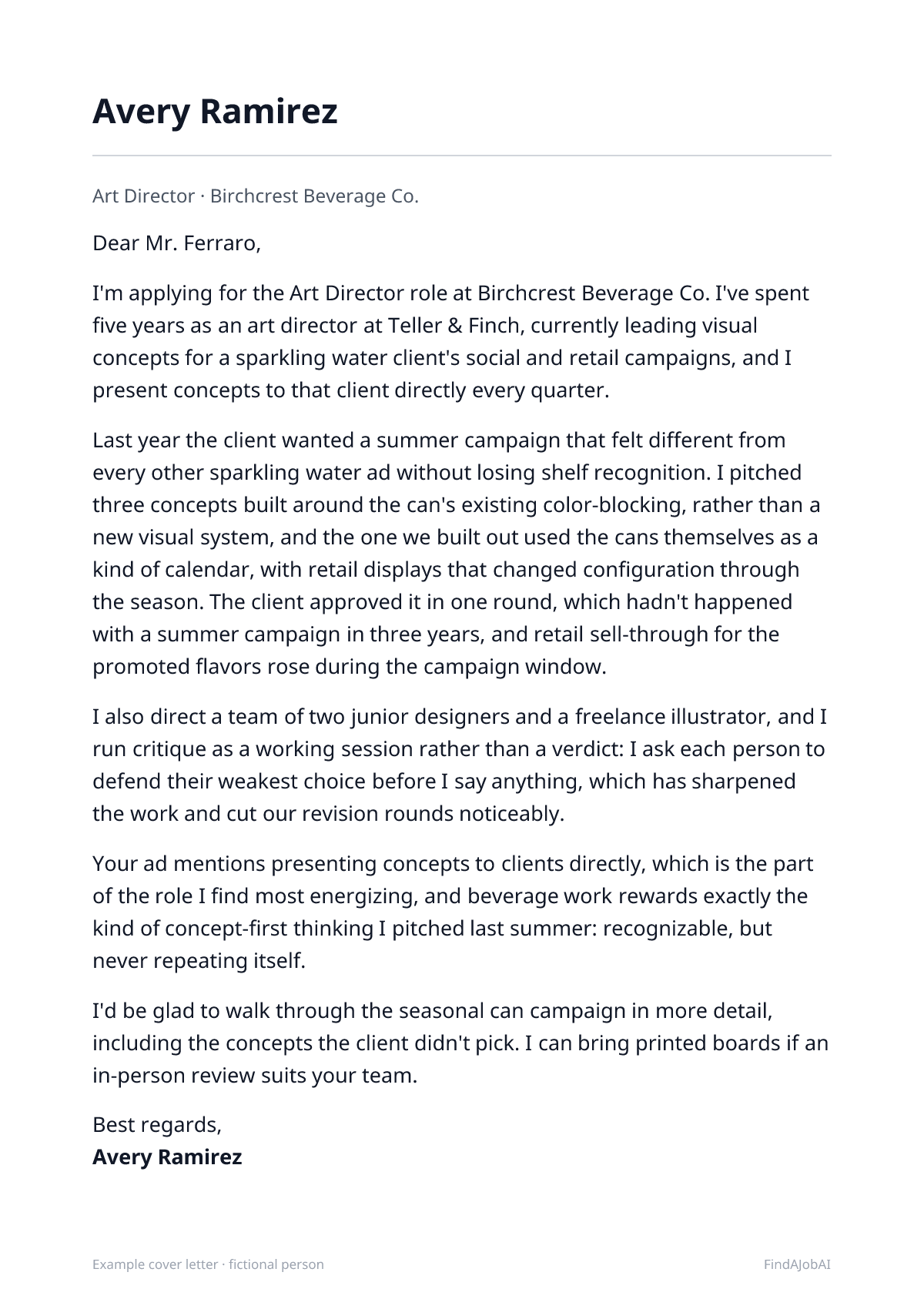
Dear Mr. Ferraro,
I'm applying for the Art Director role at Birchcrest Beverage Co. I've spent five years as an art director at Teller & Finch, currently leading visual concepts for a sparkling water client's social and retail campaigns, and I present concepts to that client directly every quarter.
Last year the client wanted a summer campaign that felt different from every other sparkling water ad without losing shelf recognition. I pitched three concepts built around the can's existing color-blocking, rather than a new visual system, and the one we built out used the cans themselves as a kind of calendar, with retail displays that changed configuration through the season. The client approved it in one round, which hadn't happened with a summer campaign in three years, and retail sell-through for the promoted flavors rose during the campaign window.
I also direct a team of two junior designers and a freelance illustrator, and I run critique as a working session rather than a verdict: I ask each person to defend their weakest choice before I say anything, which has sharpened the work and cut our revision rounds noticeably.
Your ad mentions presenting concepts to clients directly, which is the part of the role I find most energizing, and beverage work rewards exactly the kind of concept-first thinking I pitched last summer: recognizable, but never repeating itself.
I'd be glad to walk through the seasonal can campaign in more detail, including the concepts the client didn't pick. I can bring printed boards if an in-person review suits your team.
Best regards,
Avery Ramirez
Example 2 · Entry level
Junior designer moving into an art director role
Thaddeus has led visual concepts informally on three campaigns without the title. The ad is for an art director at a small creative studio.
Example letter · fictional
Dear Hiring Manager,
I'm applying for the Art Director role at Linden & Moth Studio. I've worked as a junior designer at Halloway Creative for three years, and over the last year I've informally led the visual concept on three client campaigns while our art director was out on leave.
The campaign I'm proudest of was for a local bakery chain's rebrand launch. I pitched a concept built around hand-lettering from the founder's actual recipe cards rather than a generic typeface, and ran the shoot and layout myself since there was no one else to hand it to. The client's owner told our account lead it was the first campaign of theirs that felt like the bakery rather than 'a bakery,' and we've since reused the recipe-card motif for two seasonal campaigns.
That stretch also taught me to run a creative review: I started presenting two options instead of one, with a clear reason for each, which cut client feedback cycles from three rounds to one on two of the three campaigns.
Your studio's portfolio favors concepts with a strong, specific point of view over polished genericism, which is exactly what the bakery work was reaching for. I'd like to do that kind of work with a title that matches what I've already been doing. I'd also like to learn how your studio runs internal reviews, since that is where I'd most like to be pushed.
My portfolio is linked on my resume, and I'd welcome the chance to talk through the bakery campaign and what I'd bring to your team.
Sincerely,
Thaddeus Okwuosa
Example 3 · Referral or internal move
Senior art director referred into a creative director opening
Wilhelmina was referred by a former colleague now at the agency. The ad is for a creative director who will oversee two art directors and set brand voice.
Example letter · fictional
Dear Ms. Okonkwo,
I'm applying for the Creative Director role at Hartwell & Vane. Nadia Petrossian, who leads your accounts team and worked with me for three years at Fenwick Studio, told me you're looking for someone to oversee two art directors and bring more consistency to how client work sounds and looks across accounts.
At Fenwick, I inherited a similar problem: three account teams had built visual languages for the same parent brand that barely matched. I wrote a one-page brand voice document, not a style guide full of logo rules, but three sentences on what the brand would never say and one example of a concept that fit and one that didn't. It became the first thing new hires read, and client rejections on first-round concepts dropped noticeably once teams started checking work against it before presenting.
The project I'd point to directly is a rebrand pitch for a regional grocery chain that three agencies were competing for. I directed two art directors toward a concept built on the chain's actual store layouts rather than a new abstract mark, which felt riskier going in but let us show the client their own stores used differently in the pitch deck. We won the account, and the chain's existing creative team told our lead afterward that ours was the only pitch that looked like it had actually visited a store.
Nadia can speak to how I run a room and give feedback that art directors can act on rather than just absorb. I haven't yet managed an agency's full creative department budget, and I'd want to understand how creative and account teams currently negotiate scope before proposing changes there.
I'd welcome a conversation about the grocery pitch, the brand voice document, or how you're thinking about consistency across your accounts.
Sincerely,
Wilhelmina Castellanos
All three letters, and the short version below, are fictional: the people, employers and numbers are invented. Borrow the structure, never the facts.
- Prefer to write it yourself? Use the free cover letter template.
- Check your CV against the job first: the free CV score shows the missing keywords.
Why the first letter works, paragraph by paragraph
Paragraph 1: Opening
Names the client and the kind of work (social and retail for a beverage brand) and states that the writer presents to that client directly, answering the ad's specific requirement up front.
Paragraph 2: The concept that solved a client's real problem
States the client's actual constraint (differentiation without losing recognition), the concept, and two results: a one-round approval and a sell-through increase, which shows the idea worked commercially, not just creatively.
Paragraph 3: Leading a team
The critique method (defending your weakest choice) is a specific, repeatable practice, which is more convincing than claiming to be a 'strong leader.'
Paragraph 4: Why this company
Responds directly to the ad's phrase about client presentations and connects the writer's concept-first approach to the category's specific challenge.
Paragraph 5: Close
Offers to show rejected concepts alongside the winning one, which signals confidence in the thinking, not just the final output.
What the entry-level letter does differently
The junior designer's letter leads with the informal leadership (three campaigns run without the title) and uses one campaign, the bakery rebrand, to show both the creative concept and a process change (presenting two options instead of one) that produced a measurable drop in feedback cycles, then asks directly for the title to match the work already being done.
What the referral letter does differently
The referral letter opens by naming the colleague and exactly what she said about the role's problem, which gives the letter inside knowledge no cold application has. The brand voice document and the grocery pitch both show the writer directing other art directors, not just producing concepts personally, and the budget gap is named rather than hidden.
Short art director cover letter: an email-ready version
Many applications arrive as an email or a small text box, and a full page doesn't fit. This version runs 120 to 150 words and keeps only what a reader needs to decide whether to reply. An art director answers a fitness apparel brand's short online application field, sent as an email because the brief said to apply directly to the hiring manager.
Short version · email · fictional125 words
Subject: Art Director application – campaign concepting, apparel – Rutger Van Eyck
Hello Ms. Dubrovnik,
I'm applying for the Art Director role at Solstice Athletics. I have four years directing visual concepts for a running apparel client, most recently leading a launch campaign for a new shoe line.
For that launch, I pitched a concept shot entirely at night under streetlights rather than the usual daylight studio setup, which matched how the client's core customers actually run. The client extended the shoot budget to cover two more cities after seeing the first set of images.
Apparel work rewards that kind of concept built from how people actually use the product, and I'd like to bring it to your team. My portfolio is linked below, and I'm happy to share the full campaign deck.
Best,
Rutger Van Eyck
The short version keeps one concept and folds the client's reaction (extending the shoot budget) into a single clause, which proves success better than describing the images. It cuts team leadership, since the role and years of experience already establish seniority.
Opening lines that work for art director cover letters
The first sentence decides whether the second gets read. Here are six openings, one for each situation you might be in. Pick the one that matches yours and swap in your own facts: every name and number below is invented.
1. You have a standout result
Last year a client extended our shoot budget to cover two more cities after seeing the first set of images from a concept I pitched. I'd like to bring that kind of concept thinking to your campaigns.
2. The ad names a problem you've solved
Your ad says you need an art director who can present concepts directly to clients. I do that every quarter for a sparkling water brand, and our last campaign was approved in a single round, which hadn't happened in three years.
3. Someone referred you
Your account lead, Nadia Petrossian, worked with me for three years at my last agency and mentioned you're looking for more consistency across how your accounts look and sound.
4. You admire what they build
I've followed your studio's work on independent restaurant rebrands for two years, and the way you treat typography as the whole concept rather than decoration is exactly the kind of thinking I want to keep doing.
5. You're new to the field or switching into it
I've led visual concepts informally on three campaigns while covering for an art director on leave, and one of them became the client's most-reused creative in company history.
6. You have senior scope or a specialism
As a creative director overseeing two art directors, I wrote the one-page brand document that's still the first thing new hires read three years later. I'm looking for a team ready to build that kind of consistency.
How to write an art director cover letter
Five steps, in the order you'd write them. The shape stays the same for every job (a short opening, proof, a reason for this employer, a close), and what goes into each part is what changes with the role.
Lead with one concept and the problem it solved
Pick the campaign where the concept came from a real client constraint, such as needing differentiation without losing recognition, and describe that problem before the visual itself. A reader who sees the reasoning first understands your judgment, not just your taste.
State the result in the client's or business's terms
A design that looked good is not the same as one that worked. Mention approval speed, a budget extension, sales lift, or a client's direct reaction, so the concept's success is measurable, not just described as well-received.
Describe how you run critique or client presentations
A specific, repeatable method, such as presenting two options with a stated reason for each, or asking a team to defend their weakest choice, demonstrates director-level thinking better than a claim of strong leadership or vision.
Link the portfolio instead of narrating it
The letter isn't where the visual work gets proven. Mention the portfolio link once and spend the paragraph space on the thinking behind one piece: the brief, the constraint, and why you chose that concept over the alternatives.
Close by offering what the portfolio can't show
Offer to walk through rejected concepts, a full campaign deck, or the brief itself. This gives the hiring manager a reason to respond beyond liking the work, since it shows there's more reasoning behind the final piece than what's visible online.
Art Director cover letter do's and don'ts
Do
- Name one concept and the client problem it solved, then the result in the client's own terms (approval speed, sales, engagement).
- Describe your critique or review process specifically; 'strong leader' convinces no one, but a repeatable method does.
- Mention a rejected concept alongside the winning one if it shows your range or judgment.
Don't
- Don't describe your portfolio in the letter; link it and spend the words on the story behind one piece.
- Don't claim a campaign's full business result without noting your role in a team effort.
- Don't use words like 'visionary' or 'passionate about storytelling'; show the thinking behind one specific concept instead.
Common art director cover letter mistakes
Each one is easy to make and quick to fix before you send the letter.
Narrating the portfolio instead of linking it
Describing what an image looks like in prose is a weak substitute for seeing it. Link the portfolio once and use the letter's space to explain the thinking behind one piece instead.
Claiming vision instead of showing a method
'Visionary thinker' and 'passionate about storytelling' describe nothing specific. Replace them with how you actually run a critique, a pitch, or a client presentation.
Reporting a result with no client reaction behind it
'The campaign performed well' is vague. State what the client did because of it, such as extending a budget, approving in one round, or reusing the concept again later.
Overclaiming a team campaign as solo work
If a campaign had a team, say specifically what you directed or decided, and credit collaborators. An interview will surface the gap otherwise.
Skipping the business problem behind the creative brief
A letter that's all concept and no client problem could apply to any brand. Name what the client actually needed, whether that's differentiation, recognition, or trust, and how the concept answered it.
Email subject lines for art director applications
Applying by email? Put the job title, any reference number and your name in the subject line.
- Art Director application – beverage campaigns, direct client presentation – Avery Ramirez
- Art Director application – junior designer with informal lead experience – Thaddeus Okwuosa
- Application: Senior Art Director, Retail Creative (Req. 3087) – Avery Ramirez
Everything for Art Directors
- Art Director resume exampleA full resume, plus bullet and summary examples
- Art Director interview questions30 questions with sample answers
- Art Director job descriptionDuties, skills and requirements
- Cover letter with no experience: templates
Other cover letter examples
Art Director cover letter FAQ
What should I write in an art director cover letter?
One concept, the client or business problem it solved, and the result in terms the client cared about, such as approval speed, sales or engagement. Add a sentence on how you lead critique or review, since that's often what separates a designer from a director on paper.
Do I need to describe my portfolio pieces in the letter?
No. Link the portfolio and use the letter's words on the thinking behind one piece: the brief, the constraint, and why you chose the concept you did. The portfolio shows the work; the letter shows the reasoning.
How do I write an art director cover letter without the title yet?
Use any informal leadership you've already done, such as running a campaign solo or presenting concepts in someone else's absence, and describe one project in full. Name a process change you made, like how you run reviews, to show director-level thinking even without the title.
Should I mention rejected concepts in the cover letter?
It can help, in one sentence, if it shows range or judgment, such as why a bolder option was set aside for a safer one that performed better. Keep the focus on the concept that was approved.
How we built this page
The FindAJobAI team wrote the three example letters, the short email version, the opening lines and the advice for art director roles. The people, employers and numbers in the letters are invented; the structure, the kind of evidence and the order of the paragraphs are the parts to copy.
Once we track enough live art director job ads, this page also shows the skills they ask for most, counted the same way as our in-demand skills report.
Last reviewed on November 1, 2026.