Customer Success Manager Cover Letter Example (2026)
By FindAJobAI team Updated How we built this page
Customer success ads measure retention, so hiring managers read cover letters for your book (accounts and ARR), your renewal or net revenue retention rate, and the onboarding and adoption programs you ran. The strongest letters show you can see churn coming and do something about it.
Customer Success Manager cover letter template
This letter as a one-page template: an opening that names the job and your strongest fact, proof that answers the ad, a reason for this employer and a short close.
After you sign up, FindAJobAI drafts your own letter for a real job from your CV in this format, and you edit it before you send it.
Example 1 · Experienced
Senior customer success manager applying to a learning platform
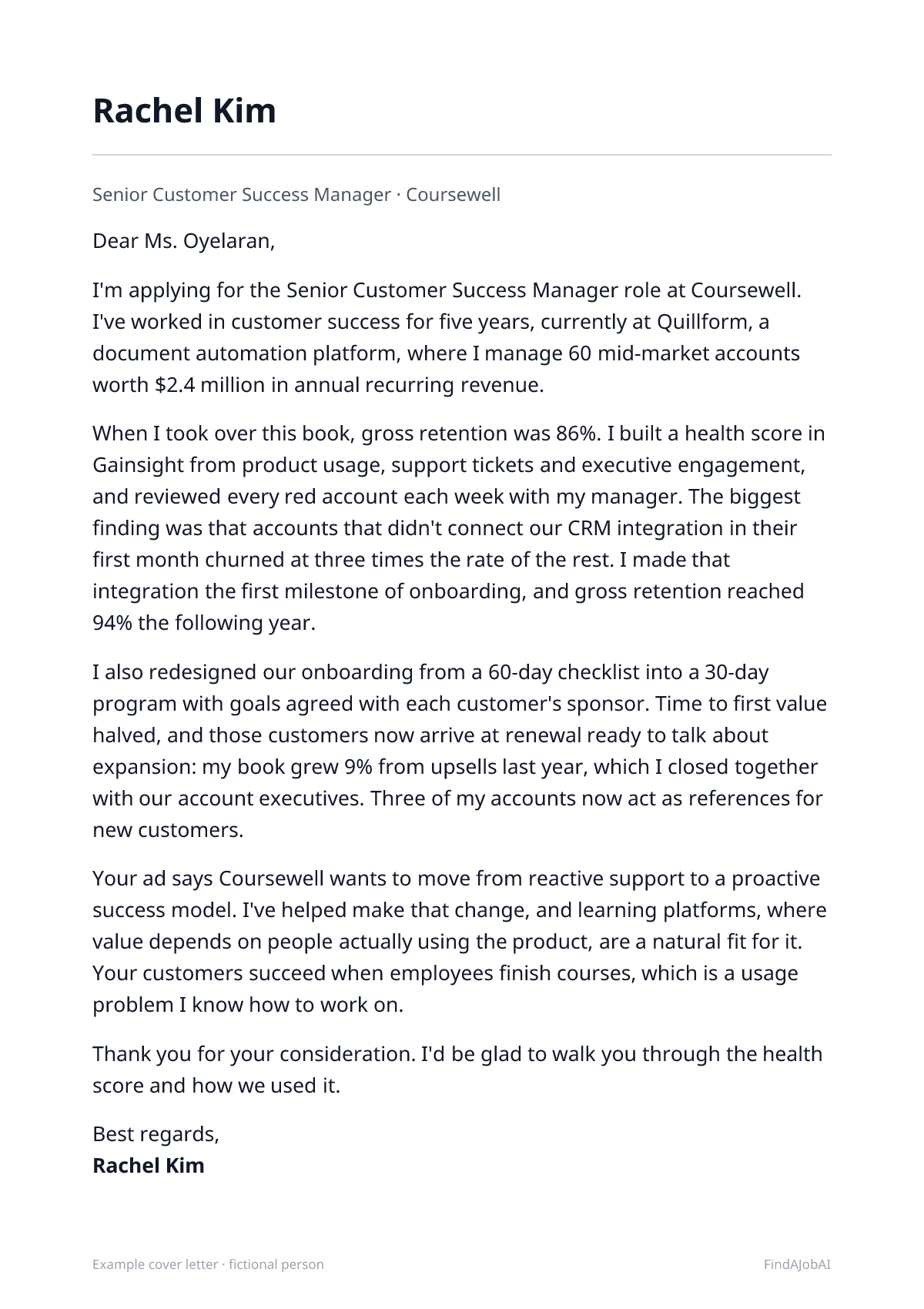
Rachel manages a $2.4M book at a document automation company. The ad says the company wants to move from reactive to proactive success.
Example letter · fictional
Dear Ms. Oyelaran,
I'm applying for the Senior Customer Success Manager role at Coursewell. I've worked in customer success for five years, currently at Quillform, a document automation platform, where I manage 60 mid-market accounts worth $2.4 million in annual recurring revenue.
When I took over this book, gross retention was 86%. I built a health score in Gainsight from product usage, support tickets and executive engagement, and reviewed every red account each week with my manager. The biggest finding was that accounts that didn't connect our CRM integration in their first month churned at three times the rate of the rest. I made that integration the first milestone of onboarding, and gross retention reached 94% the following year.
I also redesigned our onboarding from a 60-day checklist into a 30-day program with goals agreed with each customer's sponsor. Time to first value halved, and those customers now arrive at renewal ready to talk about expansion: my book grew 9% from upsells last year, which I closed together with our account executives. Three of my accounts now act as references for new customers.
Your ad says Coursewell wants to move from reactive support to a proactive success model. I've helped make that change, and learning platforms, where value depends on people actually using the product, are a natural fit for it. Your customers succeed when employees finish courses, which is a usage problem I know how to work on.
Thank you for your consideration. I'd be glad to walk you through the health score and how we used it.
Best regards,
Rachel Kim
Example 2 · Career changer
Teacher moving into customer success at an education company
Emma led her school's rollout of a learning platform. The ad asks for someone who understands teachers' days.
Example letter · fictional
Dear Classloom Team,
I'm applying for the Customer Success Manager role. I've taught middle-school math for six years, and for the last two I've also been my school's lead for our learning platform, training colleagues and working with the vendor's success team. That work is what I want to do full time.
When our district introduced a new platform, adoption at my school was slow: after two months, only a third of teachers had set up their classes. I ran short, practical training sessions by department, built a set of ready-made lessons teachers could copy, and held weekly drop-in hours. By the end of the term, 90% of teachers used the platform every week, and our school became the district's reference site for other principals.
Teaching has given me the core skills of customer success: explaining complex things simply, noticing when someone is struggling before they say so, and managing 150 "customers" at once, with their parents as stakeholders. I've completed a customer success certification course and learned HubSpot and the basics of reading usage data. I haven't managed renewals or revenue yet, and I'm ready to learn that side.
Your customers are schools, and your ad asks for someone who understands teachers' days. I know what a teacher has time for at 3 p.m. on a Thursday, which is often the difference between a tool that's used and one that's abandoned.
Thank you for reading. I'd welcome the chance to talk, and to show you the training materials I built for my colleagues.
Kind regards,
Emma Larsen
Example 3 · Referral or internal move
Support team lead applying internally for a customer success role
Leila leads six support agents and knows the biggest customers well. The internal posting is for a customer success manager on the mid-market segment.
Example letter · fictional
Dear Mr. Fitzpatrick,
I'm applying for the Customer Success Manager role on the mid-market team. I've worked in support at Tendril for four years, the last two leading a team of six, and my director, Priya Nair, knows I'm applying. I'd like to explain why customer success is the next step for what I already do.
In support I see the customers' problems earlier than anyone else. Last year I noticed that nine of our mid-market customers had raised the same reporting question in the same month. I brought it to product, wrote the help article, and asked the account owners to call those nine. Eight of them renewed and two expanded, and the reporting fix shipped six weeks later.
I've also built habits that belong to customer success. I keep a health sheet of the 40 accounts that contact us most, with ticket trends and the people who stopped writing. It flagged three quiet accounts in March, and a call to each led to one rescued renewal worth $48,000. Our first-response time also fell from 41 minutes to 29 under my team.
The advantage of an internal move is that I already know the product, the people and the history. What I haven't done is run a renewal conversation or a business review with an executive, so I've been shadowing two of your CSMs on calls for the last two months, and Jules Okafor has let me draft one review.
Which accounts would you want me to take over first, and what would success look like after six months? I'd like to talk those through.
Thank you,
Leila Farouk
All three letters, and the short version below, are fictional: the people, employers and numbers are invented. Borrow the structure, never the facts.
- Prefer to write it yourself? Use the free cover letter template.
- Check your CV against the job first: the free CV score shows the missing keywords.
Why the first letter works, paragraph by paragraph
Paragraph 1: Opening
Book size and ARR in one sentence. Customer success leaders compare candidates by the value and complexity of the accounts they've managed.
Paragraph 2: Retention, with method
A data-driven approach: a health score, a weekly review, an insight about churn and a change to onboarding, with a retention result (86% to 94%).
Paragraph 3: Onboarding and growth
A redesigned onboarding with a measurable effect, and expansion closed with sales, shows the writer knows success is commercial too.
Paragraph 4: Why this company
Mirrors the company's goal (reactive to proactive) and explains why the product category suits that approach.
Paragraph 5: Close
Offers to walk through the health score, the most transferable thing the writer built.
What the career changer's letter does differently
The teacher's letter treats a platform rollout as the customer success project it was: low adoption, a plan, and a measured result (a third of teachers to 90%). It translates classroom skills into CS language and is clear that renewals and revenue are still to learn.
What the referral letter does differently
Support experience is turned into customer success evidence: a pattern across nine accounts, a health sheet that flagged quiet customers and a rescued renewal. The writer states the honest gap, never having led a renewal or an executive review, and shows the shadowing and the drafted review that are closing it.
Short customer success manager cover letter: an email-ready version
Many applications arrive as an email or a small text box, and a full page doesn't fit. This version runs 120 to 150 words and keeps only what a reader needs to decide whether to reply. A CSM replies to a software company's hiring contact who asked for 'a few lines on how you'd run your first 30 days with a new customer'.
Short version · email · fictional133 words
Subject: Customer Success Manager – a 30-day onboarding plan – Sana Mirza
Hello Mr. Papadakis,
In the first 30 days, I'd agree one outcome with the customer in writing, get the champion and the executive sponsor on a call, and get the first real use of the product in week two, not week six. I'm applying for the Customer Success Manager role at Lakeshore Labs with three years of doing this.
At Slotwell, a scheduling company, I reworked onboarding that way. Time to first value fell from 31 days to 12, and gross retention of the customers I managed went from 87% to 93% over the following year.
Lakeshore's customers are laboratories, and I'd like to learn their workflows. My resume is attached, and I'm free for a call this week; the onboarding plan is available if you'd like to see it.
Best,
Sana Mirza
When the post asks how the writer would run the first 30 days, the note answers in one sentence of plan and one of proof. The numbers that follow, days to first value and retention, are the ones every customer success lead tracks, and the last paragraph acknowledges the new customer type.
Opening lines that work for customer success manager cover letters
The first sentence decides whether the second gets read. Here are six openings, one for each situation you might be in. Pick the one that matches yours and swap in your own facts: every name and number below is invented.
1. You have a standout result
Gross retention across my book rose from 86% to 94% in eighteen months after I changed how we onboard in the first two weeks. Your customers are the next ones I'd like to do that for.
2. The ad names a problem you've solved
Customers adopt one feature and stop: that's the pattern your ad describes. I built a health score and an adoption playbook last year that moved 60 accounts into using three or more, and I'd like to do the same here.
3. Someone referred you
I heard about this role from Amir Haddadi, a senior CSM on your team. We managed a shared customer together at a previous company, and he said your customer success group needs someone with deep product knowledge.
4. You admire what they build
I've been a customer of your platform for three years, and your onboarding emails are the best I've received; I'd like to help build the human version of that experience.
5. You're new to the field or switching into it
After six years of teaching, and leading my school's rollout of a learning platform to 80 teachers, I want to help people adopt tools for a living, starting in customer success.
6. You have senior scope or a specialism
I've led customer success for a $12 million book for eight years and built the health scoring and renewal process the team still uses. Now I want to lead a team of CSMs.
How to write a customer success manager cover letter
Five steps, in the order you'd write them. The shape stays the same for every job (a short opening, proof, a reason for this employer, a close), and what goes into each part is what changes with the role.
Identify the customer type and the stage
Customer success jobs differ: high-touch enterprise accounts, scaled onboarding for many small ones, renewal-focused roles. Read the ad for the segment and the stage, then pick the experience of yours that resembles it, and say how many accounts or what book you handled.
Open with retention or time to value
Lead with the number your function is judged on: gross retention, net revenue retention or time to first value. Give the period and the size of the book. Customer success managers who open with a satisfaction score have often not touched revenue.
Tell the story of a customer you turned around
Describe a customer who was drifting: what you saw in usage or behavior, what you did and how it ended. Show that you noticed early and acted deliberately. A rescue that depends on one big phone call is less convincing than a method.
Describe your playbook in a sentence or two
Say how you structure the work: onboarding steps, health scoring, review rhythm, escalation. Hiring managers want repeatable behavior, so a short description of the routine behind your results is worth more than another example. Keep it to what you actually do each week.
Show you understand their customers
Mention the kind of customer this company has and what usually stops them from getting value, such as laboratories or school districts. Close with an offer to share a plan or template, which gives the reader a concrete next step.
Keywords employers use for customer success manager roles
The skills named most often in the 456 newest customer success manager job ads we track (out of 2,834 live postings), with the share of ads that mention each:
- Customer retention 50%
- Account management 47%
- SaaS 43%
- CRM 29%
- Business reviews 27%
- Salesforce 25%
- Upselling 21%
- B2B 19%
Don't list them in your letter: pick the two or three the ad repeats and back each with one sentence of evidence. Full list: Customer Success Manager resume keywords.
From live job ads · updated November 2, 2026
Customer Success Manager cover letter do's and don'ts
Do
- Give your book (accounts, ARR) and your retention numbers: gross retention, net revenue retention or renewal rate.
- Show how you spot risk early: health scores, usage data, regular reviews.
- Describe one onboarding or adoption program and its effect on time to value or usage.
Don't
- Don't describe customer success as support; show proactive work and outcomes.
- Don't ignore the commercial side when the ad mentions renewals or expansion.
- Don't list every CS platform; name the one you used and what you built in it.
Common customer success manager cover letter mistakes
Each one is easy to make and quick to fix before you send the letter.
Writing 'passion for helping customers'
It describes support work as well. Replace it with something only customer success does: a retention figure, an adoption plan or a renewal you protected, with the change you made.
Quoting satisfaction scores but no retention
CSAT and NPS show mood, not commercial effect. Add gross or net retention, or expansion, for the accounts you managed. If you haven't owned revenue, say what you did that influenced renewals.
Listing success platforms
Naming Gainsight, Totango and Salesforce shows tool familiarity, not outcomes. Say how you used health scores to change what you did, and keep the tools to a clause.
Blurring support and success
If you come from support, say how you moved beyond reactive tickets: anticipating problems, running business reviews, owning outcomes. Show one proactive action and its result, so the reader sees the shift.
Skipping the executive conversation
Customer success includes talking to sponsors about value. If you've done it, describe one review. If you haven't, say what you've done to prepare, such as shadowing or drafting one, and offer to show it.
Email subject lines for customer success manager applications
Applying by email? Put the job title, any reference number and your name in the subject line.
- Senior Customer Success Manager – $2.4M book, gross retention 86% to 94% – Rachel Kim
- Customer Success Manager – teacher who led a school-wide platform rollout – Emma Larsen
- Application: CSM, Enterprise (Req. 3390) – Rachel Kim
Everything for Customer Success Managers
- Customer Success Manager jobs2,834 open roles, updated hourly
- Customer Success Manager salary in the United StatesAdvertised pay in real job ads
- Customer Success Manager resume exampleA full resume, plus bullet and summary examples
- Customer Success Manager interview questions30 questions with sample answers
- Customer Success Manager resume keywordsThe skills job ads ask for most
- Customer Success Manager job descriptionDuties, skills and requirements
- Career change cover letter: template + examples
Other cover letter examples
Customer Success Manager cover letter FAQ
What should a customer success manager cover letter include?
Your book of business, retention results, one example of spotting and preventing churn, and an onboarding or adoption program you ran. Mention expansion if you've contributed to it, and the CS platform you used.
Can teachers become customer success managers?
Yes, and it's a common move, especially into education technology. Show adoption or training results you achieved, translate classroom skills into customer terms, and be clear about the commercial skills you're still learning.
Which metrics matter in a customer success cover letter?
Gross and net revenue retention, renewal rate, time to first value, product adoption and expansion revenue. One or two of these with before and after figures are enough.
How we built this page
The FindAJobAI team wrote the three example letters, the short email version, the opening lines and the advice for customer success manager roles. The people, employers and numbers in the letters are invented; the structure, the kind of evidence and the order of the paragraphs are the parts to copy.
The live keyword section is based on 456 customer success manager job ads analysed, the newest we track, with the same deterministic skill matcher as our in-demand skills report: no AI model reads the postings. It was last computed on November 2, 2026 and refreshes daily.
Last reviewed on November 1, 2026.