Data Architect Cover Letter Example (2026)
By FindAJobAI team Updated How we built this page
Data architect ads ask for a modeling philosophy and a modern stack in the same paragraph, so the letter should show both: a schema decision that held up under real load, and a migration that didn't just move data but made it trustworthy. Name the system, the tradeoff, and who relies on the result.
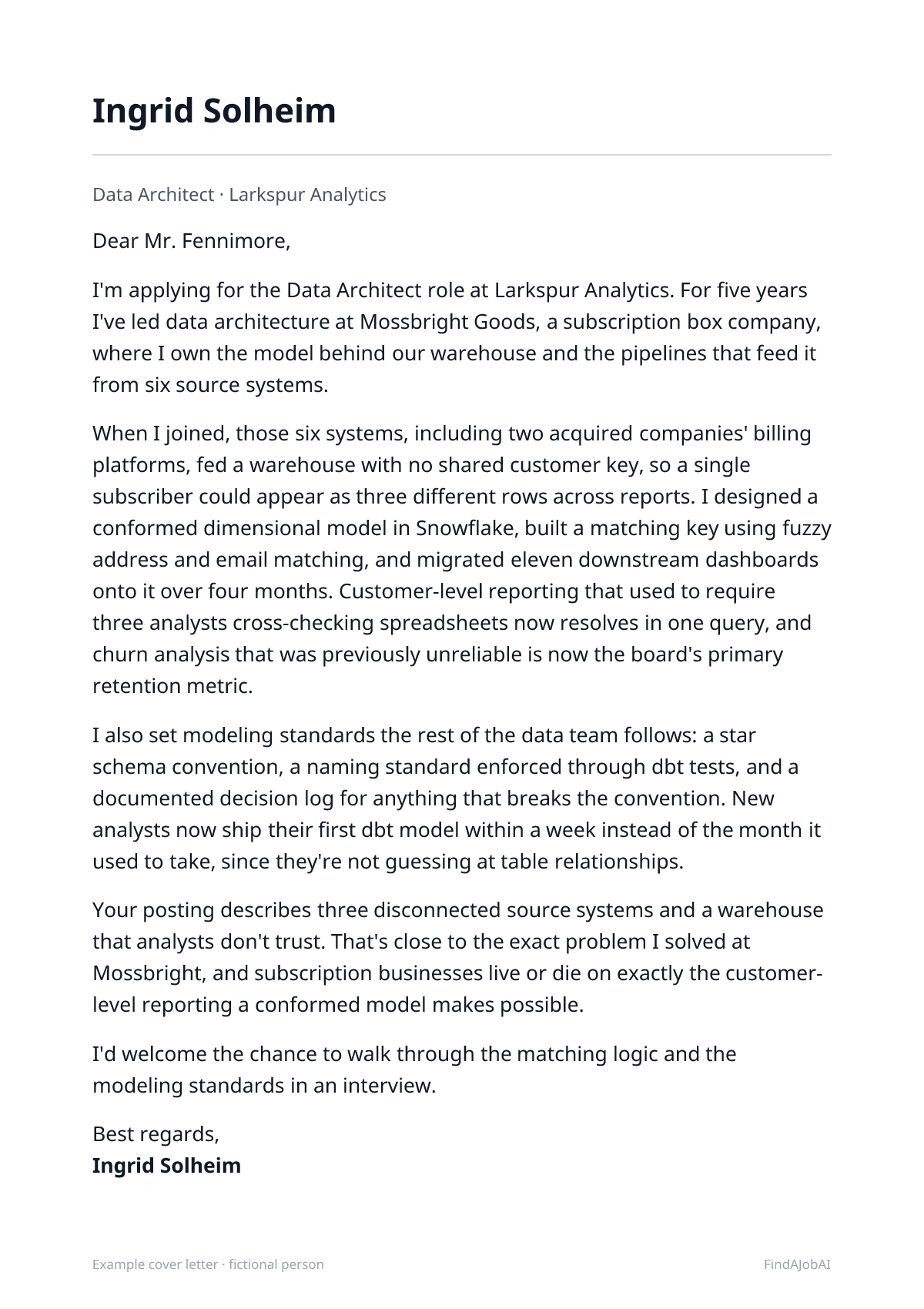
Data Architect cover letter template
This letter as a one-page template: an opening that names the job and your strongest fact, proof that answers the ad, a reason for this employer and a short close.
After you sign up, FindAJobAI drafts your own letter for a real job from your CV in this format, and you edit it before you send it.
Example 1 · Experienced
Data architect applying to rebuild a fragmented warehouse
Ingrid leads data architecture at a subscription box company. The ad asks for a unified data model across disconnected source systems.
Example letter · fictional
Dear Mr. Fennimore,
I'm applying for the Data Architect role at Larkspur Analytics. For five years I've led data architecture at Mossbright Goods, a subscription box company, where I own the model behind our warehouse and the pipelines that feed it from six source systems.
When I joined, those six systems, including two acquired companies' billing platforms, fed a warehouse with no shared customer key, so a single subscriber could appear as three different rows across reports. I designed a conformed dimensional model in Snowflake, built a matching key using fuzzy address and email matching, and migrated eleven downstream dashboards onto it over four months. Customer-level reporting that used to require three analysts cross-checking spreadsheets now resolves in one query, and churn analysis that was previously unreliable is now the board's primary retention metric.
I also set modeling standards the rest of the data team follows: a star schema convention, a naming standard enforced through dbt tests, and a documented decision log for anything that breaks the convention. New analysts now ship their first dbt model within a week instead of the month it used to take, since they're not guessing at table relationships.
Your posting describes three disconnected source systems and a warehouse that analysts don't trust. That's close to the exact problem I solved at Mossbright, and subscription businesses live or die on exactly the customer-level reporting a conformed model makes possible.
I'd welcome the chance to walk through the matching logic and the modeling standards in an interview.
Best regards,
Ingrid Solheim
Example 2 · Career changer
Database administrator moving into data architecture
Rasheed redesigned his company's reporting schema after years as a DBA. The ad wants someone to design a new data model for a growing product line.
Example letter · fictional
Dear Hiring Manager,
I'm applying for the Associate Data Architect role at Wrenfield Logistics. For seven years I've worked as a database administrator at Corvallen Shipping, and over the last two I've taken on increasing responsibility for how our data is modeled, not just how it's stored.
Our operations reporting schema had grown by accretion for a decade, with tables added for one-off requests and no documented relationships between them. A new executive dashboard project kept stalling because nobody could say which tables were current. I proposed and led a redesign: I interviewed the five teams using the schema, built an entity-relationship model that reflected how shipments, carriers and invoices actually related, and migrated reporting onto it table by table so nothing broke mid-project. The dashboard project that had stalled twice shipped on schedule, and new reporting requests now take days instead of the weeks they used to take while someone traced table lineage by hand.
Since then I've completed a data modeling certification and studied dimensional modeling and Kimball's methodology on my own, applying both to a personal project modeling a public transit dataset into a star schema I can walk through in an interview.
Your posting describes a growing product line that needs its data model designed from scratch rather than patched. That's the project I just finished at Corvallen, and logistics data, with its many-to-many relationships between shipments and carriers, is territory I already know well.
Thanks for reading. I'd like to hear how far your current model has come and what the next phase looks like.
Sincerely,
Rasheed Bello
Example 3 · Senior or lead
Principal data architect applying to unify standards across teams
Folasade leads data architecture across three business units at an insurer. The ad wants a principal to set shared modeling standards.
Example letter · fictional
Dear Ms. Castellanos,
The Principal Data Architect opening at Thornbury Mutual asks for someone who can work across business units, which is how I've spent the last three years at Greymont Insurance, leading data architecture for three of them. Before that came eight years as a senior architect on single-team data platforms, and I'd like to carry the wider view to a larger organization.
Your posting says each business unit at Thornbury has its own definition of a policyholder, and combined reporting requires a manual reconciliation every quarter. Greymont had the same problem across claims, underwriting and billing. I led the design of a shared conformed dimension for policyholders and claims, built using a Data Vault pattern so each unit's source system could feed it without losing its own history, and migrated the quarterly reconciliation process onto it over six months. The manual reconciliation that used to take two analysts a full week now runs as an automated check that flags only genuine exceptions.
Architecture earns trust through models people keep using, not diagrams they admire once. When the underwriting team wanted a new fraud-detection feature store, I ran a short review showing their proposed design would duplicate half of the conformed dimension we'd already built, and we extended the existing model instead of standing up a parallel one. That decision is now the default answer whenever a team proposes a new standalone data store.
Five engineers I've mentored have moved into architecture roles, and I host a quarterly modeling review open to all three business units. I've never sat on a formal data governance council or owned a company-wide catalog, so at Thornbury I'd build both slowly, alongside your compliance team.
I'd like to hear which of your three units' definitions causes the most reconciliation pain today, and whether modeling standards here are adopted by choice or handed down.
Sincerely,
Folasade Adeyemi
All three letters, and the short version below, are fictional: the people, employers and numbers are invented. Borrow the structure, never the facts.
- Prefer to write it yourself? Use the free cover letter template.
- Check your CV against the job first: the free CV score shows the missing keywords.
Why the first letter works, paragraph by paragraph
Paragraph 1: Opening
Names the company's structure (six source systems, two acquisitions) and the writer's exact ownership (data architecture, warehouse, pipelines). Architects are hired against a specific mess, so the mess is named early.
Paragraph 2: The model that fixed trust in the data
States the failure (one subscriber appearing as three rows), the solution (a conformed model, a matching key), and the measured result, churn analysis becoming the board's primary metric.
Paragraph 3: Standards other people follow
Shows architecture work beyond one project: a naming convention, enforced tests, a decision log, and a measured onboarding improvement. This signals the writer designs for other people, not just themselves.
Paragraph 4: Why this company
Mirrors the ad's stated problem (disconnected sources, an untrusted warehouse) and connects subscription business needs to the writer's exact experience.
Paragraph 5: Close
Proposes something concrete to discuss, the actual matching logic and modeling standards, instead of a bare request for a call.
What the career changer's letter does differently
This letter opens with a modeling problem the writer solved while still a DBA: an undocumented schema was stalling a dashboard project, and report requests went from weeks to days after the fix. A certification and a self-directed star schema project prove the training is formal now, and the final paragraph answers the company's stated need for a model built from scratch.
What the senior letter does differently
At principal level the letter reports what changed across an organization: a shared conformed dimension, and a reconciliation that went from a week of manual work to automated exception flags. The decision story shows the writer talking a team out of duplicate effort, and the gaps, governance and a data catalog, are stated outright.
Short data architect cover letter: an email-ready version
Many applications arrive as an email or a small text box, and a full page doesn't fit. This version runs 120 to 150 words and keeps only what a reader needs to decide whether to reply. A data architect replies to a retailer's brief application question by email because the portal returned an error on submit.
Short version · email · fictional122 words
Subject: Data Architect (Snowflake, dimensional modeling) – Henrik Dahlquist
Hello Ms. Osei,
I'm applying for the Data Architect role at Marrowick Retail. I have six years designing dimensional models for retail and e-commerce data, most recently leading the warehouse architecture for a company with eight regional inventory systems.
My most relevant project was unifying those eight systems into one Snowflake model with a shared product key. Inventory counts that used to disagree across regional reports by as much as 15% now reconcile automatically, and the finance team adopted the model as their system of record within a quarter.
Marrowick's data would give the same method a larger test. The resume is attached, and the matching logic is something I can explain on a call without any real identifiers.
Best,
Henrik Dahlquist
With only a few lines available, the note keeps one unification project and its clearest proof: inventory counts from two systems that used to disagree now reconcile on their own. The offer to explain the logic without real names keeps the current employer's data private.
Opening lines that work for data architect cover letters
The first sentence decides whether the second gets read. Here are six openings, one for each situation you might be in. Pick the one that matches yours and swap in your own facts: every name and number below is invented.
1. You have a standout result
A unified product model I designed last year ended a long-running disagreement between eight regional inventory reports. I'd like to bring that same clarity to your data.
2. The ad names a problem you've solved
Your ad says each business unit defines a customer differently and reconciliation eats a full week every quarter. A conformed dimension cleared that exact problem where I work now, and I'd like to build the same fix for your team.
3. Someone referred you
Your analytics lead, Petra Vann, and I were on a data modeling panel together last spring. She mentioned you need an architect who can explain tradeoffs to non-technical stakeholders, which is why I'm writing.
4. You admire what they build
I've read your engineering team's recent post on rebuilding your order data model, and the tradeoffs you described around historical tracking are ones I've worked through myself.
5. You're new to the field or switching into it
Seven years of database administration ended with me untangling a schema nobody had documented, and teaching myself dimensional modeling to fix it for good. Data architecture is where I want to keep doing that work.
6. You have senior scope or a specialism
Six years on, my analytics team still follows the modeling standards I set, and I want to bring that kind of consistency to an organization with more than one team to serve.
How to write a data architect cover letter
Five steps, in the order you'd write them. The shape stays the same for every job (a short opening, proof, a reason for this employer, a close), and what goes into each part is what changes with the role.
Identify the modeling problem behind the ad
Data architect ads usually hide a specific symptom: numbers that don't reconcile across teams, a schema nobody trusts, or source systems that don't share a common key. Read the responsibilities section for clues, then pick a project of yours that solved something similar.
Open with the trust problem you fixed, not the tool you used
State what went wrong before your design: duplicated customer records, disagreeing reports, or reconciliation that took days of manual work. Mention the warehouse or modeling tool only after naming the problem, so the reader understands why the design mattered.
Quantify the result in reporting terms
Reconciliation time, onboarding time for new analysts, or the number of conflicting reports eliminated all work better than vague claims of improved data quality. If exact figures from your employer aren't shareable, use a relative change or range instead.
Name your methodology inside a real project
Rather than listing Kimball, Data Vault, Snowflake and dbt as separate credentials, describe the specific modeling choice you made for one project and why, such as choosing a conformed dimension over separate marts. A real tradeoff proves judgment.
Show how your model gets adopted
A model only matters if other teams build on it. Mention a standard, naming convention, or review process that other analysts or engineers now follow, and close with a question about how modeling decisions get made at the company you're applying to.
Data Architect cover letter do's and don'ts
Do
- Name the data warehouse or modeling tool the ad mentions (Snowflake, dbt, BigQuery) inside a real project, not as a bare list.
- State the specific failure a bad model caused, such as inconsistent customer counts, duplicated records, or untraceable table lineage.
- Give a measurable result tied to reporting speed, data trust, or onboarding time for new analysts.
- Mention who adopted your model or standard, such as an analytics team, other engineers, or a specific dashboard that now depends on it.
Don't
- Don't describe a schema redesign without the problem it fixed; a diagram with no story reads as an exercise, not a decision.
- Don't claim fluency in every modeling methodology; name the one you used (dimensional, Data Vault, Kimball) and where.
- Don't share your current employer's raw data or exact revenue figures; use relative changes or anonymized examples instead.
Common data architect cover letter mistakes
Each one is easy to make and quick to fix before you send the letter.
Listing every tool and methodology without a project
Naming Snowflake, dbt, Data Vault and Kimball in one sentence says nothing about depth. Pick the one or two the ad asks for and tie each to a specific project where you applied it.
Describing a schema without the problem it solved
'Redesigned our data model' doesn't explain why it mattered. State what was broken, such as inconsistent counts or untraceable lineage, before describing the new structure.
Citing a gain without a starting point
'Improved data quality' gives a reader nothing to weigh. State where things started, what you changed, and the result as a figure or a range, rounded if the exact numbers must stay private.
Writing as a solo builder when the role needs adoption
Principal and lead architect roles need other teams to actually use the model. Mention a standard or convention that other people follow, not just a schema you personally built.
Ignoring the company's actual data maturity
A letter that could apply to any data role ignores whether the company has disconnected systems, an untrusted warehouse, or a model that needs building from scratch. Match your story to the stage the ad describes.
Email subject lines for data architect applications
Applying by email? Put the job title, any reference number and your name in the subject line.
- Data Architect application – unified warehouse model, six source systems – Ingrid Solheim
- Associate Data Architect – DBA with schema redesign experience – Rasheed Bello
- Application: Data Architect, Platform Team (Req. 3317) – Ingrid Solheim
Everything for Data Architects
- Data Architect resume exampleA full resume, plus bullet and summary examples
- Data Architect interview questions30 questions with sample answers
- Data Architect job descriptionDuties, skills and requirements
- Career change cover letter: template + examples
Other cover letter examples
Data Architect cover letter FAQ
What should I write in a data architect cover letter?
One modeling decision that repaired a trust or reporting problem: what failed, the model you designed, and what you measured afterward. Add a sentence on which teams adopted the standard. Your tool experience is already on your resume.
How do I write a data architect cover letter with no architect title yet?
Use schema or modeling work from a DBA, data engineer, or analyst role, such as a redesign you led informally, then add a certification or a self-directed modeling project. Name the methodology and one measured result.
Should I mention a specific modeling methodology, like Kimball or Data Vault?
Yes, if you have real experience applying it. Name the one you used on a specific project rather than listing several you've only read about.
How is a data architect cover letter different from a data engineer's?
A data architect letter should center on modeling decisions and standards other people follow, while a data engineer letter can focus more on pipelines and infrastructure. If you've done both, pick whichever matches the ad's emphasis.
How we built this page
The FindAJobAI team wrote the three example letters, the short email version, the opening lines and the advice for data architect roles. The people, employers and numbers in the letters are invented; the structure, the kind of evidence and the order of the paragraphs are the parts to copy.
Once we track enough live data architect job ads, this page also shows the skills they ask for most, counted the same way as our in-demand skills report.
Last reviewed on November 1, 2026.