Executive Assistant Cover Letter Example (2026)
By FindAJobAI team Updated How we built this page
Executive assistant ads usually list the same tools and the same traits, calendar management, travel, discretion, so they tell a hiring manager little. A cover letter earns attention by naming a specific executive's calendar, a trip you rescued, or a process you built so things stopped depending on memory.
Executive Assistant cover letter template
This letter as a one-page template: an opening that names the job and your strongest fact, proof that answers the ad, a reason for this employer and a short close.
After you sign up, FindAJobAI drafts your own letter for a real job from your CV in this format, and you edit it before you send it.
Example 1 · Experienced
Executive assistant applying to support a growing company's CEO
Renata supports a CEO through board meetings, fundraising travel and a reorganized team. The ad asks for someone who can manage up and anticipate problems.
Example letter · fictional
Dear Mr. Okonkwo,
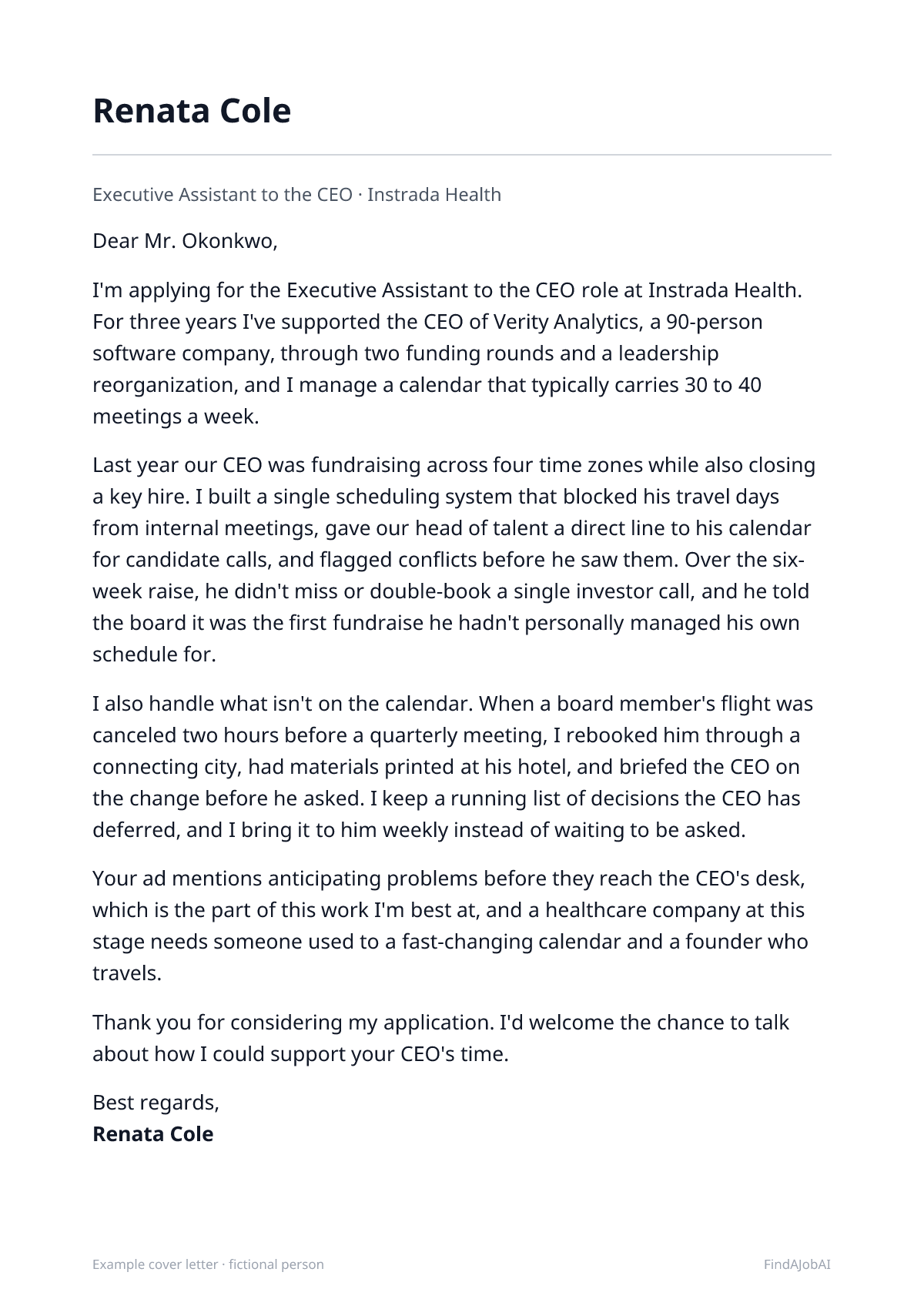
I'm applying for the Executive Assistant to the CEO role at Instrada Health. For three years I've supported the CEO of Verity Analytics, a 90-person software company, through two funding rounds and a leadership reorganization, and I manage a calendar that typically carries 30 to 40 meetings a week.
Last year our CEO was fundraising across four time zones while also closing a key hire. I built a single scheduling system that blocked his travel days from internal meetings, gave our head of talent a direct line to his calendar for candidate calls, and flagged conflicts before he saw them. Over the six-week raise, he didn't miss or double-book a single investor call, and he told the board it was the first fundraise he hadn't personally managed his own schedule for.
I also handle what isn't on the calendar. When a board member's flight was canceled two hours before a quarterly meeting, I rebooked him through a connecting city, had materials printed at his hotel, and briefed the CEO on the change before he asked. I keep a running list of decisions the CEO has deferred, and I bring it to him weekly instead of waiting to be asked.
Your ad mentions anticipating problems before they reach the CEO's desk, which is the part of this work I'm best at, and a healthcare company at this stage needs someone used to a fast-changing calendar and a founder who travels.
Thank you for considering my application. I'd welcome the chance to talk about how I could support your CEO's time.
Best regards,
Renata Cole
Example 2 · Career changer
Office coordinator moving into an executive assistant role
Desmond coordinates a 40-person office and already manages a VP's calendar informally. The ad mentions travel booking and confidential correspondence.
Example letter · fictional
Dear Hiring Manager,
I'm applying for the Executive Assistant role at Marrow & Finch. For three years I've been the office coordinator at a 40-person architecture firm, and over the last year I've taken on calendar and travel support for our VP of Operations because our previous assistant left and no one replaced her.
When that happened, the VP's calendar was double-booked most weeks and client trips were booked the night before. I set up a shared calendar with buffer time built in, created a travel request form so I'd have details two weeks out instead of two days, and started a one-page briefing I send her before every external meeting. She now reviews her week in ten minutes on Monday instead of calling me five times a day to ask what's next.
I also handle the firm's confidential client contracts and partner correspondence, so I'm used to discretion as part of the job, not an exception to it. I've completed a course on executive support fundamentals and shadowed our CEO's assistant for a week to learn how she manages board materials.
Your posting mentions travel booking and confidential correspondence, both of which I already do, just without the title. I'd bring an office manager's sense of what keeps 40 people running smoothly to supporting one executive closely. I'd also ask in my first week how your executives like to receive updates and which decisions they want to see before I act, so I'm not guessing.
Thank you for your time. I'd welcome the opportunity to discuss how I could support your team.
Kind regards,
Desmond Hale
Example 3 · Referral or internal move
Executive assistant moving internally to become chief of staff
Elena has been the founder's EA for four years and is applying for a newly created chief of staff role at the same company, with the founder's support.
Example letter · fictional
Dear Mr. Lindqvist,
I'm applying for the Chief of Staff role at Barrow Robotics. I've been your executive assistant for four years, and over the last year I've taken on parts of a chief of staff role informally: running the leadership offsite agenda, tracking cross-team commitments, and drafting the all-hands updates you've been editing instead of writing.
You've mentioned that leadership meetings produce decisions that don't get tracked anywhere. I started keeping a single action log after each one, with an owner and a date, and followed up weekly. Of the 24 items logged last quarter, 21 were closed on time, up from what you estimated was about half before. I'd want to formalize that log and extend it to OKR tracking, which currently lives in three different spreadsheets.
I also ran point on the Q3 offsite, including the agenda, a pre-read that cut the opening session from two hours to 45 minutes, and a budget that came in under what we spent the year before. The team told you afterward it was the most useful offsite they'd had, and you asked me to run the next one the same way.
I haven't managed a budget larger than an offsite's, and I haven't represented the company externally the way a chief of staff sometimes does. I'd want to build both with your guidance in the first few months.
You know my work closely, so rather than restate it, I'd like to talk through which two or three things you most want off your plate first.
Sincerely,
Elena Quintero
All three letters, and the short version below, are fictional: the people, employers and numbers are invented. Borrow the structure, never the facts.
- Prefer to write it yourself? Use the free cover letter template.
- Check your CV against the job first: the free CV score shows the missing keywords.
Why the first letter works, paragraph by paragraph
Paragraph 1: Opening
Names the executive supported, the company's size and a concrete marker of complexity (two funding rounds, a reorganization). EAs are judged by whose calendar they can handle, so this sets the scale early.
Paragraph 2: The system that prevented a failure
A specific, high-stakes period (a six-week raise across time zones), the system built to handle it, and the result stated as something that didn't happen, no missed or double-booked calls.
Paragraph 3: What isn't on the calendar
The flight rebooking and the weekly deferred-decisions list show judgment under pressure and initiative, the two traits that separate a strong EA from a scheduler.
Paragraph 4: Why this company
Mirrors the ad's own phrase about anticipating problems and connects the company's stage and industry to the writer's experience with fast change.
Paragraph 5: Close
A plain, low-pressure offer to talk, appropriate for a role built on being easy to work with.
What the career changer's letter does differently
The office coordinator's letter starts from a real gap he filled, a VP's unmanaged calendar, before he had the EA title, with a concrete fix (a travel form, a briefing memo) and a measurable change in how the VP spends her Monday. A course and shadowing show he's formalizing skills he's already using, and the letter maps directly onto the ad's own requirements.
What the referral letter does differently
A chief of staff letter written as an internal move leans on a shared track record instead of introducing the writer, and reports organizational habits: an action log with a closure rate, three OKR spreadsheets that need consolidating, an offsite's budget and length. The gaps (budget size, external representation) are named plainly because the reader already knows the writer.
Short executive assistant cover letter: an email-ready version
Many applications arrive as an email or a small text box, and a full page doesn't fit. This version runs 120 to 150 words and keeps only what a reader needs to decide whether to reply. An executive assistant answers a law firm's short online application form, sent as an email because the portal's upload tool was down.
Short version · email · fictional127 words
Subject: Executive Assistant application – calendar and travel for 3 partners – Lloyd Grayson
Hello Ms. Whitfield,
I'm applying for the Executive Assistant role at Caldwell & Vance. I currently support three partners at a mid-size consulting firm, managing calendars that combine client travel, board commitments and personal appointments across two time zones.
Last year I rebuilt our travel booking process after a partner missed a connecting flight twice in one month. I now book a buffer window on every multi-leg trip and confirm each leg 48 hours ahead; we haven't had a missed connection since.
I'm comfortable with discretion around client and personal matters as a standing part of the job. My resume is attached, and I'm glad to speak at your convenience. I also keep a running list of open items for each partner, reviewed every morning.
Best,
Lloyd Grayson
A short application form rewards one concrete fix over a list of duties, so this version keeps the travel-buffer story and its result and drops everything else. The line about discretion stands in for a longer paragraph because law firm readers look for it specifically.
Opening lines that work for executive assistant cover letters
The first sentence decides whether the second gets read. Here are six openings, one for each situation you might be in. Pick the one that matches yours and swap in your own facts: every name and number below is invented.
1. You have a standout result
After a partner missed two connecting flights in one month, I rebuilt our travel booking process around a confirmed buffer window; we haven't had a missed connection since. I'd like to bring that same attention to your partners' travel.
2. The ad names a problem you've solved
Your ad says the last assistant left after six months because the pace outgrew the role. I currently manage a calendar for three executives across two time zones and I'm looking for one role I can grow into, not out of.
3. Someone referred you
Your operations director, Felix Amara, worked with me for two years on vendor scheduling and suggested I apply, since your CEO's calendar is apparently in the state mine was in before I fixed it.
4. You admire what they build
I've followed your company's product launches for two years and noticed how often your founder is quoted traveling; keeping that kind of schedule running is exactly the work I do now.
5. You're new to the field or switching into it
I managed a 40-person office for three years, then started handling a VP's calendar when our last assistant left. I'd like to do that work full time, with the title to match.
6. You have senior scope or a specialism
As an executive's assistant for six years, I've built the scheduling and reporting systems my current company still runs on. I'm ready to take that further as a chief of staff.
How to write an executive assistant cover letter
Five steps, in the order you'd write them. The shape stays the same for every job (a short opening, proof, a reason for this employer, a close), and what goes into each part is what changes with the role.
Identify the scale and pace this executive works at
An EA ad for a solo founder differs from one for three partners or a board-facing CEO. Look for clues about travel frequency, time zones, or board involvement, then choose a story of yours at a similar scale and pace.
Open with a problem you prevented, not a duty you performed
Say what could have gone wrong, a missed flight, a double-booked board call, and what you did so it didn't. 'I manage calendars' describes a task; a prevented failure describes judgment, which is what the role is actually paid for.
Give the scale of what you handle in numbers
Meetings per week, executives supported, time zones, direct reports in the office. These numbers let a reader size up the role against their own without you having to say 'fast-paced' or 'high-volume.' Pick two numbers, not five.
Address discretion directly, once
Confidential schedules, compensation details, or personal matters are part of the job. One sentence stating you treat discretion as standard, ideally attached to a real (but vague) example, reassures a reader faster than any adjective.
Name the tools inside the story, then stop
Mention the calendar platform, expense system, or travel tool the ad names as part of describing what you built or fixed. Once the story has made your competence clear, don't list additional software with no context attached.
Executive Assistant cover letter do's and don'ts
Do
- Name the executive's role and the scale of what you manage: meetings per week, direct reports, locations.
- Describe one situation that went wrong and how your system or judgment prevented it from happening again.
- Mention the tools the ad names (calendar platforms, expense systems, travel booking) inside a specific story.
Don't
- Don't write "highly organized with excellent communication skills"; show one calendar or trip you fixed.
- Don't share details that identify a current employer's confidential deals or people; describe the work generally.
- Don't list every software you've touched; name the one or two the ad asks for and how you used them.
Common executive assistant cover letter mistakes
Each one is easy to make and quick to fix before you send the letter.
Listing traits instead of a story
"Organized, proactive, discreet" is what every applicant writes. Replace each trait with one sentence showing it: a system you built, a problem you caught early, a confidential matter you handled without being asked.
Describing duties instead of scale
"Managed the CEO's calendar" doesn't say whether that's 10 meetings a week or 50. Add the number, the time zones, or the number of executives, so the reader can judge the complexity you're used to.
Naming every tool with no context
A list of calendar apps, expense platforms, and travel sites reads like a resume skills section repeated in prose. Mention the one or two the ad asks about, inside the story of what you used them for.
Oversharing specifics about a current executive
Naming a current boss's deals, health, or personal details to prove discretion defeats the point. Describe the situation generally (a canceled flight, a sensitive hire) without identifying details.
Turning the cover letter into a duty checklist
Restating every bullet from the job posting back at the reader shows you read it, not that you can do it. Pick the one or two duties that matter most and prove them with a story instead of listing all of them.
Email subject lines for executive assistant applications
Applying by email? Put the job title, any reference number and your name in the subject line.
- Executive Assistant to the CEO application – Renata Cole
- Executive Assistant – office coordinator with 3 years of calendar and travel support – Desmond Hale
- Application: Executive Assistant, Operations (Req. 2240) – Renata Cole
Everything for Executive Assistants
- Executive Assistant resume exampleA full resume, plus bullet and summary examples
- Executive Assistant interview questions30 questions with sample answers
- Executive Assistant job descriptionDuties, skills and requirements
- Career change cover letter: template + examples
Other cover letter examples
Executive Assistant cover letter FAQ
What should I write in an executive assistant cover letter?
One situation where your system or judgment prevented a scheduling or travel problem, with the scale of what you manage (meetings per week, locations, executives supported). Add a sentence on how you handle confidential information. Your software skills belong on your resume.
How do I write an executive assistant cover letter with no direct EA experience?
Use calendar, travel or confidential work you've already done in another role, such as office coordination or project support, and name the result. Add any relevant course or shadowing, and connect it to what the ad specifically asks for.
Should I mention salary or availability in an executive assistant cover letter?
Only if the ad asks for it. If it does, give a short, direct answer in the last paragraph so it doesn't take over the letter.
How we built this page
The FindAJobAI team wrote the three example letters, the short email version, the opening lines and the advice for executive assistant roles. The people, employers and numbers in the letters are invented; the structure, the kind of evidence and the order of the paragraphs are the parts to copy.
Once we track enough live executive assistant job ads, this page also shows the skills they ask for most, counted the same way as our in-demand skills report.
Last reviewed on November 1, 2026.