Fashion Designer Cover Letter Example (2026)
By FindAJobAI Team Updated How we built this page
Fashion hiring managers will open your portfolio no matter what the letter says, so the letter's job is different: explain the category and market you design for, show that your styles reached production and sold, and connect your eye to this brand's customer. One collection or style with a real result beats a paragraph about your love of fashion.
Fashion Designer cover letter template
This letter as a one-page template: an opening that names the job and your strongest fact, proof that answers the ad, a reason for this employer and a short close.
After you sign up, FindAJobAI drafts your own letter for a real job from your CV in this format, and you edit it before you send it.
Example 1 · Experienced
Womenswear designer applying to a contemporary brand
Saoirse designs knit tops and dresses for a mid-market brand. The ad asks for knitwear experience and CLO 3D.
Example letter · fictional
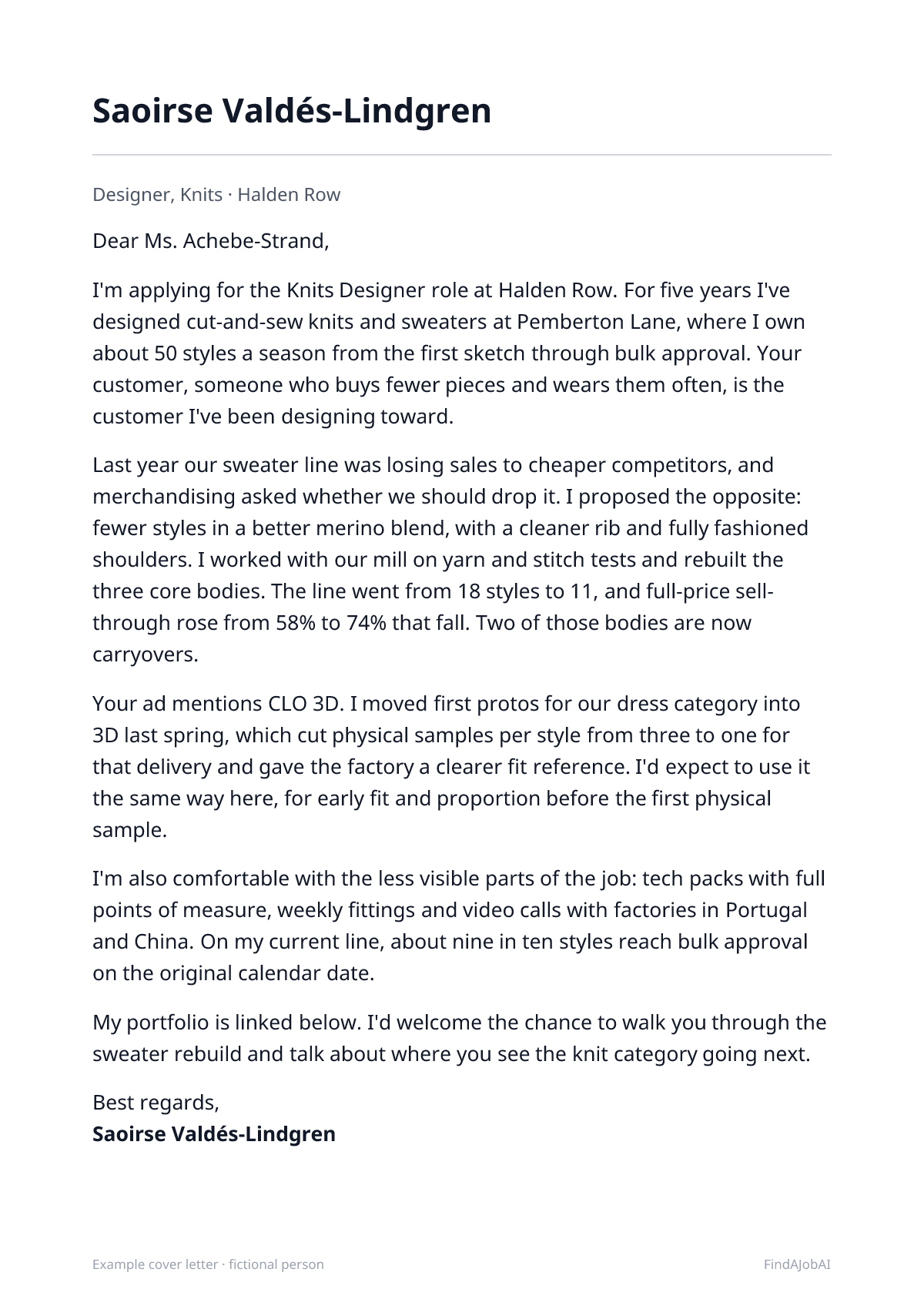
Dear Ms. Achebe-Strand,
I'm applying for the Knits Designer role at Halden Row. For five years I've designed cut-and-sew knits and sweaters at Pemberton Lane, where I own about 50 styles a season from the first sketch through bulk approval. Your customer, someone who buys fewer pieces and wears them often, is the customer I've been designing toward.
Last year our sweater line was losing sales to cheaper competitors, and merchandising asked whether we should drop it. I proposed the opposite: fewer styles in a better merino blend, with a cleaner rib and fully fashioned shoulders. I worked with our mill on yarn and stitch tests and rebuilt the three core bodies. The line went from 18 styles to 11, and full-price sell-through rose from 58% to 74% that fall. Two of those bodies are now carryovers.
Your ad mentions CLO 3D. I moved first protos for our dress category into 3D last spring, which cut physical samples per style from three to one for that delivery and gave the factory a clearer fit reference. I'd expect to use it the same way here, for early fit and proportion before the first physical sample.
I'm also comfortable with the less visible parts of the job: tech packs with full points of measure, weekly fittings and video calls with factories in Portugal and China. On my current line, about nine in ten styles reach bulk approval on the original calendar date.
My portfolio is linked below. I'd welcome the chance to walk you through the sweater rebuild and talk about where you see the knit category going next.
Best regards,
Saoirse Valdés-Lindgren
Example 2 · Career changer
Theatre costume maker moving into ready-to-wear design
Emeric has built costumes for regional theatre for six years. He is applying for an associate designer role at a menswear brand.
Example letter · fictional
Dear Mr. Kowalczyk-Brandt,
I'm applying for the Associate Designer, Menswear role at Tolland & Webb. I've spent six years as a costume maker for regional theatre, most recently at the Crescent Stage Company, and I'm moving into ready-to-wear because I want to design clothes people choose to live in, not just wear for a run.
Costume work is construction-heavy. I've patterned and built tailored jackets, waistcoats and trousers for about 15 productions, often in a few weeks, and fitted them on actors who need to move, climb and change in under a minute. That taught me a lot about how a garment is engineered and where fit breaks under stress. I've also sourced fabrics for most of those shows, often on tight budgets.
To prepare for production work, I completed a technical design certificate this year covering tech packs, grading and PLM, and I designed a 10-piece menswear capsule as my final project, from flats to a full tech pack set. I also learned CLO 3D and used it for the capsule's first fits. Building that capsule showed me how much detail a factory needs that a costume shop never writes down.
I know a factory isn't a costume shop. Volume, cost targets and calendars are new to me at your scale, and I'd expect to learn your development process carefully. What I bring is a tailor's understanding of construction and a habit of solving fit problems quickly.
My portfolio includes both the theatre work and the capsule. I'd be glad to talk about how that construction background would fit your tailoring line. I'm happy to bring a finished jacket to the interview.
Kind regards,
Emeric Ondaatje-Price
Example 3 · Senior or lead
Senior designer applying to lead a brand's design team
Ines leads a team of four at an accessories and womenswear brand. The posting is for a head of design to reposition a heritage label.
Example letter · fictional
Dear Mr. Rautenbach,
I'm applying for the Head of Design role at Ashcombe & Vale. I've spent twelve years in womenswear and accessories, the last four leading a team of four designers at Corrie Bennett, where we own about 180 styles a season across dresses, outerwear and bags.
Your posting talks about bringing a heritage label to a younger customer without losing the existing one. We faced the same tension at Corrie Bennett two years ago. Instead of a full redesign, I split the line into a core range that kept the brand's signature coats and checks, refreshed with better fits, and a smaller seasonal range where the team could take risks. The core range has held its sales, and the seasonal range now brings in a noticeably younger online customer. The team also built a simple archive library so designers can reference past coats and checks before sketching.
Running a team has changed how I spend my time. I set line plans with merchandising, review every style at concept and first proto, and spend more time on fabric and factory decisions than on sketching. I've hired three of my four designers, and I hold a short design review each week so everyone sees the whole line, not just their category.
I haven't worked with a licensing partner, which your posting mentions for fragrance and eyewear. I'd want to learn how those partners take direction before shaping that part of the brand. I'd also spend my first weeks in your stores and with your archive team.
I'd welcome a conversation about which parts of the archive you see as untouchable and which you'd like to change.
With best wishes,
Ines Margolis-Tran
All three letters, and the short version below, are fictional: the people, employers and numbers are invented. Borrow the structure, never the facts.
- Prefer to write it yourself? Use the free cover letter template.
- Check your CV against the job first: the free CV score shows the missing keywords.
Why the first letter works, paragraph by paragraph
Paragraph 1: Opening
States the category, years and the size of the line owned, then links the writer's design direction to the brand's customer in one sentence.
Paragraph 2: The sweater rebuild
A real commercial problem, the designer's counterintuitive proposal, the specific design changes and a sell-through result show taste and business judgment together.
Paragraph 3: The tool the ad names
CLO 3D appears in a short, concrete example with the sample reduction it delivered, instead of in a software list.
Paragraph 4: Production skills
One sentence on tech packs, fittings and factories reassures the reader that the designer can take styles all the way to bulk.
Paragraph 5: Close
Points to the portfolio and offers a specific conversation about the brand's category, which feels like a working discussion rather than a formality.
What the career changer's letter does differently
The costume maker's letter turns a different industry into evidence of construction skill, then closes the obvious gaps with a technical design certificate and a capsule built to industry standards. He names what he hasn't done, volume and cost targets, without apologizing for it.
What the senior letter does differently
A design leader's letter talks about structure: how the line is split, how the team works and which decisions sit with her. It connects that structure to the brand's stated challenge and names the one area, licensing, where she would be learning.
Short fashion designer cover letter: an email-ready version
Many applications arrive as an email or a small text box, and a full page doesn't fit. This version runs 120 to 150 words and keeps only what a reader needs to decide whether to reply. A designer emails a small sustainable label after meeting its founder at a trade show.
Short version · email · fictional143 words
Subject: Designer role – met at Trade Show booth 214, sustainable wovens experience – Kasimir Ferreira-Holt
Hi Ms. Lindqvist-Obi,
Thanks for the conversation at your booth last week. You mentioned you're looking for a designer to take over your woven tops and dresses, and I'd like to be considered. I enjoyed hearing about your plans for the linen range.
For four years I've designed wovens at a small label that uses only certified fabrics, owning about 35 styles a season. I moved our shirting to a deadstock and organic cotton mix that kept cost flat, and two of those shirts became our best repeat sellers. I'm also comfortable writing tech packs and running fittings with small factories, which I understand you use for most of your wovens.
My portfolio link is below, with the shirting project on the first page. I'd be glad to share tech pack samples or meet at your studio whenever suits you.
Thanks,
Kasimir Ferreira-Holt
The trade show meeting opens the email because it is the reason the founder will read it. One project with a sourcing change and a sales signal is enough, and the portfolio note tells her exactly where to look.
Opening lines that work for fashion designer cover letters
The first sentence decides whether the second gets read. Here are six openings, one for each situation you might be in. Pick the one that matches yours and swap in your own facts: every name and number below is invented.
1. You have a standout result
Last fall I cut our sweater line from 18 styles to 11 in a better yarn, and full-price sell-through rose from 58% to 74%. I'd like to bring that kind of edit to your knit category.
2. The ad names a problem you've solved
Your posting asks for a designer who can take a style from sketch to bulk. I've owned about 60 styles a season through that whole process for the past five years.
3. Someone referred you
Your senior designer, Nadia Ostrowski, saw my graduate collection at the school's runway show and suggested I apply for your assistant designer role.
4. You admire what they build
I've built tailored costumes for 15 theatre productions and completed a technical design certificate, and I'm ready to bring that construction knowledge to ready-to-wear.
5. You're new to the field or switching into it
I've shopped your stores for years, and your recent move into heavier linens is exactly the kind of fabric work I do best.
6. You have senior scope or a specialism
I lead four designers across dresses, outerwear and bags, and I'd like to take that experience to a label that is redefining its core line.
How to write a fashion designer cover letter
Five steps, in the order you'd write them. The shape stays the same for every job (a short opening, proof, a reason for this employer, a close), and what goes into each part is what changes with the role.
Study the brand's product before writing
Visit a store or the website, look at price points, fabrics and silhouettes, and note the category the role covers. Your letter should show you understand this customer, not fashion in general. Mention one specific thing you noticed, such as a fabric choice.
Open with category and scope
Say what you design, for what market level, and how many styles a season you own. This helps a busy design director place you quickly before opening the portfolio. If you've worked across categories, lead with the one this role covers.
Tell one product story with a result
Pick a style or collection and explain the problem, the design decisions and the outcome: sell-through, carryover, cost or fewer fit rounds. One clear story is more persuasive than a list of seasons. Keep it to a short paragraph.
Show you can get designs made
Mention tech packs, fittings, factories and the tools the ad names in a sentence or two. Design teams need people who can carry a style through production, not just sketch it. Keep it brief; the interview will go deeper.
Point to the portfolio clearly
Link the portfolio and tell the reader which project matches the role. Close by offering to talk through that work or share tech pack samples. Make sure the link works, opens without a login and loads quickly on a phone.
Fashion Designer cover letter do's and don'ts
Do
- Name the category and market level you design for in the first paragraph.
- Describe one style or collection with a production or sales result, such as sell-through or carryover.
- Link your portfolio and point the reader to the project the letter discusses.
Don't
- Don't spend the letter describing your personal style or lifelong love of fashion.
- Don't attach large image files to an email application unless the posting asks for them.
- Don't claim to know a brand's customer without showing you have studied the product or stores.
Common fashion designer cover letter mistakes
Each one is easy to make and quick to fix before you send the letter.
Writing about your passion instead of your product
Every applicant loves fashion. Replace that paragraph with a style you designed, how it was made and how it sold.
Ignoring the brand's category
A letter about evening wear sent to a denim brand shows you didn't read the ad. Pick experience from the same category or explain how it transfers.
Leaving out production
Design managers worry about designers who can't work with factories. Mention tech packs, fittings and calendars briefly.
Pasting the portfolio into the email
Large attachments get blocked or ignored. Use a link and say which project to look at first.
Overstating your role in a team collection
If you were one of several designers, say which styles or categories were yours. Interviewers will ask about specific pieces.
Email subject lines for fashion designer applications
Applying by email? Put the job title, any reference number and your name in the subject line.
- Knits Designer application – 5 years cut-and-sew and sweaters, CLO 3D – Saoirse Valdés-Lindgren
- Associate Designer, Menswear application – tailoring background – Emeric Ondaatje-Price
- Application: Designer, Women's Wovens (Job 8812) with portfolio link – Saoirse Valdés-Lindgren
Everything for Fashion Designers
- Fashion Designer resume exampleA full resume, plus bullet and summary examples
- Fashion Designer interview questions30 questions with sample answers
- Fashion Designer job descriptionDuties, skills and requirements
- Career change cover letter: template + examples
Other cover letter examples
Fashion Designer cover letter FAQ
What should a fashion designer cover letter include?
Your category and market level, the size of the line you have owned, one style or collection with a result, the tools the ad names and a link to your portfolio. Leave the full software list and every past collection for the resume and portfolio.
Do fashion brands read cover letters?
Many do, especially for associate and senior roles, because the letter shows whether you understand their customer and can talk about commercial results. A short, specific letter also helps your portfolio get opened first.
How do I write a fashion design cover letter with no industry experience?
Use your graduate collection, internships, costume or alteration work and any production steps you have handled. Show you understand tech packs, fittings and calendars, and point to the strongest portfolio project.
How we built this page
The FindAJobAI team wrote the three example letters, the short email version, the opening lines and the advice for fashion designer roles. The people, employers and numbers in the letters are invented; the structure, the kind of evidence and the order of the paragraphs are the parts to copy.
Once we track enough live fashion designer job ads, this page also shows the skills they ask for most, counted the same way as our in-demand skills report.
Last reviewed on November 1, 2026.