Industrial Engineer Cover Letter Example (2026)
By FindAJobAI team Updated How we built this page
Industrial engineer ads ask for lean, Six Sigma or line balancing almost interchangeably, so most applicants list the same three acronyms. A cover letter earns a read when it names the line, the bottleneck, and the number that moved after you fixed it.
Industrial Engineer cover letter template
This letter as a one-page template: an opening that names the job and your strongest fact, proof that answers the ad, a reason for this employer and a short close.
After you sign up, FindAJobAI drafts your own letter for a real job from your CV in this format, and you edit it before you send it.
Example 1 · Experienced
process engineer applying to an appliance manufacturer
Dariusz improves throughput on an assembly line at a parts supplier. The ad asks for line balancing and changeover reduction.
Example letter · fictional
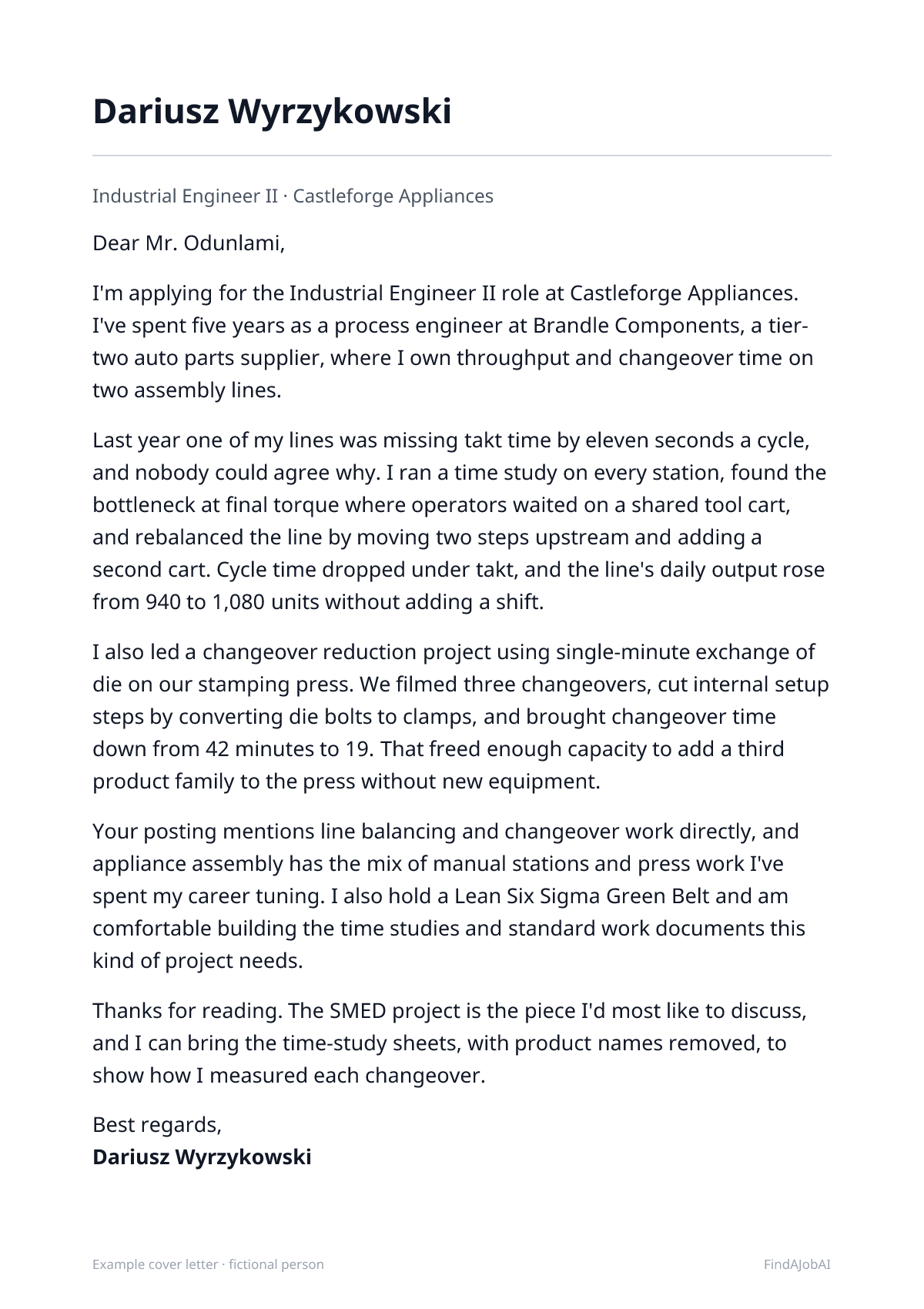
Dear Mr. Odunlami,
I'm applying for the Industrial Engineer II role at Castleforge Appliances. I've spent five years as a process engineer at Brandle Components, a tier-two auto parts supplier, where I own throughput and changeover time on two assembly lines.
Last year one of my lines was missing takt time by eleven seconds a cycle, and nobody could agree why. I ran a time study on every station, found the bottleneck at final torque where operators waited on a shared tool cart, and rebalanced the line by moving two steps upstream and adding a second cart. Cycle time dropped under takt, and the line's daily output rose from 940 to 1,080 units without adding a shift.
I also led a changeover reduction project using single-minute exchange of die on our stamping press. We filmed three changeovers, cut internal setup steps by converting die bolts to clamps, and brought changeover time down from 42 minutes to 19. That freed enough capacity to add a third product family to the press without new equipment.
Your posting mentions line balancing and changeover work directly, and appliance assembly has the mix of manual stations and press work I've spent my career tuning. I also hold a Lean Six Sigma Green Belt and am comfortable building the time studies and standard work documents this kind of project needs.
Thanks for reading. The SMED project is the piece I'd most like to discuss, and I can bring the time-study sheets, with product names removed, to show how I measured each changeover.
Best regards,
Dariusz Wyrzykowski
Example 2 · Career changer
machinist moving into industrial engineering
Talia fixed a scrap problem with data before she had the title. The ad mentions root cause analysis and capacity planning.
Example letter · fictional
Dear Hiring Manager,
I'm applying for the Junior Industrial Engineer role at Woolgate Fabrication. For six years I've worked as a CNC machinist at Harlow Metalworks, and the work I've enjoyed most there has been finding why a process drifts, not just running the machine.
Our scrap rate on one bracket part climbed for three months and nobody had pinned down why. I pulled a year of inspection logs into a spreadsheet, plotted scrap against shift, operator and tool age, and found scrap jumped sharply once a cutting tool passed 400 cycles, well before our replacement schedule called for it. We moved to a 300-cycle replacement interval, and scrap on that part fell from 7% to under 2% within a month.
Since then I've completed an associate degree in industrial technology at night and a root cause analysis course, and I built a capacity model in Excel that predicted our drill press would become the bottleneck once a new contract started, which it did four weeks later. I'm comfortable with Excel, basic SQL, and reading a process from the floor rather than only from a report.
Your posting asks for root cause analysis and capacity planning, which is the work I did on the bracket line before anyone called it that. I'd bring both the analysis and six years of knowing what's realistic to change on a shop floor.
Thank you for your time. I'd welcome the chance to talk through the tool-wear analysis in an interview.
Kind regards,
Talia Marchetti
Example 3 · Senior or lead
plant improvement manager applying to lead a new continuous improvement function
Grzegorz runs continuous improvement for three lines at a food packaging plant. The ad is for a first manager who will build the function from scratch.
Example letter · fictional
Dear Ms. Odusanya,
I'm applying for the Continuous Improvement Manager role at Thornbury Packaging. For the last four years I've led continuous improvement across three lines at Vantrelle Foods, managing a team of two industrial engineers, and before that I spent seven years as a process engineer. I'd like to build a function from its first year.
Your ad says the plant has run kaizen events before but nothing stuck once the consultants left. We had the same pattern at Vantrelle. I replaced one-off events with a standing weekly huddle where line leads bring one problem each, backed by a visual board tracking open actions and who owns them. Within six months, 80% of actions closed within their target date, up from under a third before, and three of our four lines now run their own weekly huddle without me present.
The project with the clearest payoff was a changeover standardization across our two filling lines. I found each shift ran changeover differently, with times ranging from 25 to 70 minutes for the same product switch. We filmed the best shift's method, built one standard with photos, and trained every shift to it. Average changeover time fell to 28 minutes plant-wide, and the plant gained roughly 300 hours of production capacity a year without new equipment.
I've coached a two-person team, though I haven't started a continuous improvement function from its first hire, or decided how it's funded and how results reach a plant manager. At Thornbury I'd sit down with you in the first weeks to settle that structure.
A conversation about which lines or shifts have resisted improvement work before, and why, would be a useful place to start.
Sincerely,
Grzegorz Falkowski
All three letters, and the short version below, are fictional: the people, employers and numbers are invented. Borrow the structure, never the facts.
- Prefer to write it yourself? Use the free cover letter template.
- Check your CV against the job first: the free CV score shows the missing keywords.
Why the first letter works, paragraph by paragraph
Paragraph 1: Opening
Names the exact lines and products Dariusz owns, so the reader knows the scope of his current role before any numbers appear.
Paragraph 2: The line balancing project
States the gap against takt time, the method (a time study), the bottleneck found, and the fix, ending in units per day, the plant's own measure.
Paragraph 3: The changeover project
Names the specific lean tool (SMED), the baseline and result in minutes, and what that time freed up, which shows the fix mattered beyond the metric.
Paragraph 4: Why this company
Connects the ad's stated needs to the writer's exact project history and names a credential, without listing it separately from the work.
Paragraph 5: Close
Offers to go deeper on one project rather than repeating the resume.
What the career changer's letter does differently
The career changer's letter starts from a scrap problem solved with data before the job title existed, with a measurable result (scrap down from 7% to under 2%). A degree and a capacity model that predicted a real bottleneck show the analysis is now backed by training, and the letter ties shop floor judgment to the ad's own terms.
What the senior letter does differently
A continuous improvement manager letter reports organizational habits, not just one project: a weekly huddle that made actions close on time, three lines now running it unsupervised, and a changeover standard rolled out across shifts. The gap, never having built a function from its first hire, is named directly.
Short industrial engineer cover letter: an email-ready version
Many applications arrive as an email or a small text box, and a full page doesn't fit. This version runs 120 to 150 words and keeps only what a reader needs to decide whether to reply. An industrial engineer answers a warehouse automation company's short-form application field, sent by email because the ad listed no portal link.
Short version · email · fictional125 words
Subject: Industrial Engineer (slotting, labor standards) – Teodor Vuksanović
Hello Mr. Castellanos,
I'm applying for the Industrial Engineer role at Crestline Logistics. I have four years of experience setting labor standards and slotting strategy at a regional distribution center, where I'm the engineer floor supervisors call first when a pick rate falls.
My clearest project was a re-slot of our fastest-moving SKUs by pick frequency instead of alphabetically. Average picks per hour rose from 68 to 84 across the shift, which let us absorb a volume increase without adding headcount.
Warehouse automation is the next place I want to use this kind of analysis. The resume is attached, and the slotting method is easy to explain on a call. I can also show the pick-frequency report format I give floor supervisors.
Best,
Teodor Vuksanović
A short-form field forces a single project, so the email keeps the re-slot result and its labor effect, in language a warehouse operator cares about. It skips the credentials and the lean vocabulary that the full letter would include.
Opening lines that work for industrial engineer cover letters
The first sentence decides whether the second gets read. Here are six openings, one for each situation you might be in. Pick the one that matches yours and swap in your own facts: every name and number below is invented.
1. You have a standout result
One line rebalance I led last year raised daily output by 140 units without adding a shift. I'd like to bring that kind of analysis to your assembly operation.
2. The ad names a problem you've solved
Your ad says changeovers are eating into capacity. At my current plant I cut changeover time on our stamping press by more than half using SMED, and I'd like to run a similar project here.
3. Someone referred you
Your operations director, Henrik Moszkowicz, worked with me for two years on a line rebalancing project before he moved to your plant. He mentioned you're looking for someone who starts from the floor, not the spreadsheet, which is why I'm writing.
4. You admire what they build
I've toured your facility twice as a supplier's engineer and noticed the same changeover pattern I solved at my last plant. I'd like to bring that fix to your line.
5. You're new to the field or switching into it
I spent six years as a machinist before teaching myself root cause analysis to fix a scrap problem nobody could explain. Industrial engineering is where I want to keep doing that work formally.
6. You have senior scope or a specialism
As continuous improvement lead for three lines over four years, I built the weekly review process the plant still runs without me. I'm looking for a role that lets me build that function from its first year.
How to write an industrial engineer cover letter
Five steps, in the order you'd write them. The shape stays the same for every job (a short opening, proof, a reason for this employer, a close), and what goes into each part is what changes with the role.
Find the specific line or process the ad is protecting
Industrial engineer ads usually name a pain point: changeovers, labor standards, scrap, or capacity. Work out which one the plant is describing, then choose the project of yours that comes nearest, ideally on a similar line type or at a similar volume.
Open with the bottleneck, not the tool
Say what was failing to hit target and by how much before naming the method you used. A reader who sees a real gap, such as missed takt time or excess changeover minutes, in your first paragraph will keep reading to find out how you closed it.
Pair every lean tool with its result
Name SMED, DMAIC, line balancing, or 5S only inside a sentence that also states the before-and-after number. A tool named without a result reads as a certification list; a tool named with a result reads as proof you can run it.
Use the plant's own units
State results in cycle time, units per shift, scrap percentage, or changeover minutes rather than vague terms like 'significant improvement.' Round or anonymize numbers from a current employer, but keep them specific enough to be checked in an interview.
Show you can work with operators and supervisors
One sentence on how you got buy-in: filming a changeover with the shift crew, building a visual board, or training operators to a new standard. Close by naming a process you'd like to look at in their plant, so the reader sees your first month.
Industrial Engineer cover letter do's and don'ts
Do
- Name the specific line, part, or process and the metric it moved: cycle time, scrap rate, changeover minutes, or units per shift.
- Mention the lean or Six Sigma tool the ad names (SMED, kaizen, DMAIC) inside a real project, not as a standalone list.
- Show the baseline and the result together, such as changeover time before and after, so the claim can be checked.
Don't
- Don't write "process-oriented with strong analytical skills"; show it with one bottleneck you found and fixed.
- Don't count the number of standard work documents you wrote; say what changed on the floor because of one of them.
- Don't share a current employer's actual output numbers; use rates, percentages, or rounded figures instead.
Common industrial engineer cover letter mistakes
Each one is easy to make and quick to fix before you send the letter.
Listing lean tools without a project
A row of Six Sigma, 5S, kaizen, and SMED with no story behind them tells the reader you've heard of them. Attach one to a real line and a real before-and-after number instead.
Reporting effort instead of the metric that moved
'Led a kaizen event' describes activity, not outcome. Say what changed because of it, such as changeover time or scrap rate, and give the baseline so the improvement can be judged.
Skipping the type of plant or line entirely
A letter that never mentions assembly, packaging, machining, or warehousing could apply anywhere. Name the process type this company runs and why your background fits it.
Sharing exact confidential output figures
Naming a current employer's precise daily unit count or cost per part can cross a line. Use percentages, ranges, or rounded numbers that still make the claim checkable.
Writing 'detail-oriented problem solver' as the pitch
Nearly every engineering applicant writes this. Replace it with the specific problem you solved and the method you used to find its cause.
Email subject lines for industrial engineer applications
Applying by email? Put the job title, any reference number and your name in the subject line.
- Industrial Engineer II application – line balancing and SMED – Dariusz Wyrzykowski
- Junior Industrial Engineer – machinist with root cause analysis background – Talia Marchetti
- Application: Industrial Engineer, Packaging Line (Req. 2217) – Dariusz Wyrzykowski
Everything for Industrial Engineers
- Industrial Engineer resume exampleA full resume, plus bullet and summary examples
- Industrial Engineer interview questions30 questions with sample answers
- Industrial Engineer job descriptionDuties, skills and requirements
- Career change cover letter: template + examples
Other cover letter examples
Industrial Engineer cover letter FAQ
What should I write in an industrial engineer cover letter?
One process problem you solved: the line or station, the method you used to find the cause, the fix, and the metric that moved, such as cycle time or scrap rate. Then a sentence on how you work with operators and supervisors. Your lean tools are already on your resume.
How do I write an industrial engineer cover letter with no experience?
Use process work from a shop floor, maintenance, or quality role, such as a scrap or downtime problem you diagnosed, then add relevant coursework or a certificate. Name the tool you used, such as a time study or Pareto chart, and the result.
Should I mention Six Sigma certification in the letter?
Mention it once, attached to a project where you used it, rather than as a line in a skills list. A Green Belt named next to a real DMAIC project is more convincing than the belt alone.
How specific should the numbers be?
Specific enough to sound real but rounded enough to respect confidentiality: cycle time in seconds, scrap as a percentage, changeover time in minutes. Avoid exact dollar figures tied to a current employer.
How we built this page
The FindAJobAI team wrote the three example letters, the short email version, the opening lines and the advice for industrial engineer roles. The people, employers and numbers in the letters are invented; the structure, the kind of evidence and the order of the paragraphs are the parts to copy.
Once we track enough live industrial engineer job ads, this page also shows the skills they ask for most, counted the same way as our in-demand skills report.
Last reviewed on November 1, 2026.