Insurance Agent Cover Letter Example (2026)
By FindAJobAI team Updated How we built this page
Insurance agent ads mostly ask for a license and a sales number, so most applicants read the same on paper. The cover letter is where you show how you actually build a book: who you ask for referrals, how you handle a renewal that's about to walk, and what happens after someone says no.
Insurance Agent cover letter template
This letter as a one-page template: an opening that names the job and your strongest fact, proof that answers the ad, a reason for this employer and a short close.
After you sign up, FindAJobAI drafts your own letter for a real job from your CV in this format, and you edit it before you send it.
Example 1 · Experienced
Multi-line agent applying to a regional agency
Darian has built a book of auto, home and umbrella policies over five years. The ad asks for cross-selling and retention numbers.
Example letter · fictional
Dear Ms. Castellane,
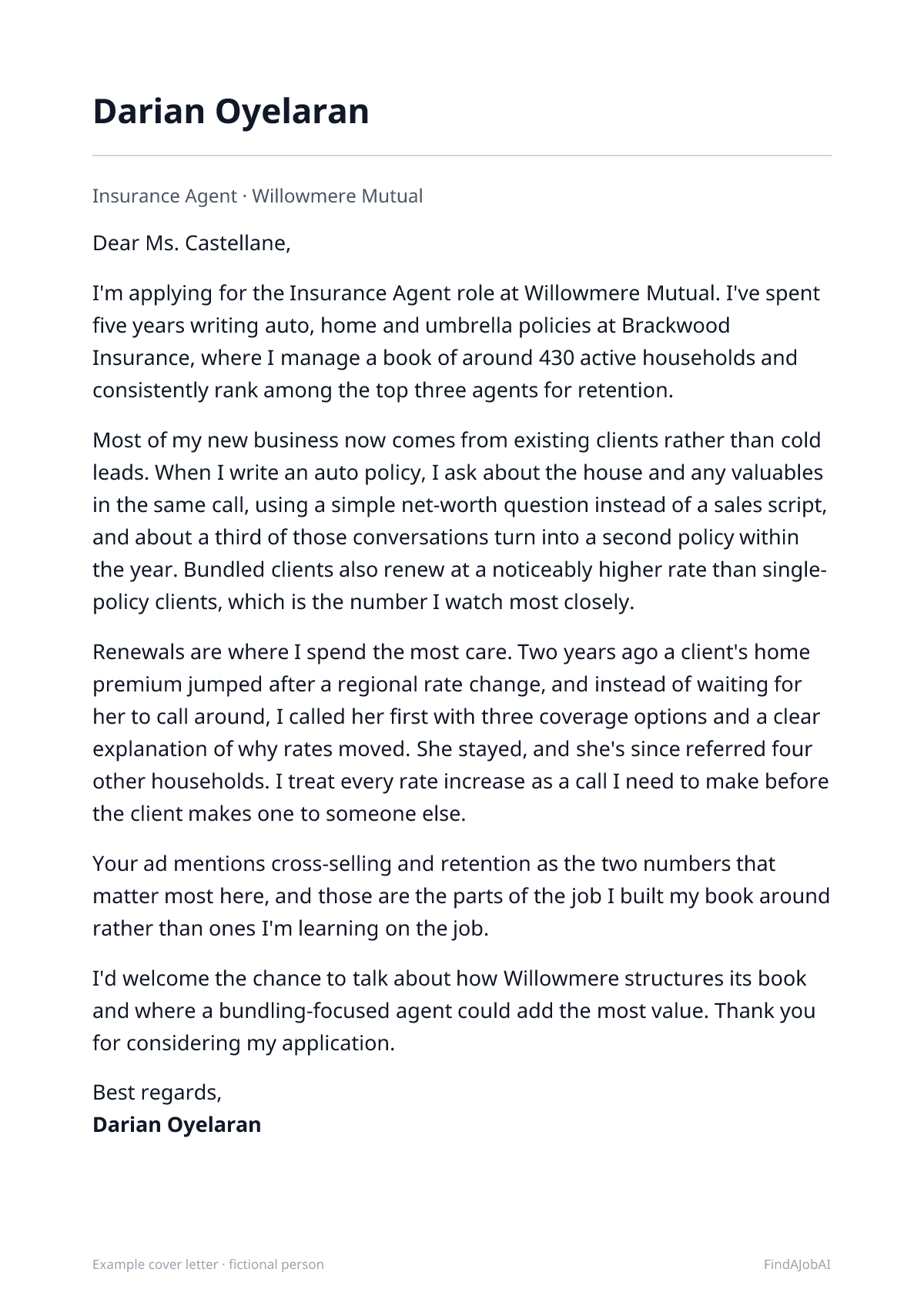
I'm applying for the Insurance Agent role at Willowmere Mutual. I've spent five years writing auto, home and umbrella policies at Brackwood Insurance, where I manage a book of around 430 active households and consistently rank among the top three agents for retention.
Most of my new business now comes from existing clients rather than cold leads. When I write an auto policy, I ask about the house and any valuables in the same call, using a simple net-worth question instead of a sales script, and about a third of those conversations turn into a second policy within the year. Bundled clients also renew at a noticeably higher rate than single-policy clients, which is the number I watch most closely.
Renewals are where I spend the most care. Two years ago a client's home premium jumped after a regional rate change, and instead of waiting for her to call around, I called her first with three coverage options and a clear explanation of why rates moved. She stayed, and she's since referred four other households. I treat every rate increase as a call I need to make before the client makes one to someone else.
Your ad mentions cross-selling and retention as the two numbers that matter most here, and those are the parts of the job I built my book around rather than ones I'm learning on the job.
I'd welcome the chance to talk about how Willowmere structures its book and where a bundling-focused agent could add the most value. Thank you for considering my application.
Best regards,
Darian Oyelaran
Example 2 · Career changer
Retail store manager moving into insurance sales
Petra ran a home goods store and handled complaint resolution daily. The ad wants a licensed or soon-to-be-licensed agent comfortable with cold outreach.
Example letter · fictional
Dear Hiring Manager,
I'm applying for the Insurance Agent role at Kestrel & Vance Insurance. For six years I managed a home goods store with a staff of twelve, and I passed my state property and casualty license last month because I want to move the relationship skills I built there into insurance full time.
Running that store meant handling the conversations other managers avoided: a damaged delivery, a warranty dispute, a customer who wanted a refund outside policy. I learned to listen past the first complaint to what the person actually needed, then offer a real option rather than a scripted apology. One recurring customer was ready to stop shopping with us over a mattress delivery issue; I worked out a replacement and a partial credit on the spot, and she's spent several thousand dollars with the store since.
I've since studied auto and home policy basics on my own and shadowed a family friend who's a captive agent for two afternoons a week over the past two months, sitting in on renewal calls and new-client quotes. I'm comfortable asking direct questions about coverage gaps, which is most of what I watched him do.
Your ad asks for comfort with cold outreach, which doesn't worry me. I spent years approaching customers who weren't looking for help and finding a way to be useful to them anyway, and I'd bring that same instinct to calling prospects who haven't thought about their coverage yet.
Thank you for your time. I'm available to start as soon as licensing requirements allow, and I'd welcome a conversation.
Kind regards,
Petra Linnehan
Example 3 · Senior or lead
Agency manager applying to lead a struggling branch
Soren manages twelve agents at a mid-size agency. The ad is for a manager to turn around a branch with high agent turnover.
Example letter · fictional
Dear Mr. Ferraby,
I'm applying for the Agency Manager role at Thornbury Mutual Group. For four years I've managed a branch of twelve agents at Caldecott Insurance, after seven years writing policies myself, and I understand your Riverton branch has lost half its agents in the past year, which is the kind of problem I'd like to help fix.
When I took over my branch, new agents were quitting within six months, mostly over unclear commission structures and no real training past week one. I built a 90-day onboarding plan pairing each new agent with a mentor for live calls, and rewrote our commission sheet into one page instead of the three-page document agents couldn't explain to each other, let alone to themselves. Agent turnover in year one of a new hire fell by more than half, and our branch now trains new agents from two neighboring branches as well.
The harder problem was a sales floor that had stopped cross-selling. I pulled six months of policy data and found that agents who asked about a second policy within the first call closed far more bundles than agents who called back later, so I made the first-call question part of our script and reviewed call recordings with agents monthly. Branch retention rose from the mid-70s to the low 80s in percentage terms within a year, and it's held since.
I haven't managed a branch this size or run a full turnaround from a declining base, and I'd want to spend real time with Riverton's agents in my first weeks before changing anything, rather than assuming my methods transfer directly.
I'd welcome a conversation about what's driven the turnover at Riverton and which of your agents you'd want involved in fixing it. Thank you for considering my application.
Sincerely,
Soren Vaickus
All three letters, and the short version below, are fictional: the people, employers and numbers are invented. Borrow the structure, never the facts.
- Prefer to write it yourself? Use the free cover letter template.
- Check your CV against the job first: the free CV score shows the missing keywords.
Why the first letter works, paragraph by paragraph
Paragraph 1: Opening
States the book size and a specific, checkable rank (top three for retention) rather than a vague claim of success. Agency hiring managers think in book size first.
Paragraph 2: How cross-selling actually happens
Explains the real mechanic, a net-worth question asked during an existing call, not a slogan about being a 'relationship builder,' and gives the behavior it produces.
Paragraph 3: A renewal saved
One concrete save, told as a decision (calling before the client calls around) with its result, referrals, which matters more in this business than a single sale.
Paragraph 4: Why this agency
Mirrors the ad's own stated priorities back directly, showing the letter was written for this posting.
Paragraph 5: Close
Invites a conversation about the agency's book structure, a specific and low-pressure next step.
What the career changer's letter does differently
The career changer's letter leads with a licensing fact (passed last month) so the reader isn't wondering about eligibility, then uses a retail complaint story to show the same instinct insurance sales needs: finding what a reluctant person actually wants. Shadowing a working agent substitutes for sales experience the letter doesn't have yet.
What the senior letter does differently
A manager's letter reports what changed at the branch level: a 90-day onboarding plan, turnover cut by more than half, a first-call script built from real call data. It names the harder, unproven part directly, a bigger turnaround than any the writer has led, rather than implying the fix is simple.
Short insurance agent cover letter: an email-ready version
Many applications arrive as an email or a small text box, and a full page doesn't fit. This version runs 120 to 150 words and keeps only what a reader needs to decide whether to reply. An agent answers a regional carrier's short online application after a referral mentioned the role was filling fast.
Short version · email · fictional125 words
Subject: Insurance Agent application (P&C licensed) – Idris Kwarteng
Hello Ms. Okonjo,
I'm applying for the Insurance Agent role at Larkspur Assurance. I'm licensed in property and casualty and have spent three years building a personal lines book, currently around 280 households, with retention above most of my peer group.
My strongest habit is calling clients before a rate increase reaches them, with options already prepared. One client stayed and referred three more households after a call like that last spring, which is typical of how my book has grown.
I'd like to bring that same approach to a larger book here. My resume is attached, and I'm glad to share more about my renewal process on a call. I can also share two renewal call scripts I use each quarter.
Best,
Idris Kwarteng
A short application keeps one habit, calling ahead of rate increases, and its downstream result, referrals, rather than listing every line the writer sells. License status comes first since it's the fastest disqualifier for a reader skimming quickly.
Opening lines that work for insurance agent cover letters
The first sentence decides whether the second gets read. Here are six openings, one for each situation you might be in. Pick the one that matches yours and swap in your own facts: every name and number below is invented.
1. You have a standout result
Last spring I called a client ahead of a rate increase with three options ready, and she's since referred three more households. I'd like to build that same habit into a book here.
2. The ad names a problem you've solved
Your ad mentions agent turnover as a problem on this team. At my current agency I rebuilt onboarding so new agents stopped quitting in their first six months, and I'd like to bring that same fix to Thornbury.
3. Someone referred you
Your branch manager, Tomasz Wrenfield, mentored me through my first year of licensing and recommended I apply here directly, which is what prompted this letter.
4. You admire what they build
I've been a Larkspur policyholder for four years, and a recent claim was handled better than I expected for the industry; I'd like to help sell that same experience to other households.
5. You're new to the field or switching into it
I managed a retail store for six years and spent most of that time turning frustrated customers into repeat ones. I'm now licensed in property and casualty and want to do that work in insurance full time.
6. You have senior scope or a specialism
As an agency manager for four years, I cut new-agent turnover by more than half with a rewritten onboarding plan. I'm ready to take on a bigger branch and a harder turnaround.
How to write an insurance agent cover letter
Five steps, in the order you'd write them. The shape stays the same for every job (a short opening, proof, a reason for this employer, a close), and what goes into each part is what changes with the role.
Lead with your license and line of authority
State your license status (property and casualty, life, health) and how long you've held it in the first sentence or two. Hiring managers often screen this first, and burying it makes a reader search for the one fact that decides whether to keep reading.
Describe one renewal or cross-sell as a real conversation
Pick a single client moment: a renewal call, a bundled quote, a complaint you turned around. Say what you asked or offered and what happened next. A specific conversation is more convincing than a claimed personality trait like being personable.
Use retention or book growth as your proof point
Agencies hire for a number, usually retention, cross-sell rate or book size. Give a rounded figure or a comparison to peers rather than a precise confidential figure from a current employer, and explain briefly what produced it.
Show how you handle a no, not just a yes
Anyone can describe closing a sale. Describe a prospect or client who said no, hesitated, or shopped around, and what you did next. This is what separates agents who only take easy business from ones who build a durable book.
Name the agency's specific need from the ad
Match the letter to what the ad actually says it needs, cross-selling, retention, cold outreach, a language skill, rather than a general sales pitch. Close with a short, concrete offer, like discussing your renewal process or sharing rounded book metrics.
Insurance Agent cover letter do's and don'ts
Do
- Name your license status and line of authority (property and casualty, life, health) right away so the reader doesn't have to ask.
- Describe one renewal or cross-sell as a specific conversation, not a category of success.
- If you're new to insurance, name the closest transferable skill (cold outreach, complaint resolution, quoting) with one real example.
Don't
- Don't write "people person" or "natural salesperson"; show one conversation that proves it.
- Don't quote your personal sales figures from a current book if your contract restricts disclosing client data; describe the method and a rounded, non-identifying result instead.
- Don't promise a specific sales number you haven't hit yet; describe the habits that produce sales instead.
Common insurance agent cover letter mistakes
Each one is easy to make and quick to fix before you send the letter.
Burying your license status
If a reader has to search for whether you're licensed and in which lines, you've lost them. State it in the first sentence, including your exam date if you're newly licensed.
Claiming traits instead of showing conversations
"Personable, driven, great with people" could describe anyone. Replace each trait with one real conversation, a renewal call, a cold approach, a complaint resolved, that demonstrates it.
Sharing confidential client or commission data
Precise figures from a current book may be restricted by contract. Use rounded numbers, percentages, or peer comparisons (top three for retention) that show results without disclosing specifics you're not allowed to share.
Treating every line of insurance the same
Auto, home, life and health sell differently and to different anxieties. Mention the specific lines you've sold or studied, and tailor your examples to the lines the ad actually asks for.
Skipping what happens after a no
A letter full of easy wins reads as incomplete. Include one moment where a prospect resisted or a client almost left, and what you did about it, since that's most of the actual job.
Email subject lines for insurance agent applications
Applying by email? Put the job title, any reference number and your name in the subject line.
- Insurance Agent application – multi-line book, retention focus – Darian Oyelaran
- Licensed Insurance Agent – retail manager transitioning to sales – Petra Linnehan
- Application: Insurance Agent, Personal Lines (Req. 2217) – Darian Oyelaran
Everything for Insurance Agents
- Insurance Agent resume exampleA full resume, plus bullet and summary examples
- Insurance Agent interview questions30 questions with sample answers
- Insurance Agent job descriptionDuties, skills and requirements
- Career change cover letter: template + examples
Other cover letter examples
Insurance Agent cover letter FAQ
What should I write in an insurance agent cover letter?
One renewal or cross-sell handled as a real conversation, including what you said and what happened, plus your license status and line of authority. Skip adjectives like 'motivated' and show the habit instead.
How do I write an insurance agent cover letter with no experience?
Lead with your license or exam date, then use a transferable story, retail, customer service or outreach, where you handled a reluctant person or a sales conversation. Name anything you've shadowed or studied so far.
Should I mention my book size or sales numbers?
Yes, if you can describe them without revealing confidential client data from a current employer. Rounded figures or rank among peers (top three for retention) work well and are easy to check in an interview.
Do I need to mention a specific insurance carrier or captive agency experience?
Only if the ad asks for it directly. Otherwise, focus on the lines you're licensed to sell and how you build and keep a book, which matters more to most agencies than which carrier's name is on your old badge.
How we built this page
The FindAJobAI team wrote the three example letters, the short email version, the opening lines and the advice for insurance agent roles. The people, employers and numbers in the letters are invented; the structure, the kind of evidence and the order of the paragraphs are the parts to copy.
Once we track enough live insurance agent job ads, this page also shows the skills they ask for most, counted the same way as our in-demand skills report.
Last reviewed on November 1, 2026.