Manufacturing Engineer Cover Letter Example (2026)
By FindAJobAI team Updated How we built this page
Manufacturing engineer ads ask for a mix of process improvement, tooling, and line support, and most applicants list the same software and certifications. The cover letter is where you name the line you worked on, the defect or bottleneck you fixed, and what that was worth in scrap, downtime, or throughput.
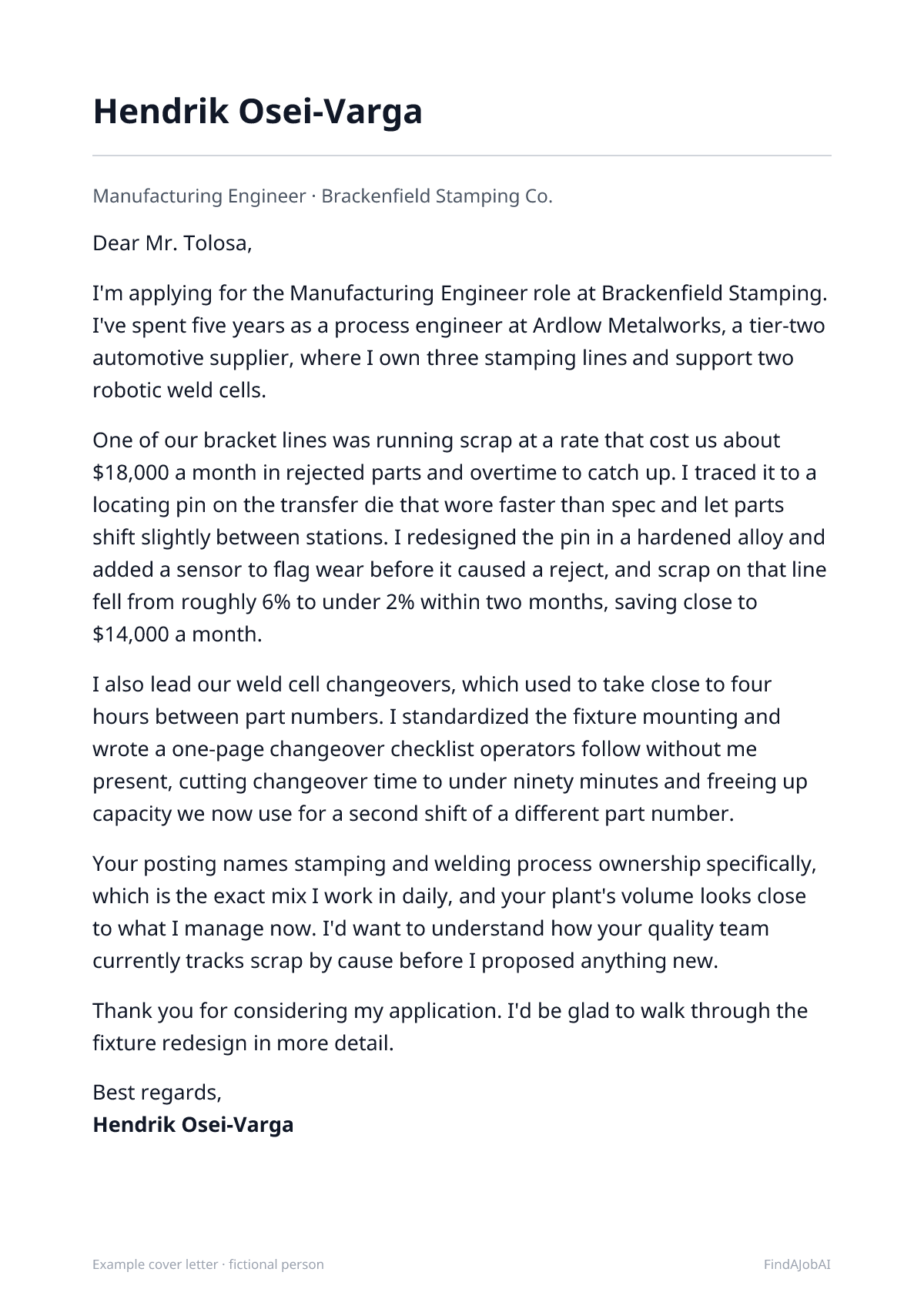
Manufacturing Engineer cover letter template
This letter as a one-page template: an opening that names the job and your strongest fact, proof that answers the ad, a reason for this employer and a short close.
After you sign up, FindAJobAI drafts your own letter for a real job from your CV in this format, and you edit it before you send it.
Example 1 · Experienced
Process engineer applying to an automotive supplier
Hendrik cut scrap on a stamping line by redesigning a fixture. The ad asks for stamping and welding process experience.
Example letter · fictional
Dear Mr. Tolosa,
I'm applying for the Manufacturing Engineer role at Brackenfield Stamping. I've spent five years as a process engineer at Ardlow Metalworks, a tier-two automotive supplier, where I own three stamping lines and support two robotic weld cells.
One of our bracket lines was running scrap at a rate that cost us about $18,000 a month in rejected parts and overtime to catch up. I traced it to a locating pin on the transfer die that wore faster than spec and let parts shift slightly between stations. I redesigned the pin in a hardened alloy and added a sensor to flag wear before it caused a reject, and scrap on that line fell from roughly 6% to under 2% within two months, saving close to $14,000 a month.
I also lead our weld cell changeovers, which used to take close to four hours between part numbers. I standardized the fixture mounting and wrote a one-page changeover checklist operators follow without me present, cutting changeover time to under ninety minutes and freeing up capacity we now use for a second shift of a different part number.
Your posting names stamping and welding process ownership specifically, which is the exact mix I work in daily, and your plant's volume looks close to what I manage now. I'd want to understand how your quality team currently tracks scrap by cause before I proposed anything new.
Thank you for considering my application. I'd be glad to walk through the fixture redesign in more detail.
Best regards,
Hendrik Osei-Varga
Example 2 · Career changer
CNC machinist moving into manufacturing engineering
Remy fixed a tolerance problem from the machine floor and finished an engineering technology degree at night. The ad wants hands-on floor experience.
Example letter · fictional
Dear Ms. Quintrell,
I'm applying for the Manufacturing Engineer role at Thorncastle Precision Parts. I've worked as a CNC machinist for six years at Ravensmoor Tooling, and this spring I completed an engineering technology degree at night while still running the floor.
Two years ago, a batch of aerospace brackets kept failing final inspection on a single bore diameter, and engineering had already changed the program twice without fixing it. From the machine, I noticed the issue only showed up after the tool had been running for an hour, which pointed to thermal drift rather than the program. I proposed a mid-run offset compensation step, and once engineering built it into the process, the scrap rate on that part dropped from about 9% to under 1%, and I was asked to help validate the fix on two similar parts.
Since finishing my degree, I've built a small home project measuring tool wear on a benchtop mill with a data logger, mostly to practice the statistical process control methods from my coursework on something concrete. I'm comfortable in SolidWorks and have used Minitab for the SPC work in my capstone project.
Your posting asks for hands-on floor experience alongside the engineering degree, which is exactly how I'd describe my background. I know what it's like to be handed a fix that doesn't account for how the machine actually behaves, and I'd bring that perspective to the engineering side.
Thank you for your time. I'd welcome the chance to discuss the bore diameter project and how it might apply to your parts.
Sincerely,
Remy Shapiro
Example 3 · Senior or lead
Engineering manager applying to lead a plant's manufacturing engineering group
Branwell manages five engineers across two product lines. The ad is for a manager who will standardize tooling documentation and new product launches.
Example letter · fictional
Dear Ms. Larkspur,
I'm applying for the Manufacturing Engineering Manager role at Corvendale Industrial. For the last four years I've managed a team of five engineers across two product lines at Fenwick Diecasting, and before that I spent seven years as an individual process engineer. I'd like to bring that structure to a plant where launches currently depend on whichever engineer is available.
Your posting says new product launches slip because tooling documentation lives in different formats across engineers, and nobody owns a standard. We had the same problem at Fenwick. I built a shared tooling and process documentation template every engineer now uses before a part is released to production, and I set up a launch checklist with signoffs from quality, maintenance, and production before first run. Average time from design handoff to stable production dropped from close to eleven weeks to under seven, and two recent launches hit stable yield on their first week instead of requiring a rework pass.
The clearest example of what that structure changed: a die for a new housing part was handed to one of my newer engineers, who followed the launch checklist and caught a venting issue during the signoff review that would have caused a known defect pattern once the die was in full production. Under our old process, that would likely have surfaced only after several thousand parts were already scrapped.
I've hired three of my five engineers and run a monthly technical review where they present a current problem to the group for input. I haven't yet managed a capital budget for new tooling purchases across multiple product lines, and at Corvendale I'd want to build that process carefully alongside your finance team.
A conversation about which launches have given your team the most trouble recently, and how documentation currently moves between engineering and production, would be a good place to start.
Sincerely,
Branwell Oyelaran-Hutchins
All three letters, and the short version below, are fictional: the people, employers and numbers are invented. Borrow the structure, never the facts.
- Prefer to write it yourself? Use the free cover letter template.
- Check your CV against the job first: the free CV score shows the missing keywords.
Why the first letter works, paragraph by paragraph
Paragraph 1: Opening
Names the exact line ownership (three stamping lines, two weld cells) and the type of supplier, since plants hire for scale and process type as much as general title.
Paragraph 2: The fix that moved a cost number
States the dollar cost of the problem, the root cause found, the specific fix (a redesigned locating pin with a wear sensor), and the result in the same dollar terms, which shows the fix was tracked, not just implemented.
Paragraph 3: A second, different kind of improvement
Changeover time is a different metric than scrap, showing range across process ownership, and naming a written checklist shows the fix survives without the writer present.
Paragraph 4: Honest fit and a next step grounded in their data
Mirrors the ad's named processes and proposes understanding their current tracking before suggesting changes, which reads as collaborative rather than presumptuous.
Paragraph 5: Close
Offers to go deeper on one specific project rather than a generic thank-you, giving the reader an easy next step.
What the career changer's letter does differently
The career changer's letter roots engineering judgment in a specific floor diagnosis (thermal drift, not the program) that formal engineering had missed twice, with a measurable scrap reduction. The degree and a self-directed SPC project show the skills are now formal, and the letter turns machine-floor years into a stated advantage rather than a gap to explain away.
What the senior letter does differently
A manufacturing engineering manager letter reports team-level habits: a shared documentation template, a launch checklist with cross-functional signoffs, a monthly technical review. The housing part example shows the structure catching a defect through someone else, a newer engineer, which is the clearest evidence a system works without the manager present. The gap, managing a multi-line capital budget, is named rather than hidden.
Short manufacturing engineer cover letter: an email-ready version
Many applications arrive as an email or a small text box, and a full page doesn't fit. This version runs 120 to 150 words and keeps only what a reader needs to decide whether to reply. A manufacturing engineer answers a plant's short online application question the night before a posting closes.
Short version · email · fictional129 words
Subject: Manufacturing Engineer application – welding process and fixtures – Tobias Granfeldt
Hello Mr. Castellano,
I'm applying for the Manufacturing Engineer opening at Millbrace Fabrication. I've spent four years as a process engineer supporting two robotic weld cells at a metal fabrication plant, with responsibility for fixture design and changeover time.
My clearest result was a fixture redesign on a chassis weld cell: changeover time dropped from close to three hours to under one hour, and weld defects tied to fixture misalignment fell from about 7% to 2% over the following quarter. I also wrote the changeover checklist operators now follow without an engineer present.
I'd like to bring that same mix of fixture design and process documentation to your weld cells. My resume is attached, and I'm glad to walk through the fixture redesign in more detail.
Best,
Tobias Granfeldt
A late-night application keeps the letter to one fixture project with two tracked numbers, changeover time and defect rate, cutting the plant description and any secondary projects to fit the space.
Opening lines that work for manufacturing engineer cover letters
The first sentence decides whether the second gets read. Here are six openings, one for each situation you might be in. Pick the one that matches yours and swap in your own facts: every name and number below is invented.
1. You have a standout result
A fixture redesign I led last year cut changeover time on a weld cell from three hours to under one, while also reducing defects tied to misalignment. I'd like to bring that same approach to your weld cells.
2. The ad names a problem you've solved
Your ad mentions launches slipping due to inconsistent tooling documentation. At my current plant I built a shared documentation template now used across our engineering team, which is the gap I'd want to help close here.
3. Someone referred you
Your maintenance lead, Ingeborg Castellanos, mentioned to a mutual colleague that your stamping line has had recurring die wear issues, which is what prompted me to apply once I saw this posting.
4. You admire what they build
I toured your Millbrace facility on a supplier visit two years ago and noticed your transfer press setup closely resembles one I've already improved scrap rates on; I'd like to bring that experience here.
5. You're new to the field or switching into it
I worked as a CNC machinist for six years, then finished an engineering technology degree at night after diagnosing a tolerance problem from the machine floor that engineering had missed twice. Manufacturing engineering is where I want to keep solving problems like that.
6. You have senior scope or a specialism
As engineering manager for a five-person team for four years, I built the documentation standard and launch checklist our plant now requires for every new part. I'm looking for a role that sets that structure for a larger operation.
How to write a manufacturing engineer cover letter
Five steps, in the order you'd write them. The shape stays the same for every job (a short opening, proof, a reason for this employer, a close), and what goes into each part is what changes with the role.
Lead with your process and line scale
State the specific process you own, such as stamping, welding, CNC, or molding, and the number of lines or cells, in your first paragraph. Plants are screening for whether your scale and process type match theirs before they read anything else.
Open with the cost of the problem, not the fix
Say what the defect, downtime, or bottleneck was costing in scrap, hours, or missed throughput before naming your fix. A reader who sees a real cost in your first paragraph trusts the result that follows more than a fix described in isolation.
Name the root cause you found, not just the fix applied
Engineers are hired to diagnose, not just patch. Say what you discovered was actually causing the problem, such as thermal drift or fixture wear, before describing the change you made. This shows judgment that a listed fix alone doesn't.
Attach a number to the result and say how it was measured
Give a before-and-after figure for scrap rate, changeover time, or throughput, and name roughly how long it held. Avoid vague claims like "significantly improved," since a specific, checkable number is what separates engineers from each other on paper.
Show the fix survives without you present
One sentence on how the fix became standard, such as a written checklist, a built-in sensor, or a documentation template others now use. This matters more in manufacturing than almost any other field, since plants run on multiple shifts you won't be on.
Manufacturing Engineer cover letter do's and don'ts
Do
- Name the specific process (stamping, welding, CNC, injection molding) and the line or cell you owned, with its approximate scale.
- Attach a dollar figure or percentage to one fix: scrap rate, downtime, changeover time, or throughput.
- Name the software or method the ad lists (SolidWorks, Minitab, SPC, Lean, Six Sigma) only inside a real example of using it.
Don't
- Don't write "strong problem solver with attention to detail"; show it with one root cause you found and fixed.
- Don't claim credit for a fix engineering implemented if you only diagnosed it; say what you actually did.
- Don't share your current employer's full cost or volume figures; use percentages or rounded, anonymized numbers.
Common manufacturing engineer cover letter mistakes
Each one is easy to make and quick to fix before you send the letter.
Describing the fix without the root cause
"I redesigned the fixture and scrap dropped" skips the diagnosis. Say what you found was actually wrong first, such as a worn locating pin or thermal drift, since that's the reasoning a hiring engineer actually wants to see.
Citing a result without a starting point
"Reduced scrap significantly" can't be checked. State the starting rate, the new rate, and roughly how long the plant tracked it, so the claim has the specificity a real engineer's report would have.
Listing every software and certification you've touched
A row of SolidWorks, Minitab, AutoCAD, and a Six Sigma belt without context suggests shallow use of each. Name the one or two most relevant to this posting and show them inside a real project.
Taking credit for a team's fix
If you diagnosed a problem but someone else implemented the change, say that honestly. A hiring manager would rather know exactly what you did than discover the gap in an interview.
Ignoring how the fix holds up on other shifts
A fix that depends on you being on the floor isn't a complete fix in a multi-shift plant. Mention the checklist, sensor, or documentation that let the improvement run without you there.
Email subject lines for manufacturing engineer applications
Applying by email? Put the job title, any reference number and your name in the subject line.
- Manufacturing Engineer application – stamping and welding process – Hendrik Osei-Varga
- Manufacturing Engineer – CNC machinist with engineering degree – Remy Shapiro
- Application: Manufacturing Engineer, Line 4 (Req. 3391) – Hendrik Osei-Varga
Everything for Manufacturing Engineers
- Manufacturing Engineer resume exampleA full resume, plus bullet and summary examples
- Manufacturing Engineer interview questions30 questions with sample answers
- Manufacturing Engineer job descriptionDuties, skills and requirements
- Career change cover letter: template + examples
Other cover letter examples
Manufacturing Engineer cover letter FAQ
What should I write in a manufacturing engineer cover letter?
One process problem you diagnosed and fixed, with the root cause, the fix, and the result in scrap, downtime, or throughput terms. Then a sentence on how the fix holds up without you present, such as a written procedure or a built-in sensor.
How do I write a manufacturing engineer cover letter with no experience?
Use floor experience from a machinist, technician, or quality role, plus any coursework or self-directed project using SPC or CAD tools. Name the specific problem you noticed from the floor and what you proposed, even if someone else implemented it.
Should I mention Lean or Six Sigma certifications in a manufacturing engineer cover letter?
Yes, but inside a real example of applying the method, such as a kaizen event or a specific SPC chart that caught a drifting process. Listing the certification alone without a result tells the reader little.
How specific should the numbers in a manufacturing engineer cover letter be?
Specific enough to be checkable but rounded enough to protect confidential figures. A scrap rate or changeover time with a before-and-after number is more convincing than a vague claim of improvement.
How we built this page
The FindAJobAI team wrote the three example letters, the short email version, the opening lines and the advice for manufacturing engineer roles. The people, employers and numbers in the letters are invented; the structure, the kind of evidence and the order of the paragraphs are the parts to copy.
Once we track enough live manufacturing engineer job ads, this page also shows the skills they ask for most, counted the same way as our in-demand skills report.
Last reviewed on November 1, 2026.