Marketing Analyst Cover Letter Example (2026)
By FindAJobAI team Updated How we built this page
Marketing analyst ads want someone who can read a dashboard and also explain why a campaign underperformed, which is two different skills most applicants only show one of. The cover letter is where you name the question a campaign raised, the number you pulled to answer it, and the budget or message that changed because of your answer.
Marketing Analyst cover letter template
This letter as a one-page template: an opening that names the job and your strongest fact, proof that answers the ad, a reason for this employer and a short close.
After you sign up, FindAJobAI drafts your own letter for a real job from your CV in this format, and you edit it before you send it.
Example 1 · Experienced
Campaign analyst applying to a skincare brand
Winnifred analyzes paid and email campaigns for an online skincare retailer. The ad asks for attribution experience and comfort presenting to brand managers.
Example letter · fictional
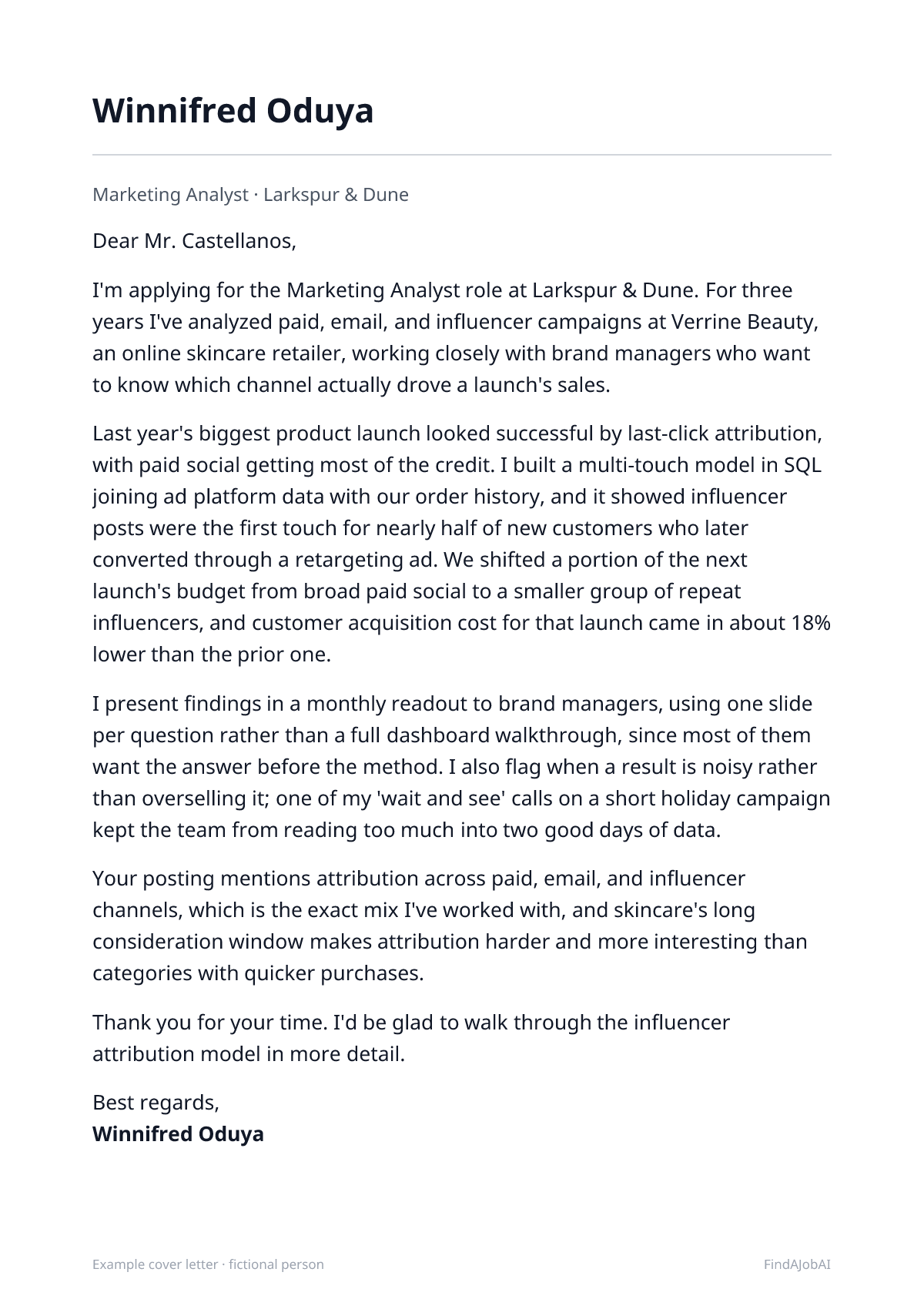
Dear Mr. Castellanos,
I'm applying for the Marketing Analyst role at Larkspur & Dune. For three years I've analyzed paid, email, and influencer campaigns at Verrine Beauty, an online skincare retailer, working closely with brand managers who want to know which channel actually drove a launch's sales.
Last year's biggest product launch looked successful by last-click attribution, with paid social getting most of the credit. I built a multi-touch model in SQL joining ad platform data with our order history, and it showed influencer posts were the first touch for nearly half of new customers who later converted through a retargeting ad. We shifted a portion of the next launch's budget from broad paid social to a smaller group of repeat influencers, and customer acquisition cost for that launch came in about 18% lower than the prior one.
I present findings in a monthly readout to brand managers, using one slide per question rather than a full dashboard walkthrough, since most of them want the answer before the method. I also flag when a result is noisy rather than overselling it; one of my 'wait and see' calls on a short holiday campaign kept the team from reading too much into two good days of data.
Your posting mentions attribution across paid, email, and influencer channels, which is the exact mix I've worked with, and skincare's long consideration window makes attribution harder and more interesting than categories with quicker purchases.
Thank you for your time. I'd be glad to walk through the influencer attribution model in more detail.
Best regards,
Winnifred Oduya
Example 2 · Career changer
Social media coordinator moving into marketing analytics
Kofi manages social content for a regional coffee chain and taught himself to analyze engagement data. The ad wants campaign reporting and some SQL.
Example letter · fictional
Dear Hiring Manager,
I'm applying for the Marketing Analyst role at Pennywhistle Coffee Co. For two years I've managed social content for a regional coffee chain with 14 locations, and the part of that job I've grown to care about most is figuring out which posts actually bring people into a store.
Last fall I noticed our seasonal drink posts got strong likes but little measurable foot traffic, while plainer posts about new store openings drove more redemptions of an in-app offer we tracked. I pulled engagement data into a spreadsheet, matched posting dates against redemption counts by location, and proposed we shift more of the seasonal budget toward opening announcements. The next quarter's redemption rate for that offer type rose noticeably, and our marketing director now asks for that comparison before any new campaign.
That project is why I started learning SQL and spreadsheet modeling on my own, through an online course, and why I built a small side project pulling public social data to practice the same kind of comparison at a larger scale.
Your ad asks for someone comfortable turning campaign data into a monthly report for the marketing team, which is close to what I already do informally for our director. I'd bring that reporting habit along with real social and content experience, which is useful context for judging what a number in a dashboard actually means.
Thank you for considering my application. I'm happy to share the redemption analysis or discuss it on a call.
Sincerely,
Kofi Pearson
Example 3 · Senior or lead
Analytics manager applying to lead a marketing analytics function
Grzegorz manages three marketing analysts at a subscription box company. The ad is for a manager who will formalize reporting for the whole marketing team.
Example letter · fictional
Dear Ms. Falkenrath,
I'm applying for the Marketing Analytics Manager role at Thistlebrook Goods. For the past two years I've managed a team of three marketing analysts at Ravelwood Subscriptions, after four years as a senior analyst there, and I'd like to bring that experience to a team your ad describes as still building its reporting process.
When I took over, each channel team pulled its own numbers, and a monthly leadership review often opened with two people disputing whose revenue figure was correct. I built one shared attribution model with definitions signed off by every channel owner, and moved our dozen separate spreadsheets into a single dashboard with one agreed source of truth. Review meetings now open with the numbers settled, and the time my team spends reconciling reports dropped by about half.
The project I'm proudest of is a churn-driver analysis that showed subscribers acquired through a specific discount code churned noticeably faster than those acquired any other way. Marketing had been expanding that code's use because it drove sign-ups cheaply; once we saw the churn pattern, they scaled it back and shifted budget to a referral program with slower but stickier growth, and our overall subscriber lifetime value rose over the following two quarters.
I've hired two of my three analysts and run a quarterly rotation where each one owns a different channel for a stretch, so no one gets siloed. I haven't yet managed analytics for a team this size across in-house and agency marketing together, which is the part of this role I'd most want to learn from your existing structure.
I'd welcome a conversation about which marketing decisions currently take the longest to get good data for, and how your channel teams share numbers today.
Sincerely,
Grzegorz Nowicki
All three letters, and the short version below, are fictional: the people, employers and numbers are invented. Borrow the structure, never the facts.
- Prefer to write it yourself? Use the free cover letter template.
- Check your CV against the job first: the free CV score shows the missing keywords.
Why the first letter works, paragraph by paragraph
Paragraph 1: Opening
Names the channels the writer analyzes (paid, email, influencer) and the stakeholder she serves (brand managers), which tells the reader her scope before any example.
Paragraph 2: The attribution finding
A specific disagreement between two attribution views, the method used to resolve it, and a budget decision measured in the company's own metric, acquisition cost.
Paragraph 3: Presenting to stakeholders
Shows she adapts format to her audience and is honest about uncertain results, which is what separates an analyst brand managers trust from one they tune out.
Paragraph 4: Why this company
Mirrors the ad's channel mix and adds a specific reason skincare's longer purchase cycle suits her attribution experience.
Paragraph 5: Close
Offers to go deeper on the one model mentioned, rather than a general offer to discuss her resume.
What the career changer's letter does differently
The career changer's letter starts from a real comparison he made between content types and store traffic before he had an analyst title, with a measurable shift in redemption rates. Naming the course and the side project signals the skills are developing formally, and the letter explicitly connects his content background to judging what campaign numbers mean.
What the senior letter does differently
A manager-level letter reports the team's operating history: one shared attribution model, reconciliation time cut, a churn finding that reshaped a discount strategy. The honest gap, no experience managing analytics across in-house and agency marketing together, is named plainly, which reads as more credible than a letter claiming full readiness.
Short marketing analyst cover letter: an email-ready version
Many applications arrive as an email or a small text box, and a full page doesn't fit. This version runs 120 to 150 words and keeps only what a reader needs to decide whether to reply. A marketing analyst answers a fitness app's short online application form, sent by email because the portal's upload tool kept failing.
Short version · email · fictional127 words
Subject: Marketing Analyst application – retention and email campaigns – Saoirse Vantongeren
Hello Mr. Abiodun,
I'm applying for the Marketing Analyst role at Brightfern Wellness. I have two years of experience analyzing email and in-app campaigns for a meal-planning app, working closely with the lifecycle marketing team on retention.
My strongest project compared two onboarding email sequences, which showed a shorter sequence led to noticeably better 30-day retention despite fewer total touches. We switched all new users to the shorter sequence, and churn in the first month dropped measurably.
I'm comfortable in SQL, Mixpanel, and building the kind of monthly report a lifecycle team actually reads. My resume is attached, and I can share the onboarding comparison in more detail. I'm also glad to walk through how I framed the retention question before pulling any data.
Best,
Saoirse Vantongeren
The short version keeps one onboarding comparison and its retention result, cutting the stakeholder-presentation detail and the second example the full letter would include. Offering more detail on request fills the space a longer letter would use for proof.
Opening lines that work for marketing analyst cover letters
The first sentence decides whether the second gets read. Here are six openings, one for each situation you might be in. Pick the one that matches yours and swap in your own facts: every name and number below is invented.
1. You have a standout result
An attribution model I built last year showed influencer posts, not paid social, were actually driving most new customers in our biggest launch, which let us cut acquisition cost on the next one. I'd like to bring that kind of analysis to your team.
2. The ad names a problem you've solved
Your ad mentions channel teams who each report their own numbers with no shared definitions. I rebuilt exactly that kind of reporting into one dashboard at my current company, and I'd like to help your team get to the same settled starting point.
3. Someone referred you
Your growth lead, Anneliese Bergstrom, and I worked together on a cross-company co-marketing campaign last spring. She mentioned your team was adding an analyst, which is why I'm writing.
4. You admire what they build
I've been a subscriber to Brightfern's app for over a year, and the way your retention emails changed after a slow start made me curious about the analysis behind that shift; I'd like to help drive more of it.
5. You're new to the field or switching into it
I've managed social content for a 14-location coffee chain for two years, teaching myself to compare engagement against actual store traffic. I'm ready to do that kind of analysis as my full-time focus.
6. You have senior scope or a specialism
As the analyst who settles disputes between channel teams over whose revenue number is right, I spend most of my time building shared definitions everyone can trust. I'm looking for a team ready to build that structure from the start.
How to write a marketing analyst cover letter
Five steps, in the order you'd write them. The shape stays the same for every job (a short opening, proof, a reason for this employer, a close), and what goes into each part is what changes with the role.
Identify which channels and stakeholders this ad serves
Marketing analyst roles vary by channel mix: paid, email, lifecycle, or social, and by audience, brand managers versus growth leads. Read the ad for both, then choose an example of yours that matches the channel and the kind of stakeholder it names.
Open with the question a campaign raised, not the dashboard
State what was unclear or disputed about a campaign's performance in one or two sentences before naming your tools. A hiring manager scanning for analytical judgment looks for a real question first, not a list of platforms.
Tie one analysis to a budget or message decision
Describe the method briefly, then the decision that changed because of it: a shifted budget, a paused channel, a new message. A result phrased as a rate or comparison, without a decision attached, reads as busywork rather than impact.
Name your tools inside that one story
Mention SQL, a BI tool, or an attribution platform while describing what you built and what it showed, not as a separate list. State roughly how much data you combined and how you handled a messy part, like mismatched channel names.
Show you can explain results to marketing, not just analysts
Describe how you present to brand or growth teams, such as one slide per question or a monthly plain-language summary. Close with a question about what the team currently finds hardest to measure, so the letter ends on what you'd tackle first.
Marketing Analyst cover letter do's and don'ts
Do
- Name the question a campaign raised and the data you used to answer it, then the decision or budget shift that followed.
- Mention the specific channels the ad lists (paid, email, influencer, social) inside a real example, not as a skills list.
- Show how you present findings to non-analysts: the format you use and how you handle an uncertain result.
Don't
- Don't describe yourself as "data-driven with strong communication skills"; show it with one attribution or campaign example.
- Don't count reports or dashboards produced; one analysis that shifted a budget beats a high weekly report count.
- Don't share your current employer's actual spend figures; use rates, percentages, or anonymized comparisons instead.
Common marketing analyst cover letter mistakes
Each one is easy to make and quick to fix before you send the letter.
Leading with tools instead of a question
Opening with a list of platforms you know tells the reader nothing about your judgment. Start with what was unclear about a campaign and let the tools appear naturally once you explain how you found the answer.
Reporting a rate with no decision attached
A lower cost-per-click or higher open rate means little if nothing changed because of it. Say what the marketing team did differently, such as a shifted budget or a paused campaign, once they had your number.
Overclaiming attribution certainty
Marketing data is messy, and claiming a single channel drove a result with full confidence reads as inexperienced. Mention how you accounted for overlap between channels or flagged where the data was inconclusive.
Treating every channel the same
A letter that mentions paid, email, social, and lifecycle with equal weight suggests shallow experience in each. Go deep on the one or two the ad actually emphasizes instead of listing all of them briefly.
Writing "passionate about marketing and data" as the hook
This line appears in most marketing analyst letters and proves nothing. Replace it with a specific question about the employer's own campaigns you'd want to investigate first, or a result you got on a similar question elsewhere.
Email subject lines for marketing analyst applications
Applying by email? Put the job title, any reference number and your name in the subject line.
- Marketing Analyst application – paid, email, and influencer attribution – Winnifred Oduya
- Marketing Analyst – social media background with SQL and reporting – Kofi Pearson
- Application: Marketing Analyst, Growth Team (Req. 2093) – Winnifred Oduya
Everything for Marketing Analysts
- Marketing Analyst resume exampleA full resume, plus bullet and summary examples
- Marketing Analyst interview questions30 questions with sample answers
- Marketing Analyst job descriptionDuties, skills and requirements
- Career change cover letter: template + examples
Other cover letter examples
Marketing Analyst cover letter FAQ
What should I write in a marketing analyst cover letter?
One campaign question you answered with data: what was unclear, how you analyzed it, and the budget or message decision that changed as a result. Then a sentence on how you present findings to marketing or brand teams.
How do I write a marketing analyst cover letter with no analyst experience?
Use a marketing or content role where you compared results, such as engagement against sales or redemptions, and describe the method even if it was a spreadsheet rather than SQL. Add a course or side project that shows you're building the technical skills formally.
Should I mention specific tools like SQL or attribution software in a marketing analyst cover letter?
Yes, but inside the story of an analysis rather than as a bare list. Naming the tool while explaining what you found with it is more convincing than listing every platform you've logged into.
How we built this page
The FindAJobAI team wrote the three example letters, the short email version, the opening lines and the advice for marketing analyst roles. The people, employers and numbers in the letters are invented; the structure, the kind of evidence and the order of the paragraphs are the parts to copy.
Once we track enough live marketing analyst job ads, this page also shows the skills they ask for most, counted the same way as our in-demand skills report.
Last reviewed on November 1, 2026.