Operations Analyst Cover Letter Example (2026)
By FindAJobAI team Updated How we built this page
Operations analyst ads ask for process knowledge and spreadsheet or SQL skill in the same paragraph, so the letter should show both: a process you measured, a change you made, and the number that moved because of it.
Operations Analyst cover letter template
This letter as a one-page template: an opening that names the job and your strongest fact, proof that answers the ad, a reason for this employer and a short close.
After you sign up, FindAJobAI drafts your own letter for a real job from your CV in this format, and you edit it before you send it.
Example 1 · Experienced
Logistics analyst applying to a regional parcel carrier
Owen tracks on-time delivery and cost per stop for a courier network. The ad asks for route and capacity analysis.
Example letter · fictional
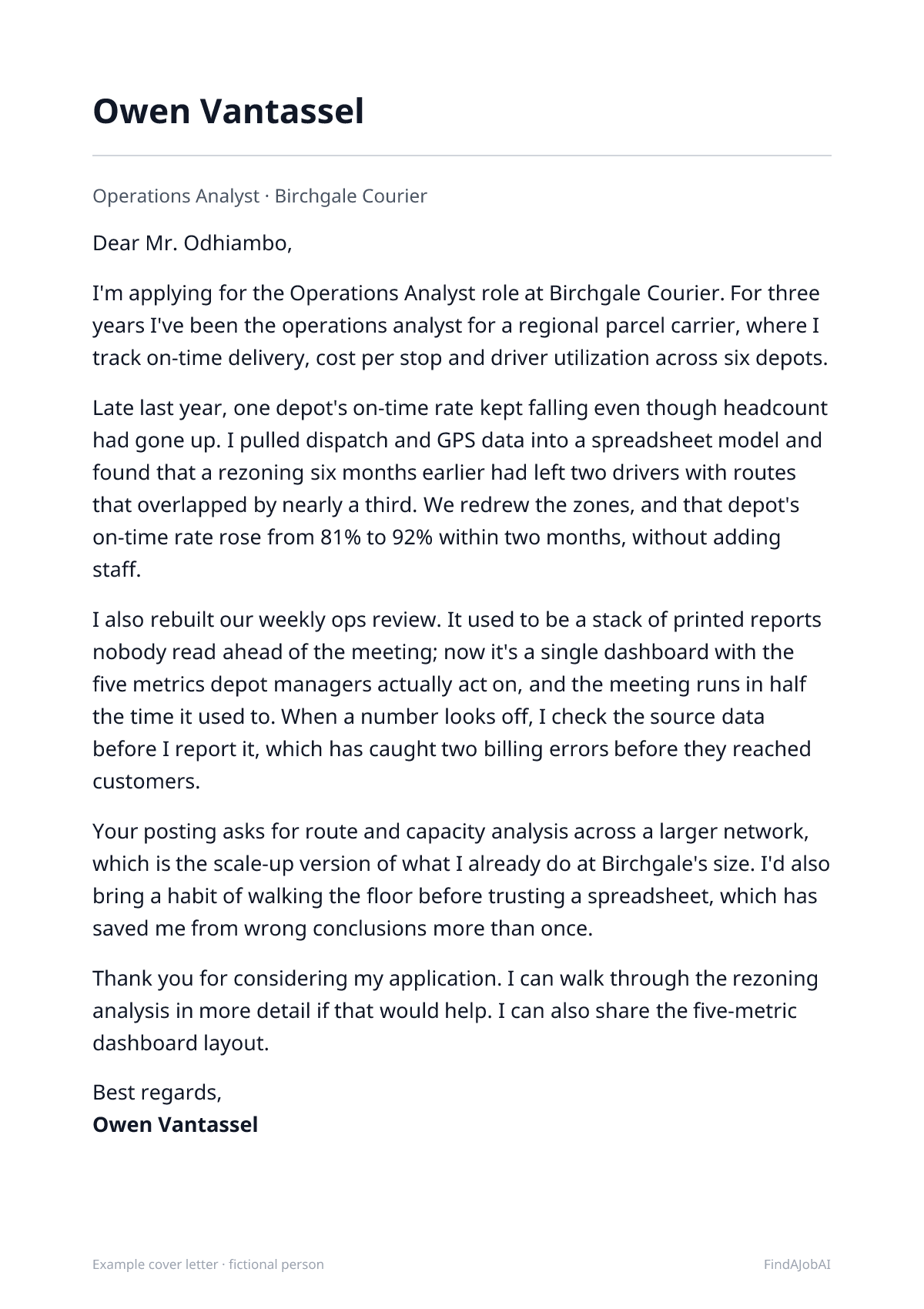
Dear Mr. Odhiambo,
I'm applying for the Operations Analyst role at Birchgale Courier. For three years I've been the operations analyst for a regional parcel carrier, where I track on-time delivery, cost per stop and driver utilization across six depots.
Late last year, one depot's on-time rate kept falling even though headcount had gone up. I pulled dispatch and GPS data into a spreadsheet model and found that a rezoning six months earlier had left two drivers with routes that overlapped by nearly a third. We redrew the zones, and that depot's on-time rate rose from 81% to 92% within two months, without adding staff.
I also rebuilt our weekly ops review. It used to be a stack of printed reports nobody read ahead of the meeting; now it's a single dashboard with the five metrics depot managers actually act on, and the meeting runs in half the time it used to. When a number looks off, I check the source data before I report it, which has caught two billing errors before they reached customers.
Your posting asks for route and capacity analysis across a larger network, which is the scale-up version of what I already do at Birchgale's size. I'd also bring a habit of walking the floor before trusting a spreadsheet, which has saved me from wrong conclusions more than once.
Thank you for considering my application. I can walk through the rezoning analysis in more detail if that would help. I can also share the five-metric dashboard layout.
Best regards,
Owen Vantassel
Example 2 · Career changer
Warehouse shift lead moving into operations analysis
Priya fixed a picking-accuracy problem with spreadsheets before she had an analyst title. The ad wants inventory and throughput analysis.
Example letter · fictional
Dear Hiring Manager,
I'm applying for the Operations Analyst role at Castleford Distribution. For four years I've been a shift lead at a mid-size warehouse, and the part of that job I enjoyed most was figuring out why a process was slow and fixing it with data, so I'm looking to do that full time.
Picking errors were costing us returns and overtime, and nobody could say which shift or zone caused them. I pulled a year of scan data into Excel, built pivot tables by zone, shift and item type, and found that two aisles with similar-looking SKUs accounted for most errors. We moved one product line and added a barcode check at those bins, and picking accuracy went from 94% to 98.5% within a quarter.
Since then I've finished a business analytics certificate and taught myself SQL well enough to query our warehouse management system directly instead of exporting to Excel first. I built a small inventory aging report as a practice project, using a public retail dataset, to learn how to flag slow-moving stock.
Your posting asks for inventory and throughput analysis, which is the same work I was already doing with a spreadsheet and a shift's worth of scan data. I'd bring both that analysis habit and a floor-level sense of where a process actually breaks down.
Thank you for your time. I'd welcome the chance to talk about the picking-accuracy project in more detail. I can bring the aging report, built on public data, to an interview.
Kind regards,
Priya Lindqvist
Example 3 · Senior or lead
Operations lead applying to build out a first analytics function
Riley leads a team of three analysts at a contract manufacturer. The ad wants someone to set standard metrics across plants.
Example letter · fictional
Dear Ms. Oyelaran,
I'm applying for the Senior Operations Analyst role at Marrowfield Manufacturing. I lead a team of three analysts at a contract manufacturer with four plants, supporting production planning and quality, and before that I spent five years as an individual analyst on a single plant floor.
Your ad says each plant tracks downtime differently and head office can't compare them. We had the same issue at my current company. I wrote a one-page definition for the five metrics every plant had to report the same way, moved the calculations into one shared SQL view instead of four separate spreadsheets, and got all four plants reporting on it within a quarter. Monthly reporting time across the team dropped from three days to one.
The clearest result came from a single plant's downtime data once it was standardized. A changeover step that every plant assumed took about the same time actually varied by nearly double between our fastest and slowest sites. We used the fastest site's method as a template, and the two slower plants cut changeover downtime by close to a third within two quarters.
I've hired and trained two of my three analysts and run a monthly project rotation so each of them owns a problem end to end. I haven't yet worked with a dedicated data engineering team or owned a tooling budget, and at Marrowfield I'd want to set both up carefully alongside your IT group.
I'd welcome a conversation about which plant comparisons matter most to you right now, and how plant managers currently ask for that kind of data.
Sincerely,
Riley Osei
All three letters, and the short version below, are fictional: the people, employers and numbers are invented. Borrow the structure, never the facts.
- Prefer to write it yourself? Use the free cover letter template.
- Check your CV against the job first: the free CV score shows the missing keywords.
Why the first letter works, paragraph by paragraph
Paragraph 1: Opening
Names the metrics the writer already owns (on-time delivery, cost per stop, utilization) and the scale (six depots), so the reader knows this isn't a first analyst job.
Paragraph 2: The analysis that changed a decision
A specific depot, a specific cause (overlapping routes from an old rezoning), the fix and the on-time rate before and after. Numbers are tied to a real operational change, not just effort.
Paragraph 3: Process and judgment
Replacing a stack of unread reports with one dashboard is a concrete communication fix; catching billing errors before customers see them shows the writer checks data rather than trusting it blindly.
Paragraph 4: Why this company
Matches the ad's wording (route and capacity analysis) and adds a stated habit, walking the floor, that fits an operations-heavy employer.
Paragraph 5: Close
Offers to go deeper on the one analysis already described, which is a low-pressure, specific next step for the reader.
What the career changer's letter does differently
The career changer's letter starts from a shift lead's actual problem, picking errors, solved with Excel pivot tables before any analyst title existed, and gives a before-and-after accuracy rate. A certificate and a practice project using public data show the skills are being formalized, and the letter ties warehouse floor experience directly to the ad's own wording about inventory and throughput.
What the senior letter does differently
A senior-level letter reports organizational habits, not just one project: one metric definition shared across four plants, reporting time cut from three days to one, and a downtime comparison that became a cross-plant template. It also names a clear gap, data engineering support and budget ownership, the way a hiring manager would want a new lead to be upfront about.
Short operations analyst cover letter: an email-ready version
Many applications arrive as an email or a small text box, and a full page doesn't fit. This version runs 120 to 150 words and keeps only what a reader needs to decide whether to reply. An operations analyst answers a food distributor's short online application form, sent by email because the portal rejected file uploads.
Short version · email · fictional124 words
Subject: Operations Analyst (routing, SQL) – delivery network – Tamsin Okafor-Reyes
Hello Mr. Castellan,
I'm applying for the Operations Analyst role at Greyfield Foods. I have three years of experience analyzing delivery routes and depot staffing for a regional distributor, working mainly in SQL and Excel.
My clearest result came from a route analysis: two depots were running nearly a third more miles than their delivery volume justified. After we redrew their routes, fuel cost per delivery fell by about 18% over the next quarter, which the finance team valued at roughly $95,000 annualized.
Routing and depot efficiency seem central to your network, and I'd like to bring that kind of analysis to a larger scale. My resume is attached, and I'm glad to walk through the route analysis in more detail.
Best,
Tamsin Okafor-Reyes
A short application form forces a single proof point, so this version keeps one route analysis and its dollar value rather than listing tools or years of experience. Naming the depot-level cause, not just the savings, shows the finding was specific rather than a guess that happened to pay off.
Opening lines that work for operations analyst cover letters
The first sentence decides whether the second gets read. Here are six openings, one for each situation you might be in. Pick the one that matches yours and swap in your own facts: every name and number below is invented.
1. You have a standout result
A routing analysis I ran last quarter cut fuel cost per delivery by about 18% across two depots. I'd like to bring that kind of analysis to your delivery network.
2. The ad names a problem you've solved
Your ad says plant managers wait days for downtime figures. At my current company I built a shared dashboard that cut that wait to same-day, and I'd like to do the same for your plants.
3. Someone referred you
Your operations director, Felix Branagh, worked with me for a year on a changeover-time project. He mentioned you need someone who can standardize metrics across sites, which is why I'm applying.
4. You admire what they build
I've shopped at your stores for years and noticed how rarely shelves run empty compared to competitors; I'd like to help analyze the operations behind that consistency.
5. You're new to the field or switching into it
I spent four years as a warehouse shift lead fixing picking errors with spreadsheets before I had an analyst title. Operations analysis is where I'd like to keep solving problems like that.
6. You have senior scope or a specialism
As the analyst who built our company's shared metric definitions across four plants, I'm looking for a role where I can do that kind of standardization from the start.
How to write an operations analyst cover letter
Five steps, in the order you'd write them. The shape stays the same for every job (a short opening, proof, a reason for this employer, a close), and what goes into each part is what changes with the role.
Find the process the ad cares about
Operations analyst ads differ by floor: logistics, manufacturing, retail or warehouse. Read for the process named, routing, staffing, inventory, downtime, and pick a project of yours that touched a similar process, at a similar scale, before describing your tools.
Open with the problem, not the spreadsheet
State what was going wrong operationally in one sentence: late deliveries, picking errors, idle machine time. Save the tool, Excel, SQL, a specific system, for the sentence after. A reader who sees the problem first keeps reading for the fix.
Give a before-and-after number tied to the fix
Pick one metric that existed before your analysis and changed after it: an on-time rate, an error rate, a cost per unit. State both numbers and roughly the time period. Avoid describing effort, like hours spent or reports built, instead of the result.
Call out your tools within the example
Mention Excel, SQL, a WMS, ERP or routing system as part of what you built to solve the specific problem, including roughly how much data you worked with. A tool named next to a result reads as real; a bare list of software reads as a resume duplicate.
Show how the fix reached the floor
Operations analysis only matters if people act on it. Name one sentence on how you got a finding to a shift lead, depot manager or plant supervisor, a dashboard, a one-page summary, a walkthrough, and close with a question you'd want to study in their operation first.
Operations Analyst cover letter do's and don'ts
Do
- Name the process you measured, the tool you used, and the metric that changed, in that order.
- Mention the systems the ad names (WMS, ERP, routing software) inside a specific example, not as a bare list.
- Show who acted on your analysis: a shift, a depot, a team, and what they changed as a result.
Don't
- Don't write "process-oriented problem solver"; show one process you changed and what it cost before and after.
- Don't count the number of reports or spreadsheets you built; count what one of them changed.
- Don't share your current employer's raw revenue or cost figures; use rates, ratios or percentages instead.
Common operations analyst cover letter mistakes
Each one is easy to make and quick to fix before you send the letter.
Describing reports instead of fixes
Listing how many dashboards or spreadsheets you built tells the reader about output, not impact. Name the one process that changed because of your analysis and what that was worth in time, cost or error rate.
Citing a number with no context
"Reduced downtime" means little without a starting number. State the rate or cost before your analysis, what you changed, and the rate or cost after, so the claim holds up if someone asks about it.
Treating the job as pure data work
A letter with only SQL and spreadsheets could describe any desk job. Show you understand the physical process behind the numbers, a route, a pick, a changeover, and what an analyst could realistically change there.
Naming every tool you've touched
A row of Excel, SQL, Power BI, Tableau and an ERP acronym suggests shallow use of each. Name the one or two the ad mentions and describe the size and complexity of what you actually built with them.
Writing "strong analytical skills" as the whole pitch
Every applicant claims this. Replace it with one specific analysis, its cause, its fix and its measurable result, and let the reader draw the conclusion about your skills themselves.
Email subject lines for operations analyst applications
Applying by email? Put the job title, any reference number and your name in the subject line.
- Operations Analyst application – route and capacity analysis – Owen Vantassel
- Operations Analyst – warehouse shift lead with throughput analysis – Priya Lindqvist
- Application: Operations Analyst, Fulfillment (Req. 2240) – Owen Vantassel
Everything for Operations Analysts
- Operations Analyst resume exampleA full resume, plus bullet and summary examples
- Operations Analyst interview questions30 questions with sample answers
- Operations Analyst job descriptionDuties, skills and requirements
- Career change cover letter: template + examples
Other cover letter examples
Operations Analyst cover letter FAQ
What should I write in an operations analyst cover letter?
One process problem you found, measured and fixed: the metric before, what you changed, and the metric after. Then a sentence on how you communicate findings to the people running the process day to day.
How do I write an operations analyst cover letter with no analyst experience?
Use a process problem from a floor, shift or support role you've held, built with spreadsheets or whatever tool you had. Add a course or certificate and a practice project, and name one measurable result.
Should I mention specific software in an operations analyst cover letter?
Only inside an example. Naming the ERP, WMS or BI tool the ad mentions, attached to what you built with it, is more convincing than listing software names on their own.
How we built this page
The FindAJobAI team wrote the three example letters, the short email version, the opening lines and the advice for operations analyst roles. The people, employers and numbers in the letters are invented; the structure, the kind of evidence and the order of the paragraphs are the parts to copy.
Once we track enough live operations analyst job ads, this page also shows the skills they ask for most, counted the same way as our in-demand skills report.
Last reviewed on November 1, 2026.