Patent Agent Cover Letter Example (2026)
By FindAJobAI Team Updated How we built this page
Law firms and in-house legal teams hire patent agents for technical depth and careful prosecution work. A strong letter names your technical field and registration status early, gives drafting and office action volume with a result, and shows you can work with inventors and supervising attorneys. The examples below keep that to a single page.
Patent Agent cover letter template
This letter as a one-page template: an opening that names the job and your strongest fact, proof that answers the ad, a reason for this employer and a short close.
After you sign up, FindAJobAI drafts your own letter for a real job from your CV in this format, and you edit it before you send it.
Example 1 · Experienced
Registered agent applying to a firm's electrical and software group
Anneliese is a registered agent with eight years in wireless and embedded software patents. A firm is growing its electrical prosecution group.
Example letter · fictional
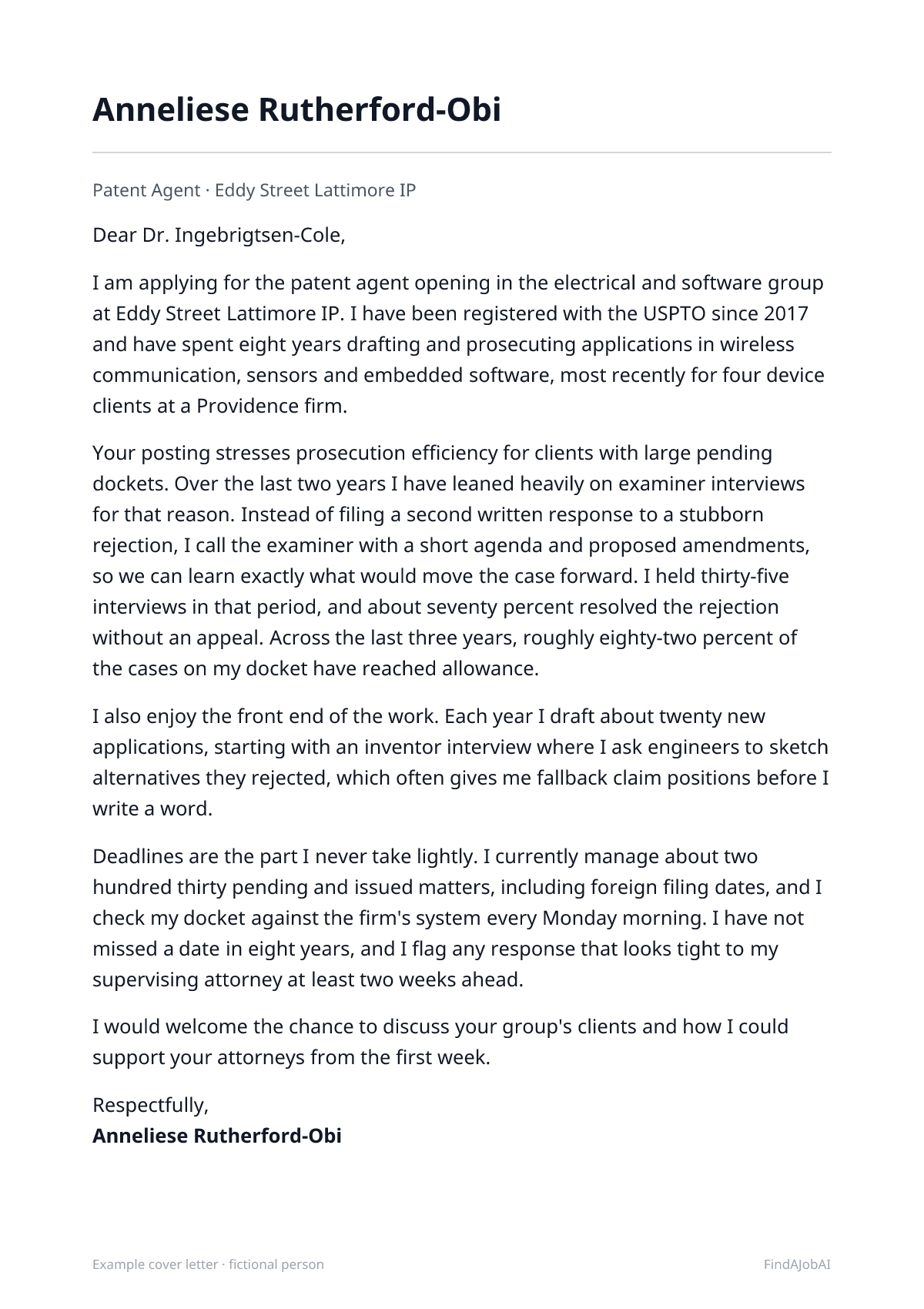
Dear Dr. Ingebrigtsen-Cole,
I am applying for the patent agent opening in the electrical and software group at Eddy Street Lattimore IP. I have been registered with the USPTO since 2017 and have spent eight years drafting and prosecuting applications in wireless communication, sensors and embedded software, most recently for four device clients at a Providence firm.
Your posting stresses prosecution efficiency for clients with large pending dockets. Over the last two years I have leaned heavily on examiner interviews for that reason. Instead of filing a second written response to a stubborn rejection, I call the examiner with a short agenda and proposed amendments, so we can learn exactly what would move the case forward. I held thirty-five interviews in that period, and about seventy percent resolved the rejection without an appeal. Across the last three years, roughly eighty-two percent of the cases on my docket have reached allowance.
I also enjoy the front end of the work. Each year I draft about twenty new applications, starting with an inventor interview where I ask engineers to sketch alternatives they rejected, which often gives me fallback claim positions before I write a word.
Deadlines are the part I never take lightly. I currently manage about two hundred thirty pending and issued matters, including foreign filing dates, and I check my docket against the firm's system every Monday morning. I have not missed a date in eight years, and I flag any response that looks tight to my supervising attorney at least two weeks ahead.
I would welcome the chance to discuss your group's clients and how I could support your attorneys from the first week.
Respectfully,
Anneliese Rutherford-Obi
Example 2 · Career changer
Product design engineer moving into patent prosecution
Casimir spent four years designing kitchen products and is now a technical specialist. He wants a patent agent trainee role at a mid-size firm.
Example letter · fictional
Dear Mr. Vandermeer-Okwuosa,
I am writing to apply for the patent agent trainee position at Seekonk Ledge Patent Law. I am a mechanical engineer who spent four years designing consumer products, and for the past year I have worked as a technical specialist at a small patent firm while preparing for the USPTO registration exam, which I sit this spring.
My interest in patents began on the other side of the table. Two products I designed became issued patents, and writing fourteen invention disclosures with our outside counsel showed me how much a good agent shapes what an invention is worth. I started reading every office action our counsel forwarded and asking why each claim had been narrowed.
At my current firm I have drafted first versions of twelve mechanical applications for two supervising attorneys, run about thirty prior art searches and prepared figures and descriptions for nine office action responses. My early drafts came back heavily marked up, so I kept a list of every correction and reviewed it before starting each new draft. My recent drafts need far fewer changes, and my supervisors now ask me to prepare the figures for their own files. I also built a claim chart template that five colleagues now use.
I know I still have much to learn about claim strategy and prosecution practice. Your posting mentions structured training under senior attorneys, and that is exactly the setting where I believe I would grow fastest while adding value through my engineering background.
I would be glad to share a redacted sample of my drafting and meet at your convenience.
Sincerely,
Casimir Thorvaldsen-Reyes
Example 3 · Senior or lead
Senior agent applying to lead a company's in-house prosecution team
Henrietta leads four agents on about 600 medical device matters. A device maker wants a senior agent to run its in-house patent prosecution.
Example letter · fictional
Dear Ms. Castellano-Pryce,
I would like to be considered for the senior patent agent role at Narrows Bridge Medical Devices. I have fifteen years in medical device and biotech prosecution, seven of them in-house at a diagnostics company and the last eight at a Providence IP firm, where I lead four agents and technical specialists on roughly six hundred matters.
Your posting describes moving more prosecution in-house and aligning filings with the product roadmap. That alignment has been the center of my recent work. For one catheter client, I met quarterly with product and legal leaders to map planned design changes against the claims in their core family. We used continuations to follow those changes, and the family gained seven issued patents over four years that cover the versions now on the market.
I also care about how a team works. When my group grew, response quality varied from agent to agent, so we built shared libraries of claim language and argument outlines for the most common rejections. Preparation time fell by about a fifth, and review comments from supervising attorneys dropped noticeably. I have trained six new agents, and five passed the registration exam within a year of joining.
From my in-house years, I know the value of plain status reports for engineers and executives, and of regular invention reviews with scientists rather than waiting for disclosures to arrive. At that company, monthly reviews with about forty scientists produced most of our strongest filings, including two families still licensed today.
I would be glad to talk about your portfolio and how I would organize the team's first six months.
Kind regards,
Henrietta Mbatha-Cavendish
All three letters, and the short version below, are fictional: the people, employers and numbers are invented. Borrow the structure, never the facts.
- Prefer to write it yourself? Use the free cover letter template.
- Check your CV against the job first: the free CV score shows the missing keywords.
Why the first letter works, paragraph by paragraph
Paragraph 1: Opening
States registration year, technical fields and client type so the reader can match the writer to the group at once.
Paragraph 2: Examiner interviews
Answers the posting's efficiency concern with a specific habit and measured results.
Paragraph 3: Drafting
Shows how the writer works with inventors to build stronger claims.
Paragraph 4: Deadlines
Addresses the biggest risk in prosecution with a docket size and a routine.
Paragraph 5: Close
Links back to the group's clients and offers quick support for its attorneys.
What the career changer's letter does differently
The career-changer letter turns engineering work and a year as a technical specialist into evidence: inventor experience, first drafts, searches and a habit of learning from corrections. Being honest about the exam date and what is still to learn keeps it credible.
What the senior letter does differently
This senior letter ties the company's plan to bring prosecution in-house to a continuation strategy built around a product roadmap, with a measured result. The shared libraries and training record show the writer can lead a team, not just a docket.
Short patent agent cover letter: an email-ready version
Many applications arrive as an email or a small text box, and a full page doesn't fit. This version runs 120 to 150 words and keeps only what a reader needs to decide whether to reply. A registered agent replies to an in-house counsel's post on a patent professionals forum that asked for contract agents to email.
Short version · email · fictional124 words
Subject: Contract patent agent – registered, sensors and IoT, office action backlog – Lucian Fairweather-Iwu
Hi Dr. Haugland-Mwangi,
I saw your post looking for a contract patent agent to help Rumstick Point Sensors with an office action backlog. I have been a registered agent for six years, focused on sensors, low-power electronics and connected devices.
Last year I worked through a backlog of twenty-two office actions for a smart building company in about ten weeks, using examiner interviews on the hardest cases. Eighteen of those applications have since been allowed. I work under the direction of in-house counsel and send weekly status notes so nothing waits on me and counsel always knows where each case stands.
I could start within two weeks. Would a short call on Tuesday or Wednesday work to go over the docket?
Thanks,
Lucian Fairweather-Iwu
In-house counsel with a backlog want proof you can clear it reliably. This email names a matching field, a similar backlog with a result, how the agent reports and a start date in three short paragraphs.
Opening lines that work for patent agent cover letters
The first sentence decides whether the second gets read. Here are six openings, one for each situation you might be in. Pick the one that matches yours and swap in your own facts: every name and number below is invented.
1. You have a standout result
Registered since 2017, I have spent eight years drafting and prosecuting wireless and embedded software patents for device makers.
2. The ad names a problem you've solved
Your posting stresses prosecution efficiency, and examiner interviews have been my most reliable way to move stubborn cases forward.
3. Someone referred you
Two products I designed as an engineer became issued patents, and that experience is why I am now training to prosecute them.
4. You admire what they build
Fifteen years in medical device prosecution have taught me that the strongest portfolios follow the product roadmap closely.
5. You're new to the field or switching into it
Genevieve Strzelecki-Amos, who supervised my drafting for three years, suggested I contact you about this opening.
6. You have senior scope or a specialism
About eighty-two percent of the cases on my docket over the last three years have reached allowance.
How to write a patent agent cover letter
Five steps, in the order you'd write them. The shape stays the same for every job (a short opening, proof, a reason for this employer, a close), and what goes into each part is what changes with the role.
Lead with registration and field
State in your first sentence whether you are a registered patent agent, since when, and your technical fields. If you are not yet registered, give your exam date. Firms assign agents by technology and registration status, so this line decides whether the rest of your letter gets read.
Give drafting and prosecution volume
Say roughly how many applications you draft and how many office actions you answer each year, and add a result such as allowance on your docket or interviews that cleared rejections. Numbers let a supervising attorney picture your workload and the quality of your outcomes.
Show how you work with inventors
Describe a habit from inventor interviews, such as asking about rejected alternatives or reviewing prototypes. Good drafting depends on getting full technical detail from busy engineers and scientists, so this shows the firm that your applications start from a solid understanding of the invention.
Prove you protect deadlines
Mention the size of your docket and how you check dates, such as a weekly review against the firm's system. A missed deadline can cost a client its rights, so hiring partners look closely for agents who treat docket management as a core part of the job.
Close with a practical offer
End by offering to discuss the group's clients, share a redacted writing sample or start on a specific backlog. Keep the final paragraph short and concrete. It shows you understand how the firm works and gives the reader a clear reason to reply.
Patent Agent cover letter do's and don'ts
Do
- State your registration status or exam date in the first paragraph.
- Name your technical fields and give drafting and office action volume.
- Show how you protect deadlines on a large docket.
Don't
- Don't claim you give legal advice beyond what agents may do.
- Don't name confidential clients or inventions.
- Don't send a general legal letter; show your technical depth.
Common patent agent cover letter mistakes
Each one is easy to make and quick to fix before you send the letter.
Hiding the registration date
Put your registration year or exam date in the first paragraph so the reader does not have to search for it.
Overstating what an agent may do
Describe opinions and analysis as prepared for attorney review, and keep the letter within prosecution work before the USPTO.
Describing technology too broadly
Replace general labels like engineering with exact fields such as wireless communication or drug delivery.
Revealing client inventions
Describe matters by technology and client type, never by unpublished invention details or client names.
Skipping docket reliability
Add your docket size and the routine you use to track dates, since deadlines matter as much as drafting quality.
Email subject lines for patent agent applications
Applying by email? Put the job title, any reference number and your name in the subject line.
- Patent Agent – registered 2017, wireless and software, 82% allowed – Anneliese Rutherford-Obi
- Patent Agent Trainee – mechanical engineer, exam this spring – Casimir Thorvaldsen-Reyes
- Senior Patent Agent – medical devices and biotech, team of 4 – Henrietta Mbatha-Cavendish
Everything for Patent Agents
- Patent Agent resume exampleA full resume, plus bullet and summary examples
- Patent Agent interview questions30 questions with sample answers
- Patent Agent job descriptionDuties, skills and requirements
- Career change cover letter: template + examples
Other cover letter examples
Patent Agent cover letter FAQ
Do patent agents need a cover letter?
Usually yes. Law firms and in-house legal teams often ask for one, and a short letter lets you match your technical field and prosecution record to the group you are applying to.
How do I write a patent agent cover letter before passing the registration exam?
Lead with your technical degree and work, any searches or first drafts you have prepared, and your exam date. Show you learn quickly from attorney feedback and explain why you want prosecution work.
How long should a patent agent cover letter be?
About 270 to 340 words. Cover registration and field, drafting and prosecution volume with one result, how you handle deadlines and a short close.
How we built this page
The FindAJobAI team wrote the three example letters, the short email version, the opening lines and the advice for patent agent roles. The people, employers and numbers in the letters are invented; the structure, the kind of evidence and the order of the paragraphs are the parts to copy.
Once we track enough live patent agent job ads, this page also shows the skills they ask for most, counted the same way as our in-demand skills report.
Last reviewed on November 1, 2026.